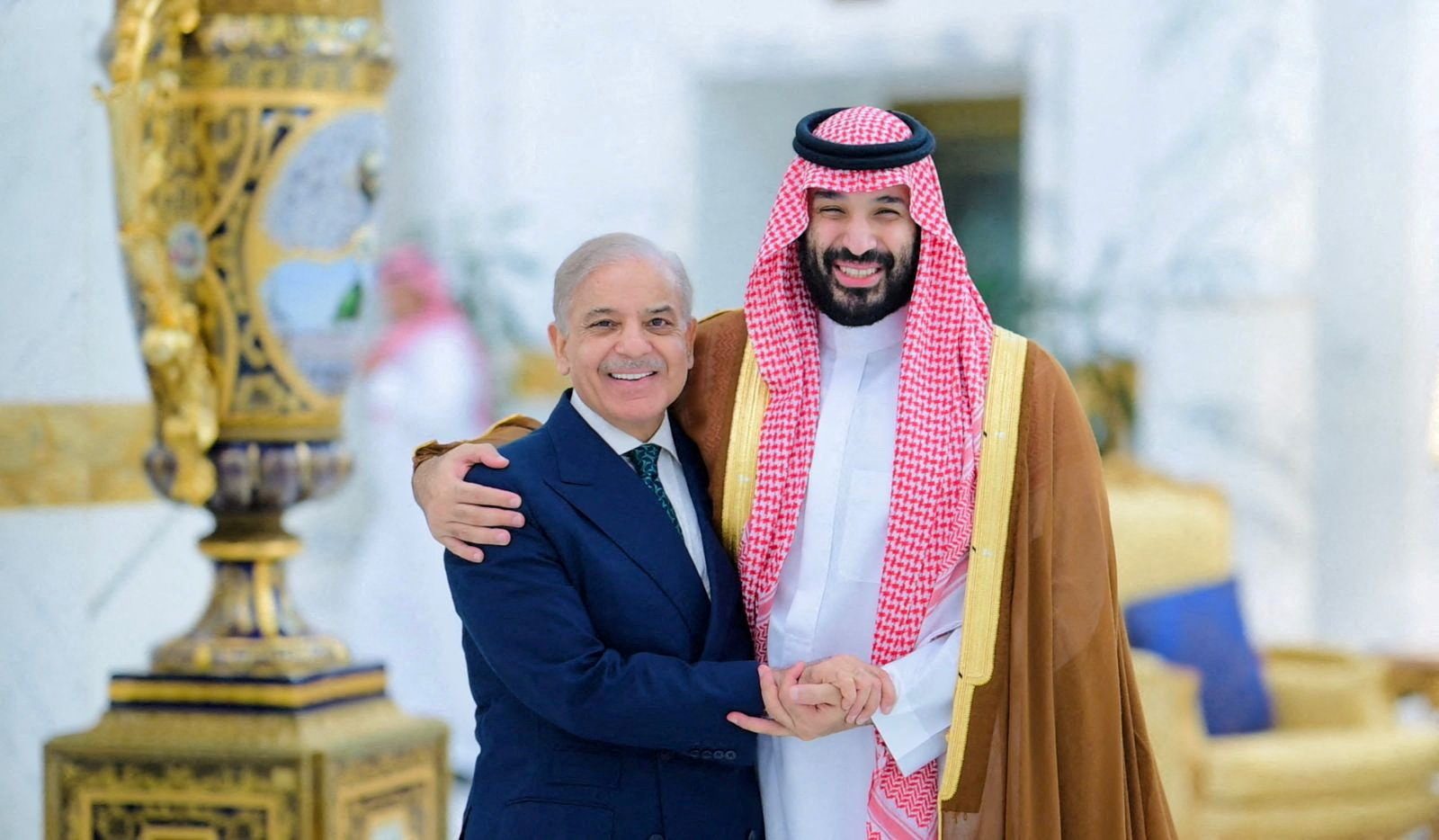
Saudi Crown Prince Mohammed bin Salman meets with Pakistani Prime Minister Shehbaz Sharif in Jeddah, Saudi Arabia, April 15. (Pakistan’s Prime Minister Office/Handout via REUTERS)
The U.S.-Israeli war with Iran has placed Pakistan in a particularly difficult position. When Islamabad signed a strategic mutual defense agreement with Saudi Arabia in September 2025, just days after Qatar came under Israeli attack, the pact was seen as a response to Israel’s military dominance and a shattered perception of U.S. security guarantees. It also suggested that Saudi Arabia could possibly enjoy Pakistan’s nuclear umbrella, though this has not been confirmed. Both sides have purposefully maintained strategic ambiguity regarding what role Pakistan’s armed forces and its nuclear arsenal could play in a military emergency.
The agreement was tested when Iran began launching missiles and drones against Saudi Arabia February 28, prompting questions as to why it didn’t trigger the mutual defense clause. Instead, Pakistan chose a diplomatic track, working alongside Egypt, Turkey, and Saudi Arabia to mediate between Washington and Tehran. In Pakistan’s thinking, siding overtly with Saudi Arabia would complicate Pakistan’s close but occasionally tense relations with Iran. At the same time, Pakistan relies deeply on foreign investments, and Saudi Arabia has played a central role propping up the country’s economy.
Keeping Balance in the Neighborhood
Islamabad’s calculus has been rooted in the fragile geopolitical situation in its immediate neighborhood. For Pakistan, Iran is an important neighbor with which it shares close economic ties. Iran is also an important energy power, a civilizational state with deep historical roots, and a key player in the Middle East and South Asia. In fact, for Pakistan, the war has elevated Iran’s profile, demonstrating the regime’s resilience under constant pressure from Western economic sanctions, internal social tensions, and diplomatic isolation.
Pakistan also shares a nearly 600-mile border with Iran, where tensions have in recent years flared. In 2024, cross border attacks raised concerns over a wider military escalation between the two countries. However, Pakistan is apprehensive about confronting Iran because nearly one-fifth of Pakistan’s population is Shia, and many of them sympathize with Iran. This was evident during the first days of the Iran war, when protestors stormed the U.S. Consulate in Karachi, part of a string of countrywide protests that left 22 people dead and dozens more injured.
Pakistan is dealing with wider instability in its neighborhood. Since February, Pakistan has been waging a military campaign against Afghanistan. And since a sharp military escalation over Kashmir in May 2025, conditions have remained fragile with rival India.
Early on in the U.S. conflict with Iran, amid talks of regime change, Pakistan was also concerned about Iran’s collapse, worried it would upset the fragile geopolitical status quo in the region. The domestic consequences, such as a refugee crisis, economic strains, and increased social tensions along the Iranian-Pakistani border represented additional concerns.
Strategy of Hedging
Pakistan’s military pact with Saudi Arabia is transactional and likely to remain so. Neither Saudi Arabia nor Pakistan is willing to move headlong into each other’s conflict theaters given the diverse array of threats each is facing. Mutual aid will be phased and limited. For example, in April Pakistan deployed fighter jets to Saudi Arabia – more than a month after the Iran war broke out. A month later, Pakistan deployed an additional 8,000 troops as well as fighter jets and an air defense system to Saudi Arabia. Meanwhile, Riyadh was not particularly eager to help Islamabad militarily in its recent conflict with Afghanistan and is unlikely to do so should another round of hostilities erupt with India.
Fully committing itself to Saudi Arabia against Iran would limit Pakistan’s room to maneuver. Pakistan therefore prefers that the defense pact serve as a deterrent, which would not necessarily require Islamabad to come to Saudi Arabia’s aid militarily and risk sacrificing Islamabad’s multivector foreign policy. For Pakistan, the agreement is an instrument to shape potential adversaries’ behavior.
Even with Pakistan’s transactional perspective on the defense pact, Saudi Arabia still expects to gain limited support from Pakistan’s powerful military. Saudi Arabia has more to gain from the defense agreement by framing it as a nuclear umbrella. The agreement also helps Riyadh signal that it has other options beyond the ambivalent security commitments offered by the United States.
It is no wonder then that Pakistan has resorted to active diplomatic mediation, which reflects a carefully calibrated strategy of hedging, limited military signaling, and deliberate military ambiguity. Islamabad is attempting to reconcile two conflicting imperatives: its deep security and economic alignment with Saudi Arabia and historically close relationship with Iran. Pakistan is deliberately attempting to convert its geopolitical vulnerability into diplomatic leverage, elevating its international relevance while reducing the likelihood of escalation that would force it into strict alignment with Saudi Arabia.
Yet the sustainability of this geopolitical approach will depend on three conditions: that military engagement remains contained, Pakistan’s military contributions remain defensive rather than offensive, and both Iran and Saudi Arabia tolerate Islamabad’s dual positioning. If any of these conditions collapse – particularly if Iran escalates attacks on Saudi infrastructure, or if Riyadh formally invokes collective defense obligations – Pakistan’s balancing strategy could quickly become untenable. The developing reality – that Iran is emerging from the conflict in a stronger, more confident geostrategic position, apparently with some degree of control over maritime traffic through the Strait of Hormuz – could also upset Pakistan’s carefully modulated hedging strategy between the two regional powers. The pre-February 28 assumptions that helped provide the balance for Pakistan’s strategy might require significant revision in the coming months, as a battered but resurgent Iran begins pressing for regional advantage.
The views represented herein are the author's or speaker's own and do not necessarily reflect the views of AGSI, its staff, or its board of directors.
After Oman-facilitated negotiations between the United States and Iran ended in a major regional conflict, Pakistan has picked up the mantle of mediator and helped broker a cease-fire, but can the country succeed at mediating a lasting peace deal?
Proposed Russian investments may come in handy as Iran attempts to develop its gas infrastructure, but international sanctions and geopolitics pose major problems.