What Do Recent Fatalities Reveal About the Quds Force and IRGC?
Targeted assassinations of skilled engineers, seasoned commanders, and intelligence operatives are no doubt taking a toll on the IRGC and the Quds Force but not enough for Iran to reconsider its attempt at containing the perceived threat from Israel.
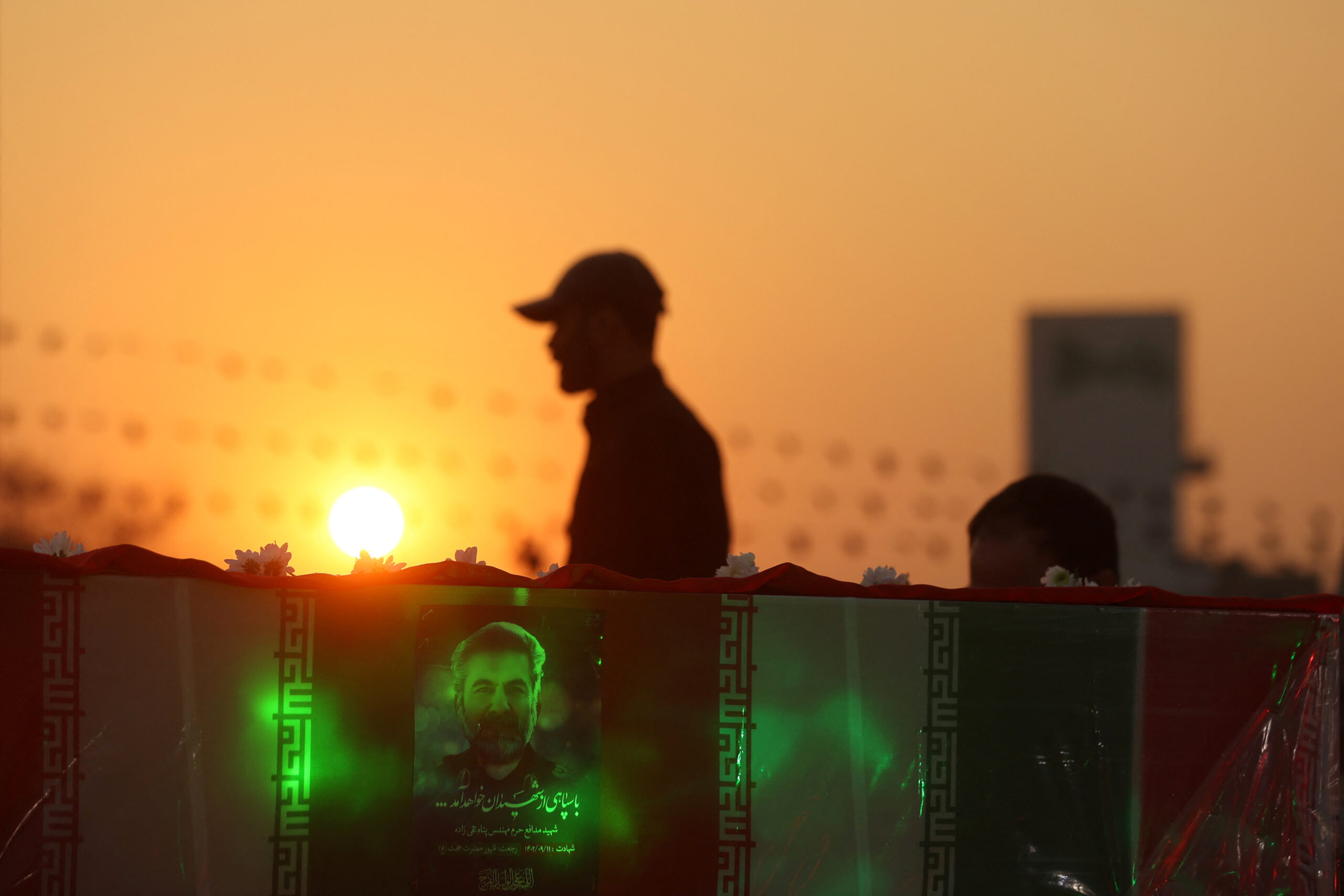
The picture of Panah Taqizadeh, a member of Iran's Islamic Revolutionary Guard Corps who was killed in an Israeli airstrike on Syria, is seen on his coffin during his funeral in Tehran, Iran, December 4, 2023. (Majid Asgaripour/West Asia News Agency via REUTERS)
Since the October 7, 2023 Hamas attacks against Israel and the ensuing war in Gaza, 219 Iranian and allied militia forces have been killed in Israeli bombings and targeted assassinations in northern Israel, southern Lebanon, and the Damascus area. With 170 fatalities, Lebanese Hezbollah has suffered the largest losses followed by 16 Iraqi Popular Mobilization Forces fighters, 10 Iranian nationals, eight Hamas fighters, seven Palestinian Islamic Jihad fighters, and two Lebanese Amal fighters. The Afghan Fatemiyoun Division and the Syrian Socialist Nationalist Party each lost one member. Who were the Iranians killed by Israel since October 7, and what does publicly available information related to the killings reveal about the Islamic Revolutionary Guard Corps and its expeditionary Quds Force?
All 10 Iranians killed in Syria served in the IRGC, with not a single member of the parallel Islamic Republic of Iran army killed. An analysis of Iranian losses in the civil war in Syria shows a similar pattern: Among the 561 identified Iranian nationals killed in combat in Syria from January 2012-November 2018, only eight served in the Iranian army – the rest were IRGC personnel.
Among the 10 IRGC fatalities, two served in the IRGC Aerospace Force, one was a Quds Force field commander, six were Quds Force intelligence officers and operatives, and the branch affiliation of one is not known.
The presence of IRGC Aerospace Force officers in Syria is hardly surprising. Brigadier General Mohammad Hosseinzadeh Hejazi, who briefly served as second in command of the Quds Force from 2020 until his passing due to cancer in 2021, has been referred to as “the father of Lebanon’s missile program” in recognition of his efforts to establish missile assembly and manufacturing plants for Lebanese Hezbollah. IRGC Brigadier Generals Mohammad-Ali Ataei-Shourcheh and Panah Taqizadeh, who held doctoral degrees, respectively, in electrical and air and space engineering, may have been involved in a similar effort in Syria before they were killed in a suspected Israeli airstrike December 2.
A December 25, 2023 strike in Damascus widely attributed to Israel killed Brigadier General Razi Mousavi, a high-ranking Quds Force field commander. On January 20, another suspected Israeli strike killed six Quds Force intelligence personnel, including the Quds Force’s intelligence chief for Syria. But like the IRGC aerospace generals, there was nothing unusual about the presence of Mousavi and IRGC intelligence officers in Damascus. Since Syria’s civil war began, the IRGC has consolidated its presence in the country, which not only serves as an overland corridor connecting Iran and Iraq with Lebanon on the shores of the Mediterranean but has also allowed Tehran to establish a military foothold not far from the Syria-Israel border. The border is effectively a dormant front that can be activated in the case of a direct confrontation between Iran and Israel. Mousavi and the Quds Force intelligence officers represented the IRGC’s penetration of Syria and Syria’s importance in Tehran’s strategic calculations.
More interesting is that an Iraqi representative of the Popular Mobilization Forces was also killed in the January 20 strike. This indicates some degree of liaising and coordination among the IRGC, Lebanese Hezbollah, and Iraqi militias.
Background information about the Quds Force field commander and Quds Force intelligence chief slain in Syria, which emerged in open sources after the attacks, provides further insights into the career pattern of Quds Force officers.
Mousavi, a 61-year-old Quds Force field commander in Syria, worked under the cover of “cultural attache” at the Iranian Embassy in Damascus. In reality, he replaced Brigadier General Javad Ghaffari, who left his post in November 2021, perhaps due to disagreements with Syria’s military leadership. Not much is known about Mousavi’s track record in the IRGC, but since his assassination, Iran’s state-censored media has presented him as a key Lebanese Hezbollah liaison, a “central element in the regional resistance,” and a master logistician who secured arms transfers from Iran to Iraq, Syria, Lebanon, and the Palestinian territories.
Open source information about 59-year-old Hojjat-Allah Omidvar, also known as Yousef Omidzadeh and Haj Sadeq, who served as the Quds Force’s intelligence chief in Syria, is just as limited, but a few references help reconstruct his career. In 1982, Omidvar volunteered for front-line duty in the Iran-Iraq War and reportedly spent most of the war at the Ramezan Headquarters, which supported Kurdish rebels and the Shia Dawa Party in their fight against the Baath regime in Iraq. He was deployed to Syria in the early days of the civil war, and he may have been among the 48 Iranian nationals taken hostage by rebel forces and later freed in a prisoner exchange.
Targeted assassinations of skilled engineers, seasoned commanders, and intelligence operatives are no doubt taking a toll on the IRGC and Quds Force, and unverified reports provide some indication that Iran is withdrawing valuable human resources from harm’s way in Syria. However, there is no indication that Iran is changing its efforts to contain the perceived Israeli threat.
The views represented herein are the author's or speaker's own and do not necessarily reflect the views of AGSI, its staff, or its board of directors.
If history is any indication, the latest ISIL attack in Iran may serve to rally Iranians around the flag against a terrorist enemy and even strengthen the regime.
Reports on Hezbollah’s fatalities provide some insight into the structure of Hezbollah’s military units and strengthen the perception of a relatively low risk of the war expanding into Lebanon.
The metamorphosis of the Islamic Revolutionary Guard Corps into an expeditionary force as a result of the Syrian war bodes ill for the United States and its allies in the Middle East, who will likely encounter a more confrontational Islamic Republic in the future.
After U.S.-Israeli strikes killed Supreme Leader Ayatollah Ali Khamenei on February 28, Iran’s collective leadership has concluded that the best defense is a good offense.
Wartime pressure has temporarily aligned the leadership’s overriding interest in regime survival, even as its members continue to differ over the costs, methods, and ultimate objectives of the war.