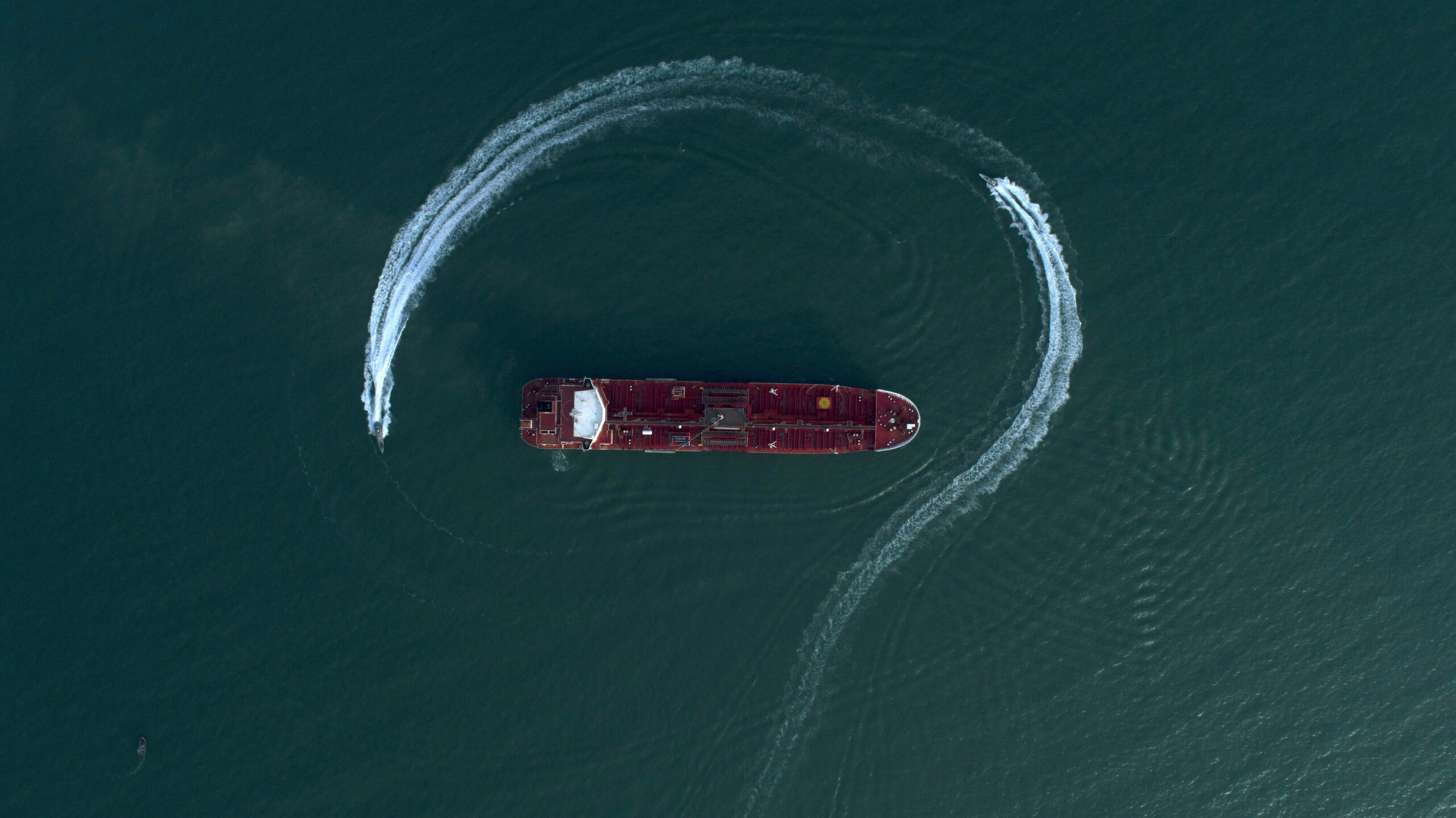
A speedboat belonging to Iran's Islamic Revolutionary Guard Corps moves around the British-flagged oil tanker Stena Impero, which the IRGC seized in the Strait of Hormuz July 21. (Morteza Akhoondi/Tasnim News Agency via AP)
Over the past week, at least two official delegations from the United Arab Emirates have visited Iran to discuss issues of mutual concern. While routine contacts between the governments had been a regular feature of relations in the past, such open contacts dried up as regional tensions intensified, leaving only a quiet intelligence backchannel between the two countries. The Emirati outreach is all the more striking given that a number of the low-intensity military actions allegedly conducted by Iran in an effort to break out of the Washington-imposed economic straitjacket were aimed at the UAE and UAE-related interests, including oil tankers. Yet this marked adjustment of UAE diplomacy is neither unexpected nor inexplicable.
On July 26, Iranian officials told the media that the UAE had dispatched a “peace delegation” to Tehran to discuss unspecified issues; the timing of the visit was notable, coming in the immediate aftermath of the announcement that there would be a significant drawdown of Emirati forces in southern Yemen. The UAE did not deny these reports, but also did not put its own spin on the nature or topics of the conversations.
On July 30, both sides acknowledged that an Emirati delegation led by coast guard commander Brigadier General Mohammed Ali Musleh al-Ahbabi went to Iran to discuss maritime security. The UAE insisted that this was the sixth in a series of coast guard meetings to discuss fishing issues that have traditionally arisen because of several disputed islands currently under Iranian control. But reports suggest that the talks also covered border security and other unspecified issues presumably related to attacks on shipping in Gulf waters. In the aftermath of this visit, the UAE Foreign Ministry officials expressed “satisfaction” with the outcome.
Seen in the broader context, these visits make sense from the UAE’s perspective. The widespread perception that the UAE (along with Saudi Arabia and Israel) has been pressing the United States into a conflict with Iran deeply misunderstands Emirati policy goals. While it welcomed the U.S. campaign of “maximum pressure” against Iran, the UAE sought policy change, not regime change, in Tehran. It never advocated warfare between the United States, or anyone else, and Iran. Such a conflict would not only fail to achieve the UAE’s aim of moderating Iran’s destabilizing regional conduct, it would also place the Emiratis themselves in peril. As Iran’s “maximum resistance” campaign of low-intensity military actions and sabotage have recently demonstrated, Tehran’s Gulf Arab adversaries would be immediate targets in any intensified regional conflict.
Given Iran’s apparent determination to continue testing the limits of “maximum resistance” with carefully calibrated escalations, the UAE has incentives to use dialogue to try to ensure that its interests are not targeted in the future. Moreover, the timing of the July 26 talks suggests that Abu Dhabi saw utility in dialogue with Iran in the immediate aftermath of the UAE’s drawdown of forces in Yemen. It would be reasonable that the Emiratis would want to explain directly to Iran their intentions in Yemen, to urge Iran not to interfere with the process and try to persuade the insurgent Houthis not to try to gain battlefield advantage from this redeployment.
Furthermore, for almost a year key Emirati officials have been quietly warning that while they strongly approved of the new sanctions regime against Iran, they worried that there did not appear to be a viable diplomatic or political path for translating the gains made by “maximum pressure” into a clear policy framework. Therefore, given recent reminders of its vulnerabilities, and since it was already quietly pressing for concerted outreach to Iran to leverage the sanctions, it is not surprising that the UAE is the first of Iran’s main antagonists to conduct this sort of public outreach. While all parties appear to be seeking a way to avoid conflict, and Washington and Tehran each has made conciliatory gestures, at the same time each has slowly continued to ratchet up pressure.
Washington does not appear to take exception to this modest outreach to Iran by the UAE. The administration of President Donald J. Trump has made its desire to engage in a dialogue with Iran very clear. So, if its allies begin the conversation with Tehran, even about unrelated issues like disputed islands, for example, that at least pushes in the direction Trump would like to go. If nothing else, the Emirati outreach to Iran, however limited, can serve as a test case for Washington itself for some sort of resumption of dialogue with Iran. If it succeeds and builds, perhaps there will be something for Trump to work with. If it fails, that comes at no cost to the U.S. administration.
The bigger question is whether Saudi Arabia will similarly feel comfortable with this outreach. If Riyadh was going to be displeased by UAE policy changes, it is more likely to have been over Yemen. By withdrawing most of its forces from southern Yemen, the UAE has pulled out of the most high-profile joint endeavor it has been engaged in with Saudi Arabia. That decision has left Riyadh essentially alone in pursuing the far more difficult tasks of dislodging the Houthis from Sanaa and much of the north and, most importantly for Riyadh, securing the kingdom’s southern border with Yemen.
Saudi Arabia could just as easily see the UAE’s very limited outreach to Iran in the same light as the Trump administration probably does: as a test case, to see how far Iran is willing to cooperate and what dialogue with the least threatening of its primary adversaries might produce, therefore suggesting whether others might also engage in “satisfactory” discussions with Tehran.
It is, of course, important not to read too much into this. The UAE is right that conversations between Iran’s border police and the UAE’s coast guard have gone on in the past. Emirati media emphasis that this is the “sixth in a series of meetings” clearly is meant to portray it as unremarkable, although on several issues there has not been such a conversation in six years. The caginess of this formulation indicates due caution. It is, of course, what outreach looks like unless there is a sudden and dramatic breakthrough. That is certainly not the case here, as the UAE and Iran remain at loggerheads.
Feeling that it had the advantage in recent years, Tehran has typically emphasized its willingness to talk, while Gulf Arab states have tended to insist that dialogue could not go very far unless Iran started to behave “like a normal country,” meaning that it should stop destabilizing the region through its support for nonstate armed groups. But in the light of “maximum pressure,” dialogue may be starting to look very different to both sides. While this outreach to Iran signals a shift in the UAE’s diplomatic tactics, it is important not to mistake these gestures for a significant change in policy. The same, of course, applies to Iran. But the door between the UAE and Iran, while never fully shut, has been cracked open a bit more and over time, that could enhance the prospects for dialogue between the United States, or Saudi Arabia, and Iran as well.
The views represented herein are the author's or speaker's own and do not necessarily reflect the views of AGSI, its staff, or its board of directors.
After decades of tolerating Hezbollah’s warmaking independence, the current crisis has compelled Lebanese leaders to ban its military activities; this project will do much to determine the reach Iran can maintain in the Arab world.
After decades of tolerating Hezbollah’s warmaking independence, the current crisis has compelled Lebanese leaders to ban its military activities; this project will do much to determine the reach Iran can maintain in the Arab world.
Gulf Arab countries urged the United States not to strike Iran, but now that is happening, they are in danger of being sucked into a conflict they cannot control but that will likely reshape their present and future realities.
When quickly debunked rumors in the Israeli media that the UAE was seeking to manage postconflict Gaza were widely welcomed in Israel, it demonstrated both the trust the UAE has built among Israelis but also their lack of understanding of Emirati policies and interests.
When the Saudi crown prince meets President Trump in Washington, the main topics of discussion are likely to be commercial deals, a defense pact, a Saudi civilian nuclear program, and normalization with Israel.
On January 8, AGSI hosted a virtual roundtable with its leadership and scholars as they look ahead and assess trends likely to shape the Gulf region and U.S. foreign policy during the coming year.