The visit of Saudi King Salman bin Abdulaziz to Washington last week was intended by both sides to reinforce the Saudi-U.S. alliance in a new era of international relations in the Gulf region, with a new emphasis on economic and security considerations. Salman was noticeably absent from the Camp David Summit in May, but it...
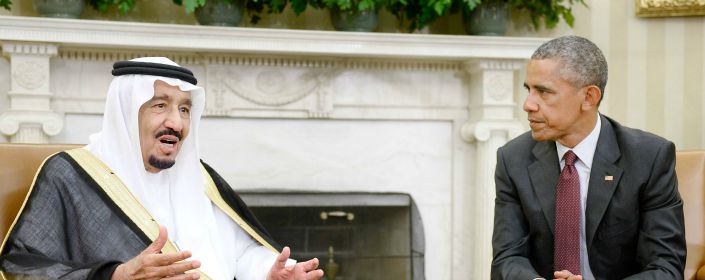
'U.S. President Barack Obama looks on as King Salman bin Abdulaziz of Saudi Arabia speaks during a meeting at the White House September 4 in Washington, D.C. (Photo b Olivier Douliery-Pool/Getty Images)'
The visit of Saudi King Salman bin Abdulaziz to Washington last week was intended by both sides to reinforce the Saudi-U.S. alliance in a new era of international relations in the Gulf region, with a new emphasis on economic and security considerations. Salman was noticeably absent from the Camp David Summit in May, but it had been widely anticipated that he would make an individual trip to Washington before the end of the year. His trip came one month after the August 3 Gulf Cooperation Council (GCC) foreign ministers summit with Secretary of State John Kerry in Qatar at which the Gulf countries endorsed the nuclear deal with Iran and the United States reiterated its commitment to Gulf security and its strong opposition to Iran’s regional policies.
Salman’s visit also comes in the wake of a series of major arms deals and pledges of more robust security cooperation and coordination between the United States and its Gulf allies. Saudi Arabia had already committed to an unprecedented 20-year arms purchase program in 2010, which involves, among other things, 84 new F-15 fighters and upgrades of 70 more as well as the purchase of three helicopter classes including 70 Apaches, 72 Black Hawks, and 36 Little Birds. That deal alone was said to support 75,000 American jobs. The United States is now preparing to resupply Saudi Arabia with thousands of precision-guided munitions to replace those used in the intervention in Yemen. Congress recently approved the sale of 600 Patriot missiles to Saudi Arabia for an estimated $5.4 billion. The United States is also preparing to sell Saudi Arabia two frigates, which will cost over $1 billion, and 10 MH-60R helicopters, priced at $1.9 billion.
The sale of the precision-guided munitions is an important statement of practical support for the Saudi-led Arab intervention in the Yemen war, which is becoming increasingly complex and controversial. Having driven the Houthi militia almost entirely out of the South, and preparing to reestablish the government of exiled President Abd-Rabbu Mansour Hadi in Aden, Yemeni government and allied Arab forces feel they have the momentum. But the next phase of fighting, if it is pressed aggressively, will involve areas in the north, including the capital of Sanaa, where the Houthis and their Yemeni allies aligned with former President Ali Abdullah Saleh have significant support. Additionally, international concern and criticism regarding the human and social costs of the conflict is growing, and is largely directed at the Gulf states because they are leading the military effort to contain and rollback the Houthis and their supporters.
U.S. diplomatic, intelligence, and logistical support for the Saudi-led intervention is an important expression of the strength of the alliance with Saudi Arabia and the extent to which Washington is willing to put aside its own evident misgivings and encourage its Arab allies to pursue their own national security policies. Indeed, one of the most important dynamics at work is a U.S. acceptance of, and support for, a new, more vigorous and independent Saudi and Gulf Arab national security agenda. On September 2, in the immediate run up to the king’s visit, National Security Council Senior Director for Iran, Iraq, Syria, and the Gulf Jeff Prescott said the United States is “looking to support Saudi efforts to build their own capabilities and build their own capacity to act.”
This is not to say that the United States isn’t going to have its reservations about, or even differences with, Saudi Arabia’s emerging and increasingly proactive national security approach. But every indication before and after Salman’s meeting with President Barack Obama suggests the United States is adjusting its policies and expectations to welcome a more independent Saudi defense policy. For years the United States has called on its Middle East and Gulf region allies to do more in their own defense. Now that this is beginning to happen, Washington is embracing the development.
If the United States is quietly concerned about Saudi policy toward Yemen, and is pushing hard for a political resolution to the conflict there (a goal endorsed by the joint statement following the Obama-Salman meeting), Saudi Arabia, having moved on from the question of the nuclear agreement with Iran, has strongly expressed concerns about U.S. policy toward Syria. The Saudis feel that the United States is simply not doing enough to confront Syrian President Bashar al-Assad, and fails to understand that the Damascus dictatorship has a symbiotic relationship with the Islamic State in Iraq and the Levant (ISIL). Saudi Arabia, Turkey, and several other traditional U.S. allies in the Middle East maintain that, because the dictatorship is one of the primary sources of legitimacy for ISIL, it is essential to confront both simultaneously. They say that any policy that fails to do so, arguably including the present U.S. approach, which at most involves only a vague aspiration about a post-Assad Syria, is bound to fail because it will push many Syrian Sunnis into the arms of ISIL fanatics and play into their hands of claiming to be the protectors of the Sunni community in a zero-sum, existential sectarian conflict.
U.S. concerns, based on lessons drawn from the Iraqi experience in the past decade, center on the dangers of a rapid collapse of all governing institutions in the country. From a Saudi perspective, this comes perilously close to providing a rationalization for not seeking the downfall of the regime, no matter how brutally it is behaving, or what the implications of such a policy might be. The Saudis point to the repeated violations by the Assad dictatorship of Obama’s “red line” regarding the use of chemical weapons without any practical consequences. The United States is under tremendous pressure from many of its allies to amend its policies toward Syria, but the Obama administration, strongly supported by congressional and public opinion, is wary of a deeper commitment.
Moreover, the United States has its own concerns about Saudi and Turkish policy, most bluntly expressed in an October 2014 speech by Vice President Joseph Biden in which he accused “The Turks… the Saudis, the Emirates, etc.” of supporting “anyone who would fight against Assad,” thereby facilitating the rise of extremist groups. Biden apologized to all three countries, but many Americans continue to feel he had a point. Indeed, the two accusations are not mutually exclusive, and it’s possible to sympathize with both Saudi and U.S. concerns that the effects, if not the intentions, of each other’s policies in Syria have involved negative, unintended consequences. Nonetheless, Syria’s ongoing civil war is a good candidate to be the primary source of U.S.-Saudi disagreement in the coming months, unless the policies of one or the other, or both, undergo a significant transformation.
Even though such differences remain unresolved and could be the source of ongoing disagreements, the U.S.-Saudi relationship is undergoing a period of palpable warming after at least two years of creeping chill. Both sides are driving the revitalization of the partnership, but the Saudis seem particularly keen on solidifying the relationship by adding a potent economic, commercial, and investment dimension to the otherwise familiar affiliation based on regional and energy sector security. During the king’s visit the Saudi delegation presented a detailed economic roadmap for what Salman himself has described as a “new strategic alliance for the 21st century.”
The Saudi Economic and Development Council, which is chaired by Deputy Crown Prince Mohammed bin Salman (the king’s youthful son, who is also the Saudi defense minister) pressed the case for U.S. investment. This is intended to solidify the relationship with the United States, as well as diversify the Saudi economy and help it begin to manage lower oil prices and greatly increased global energy supplies. King Salman met with senior U.S. business officials from corporations such as General Electric, Chevron, J.P.Morgan, Boeing, Dow, Alcoa, Fluor, Halliburton, Raytheon, and Lockheed Martin. Saudi Arabia has also dropped restrictions on foreign investment in the retail sector in order, according to The Financial Times, to try to lure companies like Apple, JCPenney, Best Buy, The Home Depot, Walgreens, Lowe’s, and CVS.
The Saudi investment roadmap includes the following:
Mining: involving “vast amounts of phosphate and bauxite and silica.”
Oil and gas: promising a new five-year plan forthcoming from Aramco involving “new projects mainly in refining, distribution and support services.”
Health care: suggesting a doubling of “the clinical capacity rate in Saudi hospitals in the coming five years.”
Retail: unveiling a new “package of incentives to ease burdens for retail as a foreign direct investment.”
Entertainment: seeking “direct cooperation with US leading entertainment companies such as Disney, Universal Studios and Six Flags.”
Infrastructure: planning for the construction of “roads, communications and new free zones.”
Housing: promoting a $400 billion market, “including an outstanding demand of 700,000 home mortgages in the Ministry of Housing,” and expecting “the size of the partnership with the US side in this area will exceed $100 million.”
Banking: suggesting that “US banks… can serve subsectors such as services for individuals, establishments and SMEs,” and that the “market share of US banks could reach more than $150 billion in the next five to ten years.”
Technical services: estimating that “total investment [in this sector] is expected to exceed $50 billion.”
The Financial Times reported that, “One person aware of the meetings said the US executives were ‘enthused’ and optimistic about the incentives for overseas investors pledged by the Gulf monarchy, including an easing of ownership restrictions for large foreign retailers.”
From the Saudi perspective, adding an intensified commercial and trade dimension to the relationship with the United States means, in effect, doubling-down on the alliance and a concerted effort to move beyond the political disputes of the past few years. Moreover, it looks to the medium term, beyond the term of the Obama administration, toward a partnership with the United States that has multiple new parameters and aspects, but which is plainly in the mutual national interests of both parties. The United States, too, appears to be interested in consolidating and developing the relationship with Saudi Arabia. The mutual interests that led to the establishment of close cooperation 80 years ago either remain operative to this day, or have been superseded by new factors that prompt both Saudi Arabia and the United States to continue to value, protect, and even intensify their partnership.
The views represented herein are the author's or speaker's own and do not necessarily reflect the views of AGSI, its staff, or its board of directors.
President Trump has led the United States into an impossible dilemma in which resuming and intensifying the war presents one set of alarming consequences while ending it under current circumstances offers at least as many disasters for Washington.
The Trump administration has positioned the United States at a crossroads between a new regime of containment against Iran or a historic drawdown of U.S. influence in the Gulf and broader Middle East.
Riyadh and Abu Dhabi urged President Trump not to attack Iran, but now that the war is into its second month, leaving the current situation in place would be an unthinkable fiasco for them.
Though they were unsuccessful in preventing the current conflict, and, as expected, have been dragged into the U.S.-Israeli confrontation with Iran, Gulf Arab countries remain crucial to hopes for limiting the war and bringing it to a quick resolution.