The erosion of the regime’s legitimacy across broad segments of society, combined with the breadth of the 2025-26 protest coalition, raises the possibility that a new confrontation could trigger renewed anti-regime mobilization.
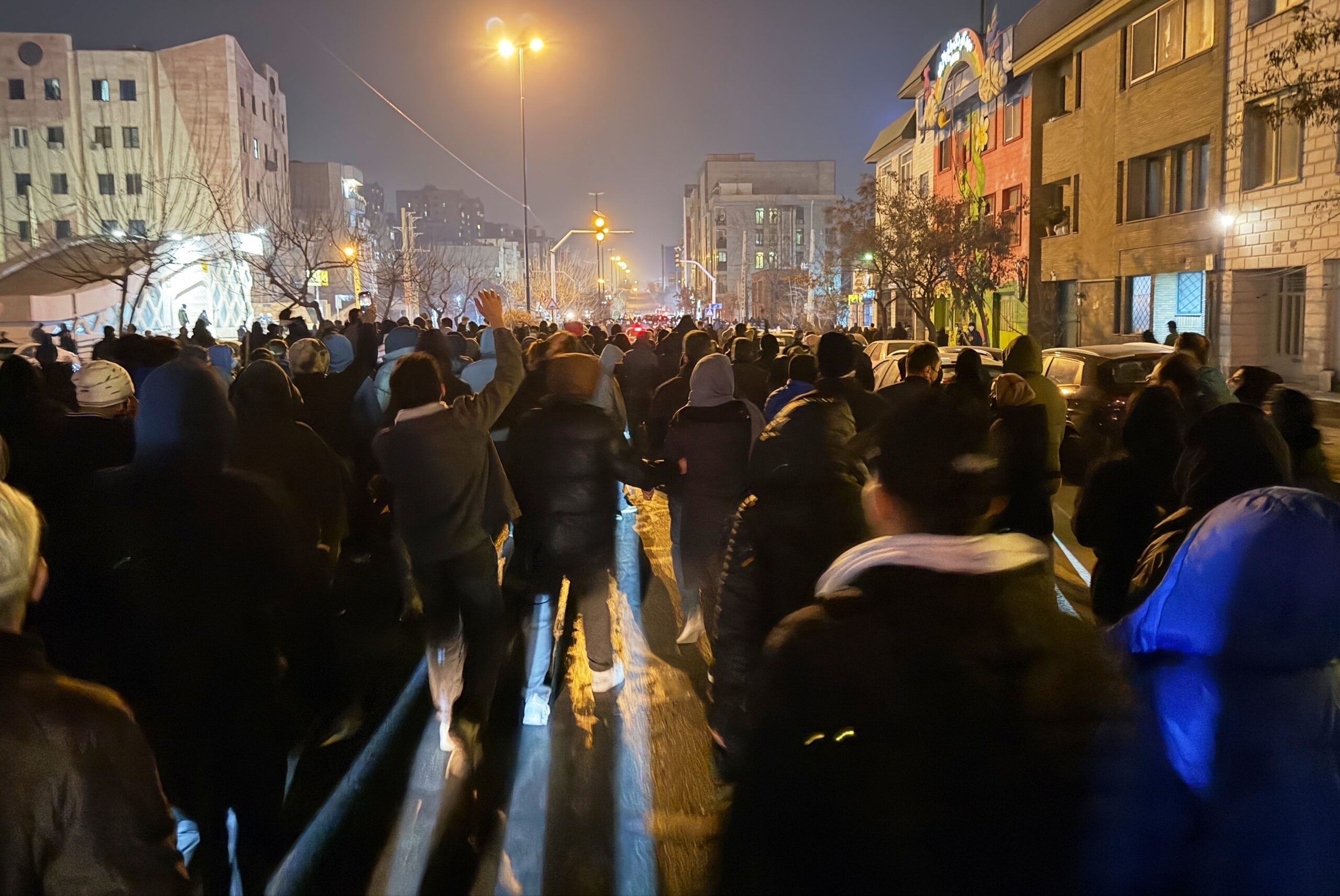
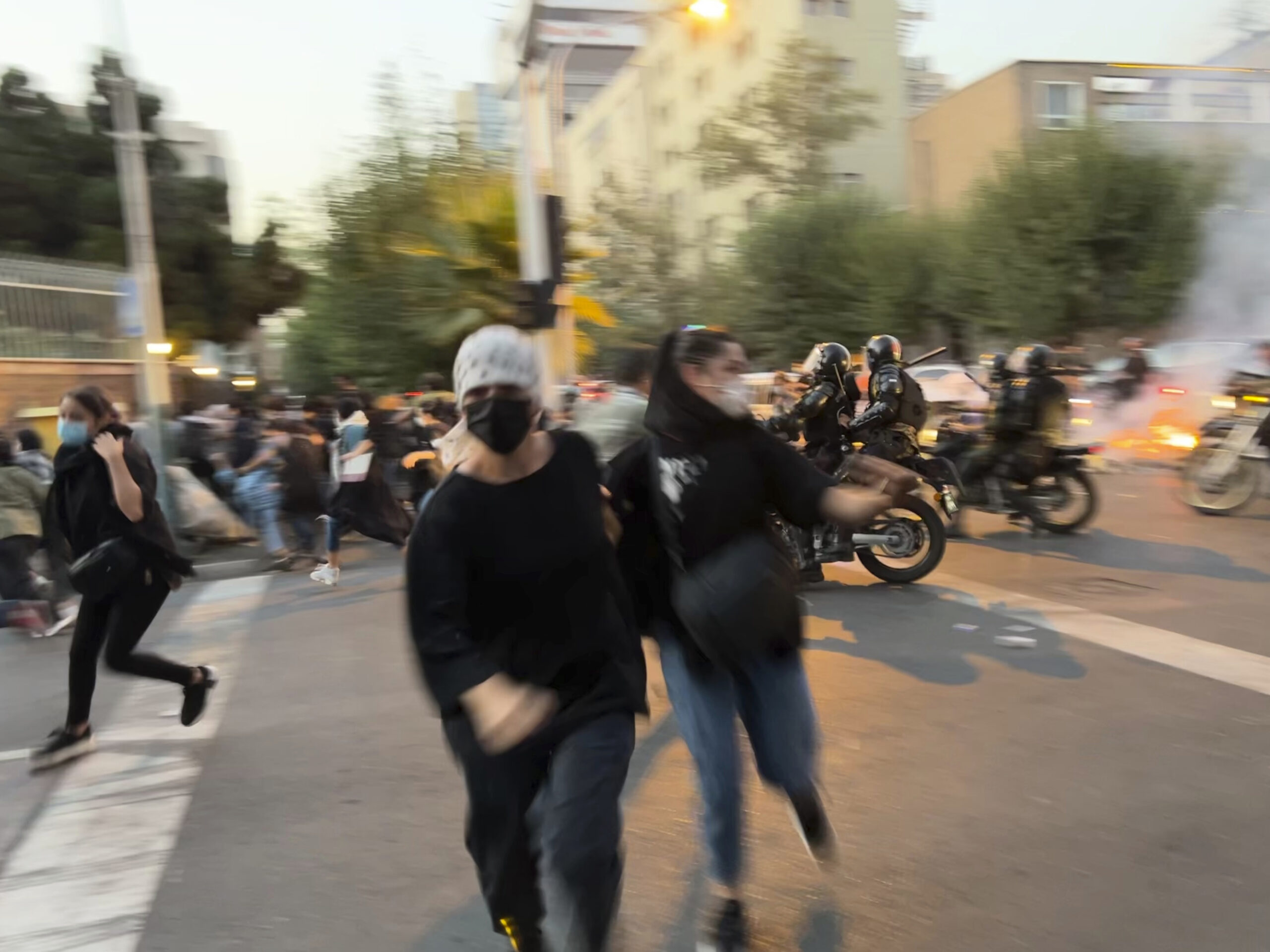
In this photo obtained by The Associated Press, Iranians attend an anti-government protest in Tehran, Iran, Jan. 8. (UGC via AP)
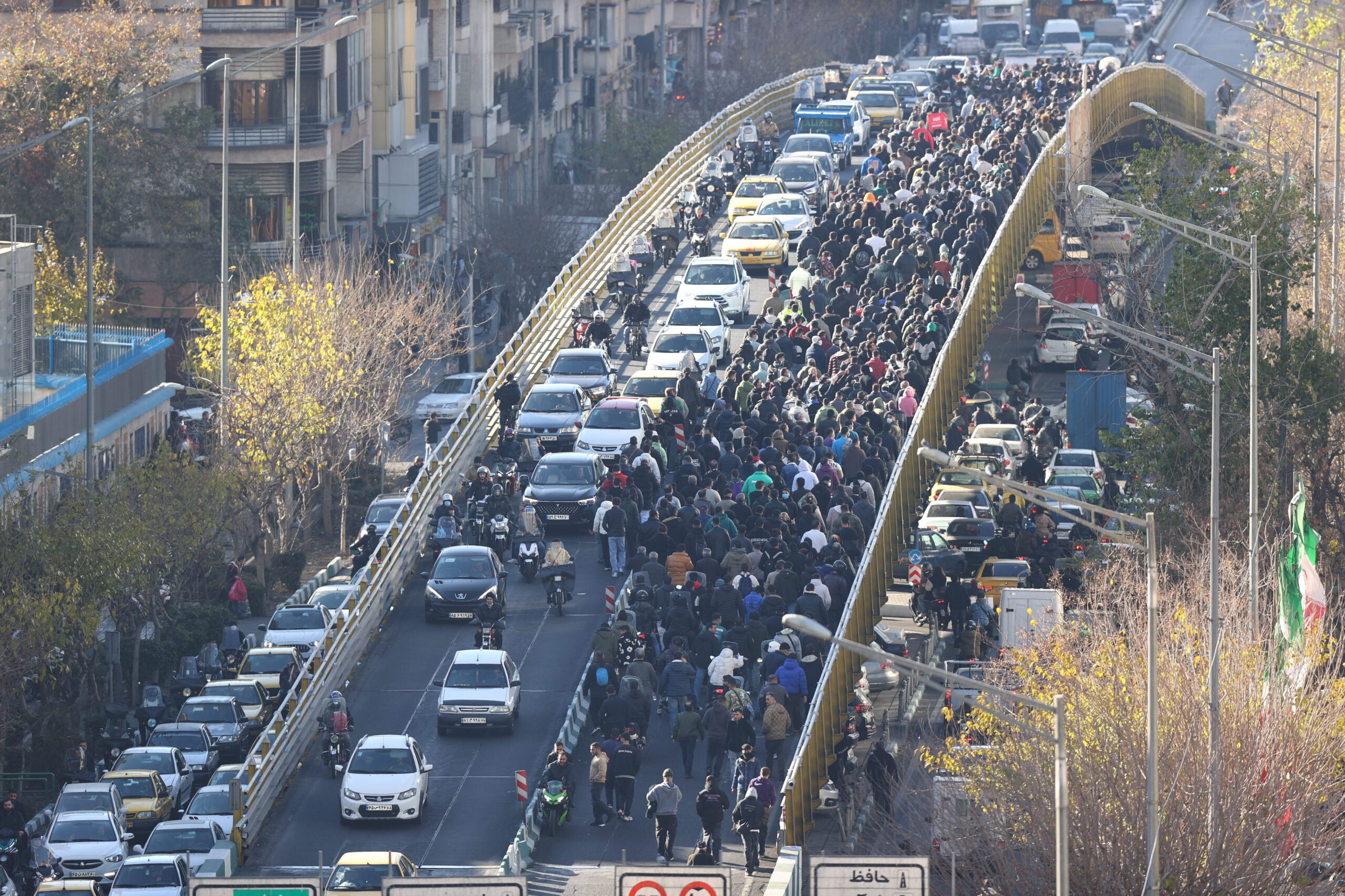
Since December 28, 2025, the regime in Tehran has been grappling with mass anti-government protests and a deepening economic crisis, and it may soon also face the prospect of military confrontation with the United States on top of these internal challenges. How does this latest wave of unrest compare with earlier episodes of upheaval? How has anti-regime dissent evolved over the course of the Islamic Republic’s rule? And how might a military confrontation with the United States affect the trajectory of future protests?
Born out of a mass protest movement against Shah Mohammad Reza Pahlavi, the Islamic Republic is no stranger to anti-regime mobilization. Soon after the revolution’s February 11, 1979 victory, revolutionary factions turned on one another in struggles to dominate the emerging order. This infighting contributed to a near-permanent state of crisis and the reemergence of separatist movements in Iran’s peripheral regions that had lain largely dormant since the end of World War II. By June 1981, however, the alliance between the revolutionary Shia clergy led by Grand Ayatollah Ruhollah Khomeini and the Islamic Revolutionary Guard Corps had effectively crushed organized opposition inside Iran and consolidated the regime’s rule.
Typology and Evolution
Since June 1981, Iran has experienced numerous local protests and uprisings, including scattered anti-war demonstrations during the final phase of the Iran-Iraq War in the 1980s, labor unrest, ethnic and sectarian protests, and, increasingly, demonstrations driven by global warming, water scarcity, and electricity shortages. Yet only eight episodes have risen to the level of major anti-regime protest movements.
These can be broadly grouped into four archetypes: economic, political, personal freedom, and ethnic protests. These archetypes have evolved over time, particularly regarding frequency of occurrence, length, locality, the protesters and primary means of mobilization, and degree of violence, as reflected in estimates of fatalities.
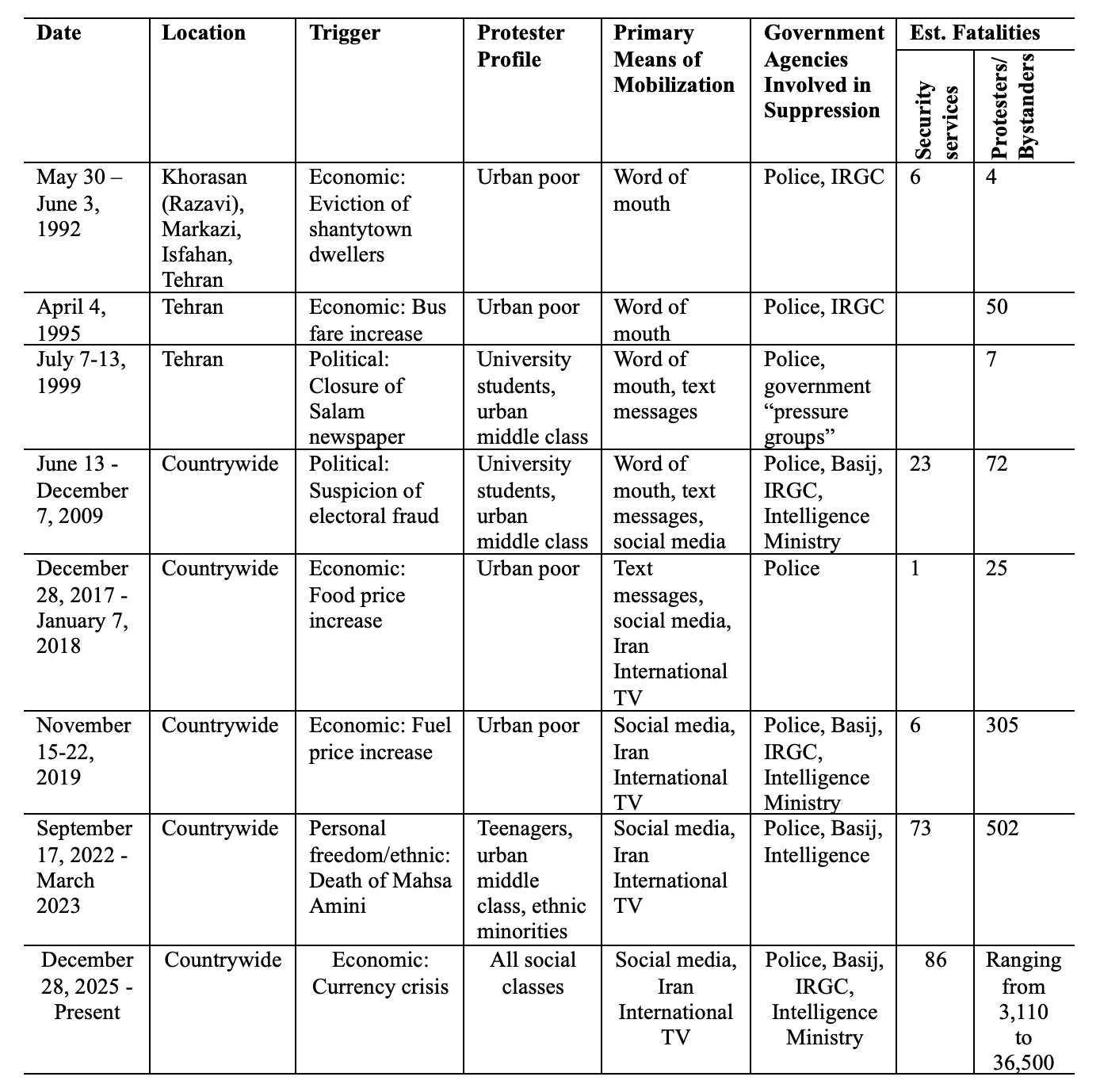
Major Anti-Regime Protests in Iran, June 1981 – February 2026
While five of the eight major anti-regime protest movements were driven primarily by economic grievances, two were chiefly political, and one centered on personal freedoms and ethnic concerns in Iran’s peripheral regions.
Traditionally, economically driven protests – such as local protests against urban development projects that displaced shantytown residents (1992), bus fare hikes that hindered street vendors’ and day laborers’ commutes to city centers (1995), and increases in food and fuel prices (2017-18 and 2019) – mobilized the urban poor, many of them first-generation rural migrants living on the outskirts of major cities. The protests that began in December 2025 were an exception to this pattern: Protests began among mobile phone and electronic good merchants in Tehran’s Grand Bazaar over the collapse of the Iranian currency against the U.S. dollar and subsequently spread to the rest of the country and across a broad range of social groups. Economic protests had also tended to be shorter in duration than other forms of unrest, but this pattern shifted as well: The December 2025 demonstrations have continued – with varying intensity – well into February 2026. These protests also appear to be by far the deadliest, with the government reporting 3,110 deaths, and The New York Times estimating at least 5,200, while the London- and Washington-based Iran International TV has estimated the toll at more than 36,500. It is presently impossible to independently verify these claims.
Iran’s political protests have traditionally mobilized university students and the urban middle class. President Mohammad Khatami’s promise of political liberalization – followed by a regime backlash, exemplified by the closure of reformist newspaper Salam – provoked university students to protest (1999). A decade later, the urban middle class took to the streets over perceived electoral fraud that secured President Mahmoud Ahmadinejad a second term in office (2009).
The one major protest primarily motivated by demands for personal freedoms, while also incorporating a strong element of ethnic grievance, followed the suspicious death of Mahsa Amini, an ethnic Kurd who had been arrested by agents of the Promotion of Virtue and the Prevention of Vice and died under suspicious circumstances in police custody. Her death sparked prolonged countrywide demonstrations involving teenagers, the urban middle class, and ethnic minorities – especially Kurds and Baluchis (2022-23). The unrest claimed the lives of 502 protesters and 73 members of the security forces, with Kurds and Baluchis accounting for roughly half of those protesters killed.
Overall, anti-regime protests in Iran have become more frequent. Since 2017, the regime has faced major unrest roughly every two to three years. Protests have also grown longer, more geographically widespread, more socially diverse, and significantly more violent, as reflected in rising fatality estimates among both protesters and security personnel.
The increasing geographic spread and cross-class character of protests may be linked to technological change. New communication tools have enabled demonstrations in one locality to spread across the country with unprecedented speed. Whereas the Pahlavi regime blamed BBC Persian radio broadcasts for inciting unrest during the 1979 revolution, foreign broadcasters historically had limited influence compared to state-controlled media. This began to change in the late 1990s with the spread of mobile phones, text messaging, and later smartphones and social media. Despite government censorship, technologically adept Iranians have accessed foreign news sources, including Iran International, whose role in recent protests has at times been compared to that of Al Jazeera during the Arab Spring uprisings. During the 2025-26 protests, however, the regime imposed a countrywide internet blackout beginning January 8, only partially restoring connectivity on January 28.
Protests and Military Confrontation
As discussion heats up about a potential impending military confrontation with the United States, it is not easy to predict what Iranian public reactions might be. During the 12-day war in June 2025, when Israel and the United States bombarded Iran, the public did not rise against the regime; for a time, a “rally around the flag” effect allowed the authorities to portray dissent as treason and to justify extraordinary security measures.
However, circumstances may have changed due to the regime’s extreme violent suppression of protests and the staggering number of fatalities. The erosion of the regime’s legitimacy across broad segments of society, combined with the breadth of the 2025-26 protest coalition, raises the possibility that a new confrontation could instead trigger renewed anti-regime mobilization.
Much would depend on the scale and duration of hostilities, the extent of civilian casualties and damage to infrastructure, the regime’s ability to control information flows, and the U.S. government’s capacity to persuade Iranians that Washington is committed to regime change in Tehran.
A Cycle of Crisis
These trends paint a sobering picture of the trajectory of anti-regime dissent in Iran. The Islamic Republic appears caught in a cycle of recurrent crisis: Each wave of protests is broader, longer, and more violent than the last. Yet repression alone has not addressed the underlying drivers of dissent. Unless the regime enacts structural economic and political reforms, Iran is likely to face continued instability, with protest movements that are more interconnected, more persistent, and potentially more consequential for the durability of the regime.
A potential military confrontation with the United States may interact with domestic grievances in unpredictable ways. While war might temporarily consolidate elite cohesion and justify heightened repression, it would almost certainly intensify economic dislocation, deepen social hardship, and expose the state to new legitimacy risks, especially if the conflict were protracted.
The views represented herein are the author's or speaker's own and do not necessarily reflect the views of AGSI, its staff, or its board of directors.
Though the Iranian regime is facing increasing pressure from protesters and armed insurgent groups, it is not yet doomed – but without a deal with the United States, the regime is likely headed for a slow collapse.
The demands of the protesters for regime change are a clear manifestation of the deep frustration and the loss of hope for reform among the Iranian public and seem to signal that the time is ripe for comprehensive change.
Though the Iranian regime is facing increasing pressure from protesters and armed insurgent groups, it is not yet doomed – but without a deal with the United States, the regime is likely headed for a slow collapse.
Saudi Arabia seeks a U.S. security umbrella strong enough to deter Iran but a diplomatic posture measured enough to avoid provoking Iran unnecessarily.
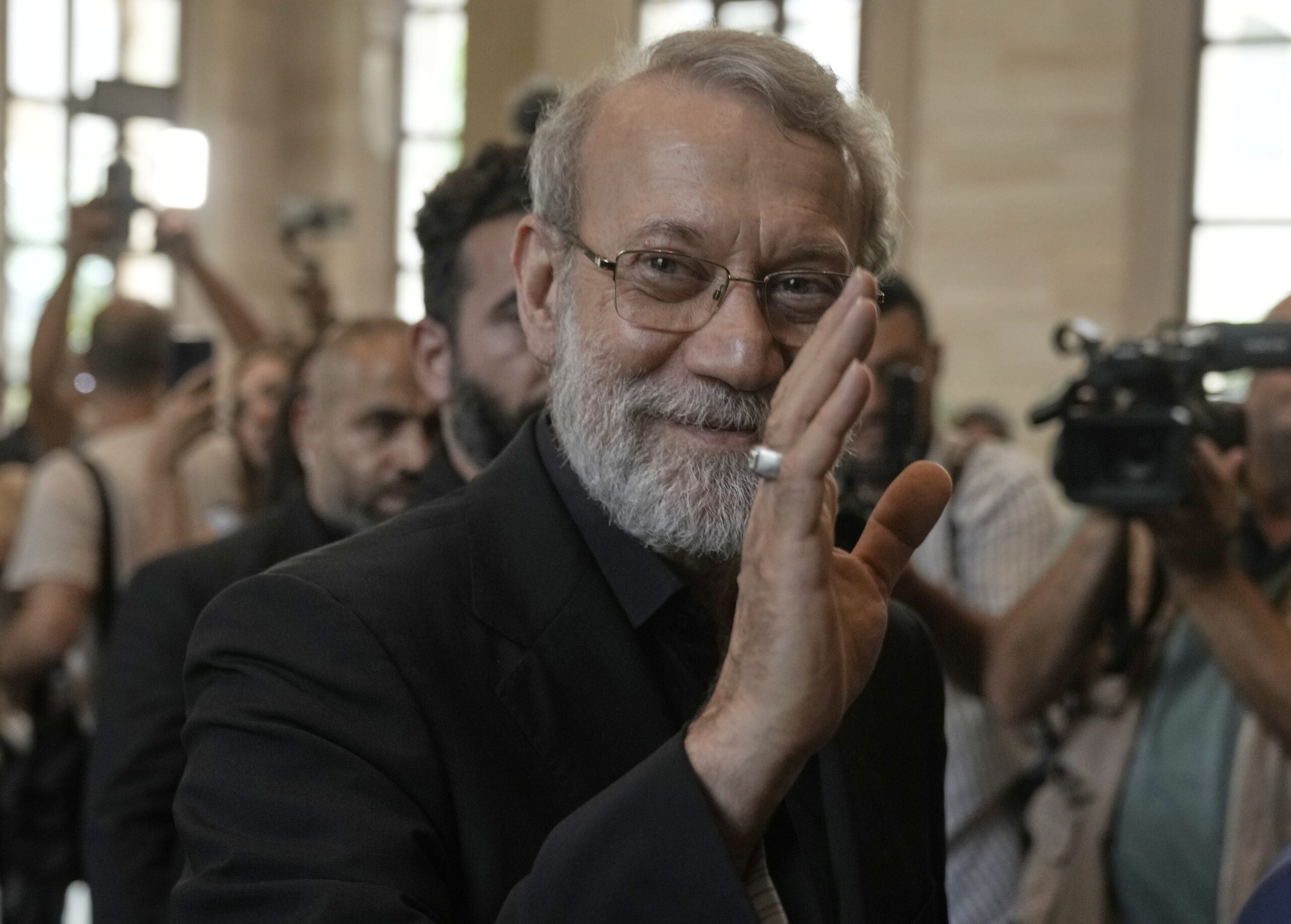
An Iraqi-born native of Najaf but an unmistakably Iranian nationalist, Ali Larijani is expected to leverage his record of bureaucratic competence and global fluency to coordinate Iran’s security bureaucracy.
Confronted with the clear and present danger posed by Israel, Iran’s collective leadership appears mired in policy paralysis, leaving Iran strategically adrift.
On January 8, AGSI hosted a virtual roundtable with its leadership and scholars as they look ahead and assess trends likely to shape the Gulf region and U.S. foreign policy during the coming year.