For Many Players the Focus in Syria Shifts from ISIL to Iran
The once closely linked and relatively coherent struggle inside Syria has fragmented into a series of intense, but highly localized, battles, which are being watched warily by regional powers because of the significant impact the outcomes are likely to have on the regional strategic landscape.
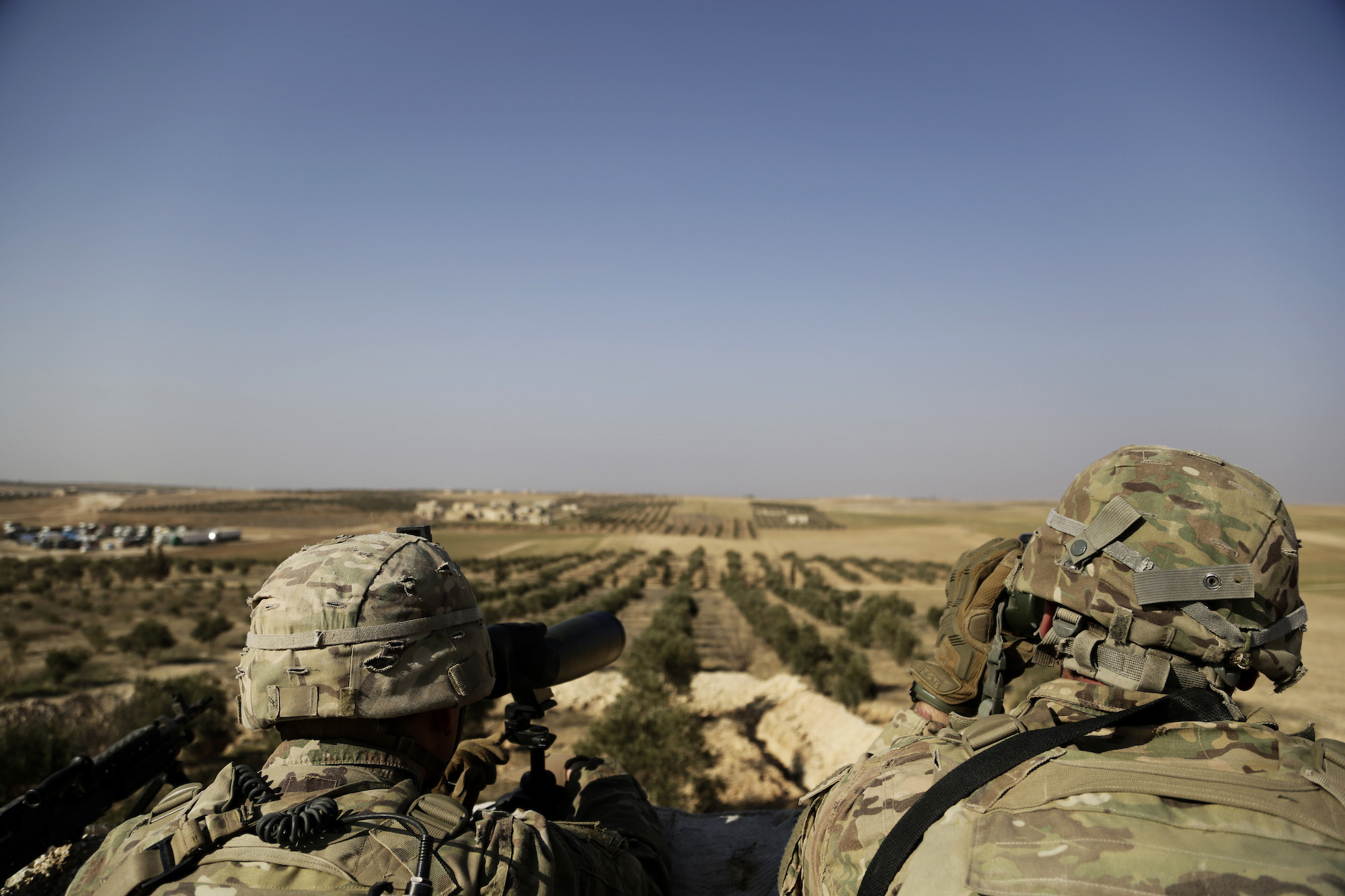
'U.S. troops look out toward the border with Turkey from a small outpost near the town of Manbij, northern Syria, Feb. 7. (AP Photo/Susannah George)'
One year after a crucial turning point in the war in Syria – the fall of rebel-held parts of Aleppo to pro-regime forces – the once closely linked and relatively coherent struggle inside the country has fragmented into a series of intense, but highly localized, battles that, at first glance, appear only loosely connected: a dramatic flare-up in the south of Syria pitting Israel against Syrian government and Iranian forces; a bitter battle between Turks and Kurds in the north, also involving a tense standoff between fellow NATO members Washington and Ankara; and a horrifying series of attacks by the Assad regime, both in the far-flung north and Damascus’ own suburbs, with hundreds of civilians killed in a few days.
These seemingly disparate battles are being watched warily by regional powers not directly involved, including the Gulf Arab countries, because of the significant impact the outcomes are likely to have on the regional strategic landscape in coming years. While many factors are in play, it is above all Iran’s policies and ambitions that contribute to a kaleidoscopic effect whereby small adjustments in one corner of the map can alter, if not reshape, the bigger picture.
Another major factor in this simultaneous fragmentation and intensification of the conflict in Syria is linked to the recent collapse of the Islamic State in Iraq and the Levant’s “caliphate,” which had been based in eastern Syria and headquartered in the city of Raqqa. For much of 2017, virtually all other actors in Syria were committed to its elimination. But ISIL’s defeat has intensified other battles in Syria that were contained or postponed while that was a shared priority.
Nowhere is this more readily apparent than in northern Syria, where Turkey has launched a major offensive designed to curb the power of Kurdish militias that had been the primary ground forces against ISIL. Turkey views them as offshoots of the Kurdistan Workers’ Party (PKK), which has fought a bloody conflict for Kurdish independence from Turkey for decades. Washington has also formally designated the PKK a terrorist organization. However, these Syrian Kurdish militias have developed close ties with U.S. forces, over 2,000 of which have been operating in northern Syria to coordinate the battle against ISIL. As a consequence, Washington is deeply uneasy about Ankara’s attack on militias closely aligned with the United States. While the fighting has been concentrated around the city of Afrin, there are indications that it could turn in the direction of Manbij, where Kurdish fighters and U.S. special forces operate in close coordination. Hence a highly unusual confrontation between NATO members could deteriorate into a completely unprecedented open clash. Back-to-back visits to Turkey by National Security Advisor H.R. McMaster and Secretary of State Rex Tillerson appear designed to prevent any combat between the two NATO allies from occurring.
Gulf Arab countries will be concerned about the evident close coordination between Ankara and Moscow before and during Turkey’s offensive. Russia withdrew its troops from the area before the Turkish assault, and Russian-supported pro-regime forces swung into action simultaneously in other areas, most notably Aleppo. It seems clear that Russia and Turkey agreed to new and unpublicized de facto deconfliction lines before Ankara’s offensive. Turkey had once been closely aligned with Gulf Arab countries, particularly Saudi Arabia and Qatar, in promoting the overthrow of President Bashar al-Assad and supporting armed opposition groups. However, for more than two years now, Turkey has narrowed its focus in Syria on preventing the creation of a unified Kurdish-ruled area along most of its southern border with Syria and curtailing the power of Kurdish militias. Ankara appears reconciled to Assad remaining in power, at least for now, and Turkey’s practical withdrawal from the campaign for regime change in Syria was a major factor in Assad’s victory in Aleppo in 2017. The current close coordination between Turkey and Russia underscores that Ankara’s role in Syria has shifted to the point where it is aligned not only with Russia but, in effect, with the Assad regime and its Iranian backers, and its interests are now incompatible with those of both Washington and the Gulf Arab countries.
The U.S. focus in Syria has also been shifting from destroying ISIL to a more long-term and multifaceted campaign to prevent Iran from emerging as the main beneficiary of the Syrian war. In January, Tillerson was the first senior U.S. official to confirm that, despite the defeat of ISIL, thousands of U.S. troops would remain in Syria indefinitely in order to combat Iranian influence and encourage the replacement of the Assad regime by denying it a comprehensive victory. Along with preventing any major resurgence by ISIL, the U.S. role in Syria will focus, among other things, on denying Iran the ability to create a consolidated “land bridge” through Iraq and Syria linking Iran with Lebanon and the Mediterranean coast. For Gulf Arab countries, preventing this development is essential, since it would leave Iran in control of a vast and relatively contiguous swath of territory across the northern Middle East.
Therefore, Gulf Arab countries will be working with, and relying on, Washington to ensure that such a land bridge isn’t developed and that Iranian influence in Syria and Iraq is attenuated, if not eliminated. Secretary of Defense Jim Mattis in early February denied that Iran has succeeded in establishing this land bridge. Shortly after his comments the U.S. military attacked, for the first time, pro-Assad regime fighters in northern Syria that were advancing toward Kurdish militias and U.S. special forces. The strike underscored that Washington is prepared to act militarily to protect its allies and deny pro-regime forces a comprehensive victory in northeastern Syria. But the clash was more broadly significant, including for Gulf Arab countries, given its proximity to the border crossing area between Qaim in Iraq and Bukamal in Syria, control of which would be essential for Tehran and its proxies, above all Hezbollah, to create a secure and consolidated link between Iran and Lebanon.
As the dramatic events over the weekend demonstrated, Israel also has become increasingly alarmed by Iran’s expanding role, and Hezbollah’s buildup, in Syria, including near the Israeli-occupied (and annexed) Golan Heights. Israel has periodically used airpower to disrupt the transfer of major weapons from Syria to Hezbollah in Lebanon, and Israeli and Hezbollah leaders have been exchanging dire threats for at least a year. Israel appears to be responsible for the recent bombing of a reportedly Iranian-controlled arms facility in Syria. Either in retaliation, or to test the ever-shifting “rules of the game,” Israel claims an Iranian-manufactured drone was launched into its territory from Syria before being shot down by Israeli helicopters. Israel then launched a series of retaliatory airstrikes against Syrian regime and Iranian targets (allegedly including the “Iranian trailer” from which the drone was launched), during which an Israeli F-16 was apparently shot down or crashed under heavy anti-aircraft fire. This appears to be the first time that the Israeli and Iranian militaries have confronted each other directly.
In addition to the transfer of sophisticated weapons to Hezbollah, Israel has expanded its red lines, including the establishment of an Iranian military base or the construction of Iranian weapons factories and facilities in Syria. Israel has become alarmed at the buildup of an estimated 10,000 pro-Iranian militiamen, drawn from Afghanistan, Iraq, and even Pakistan, in southern Syria. And while Israel’s attention is focused on southern Syria, not least because of concerns about security in the Golan Heights, like Washington and the Gulf Arab countries, Israel is committed to ensuring that Iran does not emerge from the Syrian conflict as a regional hegemon, with reinforced unfettered access to Hezbollah in Lebanon.
Concern about Iran’s growing influence in the region is the thread that most clearly ties together the patchwork of seemingly disparate, but actually interconnected, localized conflicts in Syria, particularly from a Gulf Arab perspective. The continued, and arguably expanded, U.S. role in northern and northeastern Syria is increasingly focused on curbing Iran’s power and influence in key areas, including along the Syrian border with Iraq. Israel’s airstrikes against Iranian and Syrian regime targets similarly underscore the urgent imperative shared by many regional powers to limit, and eventually rollback, the outsized gains made by Iran and Hezbollah during the course of the Syrian war. The United States, Israel, and the Gulf Arab countries will also have to try to convince Russia, arguably the most powerful player in Syria today, that Iranian dominance in Syria is not in Moscow’s interests.
Israel’s airstrikes in the south and Washington’s intensified military presence in the north both send a strong signal to Russia about how much Moscow stands to lose if it allows Iran’s regional agenda to spark larger, more damaging and destabilizing conflicts engulfing Syria. In the longer term, a similar message will be aimed at Turkey as well. The Gulf Arab countries will be closely watching, and trying their best to influence, these developments as they continue to feel that the regional balance of power will be shaped by the long-term outcomes in Iraq and Syria. The intensification of relatively localized conflicts throughout Syria, all of them directly involving significant outside powers, is the clearest barometer of how crucial the stakes at play in that country have become.
The views represented herein are the author's or speaker's own and do not necessarily reflect the views of AGSI, its staff, or its board of directors.
As the September deadline for the U.S. troop drawdown approaches, Iraq’s period of comfortable neutrality is ending, but the country’s policymakers should not rush into unsustainable alignments.
President Trump has led the United States into an impossible dilemma in which resuming and intensifying the war presents one set of alarming consequences while ending it under current circumstances offers at least as many disasters for Washington.
The Trump administration has positioned the United States at a crossroads between a new regime of containment against Iran or a historic drawdown of U.S. influence in the Gulf and broader Middle East.
Riyadh and Abu Dhabi urged President Trump not to attack Iran, but now that the war is into its second month, leaving the current situation in place would be an unthinkable fiasco for them.
Though they were unsuccessful in preventing the current conflict, and, as expected, have been dragged into the U.S.-Israeli confrontation with Iran, Gulf Arab countries remain crucial to hopes for limiting the war and bringing it to a quick resolution.