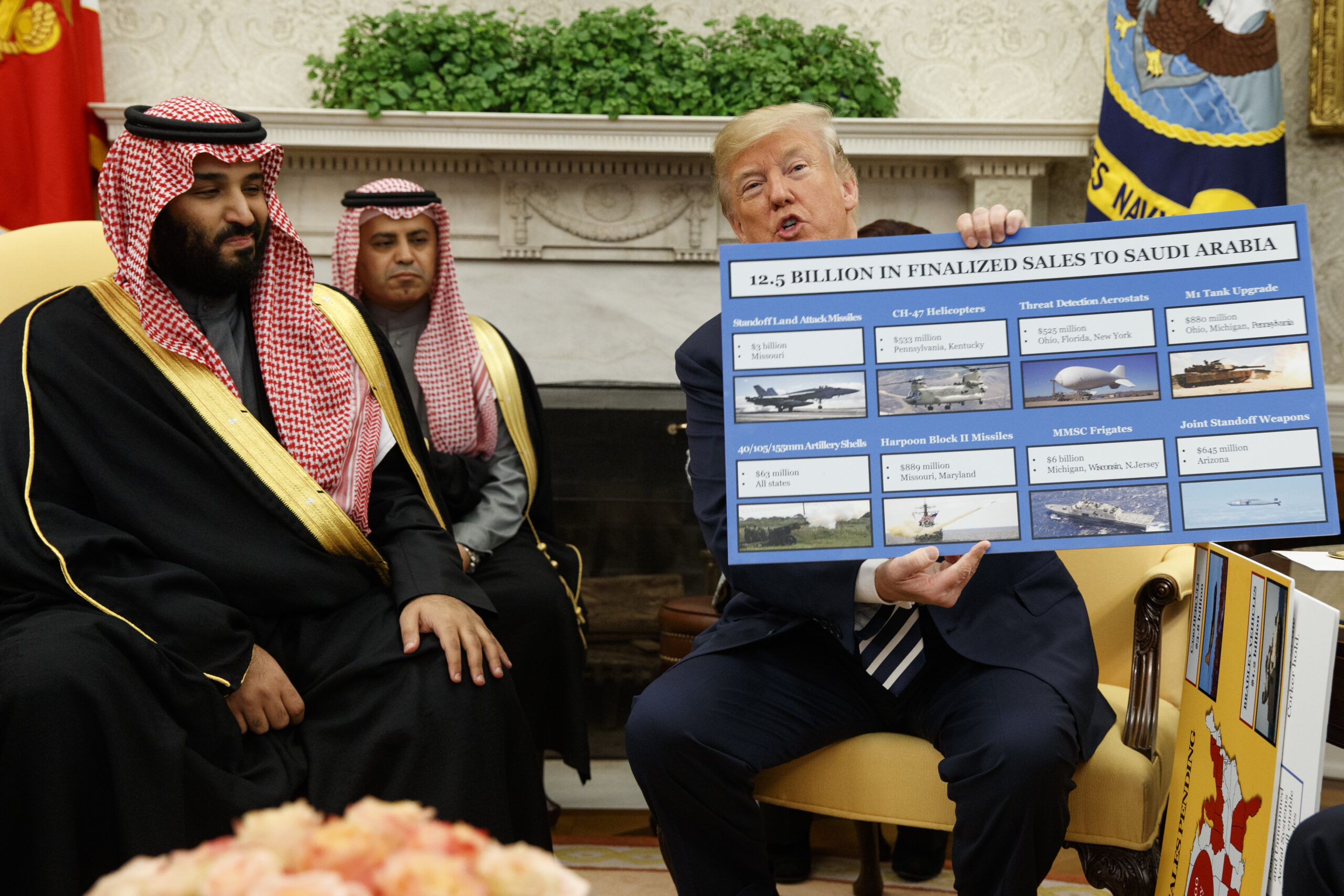
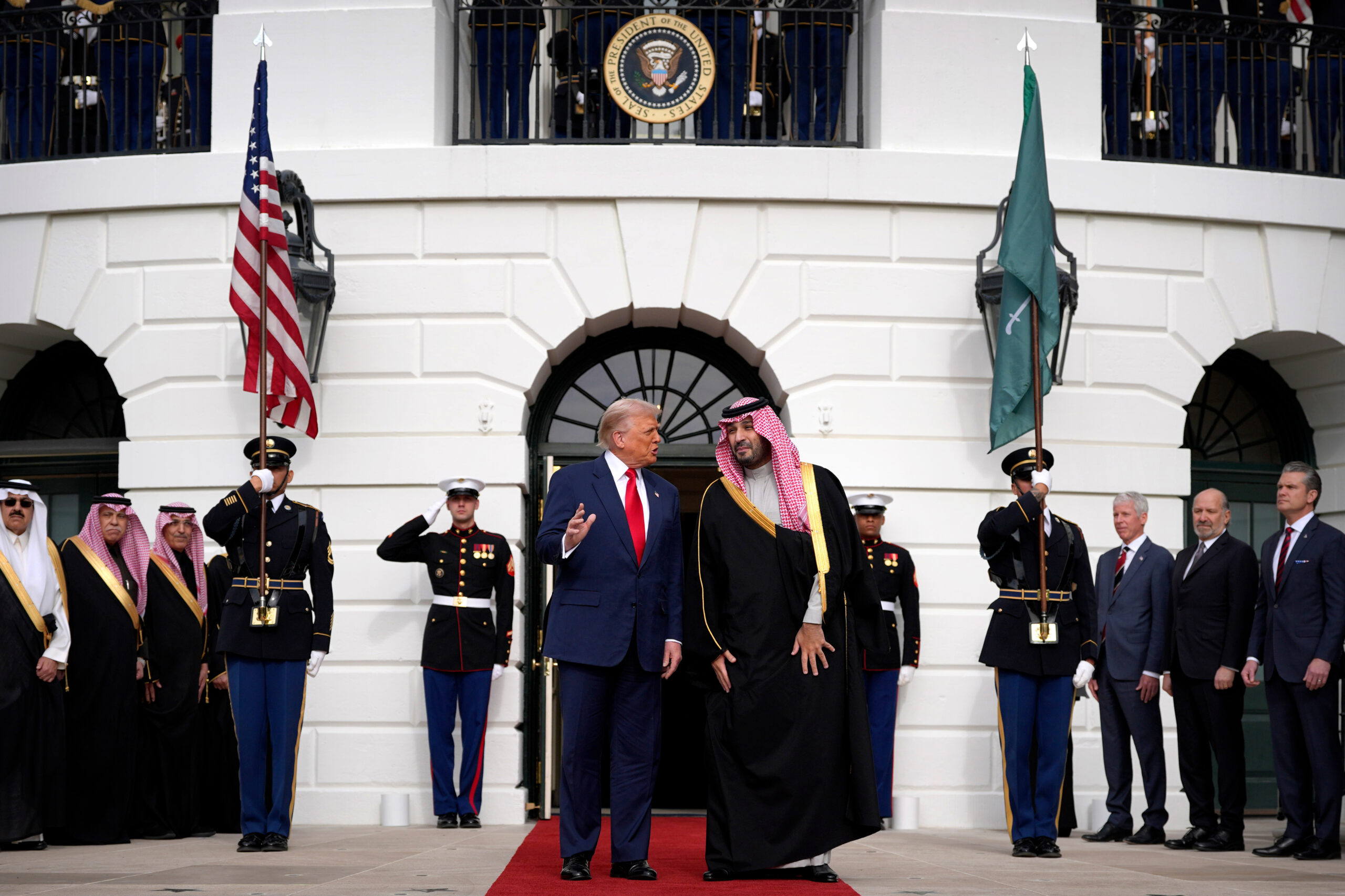
U.S. President Donald J. Trump shows a chart highlighting arms sales to Saudi Arabia during a meeting with Saudi Crown Prince Mohammed bin Salman at the White House, Washington, DC, March 20, 2018. (AP Photo/Evan Vucci)
In an effort to bypass opposition from Democrats and Republican internationalists in Congress, on May 24 the administration of President Donald J. Trump issued a national emergency declaration citing tensions with Iran to complete weapon sales to Saudi Arabia, the United Arab Emirates, and Jordan. The declaration covered 22 contracts worth over $8 billion, mostly for the Gulf Arab countries and many connected to the war in Yemen. Lawmakers in both houses and from both parties, although especially Democrats in the House of Representatives, had been seeking to use traditional congressional oversight prerogatives to block these weapons sales to Saudi Arabia and the UAE, citing the humanitarian crisis caused by the war in Yemen as well as the murder of Saudi journalist Jamal Khashoggi and other human rights concerns.
They now say they will seek additional means to block the sales to preserve their institutional powers. These developments are dragging the Gulf Arab countries deeper into U.S. domestic political disputes and threaten to exacerbate strains in relations with core parts of the U.S. political establishment and policy-framing community, despite ongoing strong ties to the Trump administration.
Saudi Arabia and the UAE are caught in the crossfire of domestic U.S. disputes along three axes: the separation of powers between the legislative and executive branches of government; efforts by opposition Democrats to attack Trump and the Republicans on foreign as well as domestic policy; and attempts by more traditional, internationalist Republicans to push back against the president’s sometimes mercantilist or neo-isolationist “America First” agenda. On all three fronts, these Gulf Arab countries find themselves vulnerable to being used as a cudgel against Trump by his Democratic antagonists and Republican “constructive critics” alike.
The Yemen intervention was never popular among Democrats, but they were restrained while President Barack Obama was in power, given his tepid support for the Saudi-led effort precluded any confrontation – especially since he allowed a hold to be placed on a large shipment of precision guided munitions to be sold to Saudi Arabia to replenish stockpiles that had been exhausted in Yemen. Trump lifted the hold soon after coming into office and expanded the scope of U.S. support for the Saudi-led coalition’s participation in the Yemen conflict.
While critical Democratic voices became louder throughout the first half of the Trump term, it wasn’t until the Khashoggi murder that an influential group of Republican internationalist senators, notably Lindsey Graham and Marco Rubio, became willing to oppose delivery of weapons to Saudi Arabia to express a more generalized alarm about the trajectory of Saudi government behavior. Graham, in particular, turned from being a notable defender to a vociferous critic of the Saudi government, and particularly Crown Prince Mohammed bin Salman.
Shortly after the Khashoggi murder, the Democrats regained control of the House of Representatives in the November 2018 midterm elections. Tensions with Congress were further stoked by the detention and reported abuse of women’s rights activists in Saudi Arabia and allegations that Saudi diplomats had helped Saudi nationals abscond from the United States to avoid trials on serious criminal charges. And it became increasingly clear that newly empowered Democrats and increasingly frustrated Republican internationalists were likely to view weapons sales to Saudi Arabia and the UAE as a key form of foreign-policy leverage with the administration.
The partisan division with the Democrats was evident from the beginning of the Trump administration but became actively contentious when Democrats retook the House. Strong ideological and strategic pressure from Republican internationalists in the Senate began after the Khashoggi murder. The institutional, separation-of-powers contest between the White House and Congress centered on these issues came to the fore with Trump’s April 16 veto of the legislative effort to invoke the 1973 War Powers Resolution to mandate the cessation of all U.S. operations related to the Yemen war. With this emergency declaration seeking to bypass the prospect of a legislative rejection of these weapons sales, the White House has doubled down on its effort to sideline Congress.
All of this illustrates the way in which Saudi Arabia and the UAE, and particularly their military intervention in Yemen, have become exposed to three of the most important fault lines in domestic U.S. politics, along partisan, ideological, and institutional axes. Saudis may feel they’ve been here before. Similar emergency declarations were used to sell them weapons over congressional objections by Presidents Ronald Reagan in 1984, George H.W. Bush in 1990, and George W. Bush in 2002. And, they may well reason, the strategic alliance with the United States that began in the 1940s under President Franklin D. Roosevelt has been maintained by all presidents of both parties since and has survived far more extreme tests than any that exist today, such as the 1973 oil embargo, the Sept. 11, 2001 attacks, and the 2003 invasion of Iraq.
However, the political dynamics of foreign policy in Washington are dramatically shifting away from the post-World War II and post-Cold War contexts that were the basis for this alliance until now. Even if Trump does not restructure U.S. foreign policy in a profound and lasting way, by resurrecting neo-isolationism, for example, it will still not return to what it was during either of those bygone eras. Apart from the strong ties to the Trump administration and family, Saudi Arabia and the UAE are witnessing significant fraying of their support base among Democrats and some influential Republicans. Trump has vetoed the Yemen war resolution and will supply these weapons through the emergency declaration. But both actions, while they get the Gulf Arab countries what they want immediately, reinforce the sense in Congress and among key voices in both parties that this relationship is somehow particular to the Trump administration’s view of international relations. In the long run, that’s unlikely to be a strong position for Abu Dhabi and Riyadh in Washington.
The views represented herein are the author's or speaker's own and do not necessarily reflect the views of AGSI, its staff, or its board of directors.
This paper examines the defining characteristics of asymmetrical hostilities, in particular, the imbalance created when different security objectives – dominance or disruption – come into play.
The large wealth, small size, powerful rivalries, and apparent unwillingness to engage in full-scale war of the Gulf Arab states indicate that the future of conflict in the region will be hybrid.
Riyadh and Abu Dhabi urged President Trump not to attack Iran, but now that the war is into its second month, leaving the current situation in place would be an unthinkable fiasco for them.
Though they were unsuccessful in preventing the current conflict, and, as expected, have been dragged into the U.S.-Israeli confrontation with Iran, Gulf Arab countries remain crucial to hopes for limiting the war and bringing it to a quick resolution.
After decades of tolerating Hezbollah’s warmaking independence, the current crisis has compelled Lebanese leaders to ban its military activities; this project will do much to determine the reach Iran can maintain in the Arab world.
Gulf Arab countries urged the United States not to strike Iran, but now that is happening, they are in danger of being sucked into a conflict they cannot control but that will likely reshape their present and future realities.
On January 8, AGSI hosted a virtual roundtable with its leadership and scholars as they look ahead and assess trends likely to shape the Gulf region and U.S. foreign policy during the coming year.