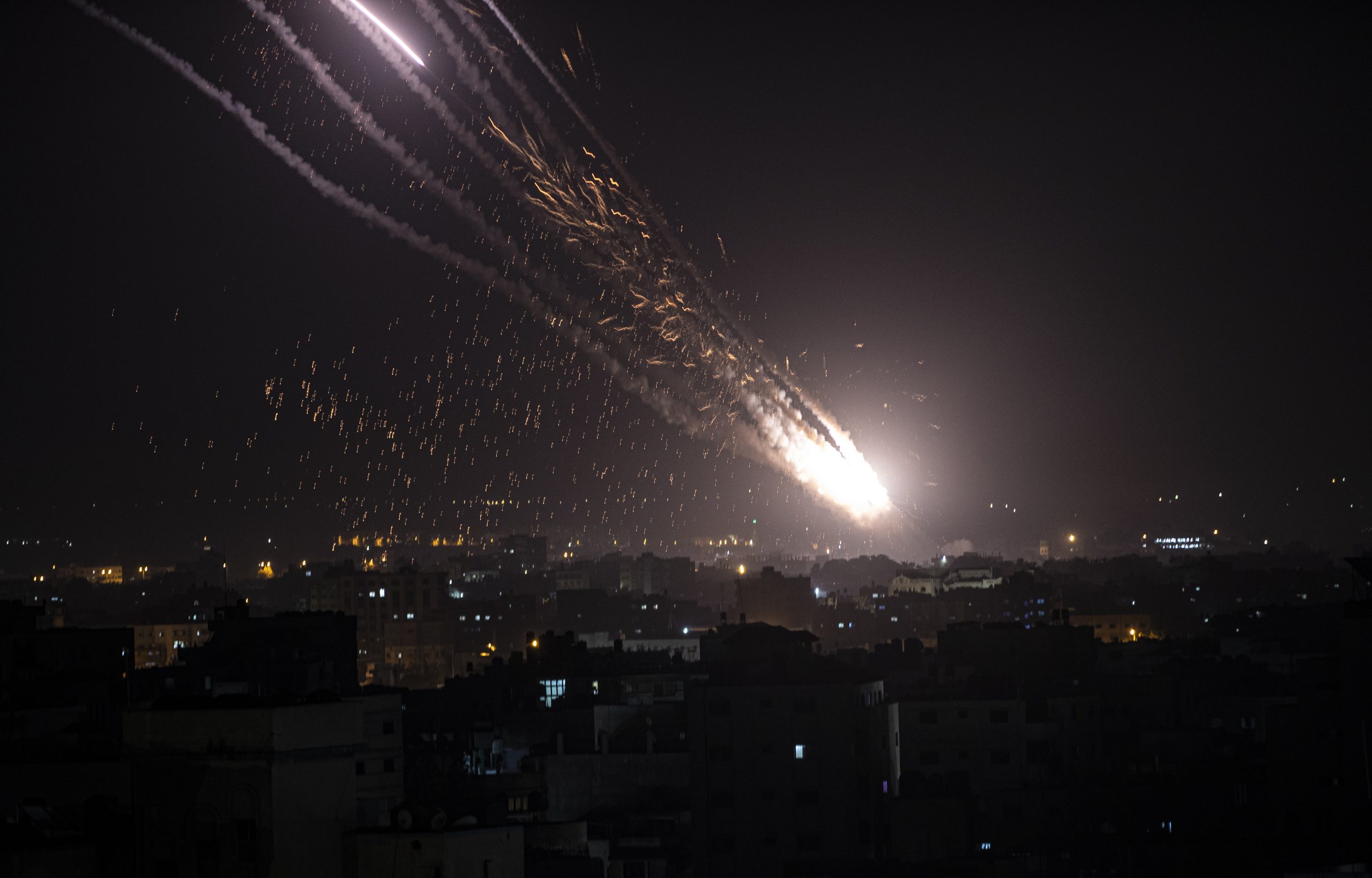
Rockets are launched from the Gaza Strip toward Israel, May. 10. (AP Photo/Khalil Hamra)
The recent explosion of violence between Israel and the Palestinians has posed serious quandaries for the Gulf Arab countries that have either begun normalizing diplomatic relations with Israel or may be considering doing so in the future. The United Arab Emirates and Bahrain are well into the process, while Qatar and Oman have a long history of diplomatic interactions with Israel and could easily take that step. Saudi Arabia, too, has been careful to keep the option open, both politically and diplomatically. Only Kuwait, which is concerned about importing any avoidable regional controversy into its delicate political balance at home, seems distinctly reluctant to consider such a move.
Yet the Gulf Arab conundrum has eased somewhat in recent days as the epicenter of the confrontation shifted from Israeli-occupied East Jerusalem to an exchange of aerial bombardments between Israel and Gaza. Tensions in Jerusalem built over several recent weeks toward a scheduled final Israeli Supreme Court decision expected to support an effort by Jewish settlers to evict several Palestinian families from the Sheikh Jarrah area of East Jerusalem. Anything in East Jerusalem has religious and symbolic significance, among other reasons, because it is the location of the Dome of the Rock and Al-Aqsa Mosque. And, Arabs, especially Palestinians, stress that the capital of a Palestinian state must be in East Jerusalem. Because the families facing eviction are already refugees and the Israeli settlers are invoking a law allowing Jews to regain privately owned land allegedly lost in 1948, a right that Israel does not extend to Palestinians, emotive themes of occupation, displacement, and discrimination are also invoked.
Gulf leaders were well aware that Egyptian and Jordanian officials, among others, had been warning the United States that tensions over this latest displacement were brewing noticeably in Jerusalem in recent weeks. On May 6, ongoing Sheikh Jarrah protests picked up steam with the impending court decision. And after Friday prayers on Laylat al-Qadr, arguably the holiest night during Ramadan, a major confrontation between Palestinians and Israeli forces ensued when congregants joined with Sheikh Jarrah protests. That’s when the situation became particularly awkward for Gulf countries, inducing them to issue strongly worded statements they would otherwise have preferred to avoid.
Videos circulated widely, going from ubiquitous Palestinian TikTok accounts to the Instagram and Twitter streams that are more normative in the Gulf, showing Israeli forces rampaging through the Al-Aqsa Mosque, firing teargas and stun grenades as Palestinian youths pelted them with stones. Hundreds of Palestinian protesters were injured, along with a number of Israeli troops. Gulf countries, including the UAE, Bahrain, and Saudi Arabia, issued strong statements condemning the violation of the holy places, calling for Israel to respect their sanctity, and reiterating strong support for the right of Palestinians to an independent state with its capital in East Jerusalem.
Confrontations continued over the weekend but were noticeably dying down in frequency and intensity (possibly influenced by the Israeli Supreme Court’s action postponing a decision on the case). At this stage, the confrontation was still largely defined by Jerusalem and Al-Aqsa. This dynamic threatened to make conditions very difficult, at least in the short term, for Gulf Arab countries to publicly and significantly move forward with improved ties with Israel. However, since those moves were prompted by reasons of state and national interests, there’s little question of any significant reversal. But an unwelcome slowing down and lowering the profile seemed possible.
On May 10, however, Hamas in Gaza launched a barrage of rockets toward Israel and even Jerusalem itself. As it has in previous Palestinian-Israeli confrontations, the Islamist group wanted to seize the agenda and mantle of national and religious leadership and score vital political points before clashes petered out. Hostilities quickly shifted into an all too familiar exchange of deadly aerial bombardments between Israel and Gaza.
Hamas’ intervention shifted the focus from the protesters and holy sites in Jerusalem to the radical group’s ability to strike Israel and cause injury and death. That shift removed the galvanizing pressure that Jerusalem creates. And even putting aside Hamas’ origins decades ago as an offshoot of the Muslim Brotherhood, the group is widely perceived as a radical and even terrorist organization in much of the Arab world, especially in the Gulf states. Unlike the largely nonviolent protesters at Sheikh Jarrah and Al-Aqsa, Hamas’ rocket and missile attacks against Israel are broadly perceived as cynical, dangerous, unnecessarily provocative, and endangering Israelis and Palestinians in Gaza alike. There won’t be much sympathy for what is widely viewed in the Gulf as Israel’s heavy-handed and disproportionate retaliation, but it will be much easier for Gulf leaders and many citizens to regard the exchange as a tragic conflagration at the expense of ordinary people brought about by two leaderships over which they have neither control nor responsibility. This sentiment has been notably expressed in the trending hashtag “Palestine is not our cause.”
Much the same applies to communal rioting and deadly violence between Jewish and Arab citizens of Israel in “mixed cities.” This can be and largely has been regarded as the internal and civil affairs of another country, and while Gulf Arab sympathy has been entirely with the Palestinian citizens of Israel, such communal violence will not be regarded as an appropriate issue to raise at the bilateral level. As such, it’s not likely to have much impact on the diplomatic process, including concerning ongoing and potential normalization agreements.
There remains, however, a potential political risk for Gulf Arab governments and their options regarding Israel. Just as the confrontation began in Jerusalem and then shifted to Gaza, the pendulum could swing back in the other direction. Such a shift could occur if Israel launches major military operations in Gaza that cause significant bloodshed and civilian casualties over an extended period. During such a period, sympathy for the Palestinian people of Gaza would almost certainly grow despite dismay with Hamas, both in the Arab world and even among many Palestinians. All of this could lead to the pendulum swinging back to protests across the West Bank and East Jerusalem, including the holy places. If Muslim holy sites, especially the Al-Aqsa Mosque, once again become focal points for Israeli-Palestinian confrontations, the political and diplomatic calculation for Gulf Arab countries become much more difficult.
A key diplomatic guide for responses from the states that have signed on to the Abraham Accords, especially the UAE, may be the official response from Egypt and Jordan, the two countries that pioneered peace treaties with Israel and border Gaza and the West Bank, respectively. Neither country, despite condemnations, has made any overt diplomatic move, such as recalling its ambassador, to confront Israel yet. However, if they do, it may become extremely difficult for Gulf countries to continue to limit their own responses to expressions of dismay in solidarity with those countries and the Palestinians. The Egypt and Jordan element, even if it does not come into play in the current crisis to an extent that would shape the response of Abraham Accord states, is likely to play a key role in future iterations of Israeli-Palestinian confrontation.
Perhaps counterintuitively, the Abraham Accord countries aren’t in a position to meaningfully help mediate the Hamas-Israel crisis. All of them shun Hamas as an extremist organization and have no working relationship with it. They would be loath to grant the group the diplomatic recognition and political advantage that might accrue from direct engagement. Moreover, as things stand, they have little leverage with Israel because their relationships remain at a very early stage and were undertaken for reasons almost entirely unconnected to the Israeli-Palestinian conflict, with the exception of forestalling further Israeli annexation in the West Bank. Unless the conflict pivots back to Jerusalem, and especially the Al-Aqsa Mosque, to a significant degree the UAE and Bahrain are likely to try to ride out the storm – keep a low profile and allow this confrontation to play itself out with minimal engagement from them.
The Egyptians have played the key bridging role between Israel and Hamas in securing previous cease-fires, and that’s likely to be repeated in this instance. Given its history, geography, and working relations with both parties, Cairo is uniquely positioned for this role. However, Qatar, with a long history of mediating between warring parties, and a key role in Gaza, could also help end the fighting. Doha, at Israel’s behest, is the main financier of Gaza’s economy, providing quarterly cash payments to Hamas for public employee salaries in the Gaza Strip. In addition, Qatar has a long history of engagement and, from 1996-2000, maintained low-level diplomatic relations with an Israeli trade office in Doha. So, while it cannot take the place of Egypt as the primary interlocutor, Qatar could be a crucial support in securing an end to the hostilities and possibly even prospects for reconstruction.
This confrontation, even if contained and lacking a pendulum swing back in Jerusalem’s direction this time, provides a foretaste of possible future political discomfort and awkward diplomacy key Gulf countries could face whenever confrontations in Jerusalem again erupt on a large scale. Engagement with Israel, over the long run, will have positive and negative strategic, diplomatic, and political effects on the UAE and Bahrain, as well as Sudan and Morocco. Thus far, nothing that has developed or seems imminent will prompt them to reconsider their decision to normalize relations with Israel. Yet, the Israeli-Palestinian conflict retains its ability to destabilize and inflame the region, particularly when it involves Jerusalem and other holy or emotive places. The full costs and benefits of normalization will only be evident over time.
The views represented herein are the author's or speaker's own and do not necessarily reflect the views of AGSI, its staff, or its board of directors.
If the U.S. F-35 sale goes through, it will add a new layer to Saudi airpower. But the fifth-generation fighter by itself will not address Saudi Arabia’s present and future vulnerabilities.
President Trump has led the United States into an impossible dilemma in which resuming and intensifying the war presents one set of alarming consequences while ending it under current circumstances offers at least as many disasters for Washington.
The Trump administration has positioned the United States at a crossroads between a new regime of containment against Iran or a historic drawdown of U.S. influence in the Gulf and broader Middle East.
Riyadh and Abu Dhabi urged President Trump not to attack Iran, but now that the war is into its second month, leaving the current situation in place would be an unthinkable fiasco for them.
Though they were unsuccessful in preventing the current conflict, and, as expected, have been dragged into the U.S.-Israeli confrontation with Iran, Gulf Arab countries remain crucial to hopes for limiting the war and bringing it to a quick resolution.