China Leg is Key to Success of King Salman’s Asia Tour
Saudi Arabia’s King Salman bin Abdulaziz is on the first leg of an unprecedented trip to several key countries in East Asia, including Malaysia, Indonesia, Brunei, China, Japan, and the Maldives. This will be the first time a Saudi monarch has been to Japan, one of the world’s most important industrial powers and economies, and...
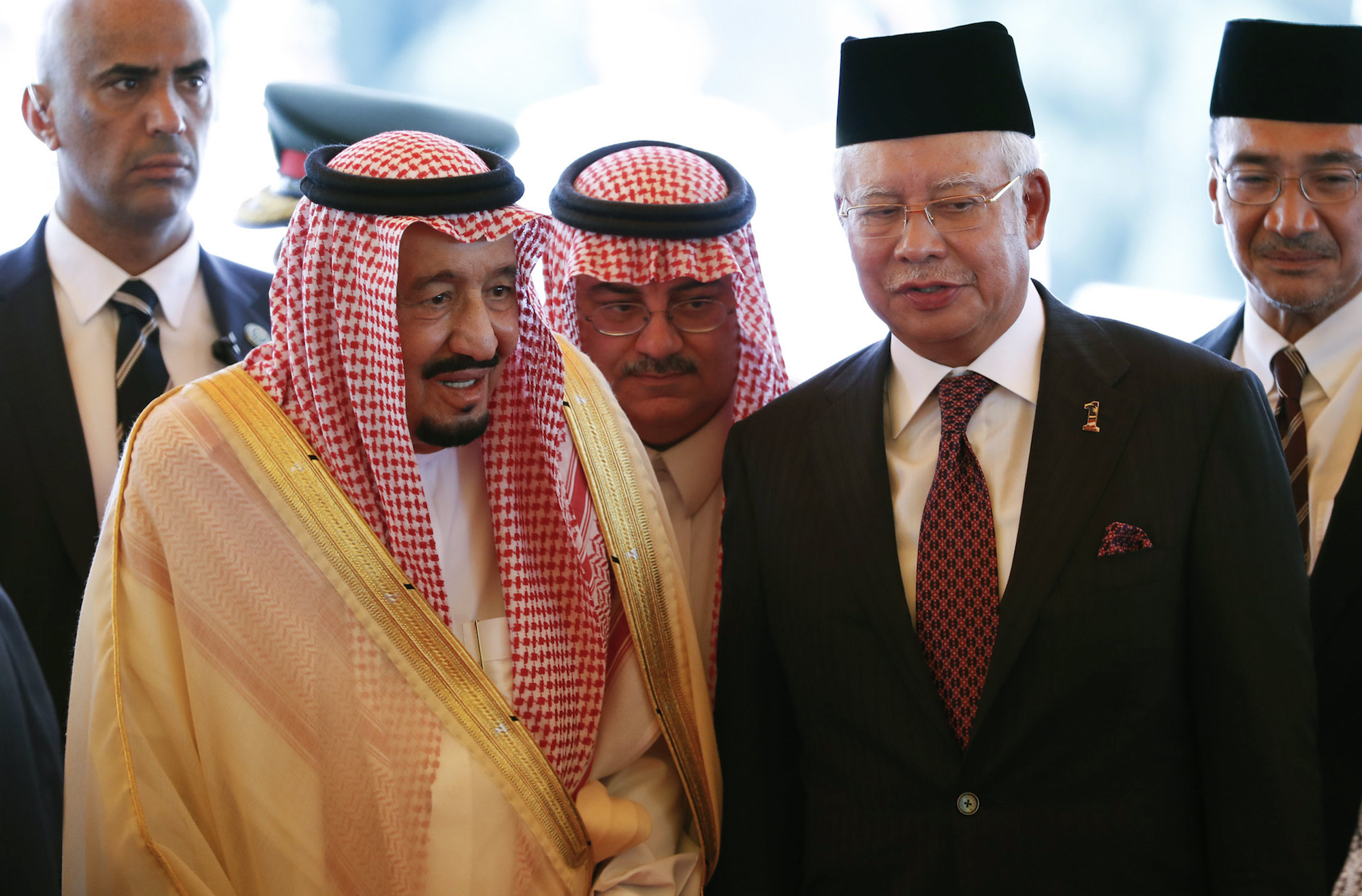
'Saudi Arabia's King Salman, left, stands next to Malaysian Prime Minister Najib Razak during a welcoming ceremony in Kuala Lumpur, Malaysia, Feb. 26. (AP Photo/Vincent Thian)'
Saudi Arabia’s King Salman bin Abdulaziz is on the first leg of an unprecedented trip to several key countries in East Asia, including Malaysia, Indonesia, Brunei, China, Japan, and the Maldives. This will be the first time a Saudi monarch has been to Japan, one of the world’s most important industrial powers and economies, and he will be the first to visit Indonesia, the world’s most populous Muslim country, since the 1970s. But the most multifaceted, significant, and, potentially, far-reaching destination on King Salman’s itinerary will be his visit to Beijing during the third leg of his trip. This East Asia tour, particularly the visit to China, as well as Saudi Arabia’s goals for outreach to Beijing, need to be understood in several broad contexts.
The tour is part of a Saudi regional and international diplomatic offensive on multiple fronts. Having ventured further than ever into the realm of hard power, particularly in Yemen, with, at best, mixed results, Riyadh seems to be seeking to bolster its diplomatic and political outreach, particularly throughout Asia. In this regard, King Salman is also scheduled to attend an Arab League summit in Jordan, at a time when Saudi Arabia and its Gulf Cooperation Council partners will be more firmly in the position of leadership in the Arab world than ever before.
This level of activity indicates major Saudi diplomatic outreach and a considerable expansion of its efforts to build and consolidate ties, particularly in Asia and the Middle East. It is highly significant that the king himself is stepping into the role of chief diplomat, underscoring not only his own hands-on leadership, but also the importance Riyadh attaches to this diplomatic initiative. The marathon diplomacy will be an important demonstration of the king’s personal vitality and functionality as monarch. He is 81-years old, and Saudi officials are continuously denying rumors about his physical health and mental acuity. If he can perform well with this ambitious schedule, such rumors will be squelched for some time. This is particularly important because of concerns regarding succession in the kingdom, and a purported, although officially denied, rivalry between the crown prince and deputy crown prince.
In addition, there are three crucial registers at which the Chinese part of this Saudi diplomatic outreach should be understood.
First, Saudi Arabia is seeking to strengthen strategic ties with China – including weapons sales, military and intelligence cooperation, and diplomatic coordination – in recognition of growing Chinese influence globally and in several key regions of Saudi interest. Saudi Arabia’s efforts to diversify its support base and weapons supply chain have gained steam, given the perceived U.S. pullback from Middle East engagement; Washington’s differences with Saudi Arabia over Iran, Syria, and other issues; and the controversial 2016 Justice Against Sponsors of Terrorism Act that permits Americans to sue foreign governments, particularly that of Saudi Arabia, and officials over alleged responsibility for terrorist acts. China has already expressed a willingness to intensify military ties and defense cooperation with Saudi Arabia, including signing a five-year plan for Saudi-Chinese security cooperation and joint military drills.
Second, Saudi Arabia will be making the case that it, and not Iran, is China’s optimal partner in the Gulf region. Given China’s long-standing close relations with Iran, this will be a tall order, and it’s likely that Saudi Arabia doesn’t believe that Beijing can be truly separated from Tehran in any decisive sense, at least not yet. But the Saudis will be trying to emphasize what they can offer to China in the region. To that end they will primarily point to the U.S. Commerce Department’s imposition of a $1.19 billion fine against China’s largest telecom equipment manufacturer, ZTE, for violating sanctions against Iran and North Korea, and another U.S. investigation of a second Chinese telecom producer, as evidence of the risks of betting too much on Iran when Tehran is subject to major international sanctions because of its destabilizing activities in the Middle East. China has maintained some distance from Iran recently, most notably by rejecting Tehran’s bid to join the Beijing-led multilateral security group, the Shanghai Cooperation Organization, in June 2016.
The Saudis will make the case that China ultimately benefits from stability in Southwest Asia, and in global trade and oil markets, and strongly argue that Riyadh, not Tehran, pursues policies that promote these Chinese goals. They will add that they can be helpful in China’s relations with Pakistan, and its goals in Afghanistan and other parts of Central Asia, and in containing the threat from radical Islamists among China’s own Uyghur population. James Dorsey argues that Iran, ultimately, has much more to offer China’s policy goals, particularly its infrastructure project in Eurasia, than Saudi Arabia. However, if its Middle East regional ambitions remain largely commercial, or even, like Russia’s, strategic but limited, Beijing could end up with strong relations with both Riyadh and Tehran. The first meeting in Beijing in August 2016 of a senior-level Saudi-Chinese Joint Committee to enhance bilateral cooperation in a range of sectors, co-chaired by Deputy Crown Prince Mohammed bin Salman and Vice Premier Zhang Gaoli, set the stage for close ties and will be a key basis for progress during the king’s visit.
China may not have to choose the way a strictly Middle Eastern power, or the pre-eminent global power, the United States, must between Iran and Saudi Arabia. It can, in effect, have both. And since Iran already has close ties to China, Saudi Arabia would be adding itself to the mix, even if it cannot subtract Iran. This would certainly be a gain for Riyadh, if not a loss for Tehran. Moreover, the Saudis understand that wooing China away from Iran is, perforce, a long-term prospect, and therefore this trip is framed as an important step in the right direction (assuming it goes well).
Third, China is a major market for Saudi energy exports, and commercial ties and investments will be an important feature of every stop on the king’s Asian tour. In China there are the added military and strategic dimensions that feature more strongly in that leg of the trip than others, many of which are largely economic, commercial, diplomatic, and cultural.
King Salman’s visit to Beijing is in many ways the most complex, and potentially meaningful, part of the whole trip. If it is as successful as Saudis hope, it could prove historic. But even if it doesn’t meet those ambitious goals, it could still be an important milestone in Saudi outreach to China and the rest of East Asia.
The views represented herein are the author's or speaker's own and do not necessarily reflect the views of AGSI, its staff, or its board of directors.
The significance of Kuwait’s defense pact with Pakistan lies less in any immediate military transformation than in what it reveals about the evolving security landscape of the Gulf.
President Trump has led the United States into an impossible dilemma in which resuming and intensifying the war presents one set of alarming consequences while ending it under current circumstances offers at least as many disasters for Washington.
The Trump administration has positioned the United States at a crossroads between a new regime of containment against Iran or a historic drawdown of U.S. influence in the Gulf and broader Middle East.
Riyadh and Abu Dhabi urged President Trump not to attack Iran, but now that the war is into its second month, leaving the current situation in place would be an unthinkable fiasco for them.
Though they were unsuccessful in preventing the current conflict, and, as expected, have been dragged into the U.S.-Israeli confrontation with Iran, Gulf Arab countries remain crucial to hopes for limiting the war and bringing it to a quick resolution.