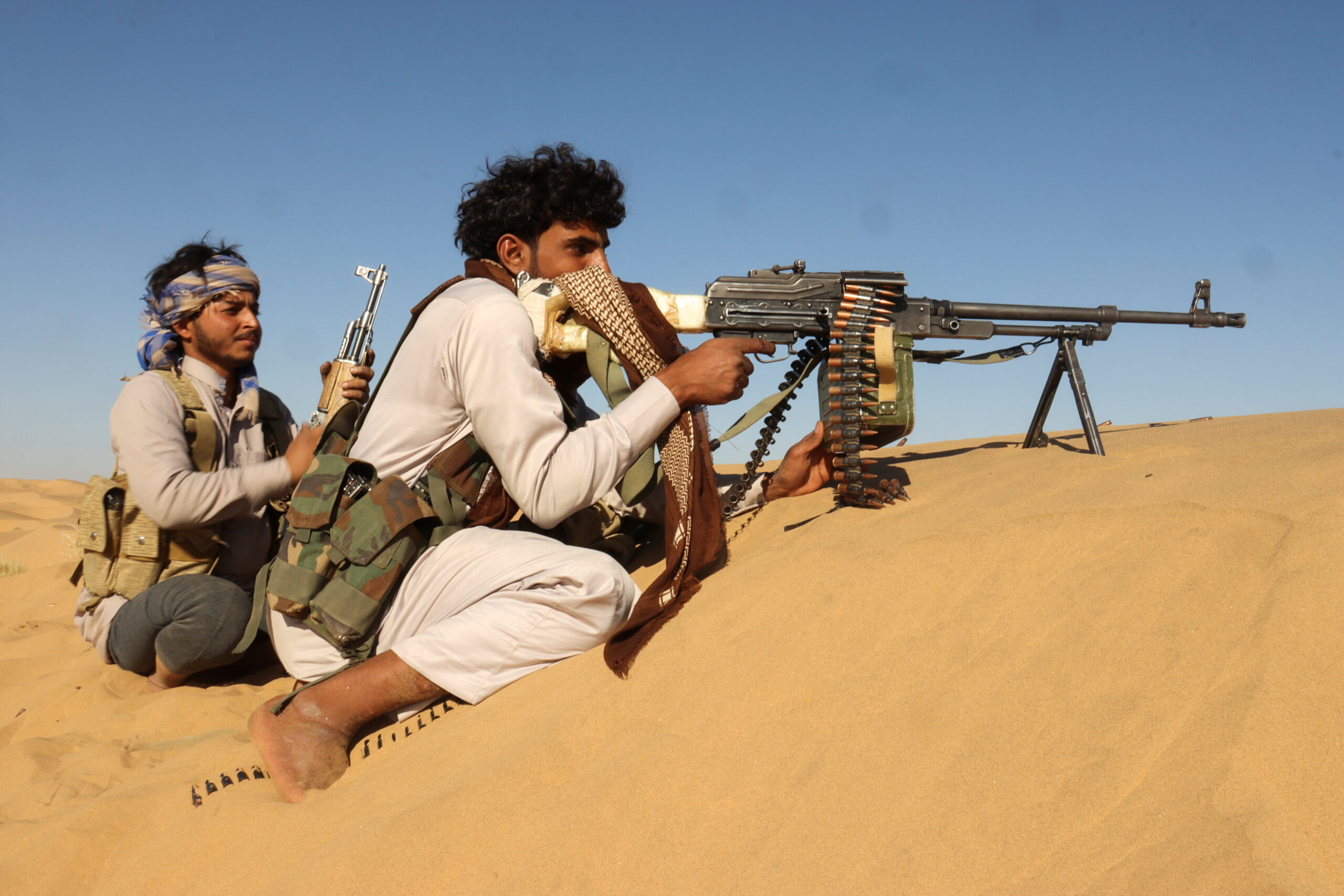
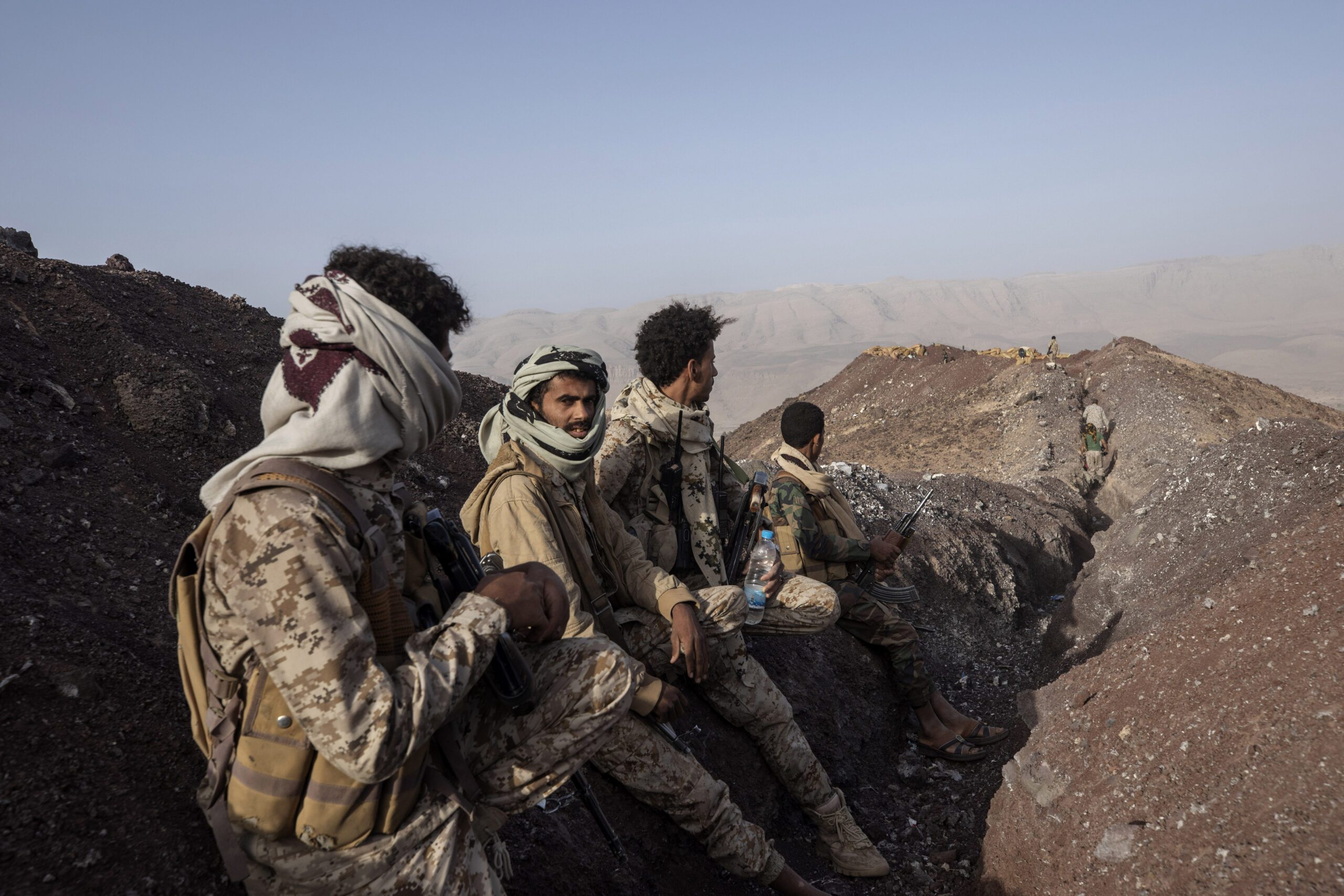
Pro-government tribal fighters take position in a desert area southeast of Marib, Yemen, December 6, 2021. (REUTERS/Ali Owidha)
In mid-December 2021, the Houthis made an unusual request. The group, which controls Sanaa and much of Yemen’s northern highlands, asked Saudi Arabia’s permission to allow Iran’s ambassador to the Houthis to fly home. Initially, Saudi officials, who control the airspace over Yemen, viewed the request as an attempt by the Houthis to distance themselves from Iran.
Over the course of the 7-year war in Yemen, Iran and the Houthis have developed an increasingly close relationship. Iran smuggles weapons to the Houthis and provides them with military advisors, while the Houthis weaken Saudi Arabia and occasionally provide cover and deniability for Iranian actions. Perhaps most notably, the Houthis took credit for the September 2019 missile and drone attacks on oil installations in Saudi Arabia. The United States later released a report incriminating Iran in the attacks.
Iran was also the first country to recognize the Houthis as a government in northern Yemen, and, in August 2019, the Houthis named an ambassador to Tehran. Iran reciprocated months later, naming Hassan Irloo its ambassador to Houthi-controlled Yemen. Irloo, a member of the Islamic Revolutionary Guard Corps, was smuggled into Yemen in October 2020 and subsequently sanctioned by the United States. During his time in Sanaa, Irloo maintained a prominent public profile, often appearing alongside Houthi leaders at key events. Irloo reportedly also played a role in shaping the Houthis’ military strategy within Yemen.
This, the thinking went, became a problem for the Houthis. Although many outsiders, particularly Western analysts, see the Houthis as an Iranian proxy, the Houthis do not see themselves this way. The Houthis see themselves as a sovereign state – Iran’s ally not its proxy.
The perception that Irloo was calling the shots also created domestic difficulties for the Houthis. The Houthi leadership, which is Zaydi Shia and doctrinally distinct from the Twelver Shiism practiced in Iran, is not a monolithic bloc. There are strongly pro-Iranian members within the Houthi leadership, but there are also members who are more ambivalent, pointing to the costs of Iranian support.
The Houthi movement was originally formed to preserve traditional Zaydi theology in Yemen and could just as easily be eradicated by Twelver Shiism as by the type of generic Sunnism that was being supported by the Yemeni state in the 1990s. Indeed, there are already signs that traditional Zaydism is being eroded in areas under Houthi control. For instance, in September 2019, shortly after the Houthis named an ambassador to Iran, they also instituted a public celebration of the Twelver Shia festival Ashura. The festival had never been celebrated in Yemen even under the Zaydi imams.
One regional official told The Wall Street Journal that Irloo had become a “political problem” for the Houthis. But as the Saudis were debating the wisdom of granting the Houthis’ request, the Houthis informed them that Irloo was suffering from the coronavirus and that if Saudi Arabia allowed him to leave the country the Houthis would not replace him with “a new Iranian diplomat.”
Saudi Arabia eventually worked out a compromise, allowing an Iraqi medevac flight to fly Irloo back to Tehran. A few days after, on December 21, 2021, Irloo died from what Iranian officials said were complications from the coronavirus.
Although Iran initially said it would appoint another ambassador to Yemen, it later named Abdul Reza Shahlai, another IRGC official already in Yemen, as Irloo’s replacement. Like Irloo, Shahlai is under U.S. sanctions and is also tied to the 2011 assassination plot against the Saudi ambassador to the United States. Shahlai escaped a U.S. drone strike in January 2020 that targeted him in Yemen the same day the United States killed the head of the IRGC Quds Force, Major General Qassim Suleimani, in Iraq.
There are two ways to read Shahlai’s appointment. If the narrative of a split between the Houthis and Iran is true, then it is notable that Shahlai will not be given a diplomatic title, and by selecting an official already in Yemen, Iran honored the Houthi commitment to Saudi Arabia not to bring in a “new diplomat.” Alternatively, the shift in the military landscape in Yemen since Irloo’s death could have convinced Iran of the value of having a seasoned commander in charge on the ground.
In early January, as Iran commemorated Irloo’s life, units of the United Arab Emirates-backed Giants Brigades moved into the southern Yemeni governorate of Shabwa. The Giants Brigades, established in 2016, had been based on the Red Sea coast for much of the war. But as Houthi advances into northern Shabwa in late 2021 threatened to split the south, cutting Aden off from Hadramout and giving the Houthis another outlet to sea, the Giants Brigades redeployed.
Within a matter of days, the Giants Brigades had pushed the Houthis out of the three districts they had seized in northern Shabwa as well as areas of southern Marib governorate. Currently, the Houthis are on the defensive in Marib in a way they haven’t been in over a year. Should the Giants Brigades succeed in pushing the Houthis back in Marib it would change the direction of the war and give negotiators an opportunity to press the Houthis to compromise.
For the Houthis, of course, Marib and particularly the governorate’s oil and gas fields are essential. In order to have an economic base for a future independent state, the Houthis need to control, at least, Marib if not also the oil and gas fields in Shabwa and Hadramout.
If the Houthis believe their military offensive in Marib is in danger, they will likely look to the only real ally they have, Iran. The more threatened the Houthis feel on the battlefield the more sway Iran will have over them, regardless of what divisions existed a month ago.
The views represented herein are the author's or speaker's own and do not necessarily reflect the views of AGSI, its staff, or its board of directors.
Over the year, there were some small steps forward on Yemen. But as diplomatic efforts continue in 2022, there will still be no quick fix to end the war.
UAE, Saudi, and affiliated local forces have begun withdrawing from locations across southern and western Yemen; while couched as “redeployments,” together the moves suggest the Saudi-led coalition is actively looking for an exit strategy.
Rival camps within the Islamic Republic are increasingly turning to YouTube for policy debate, but there is a limit to the regime’s tolerance for that debate.
After U.S.-Israeli strikes killed Supreme Leader Ayatollah Ali Khamenei on February 28, Iran’s collective leadership has concluded that the best defense is a good offense.