The Supply-Side Politics of Kuwait’s Industrial Strategy
Kuwait hopes to usher in a “new industrial era,” but the country will have to pay more attention to demand and regional competition to boost industrial output.
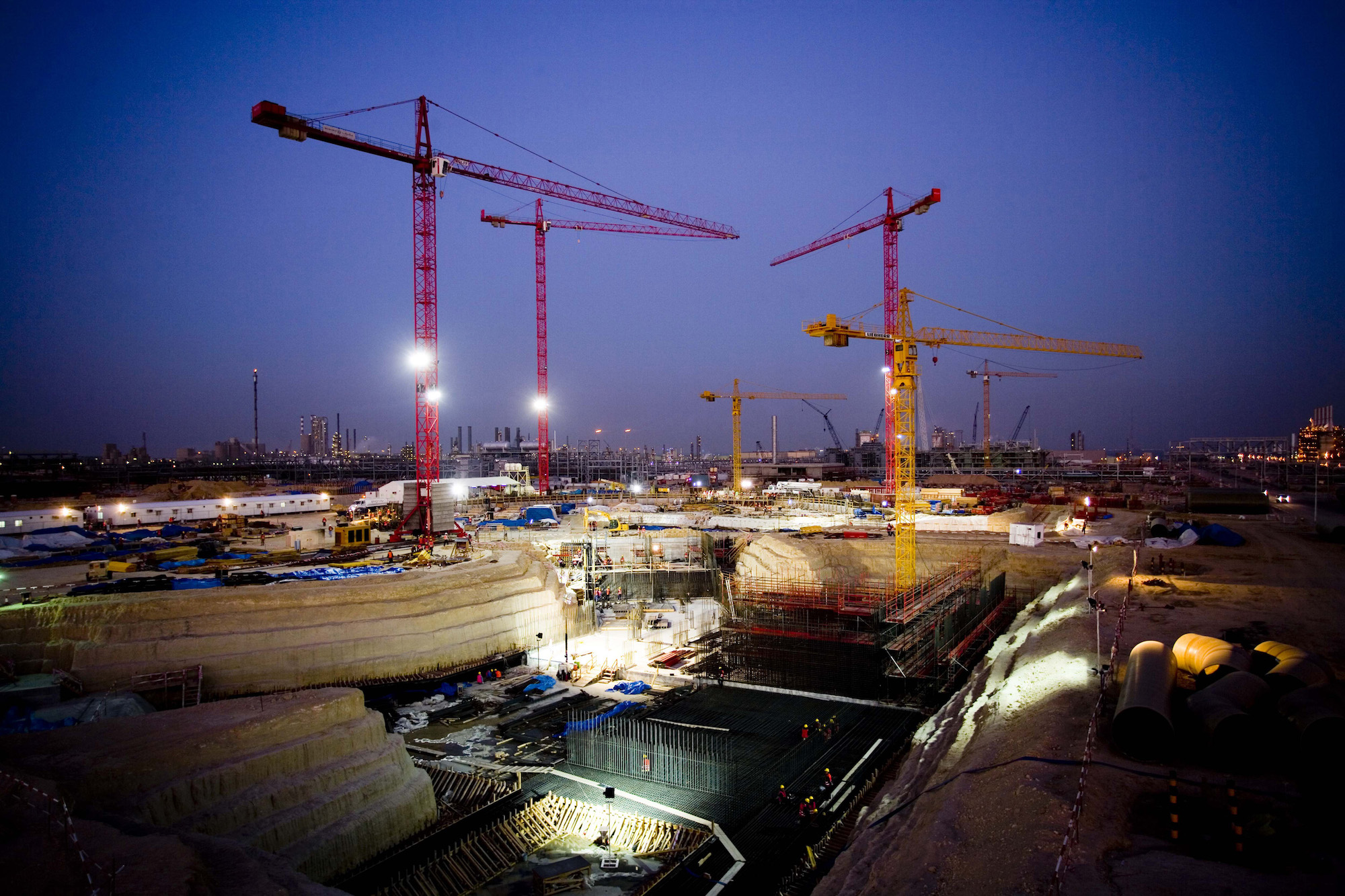
Construction site in Shuaiba, Kuwait (Fluor/Wikimedia Commons)
On October 2, Kuwaiti Minister of Commerce and Industry Khaled al-Roudhan announced plans to distribute 700 industrial units in Kuwait’s Al-Salmi and Al-Shadadiya industrial cities – increasing the country’s available industrial plots by 50 percent. According to the minister, the initiative will augment the state budget, create jobs for 2,000 Kuwaiti citizens, and usher in a “new industrial era in the country.” However, increasing the supply of industrial real estate alone is unlikely to overhaul Kuwait’s industrial sector. Economic policymakers in Kuwait must instead afford greater attention to demand-side factors and the effects of regional competition in order to reinvigorate the country’s industrial activity.
The distribution of industrial units aligns with broader government efforts to diversify the country’s economy away from hydrocarbon resources – oil revenue constitutes approximately 78 percent of the state budget. A drop in global oil prices created a record deficit of $40.2 billion in 2016-17, thereby accelerating the perceived urgency of diversification initiatives and encouraging the relaunch of a New Kuwait Vision 2035. The vision aims to transform Kuwait into a competitive financial and commercial hub and simultaneously shift the country’s dependence away from hydrocarbon resources and toward other strategic sectors. As of 2016, the industrial sector contributed 9 percent to Kuwait’s gross domestic product and officials from the Public Authority for Industry hope to boost this industrial output by 25 percent in the coming years.
Governmental objectives and public sector policies, however, do not always drive private sector demand. Although the Al-Salmi industrial city initially launched in 2011 as an environmental initiative to relocate industrial activity outside Kuwait’s main urban areas, the current utilization of industrial plots in Al-Salmi and Al-Shadadiya reflects a supply-side distribution of state-owned resources to the private sector. In return, the government will expect private sector actors to assume greater responsibility for economic diversification processes and the employment of Kuwaiti citizens. This responsibility includes a hefty price tag – investors must possess at least $825,000 worth of capital investments to qualify for one of the newly available industrial plots.
Yet foreign direct investment trends in Kuwait indicate that global demand for local projects remains low. From 2016-17, FDI inflows decreased from $419 million to $301 million, whereas FDI outflows increased drastically from $4.5 billion to $8.1 billion. Kuwait ranked the lowest among Gulf Cooperation Council countries for greenfield FDI projects – when a company builds operations in a country from the ground up – between 2013 and 2018. Only 71 greenfield FDI projects emerged in Kuwait, whereas the United Arab Emirates attracted 1,582 greenfield FDI projects during the same period.
Where demand does exist for industrial plots, the government must ensure that investors engage in productive economic activities rather than rent-seeking behavior. An Oxford Business Group report from 2013 notes that as many as 4,000 requests for industrial units were registered and pending approval. Moreover, the market value for industrial plots varies considerably across Kuwait’s governorates. The industrial cities of Al-Salmi and Al-Shadadiya are located in the governorates of Al-Jahra and Farwaniya, respectively. The average price of a square meter of industrial land in Al-Jahra is approximately $1,316, while the average price in Farwaniya reached nearly $5,267. This could lead to a scenario wherein local investors speculate on industrial real estate rather than promote genuine industrial development.
Bahrain has encountered similar issues concerning commercial real estate speculation: Persistent land shortages and expensive land reclamation projects encouraged investors to purchase industrial plots without intending to commence industrial operations. This practice – known locally as land banking – forced the Bahraini Minister of Industry and Commerce to decree that if companies in industrial areas did not begin operations within two years upon receiving licenses, the government could reclaim the land.
Once investors secure industrial plots and launch operations in Kuwait, they must contend with Kuwaitization regulations – a government-led labor policy to increase the number of Kuwaiti citizens in the national workforce. While the manufacturing and agriculture sectors possess minimal quotas stipulating that 3 percent of a firm’s workforce be Kuwaiti citizens, the petrochemical and refining sectors remain much higher at 30 percent. The government expects the petrochemical sector in particular to lead much of the industrial expansion and forecasts that Kuwait’s petrochemical output will increase by 39 percent between 2014 and 2019. Yet in Dubai, nearly half of the emirate’s industrial areas are situated within free zones where there are no limitations on foreign labor, representing a substantial commercial advantage for industrial firms located in Dubai.
Kuwait confronts broader economic competition from other GCC states seeking to boost their industrial capacities. In August, King Salman bin Abdulaziz increased the capital funding for the Saudi Industrial Development Fund by approximately $6.7 billion. The Saudi Industrial Property Authority – created by the Saudi government in 2001 to oversee the development of industrial cities – manages 3,380 productive factories and a total workforce of 500,000 employees. Dubai’s 2021 plan also includes the Dubai Industrial Strategy 2030, which seeks to transform the emirate into “an international hub for knowledge-based, innovation and sustainable industrial activity.” The industrial sector currently constitutes between 11 and 14 percent of Dubai’s GDP, and the emirate aims to continue growth in this segment of its economy.
Initiating a new industrial era in Kuwait would entail wide-ranging improvements to the country’s investment climate, the right incentive structure to encourage genuine industrial development, and commercial policies that position Kuwait as a competitive hub for industry within the region. Increasing the supply of available industrial plots is a useful but nevertheless merely initial step in the country’s long march toward industrial progress.
The views represented herein are the author's or speaker's own and do not necessarily reflect the views of AGSI, its staff, or its board of directors.
An updated economic program and new regulatory framework reveal Oman’s focus on generating in-country value associated with promising economic development areas.
Gulf producers have raised billions of dollars by selling stakes in pipeline revenue while retaining ownership and operational control. But what happens when the pipelines stop working?
An updated economic program and new regulatory framework reveal Oman’s focus on generating in-country value associated with promising economic development areas.
Beijing keeps treading carefully around conflict in the Middle East while seeking opportunities to deepen ties with key country partners through a longer-term regional engagement strategy.
The UAE’s decision to halt trade and commercial ties with Iran reflects an exercise in applying carefully calibrated geoeconomic pressure amid an uncertain and evolving geopolitical context.