Tougher Sanctions on Iran May Help Other OPEC+ Producers
The global oil market will be challenging for OPEC+ members in 2025, although the likelihood of tougher sanctions on Iranian oil exports under the Trump administration may create space for production increases by other OPEC+ members.
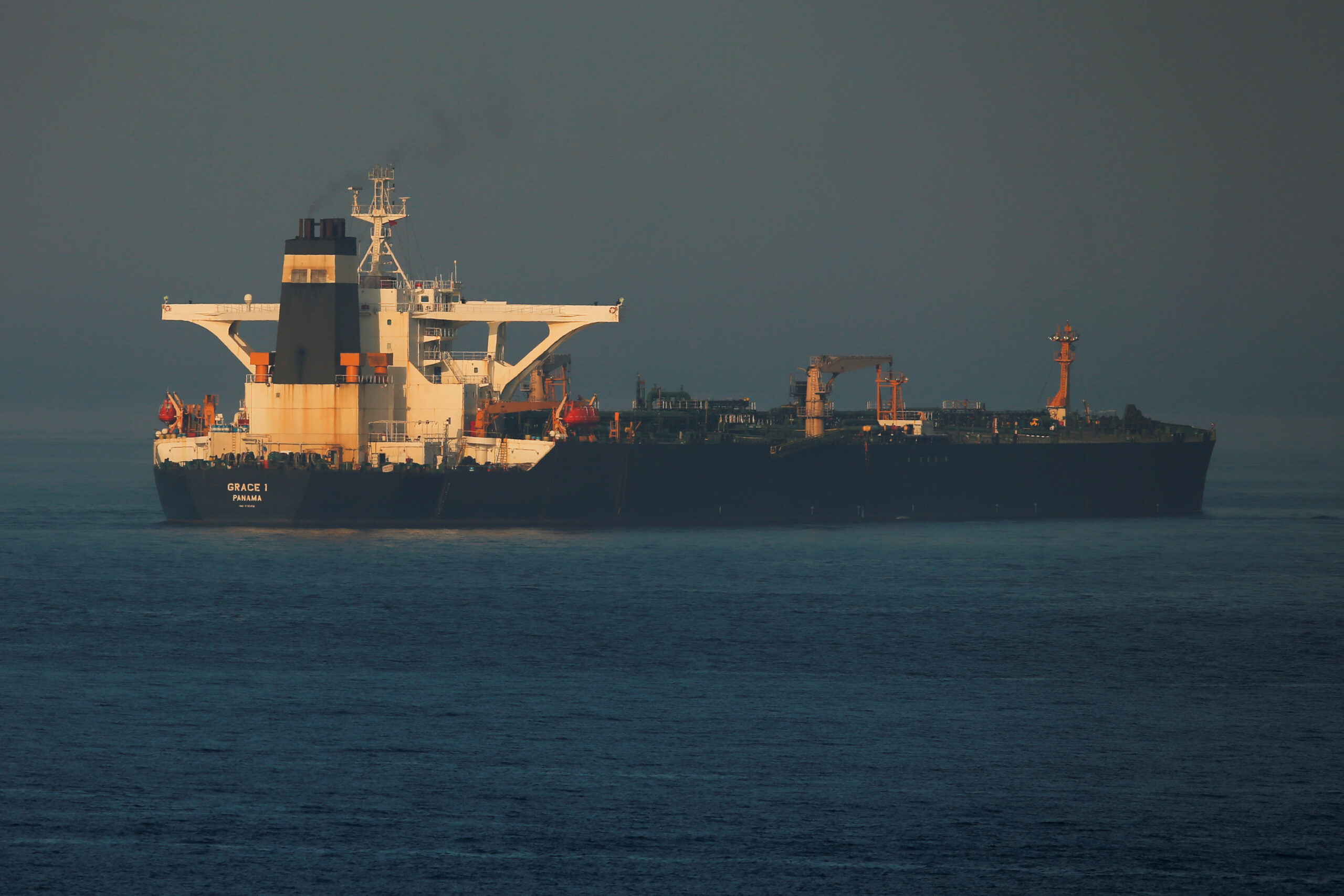
'Iranian oil tanker Grace 1 sits anchored after it was seized by British Royal Marines off the coast of the British Mediterranean territory on suspicion of violating sanctions against Syria, in the Strait of Gibraltar, Spain August 13, 2019. (REUTERS/Jon Nazca)'
The biannual ministerial meeting of OPEC+ is scheduled for December 1. The meeting will assess the current state of the global oil market and decide on the group’s production plans for 2025. Against the backdrop of weaker growth in global oil demand and the continued expansion of supply from countries outside the OPEC+ alliance, the group faces some difficult decisions. OPEC+ has already delayed its plans to reverse some of the production cuts it made during 2023 until January 2025, but the oil market outlook is not encouraging for the alliance’s production plans. The likelihood that the administration of President-elect Donald J. Trump will tighten sanctions on Iranian oil exports when it takes office on January 20, however, may create some room for other producers in the OPEC+ alliance to increase their production levels as the year progresses.
Oil Market Outlook
While there are significant uncertainties, a reasonable baseline is that increased oil supply from non-OPEC+ producers will continue to meet or outstrip growth in global oil demand in 2025. The International Energy Agency and U.S. Energy Information Administration both project that non-OPEC+ production will increase by 1.5 million barrels per day in 2025 and that global oil demand will grow by 1 mb/d (IEA) or 1.2 mb/d (EIA). OPEC has a more optimistic outlook, projecting global oil demand growth of 1.5 mb/d against a non-OPEC+ supply increase of 1.2 mb/d.
Even OPEC’s more optimistic projections suggest there will be little room for OPEC+ to increase production in 2025 without risking a drop in oil prices from their current $70 to $75 per barrel range. OPEC+ has undertaken a series of production cuts in recent years. The most recent were in November 2023 when eight member countries (the OPEC+ 8 – Algeria, Iraq, Kuwait, Kazakhstan, Oman, Russia, Saudi Arabia, and the United Arab Emirates) announced additional production cuts of 2.2 mb/d on top of earlier cuts made in April 2023 and November 2022. The alliance subsequently announced that the last round of cuts would be gradually unwound starting in October. However, this unwinding has now been delayed until January 2025, although it is unlikely that the market will be able to absorb significant additional OPEC+ supply without a sharp downward price adjustment.
Tighter Sanctions on Iranian Oil Exports
The calculus of the oil market could change if the Trump administration returns to a “maximum pressure” campaign on Iran when it takes office. What this would exactly entail is not clear, but it would certainly involve a tightening of sanctions on Iranian oil exports. In November 2018, the first Trump administration reimposed the sanctions on Iran that had been lifted under the 2015 Joint Comprehensive Plan of Action nuclear deal. These sanctions, however, have increasingly been circumvented in recent years, and Iran’s oil production, exports, and revenue have all increased. It should be noted that Iran is not subject to the OPEC+ production agreements.
According to the EIA’s October 2024 “Report on Iranian Petroleum and Petroleum Product Exports,” Iranian oil exports fell from 2 mb/d in 2018 to around 400,000 b/d in 2019 but rebounded to around 1.4 mb/d to 1.6 mb/d in 2023. Similarly, Iran’s oil export revenue fell from $65 billion in 2018 to $16 billion in 2020 but recovered to $53 billion in 2023. Estimates from other sources suggest that Iranian oil exports reached 1.8 mb/d in September 2024, before dropping in October ahead of Israel’s retaliatory strikes on the country. Much of this oil makes its way to China through transshipment hubs in Malaysia, Oman, and the UAE. OPEC’s “Monthly Oil Market Report” shows a similar path for Iranian oil production – after declining from 3.6 mb/d in 2018 to 2 mb/d in 2020, production had recovered to 3.3 mb/d by the third quarter of 2024.
Tighter sanctions that reduce the flow of Iranian oil exports would have an important impact on the global oil market. If Iranian oil exports fell to their 2019 level (the 2020 level may not be a realistic base given the impact of the coronavirus pandemic that year), this could remove around 1 mb/d from global oil supply. In particular, China would need to find new sources of supply. Saudi Arabia, which has lost export market share in the Chinse market in recent years, would be particularly well-placed to step in.
Heightened Uncertainty
Tougher sanctions on Iranian oil exports could create room for the OPEC+ 8 to increase their production in 2025. However, renewed U.S. pressure on Iran or a green light from the U.S. administration for an Israeli attack on Iranian oil facilities could escalate regional conflict and would carry risks for the oil market. Diplomatic efforts have prompted a thawing of relations between Iran and the Gulf countries, but Iran or its regional proxies could still respond to actions by the United States or Israel by attacking oil facilities in the region or by disrupting shipping. Both would negatively affect Gulf oil exports and cause a spike in oil prices (the overall impact on oil revenue is unclear).
Beyond the region, the Trump administration’s policies to promote U.S. oil and gas production, impose tariffs on a wide range of imported goods, deport unauthorized immigrants, and cut taxes could all affect the global oil market, although there is uncertainty about the effect of the totality of these policies. Trump’s “drill, baby, drill” mantra is likely to see an easing of the regulations governing the U.S. oil and gas industry, although to what extend and over what period this policy would lead to higher U.S. oil and gas production is unclear. Trade, immigration, and fiscal policies will affect growth in the United States and the global economy. Higher tariffs, particularly if met by retaliatory actions by major trading partners, will likely lead to a slowing in U.S. and global growth and higher inflation with implications for the path of U.S. monetary policy. Further, while tax cuts should boost growth in the near term, less immigrant labor will reduce potential economic growth in the United States. In sum, Trump’s economic policies create uncertainties for U.S. and global growth, which will ultimately impact the global demand for oil.
Bottom Line for Saudi Arabia and the Gulf
In the absence of sanctions on Iran, the scope for other OPEC+ members to increase oil production in 2025 is likely to be limited. Iranian sanctions would change the equation, creating the scope for production increases. With Saudi Arabia set to return 1 mb/d to the market under the OPEC+ plan over the next year, the kingdom would be a major beneficiary if the production increases can move forward. The UAE would also be a major beneficiary as it has been permitted to produce an additional 300,000 barrels a day above what the country cut in November 2023 in recognition of its investment in capacity expansion.
While the UAE is much less in need of the additional oil revenue than Saudi Arabia, an increase in oil production would boost real growth in both countries. For Saudi Arabia, the 2025 Pre-Budget Statement forecast economic growth of 4.6% in the kingdom next year. This will only be achievable with a substantial increase in oil production. Further, higher oil revenue is needed to finance the spending plans of the government and Public Investment Fund on Vision 2030 projects. While it is undoubtedly the case that a lasting peace in the Middle East would provide a significant boost to growth in Saudi Arabia and the region, in the absence of this, sanctions on Iran would provide some support to the kingdom’s economic plans.
The views represented herein are the author's or speaker's own and do not necessarily reflect the views of AGSI, its staff, or its board of directors.
The outcome of the U.S. presidential election is unlikely to have a major impact on the Saudi economy in 2025, but policy differences between the two candidates could have longer-term implications for the kingdom.
Saudi equity prices have risen since the start of the Iran conflict, outperforming many regional and global markets. Whether this continues will depend on how and when the conflict ends.
The conflict with Iran has curtailed the supply of oil from the Gulf, pushing up the price of the medium and heavier grades it usually exports relative to lighter grades.
With young Saudis continuing to enter their working age years in large numbers, robust employment gains need to continue, but slower non-oil growth may present a challenge.
On January 8, AGSI hosted a virtual roundtable with its leadership and scholars as they look ahead and assess trends likely to shape the Gulf region and U.S. foreign policy during the coming year.