The Iran War and the Gulf’s Clean Energy Ambitions
The conflict has turned renewables into security assets at home, and rendered them far more expensive to build out, while Gulf states send clean energy capital abroad.
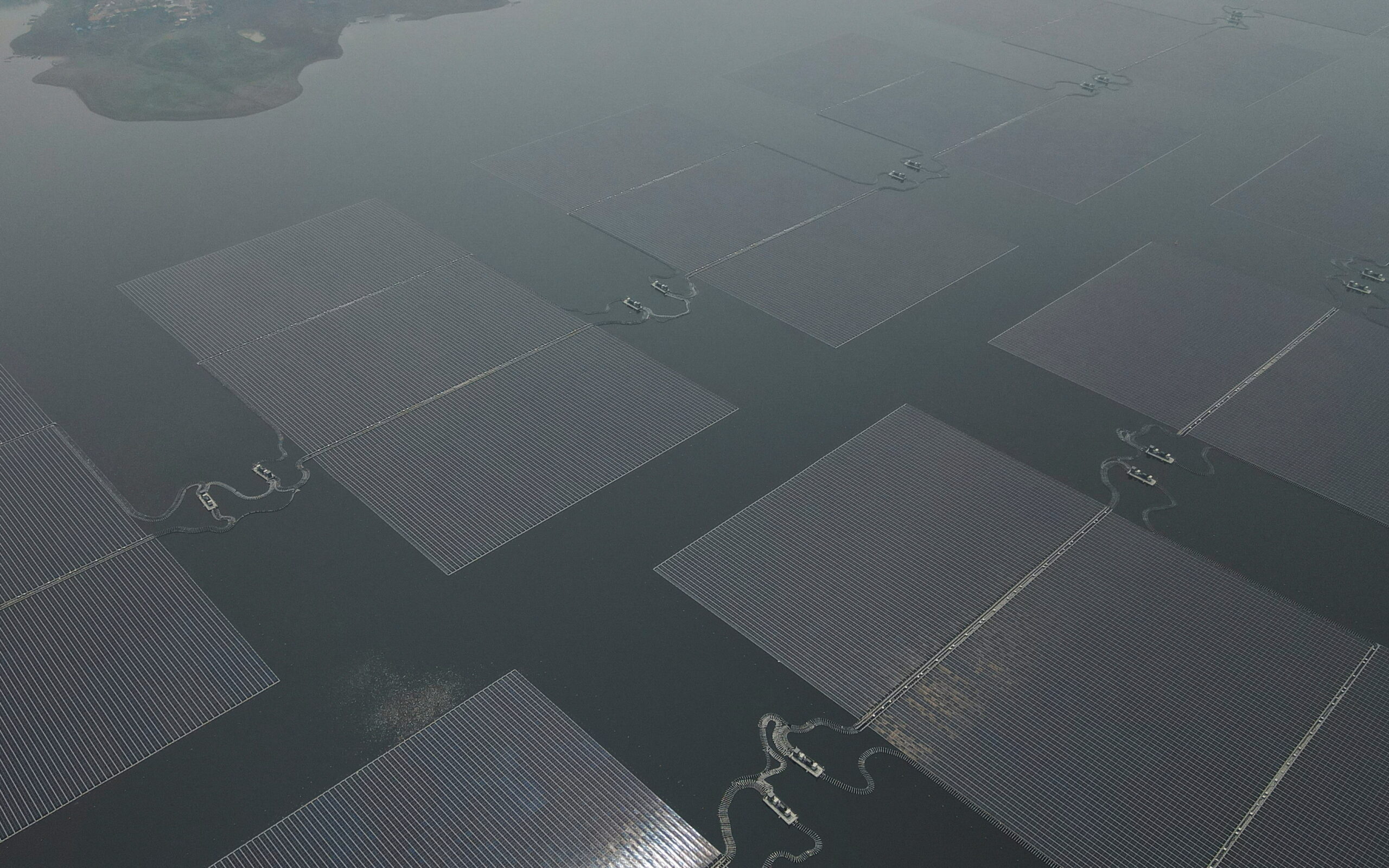
A view shows solar panels of the 192 megawatt peak floating solar power plant built on Cirata dam, developed by PLN Nusantara Power, a unit of Indonesia's state utility company Perusahaan Listrik Negara and United Arab Emirates renewable energy company Masdar, a unit of Mubadala Investment Company, in Purwakarta, West Java province, Indonesia, November 9, 2023. (REUTERS/Willy Kurniawan)
In mid-July, four and a half months into what has been reported as the largest supply disruption in the history of the oil market, Abu Dhabi’s Masdar closed a $5 billion financing package for a 5.2-gigawatt solar plant and a 19-GW-hour battery system, raised from 13 banks across the United Arab Emirates, France, the United Kingdom, Germany, China, and Japan. The strait that carries one-fifth of the world’s oil remained shut. Iranian drones were striking energy infrastructure across the region. And the Gulf’s flagship clean energy company was closing one of the year’s biggest renewable deals, with every asset involved outside the war zone.
The war is redrawing the Gulf energy investment landscape, but it has not halted the region’s clean energy ambitions so much as split them into two tracks moving in opposite directions. At home, renewables have been promoted from an element of diversification into a security asset, precisely as the physical and fiscal conditions for building them have deteriorated. Abroad, Gulf capital is accelerating into clean energy assets in Asia and Europe.
Solar as Strategic Depth
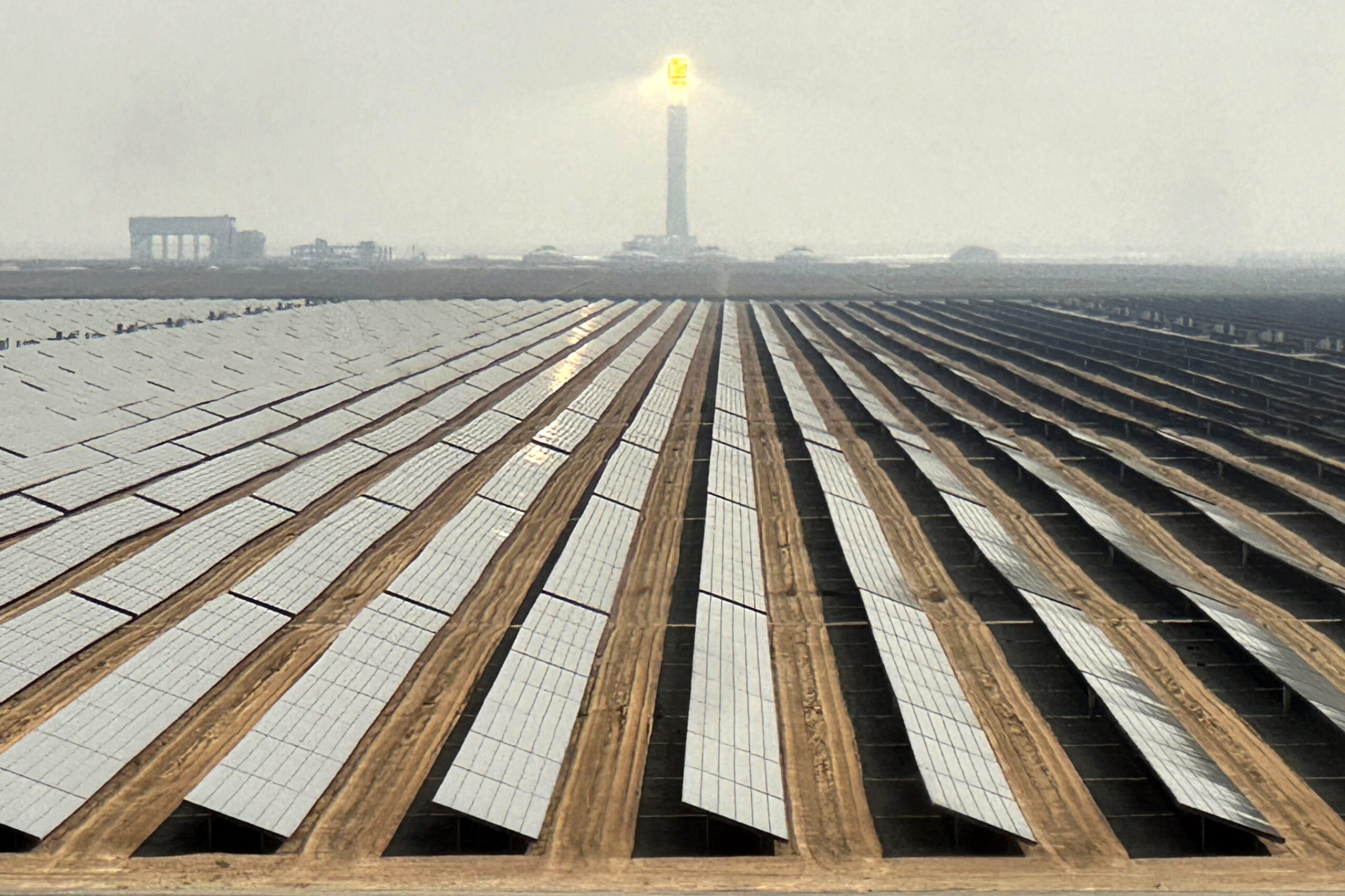
The dynamics of that redrawn energy landscape are evident most prominently in Saudi Arabia and the UAE. Saudi Aramco switched crude exports to Yanbu on the Red Sea at the start of the war and ramped up flows through the East-West pipeline, while Abu Dhabi kept Murban crude moving through Fujairah. Saudi Arabia and the UAE were the only Gulf producers to have invested – years earlier – in routes around the strait. The war has converted those earlier pipeline investments from routine redundancy and export-route diversification efforts into security imperatives. A similar reassessment is underway with renewables. Domestic solar, storage, and grid interconnection, for example, now serve the same strategic purpose. A solar plant in Hail or a battery park in Bisha provide strategic depth: Electricity generated inside national borders does not transit the Strait of Hormuz, cannot be blockaded, and frees up natural gas that would otherwise be burned in power plants for industrial use or exportation.
For a decade, renewables were sold under Saudi Vision 2030 and the UAE’s successive energy strategies as diversification, a growth story about jobs, localization, and insulation from oil cycles. Six months of Iranian missile and drone attacks across the region have recast them as resilience infrastructure, closer in function to strategic storage or a redundant export route than to an economic development program.
A Buildout Under Fire
But there is a problem: This strategic depth in renewables infrastructure has to be shipped in before it can be built. The Gulf makes almost none of the equipment its clean energy program depends on: Panels, inverters, and battery cells all arrive by sea, overwhelmingly from China. Once a plant is running, nothing can interdict the sunlight it burns. But everything it is made of has to cross an ocean first.
The war strengthened the strategic case for renewables but at the same time disrupted the shipping of equipment needed to build clean energy infrastructure. Cargo bound for Jebel Ali, Dammam, and Jubail has to clear the Strait of Hormuz. Beyond the chokepoint, war-risk premiums and carriers pulling tonnage out of the region have made any voyage into the Gulf more expensive and harder to book, which is why even Omani ports south of the strait went quiet.
The import figures are telling. Rystad Energy data shows Gulf solar module imports, critical for continuing the buildout of solar farms, collapsed in March: The UAE’s fell to 160 megawatts from 767 MW a month earlier, Saudi Arabia’s dropped from 704 MW to 80 MW, and Oman recorded none. Shipping a standard container from Shanghai to the Gulf cost $980 before the war and $4,131 by mid-May, according to Clarksons Research, above even the coronavirus pandemic-era peak. Rystad estimates a net delay of three to 12 months across the region’s active renewables pipeline, with projects in procurement likely to be restructured or deferred into 2027. The kingdom can tender GW-scale solar capacity at record-low prices, but it cannot tender its way around a quadrupled freight rate and a supply chain that runs through a conflict zone.
Saudi Arabia’s National Renewable Energy Program entered 2026 with its most ambitious calendar yet. Qualified bidders for the seventh tender round, covering 3.1 GW of solar and 2.2 GW of wind capacity, were announced January 7 as part of the drive to generate 50% of the kingdom’s electricity from renewables by 2030. Oman signed a contract in May for a 770-MW round-the-clock wind, solar, and storage project in the same quarter its module imports registered zero.
Now, however, the scale of these renewables ambitions seems unrealistic, given the levels of economic and infrastructure damage. Qatar’s minister of energy has put the annual revenue cost of damage to the Ras Laffan gas liquefaction trains at up to $20 billion, with repairs expected to take three to five years. Goldman Sachs projected in March that Saudi Arabia and the UAE could see gross domestic product contract by 3% to 5% in 2026 if the conflict persisted. Curtailed export revenue is colliding with higher defense and reconstruction bills, which means, to provide one compact example, investments in grid batteries and air defense batteries are competing for the same fiscal space. Domestic renewables procurement will feel that competition.
Petrodollars Into Electrons
Abroad, the picture inverts. The Masdar-TotalEnergies venture, headquartered in Abu Dhabi Global Market, combines 3 GW of operating assets with 6 GW in advanced development. It also extends Masdar’s push toward a 100-GW global portfolio by 2030, a target it is already two-thirds of the way to meeting after deploying $15 billion in 2025 alone. Mubadala invested $325 million in Hornsea 3, the North Sea offshore wind project slated to become the world’s largest on completion, alongside positions in renewables platforms from central Europe to the United States. And Global SWF data shows Saudi Arabia’s Public Investment Fund, Mubadala, and Qatar Investment Authority together deployed close to $25 billion in fresh capital in the first quarter of 2026, despite active conflict over one-third of that period, with clean energy prominent.
In the 1970s, Gulf oil surpluses were recycled into U.S. Treasuries and Western bank deposits, a flow that reshaped global finance and bound producer and consumer economies together. Today, a growing share of Gulf surplus capital is being recycled into operating clean energy assets in Asia and Europe: wind farms, solar platforms, and storage portfolios that earn revenue entirely outside the Strait of Hormuz chokepoint. The deployment has changed from paper claims on Western governments to hard infrastructure in third markets.
What Survives the Cease-Fire
Three questions follow. The first is whether the security framing survives peace. A reopened strait would restore export revenue and ease the squeeze. Insurance markets, project financiers, and utility planners will price this precedent long after tankers move again. That strengthens the long-term strategic case for domestic renewables.
The second is whether outbound deployment comes at the expense of domestic targets. Capital is fungible; institutional bandwidth and contractor capacity are not. Every sovereign dollar committed to an Abu Dhabi-headquartered Asian platform is a dollar not underwriting domestic project finance at a moment when private developers face repriced insurance and hesitant lenders. If the pattern persists, the Gulf could arrive at 2030 with world-class clean energy portfolios abroad and delayed programs at home, an inversion of the sequencing Vision 2030 imagined.
The third is what the pattern signals to Washington. Hedging chokepoint risk through foreign clean energy portfolios, rather than through domestic capacity alone, is a quiet vote of limited confidence in any security architecture for the Gulf itself. U.S. policymakers still tend to measure the war’s damage in oil price terms and view Gulf states as producers rather than energy transition partners with global portfolios. The direction of Gulf clean energy capital suggests those governments are planning for a world in which the strait can close again and their energy relevance is secured as much by what they own abroad as what they pump at home.
The war has not ended the Gulf’s clean energy ambitions; it has split them. The domestic track is strategically elevated but physically and fiscally constrained, while the external track is accelerating. How long the divergence lasts will be determined less by any cease-fire than by whether Gulf governments treat domestic clean energy as the security asset they now say it is and fund it accordingly. Until then, the most revealing indicator of Gulf energy strategy will not be found in any vision document. It will be found in where the next $2.2 billion is deployed.
The views represented herein are the author's or speaker's own and do not necessarily reflect the views of AGSI, its staff, or its board of directors.
As hostile actors recognize the vulnerability of critical water infrastructure, recognizing water as a national security priority is the first step toward resilience.
The Iran conflict has arrived at the worst possible moment for Gulf sustainable finance, a sector already navigating fiscal strain, a global ESG backlash, and the unresolved tension between hydrocarbon revenue and transition capital.
Despite billions of dollars in infrastructure damage and economic loss, Gulf sovereign wealth funds are still investing in clean energy projects as a pathway to resilience.
The Iran conflict has arrived at the worst possible moment for Gulf sustainable finance, a sector already navigating fiscal strain, a global ESG backlash, and the unresolved tension between hydrocarbon revenue and transition capital.
The Gulf is defying global trends and investing in sustainable-labeled projects, and if those labels translate to real guidelines, the region could become a global benchmark for transition finance.
Gulf insurers can embed environmental resilience, social safeguards, and governance rigor into underwriting to strengthen local markets and align with the expectations of global investors increasingly focused on ESG.