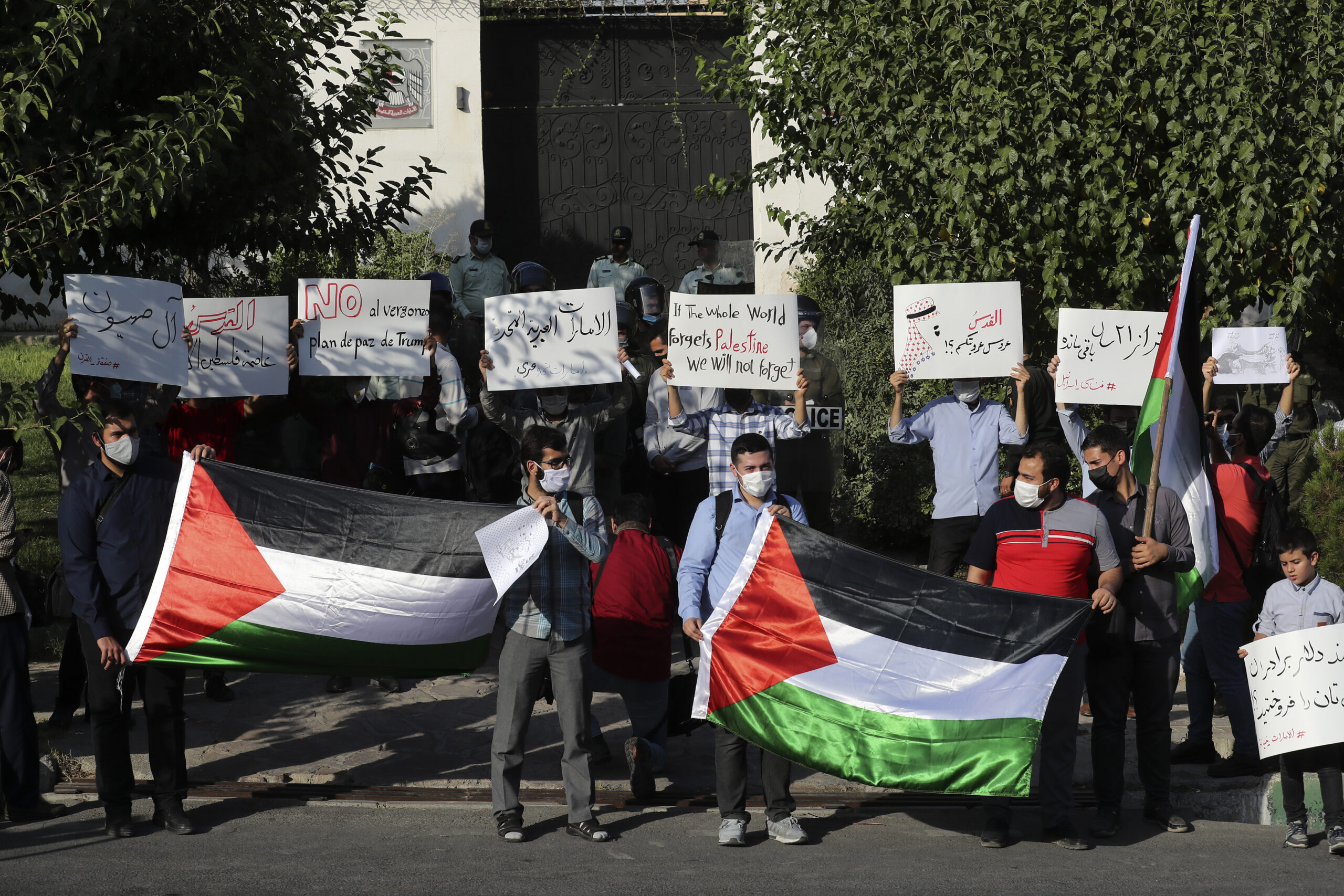
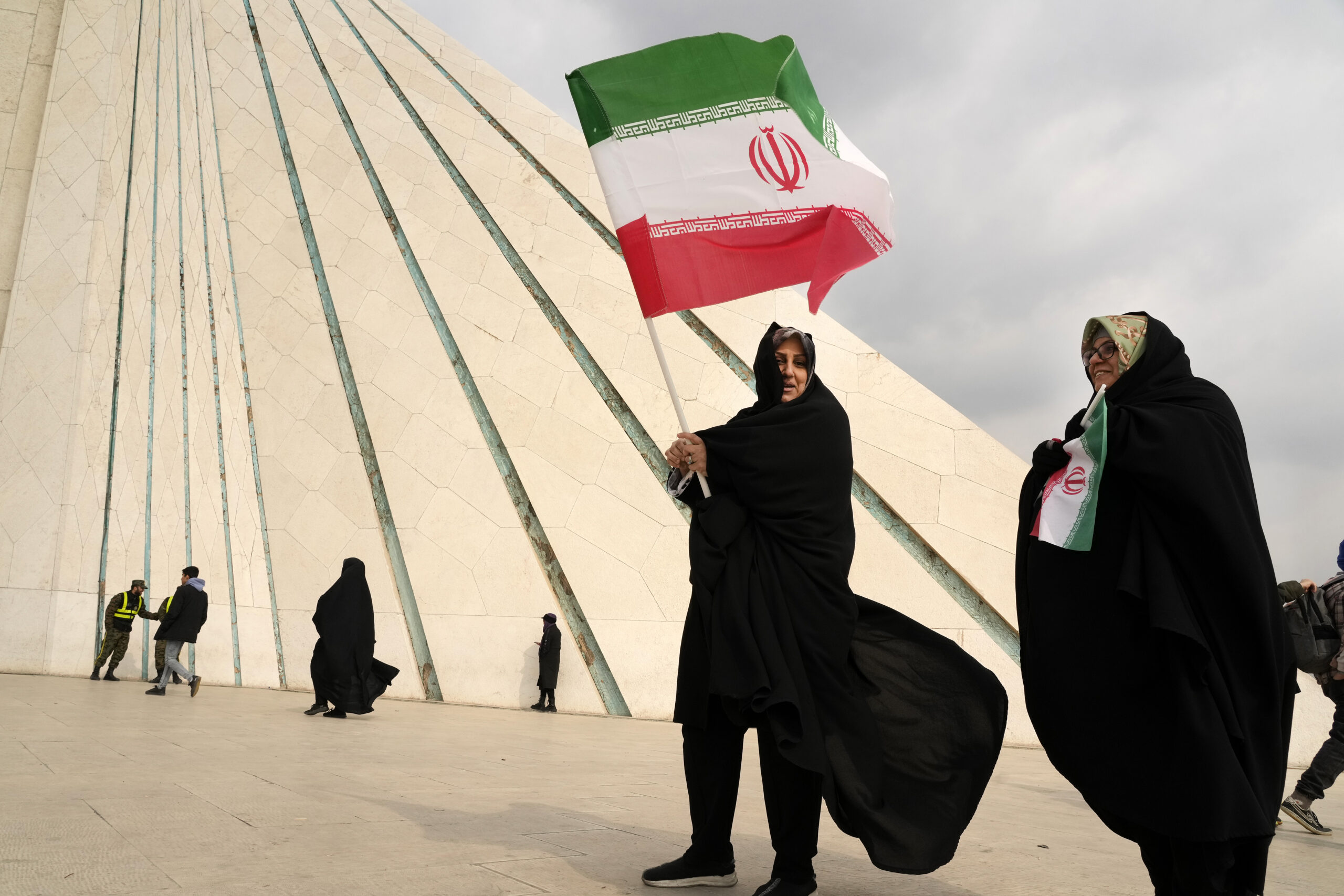
A group of protesters hold placards against Israel and the United Arab Emirates while holding Palestinian flags during a gathering outside the UAE Embassy in Tehran, Iran to condemn the UAE's deal with Israel to open up diplomatic relations, Aug. 15. (AP Photo/Ebrahim Noroozi)
Iranian political and military leaders, and state-censored media, reacted angrily to the news of a U.S.-brokered landmark agreement between the United Arab Emirates and Israel. However, neither the agreement itself nor the prospects of other Arab states normalizing relations with Israel represent a seismic shift in regional power equations as they merely formalize preexisting alignments. However, the anger may in part reflect the Islamic Republic’s trepidation about the prospects for an increased Israeli presence in Iran’s immediate neighborhood. But the Islamic Republic has yet to realize taking such a posture toward its Arab neighbors further encourages them to align with Iran’s adversaries.
“Strongly condemning” the agreement and describing it as “a strategic folly” and “backstabbing of the Palestinians,” the Iranian Foreign Ministry took the lead in the regime’s verbal cannonade against the UAE. In its August 15 statement, the ministry warned against “any intervention of the Zionist regime in regional equations” for which Iran would “hold the Emirati government and its allies responsible.” Additionally, it referenced “rulers residing in their glass palaces,” echoing Kayhan newspaper’s November 5, 2017 and Hezbollah Secretary General Hassan Nasrallah’s September 20, 2019 threats against Saudi Arabia and the UAE.
President Hassan Rouhani, addressing the national headquarters for the fight against the coronavirus, also commented on the agreement, saying he found it “deplorable” and wondered why “an Islamic country, for the sake of pleasing the ruler of a country facing elections in a few months, did such a thing.” Rouhani added: “The rulers of the Emirates should know they are mistaken if they think they can buy security by getting closer to the enemies of Islam and Iran.” He more bluntly warned: “If they want to open the path to Israel’s presence in the region, they [the UAE] will be dealt with in a different manner.”
The Islamic Revolutionary Guard Corps issued an official statement condemning the “treacherous deed” of Abu Dhabi, which it claimed aims at “legitimizing the Zionist regime, weakening the front of Palestinian resistance, and marginalizing the Quds [Jerusalem] and Palestine issue.” The IRGC claimed the agreement reduces the UAE to an “Israeli colony,” and predicted “popular uprisings” against the country’s rulers, or “the dwellers of glass palaces.” On August 16, IRGC Major General Mohammad Baqeri, chief of staff of the armed forces, repeated the threats against the UAE: “Should anything happen in the Persian Gulf region that threatens the national security of the Islamic Republic of Iran … we will not tolerate it and will hold the United Arab Emirates to account for it.”
State-censored media followed the lead of Iranian officials. Kayhan, mouthpiece of Supreme Leader Ayatollah Ali Khamenei, took the threats against the UAE one step further under the headline: “Emirates has made itself a legitimate target for the resistance,” in reference to Tehran’s regional allies, and specifically referred to the Iraqi Kataib Hezbollah militia’s threats against the UAE. The pro-IRGC Javan daily condemned the agreement as “treason and folly,” suggested that other Arab states are “waiting in line to normalize relations with Israel,” and found some consolation in Turkey’s opposition to the deal.
Media outlets close to what is usually referred to as the reformist camp chose a more analytical approach in their coverage of the agreement. Etemad columnist Sara Masoumi noted: “In regional issues ranging from Syria to Yemen, the Emirates tried to weaken Iran … but fearing a direct confrontation with Tehran, managed those crises.” She also warned how Israel skillfully managed to depict Iran as the main enemy of the Arab states and predicted other Arab states would follow the UAE’s example. Arman-e Melli daily quoted political analyst Ali Bigdeli, who pointed out that “Palestine is no longer an issue” in the Arab world, and warned “the resistance” is likely to face greater challenges as more Arab states normalize relations with Israel, and the Islamic Republic’s attempts at improving relations with the Arab world are more or less “canceled.” Sharq, the most intellectual among reformist newspapers, did not cover the agreement.
The Islamic Republic has probably realized it is no longer capable of weaponizing the Palestinian cause against Israel and is concerned about the prospect of a sustained Israeli presence in the Gulf region. But it has yet to realize what former parliamentarian Ali Motahari expressed in his August 15 tweet: “Apart from treachery of the Emirates, we too are to blame. We frightened the Arabs into the arms of Israel.”
The normalization of relations between the UAE and Israel is rooted in numerous factors, only one of which is to counterbalance the Islamic Republic. But as long as the regime in Tehran is perceived as a threat to its Arab neighbors, it should expect them to act accordingly, and Tehran’s angry reactions are not likely to prove helpful for the regime in this regard.
The views represented herein are the author's or speaker's own and do not necessarily reflect the views of AGSI, its staff, or its board of directors.
Palestinians are fuming, but the United States, the United Arab Emirates, and Israel all see clear benefits in the normalization of relations between a key Arab state and Israel.
Despite Iranians’ contempt for the U.S. “maximum pressure” campaign, many see the regime as the main source of the country’s economic and social problems.
Iran may still call itself an Islamic Republic. In practice, however, it increasingly resembles a state in which the military governs from behind clerical robes.
Ayatollah Ali Khamenei was killed in his office in Tehran at age 86, leaving behind a country in ruins and on the verge of civil war and potential disintegration.
Iran is signaling that it will not absorb attacks passively. But whether this strategy ensures the regime’s survival, seals its fate, or accelerates a broader catastrophe will shape the region for years to come.
The erosion of the regime’s legitimacy across broad segments of society, combined with the breadth of the 2025-26 protest coalition, raises the possibility that a new confrontation could trigger renewed anti-regime mobilization.
On January 8, AGSI hosted a virtual roundtable with its leadership and scholars as they look ahead and assess trends likely to shape the Gulf region and U.S. foreign policy during the coming year.