For SME Growth, Gulf Countries Need Supportive Ecosystems
Small and medium enterprises are central to Gulf diversification efforts, but strong, well-integrated support systems, including national small business administrations and public credit guarantee schemes, are needed to help them thrive.
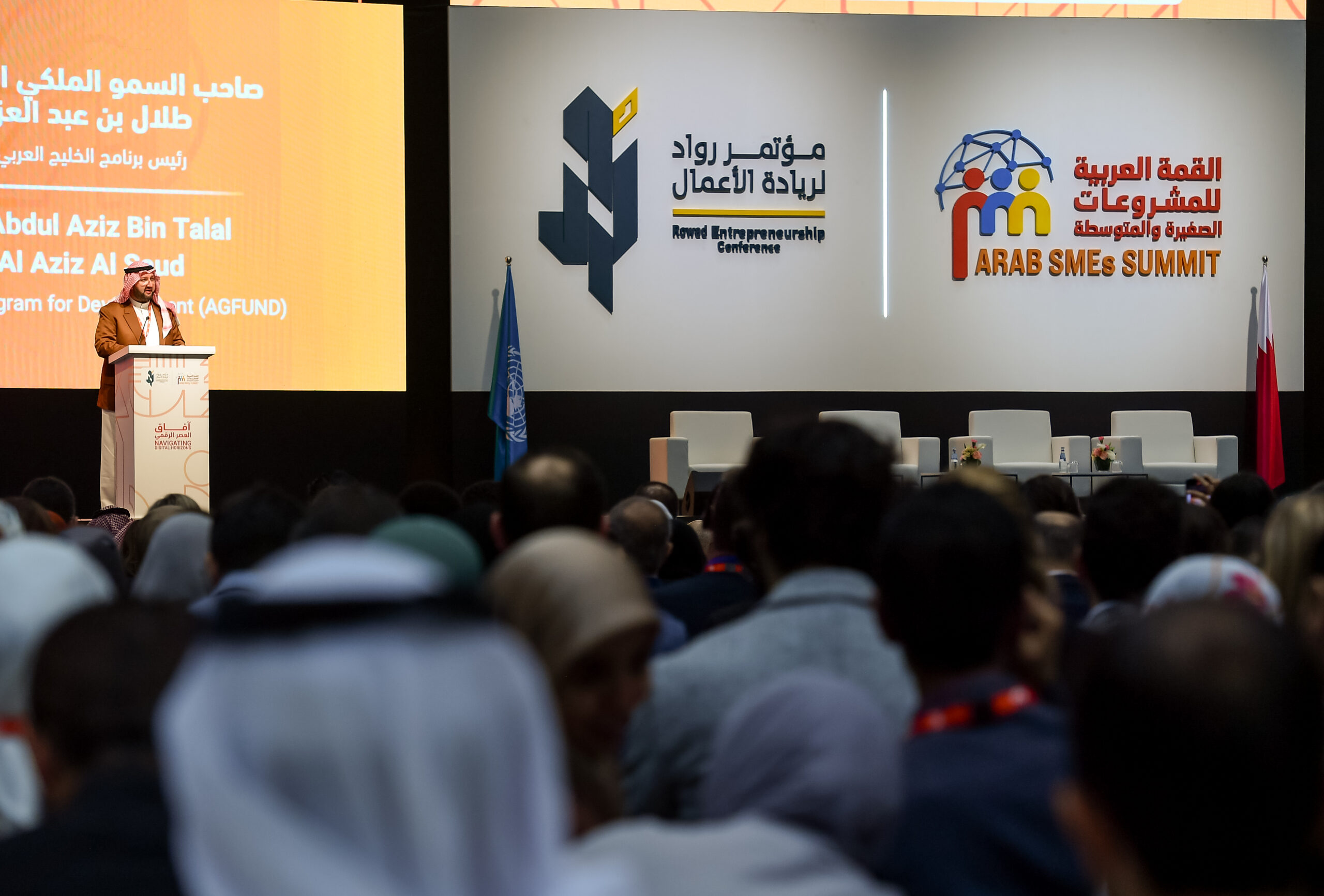
Prince Abdulaziz bin Talal, chairman of the Arab Gulf Program for Development, delivers a speech during the opening ceremony of the ROWAD Entrepreneurship Conference and the Arab SMEs Summit 2024 in Doha, Qatar, November 18, 2024. (Photo by Noushad Thekkayil/NurPhoto)
Small and medium enterprises are at the center of national development and diversification strategies for Gulf Cooperation Council countries, yet their potential is constrained by fragmented public support systems and limited financing options. SMEs have to deal with different ministries and agencies. And in the United Arab Emirates, the relevant agencies are emirate specific, such as SME Dubai. Digitalization also took time. In Qatar, for example, the funding gate Tamkeen was only established in November 2025, and the portal Reyada was launched in January 2026.
This has resulted in a lack of available financing. Global management consulting firm Kearney estimated an SME financing gap – the volume of viable SME credit demand that remains unmet or underserved by the financial system – of more than $250 billion. Kearney found that SMEs were receiving less than 5% of total bank lending, despite employing over three-quarters of the region’s workforce. This undercapitalization of the sector represents a critical obstacle to Gulf states’ aspirations to foster a vibrant private sector capable of driving non-oil growth and knowledge-based sustainable development.
In the GCC states, the absence of well-resourced and effective small business administrations has resulted in limited access to finance, weak registrars of commercial assets, fragmented or suboptimal public credit guarantee schemes, and inadequate dispute settlement mechanisms outside courts. This, in turn, is impeding SME development.
The Absence of a Well-Resourced Small Business Administration
All GCC countries have established some level of public support for SMEs, but the systems are fragmented. Saudi Monshaat was established in 2016 to foster an entrepreneurial mindset, diversify financial support for businesses, stimulate venture capital initiatives, and help enterprises conduct operations in areas including administration, technology, finance, marketing, and human resources. The Qatar Development Bank offers a variety of support services to SMEs from accounting and bookkeeping services to preseed investment and seed funding to tech financing. Bahrain’s Tamkeen helps SMEs access finance opportunities, including a focus on SMEs run by women entrepreneurs, through dedicated programs such as “Riyadat” in collaboration with the Supreme Council for Women and Bahrain Development Bank. Oman’s SME development authority, Riyada, has launched an array of initiatives in partnership with Oman Development Bank to enhance SMEs’ access to finance. In addition, the Future Fund, launched in 2024 by the Oman Investment Authority, is focusing on nonhydrocarbon private sector industries, with 10% of its investments targeting SMEs.
The system is particularly fragmented in the United Arab Emirates. For example, access to support from the Mohammed Bin Rashid Establishment for SME Development, or Dubai SME, is restricted to Dubai-based businesses. Even Khalifa Fund, which has a national reach, is an Abu Dhabi government entity, not a federal government agency, meaning its policies are set by the emirate, and eligibility for market access, resources, mentorship, and enterprise funding is limited to Emirati-owned SMEs. In Kuwait, SME support activities are spread across several government entities, such as the National Fund for SME Development and Industrial Bank of Kuwait, rather than consolidated under a single, coordinated ecosystem.
To address this fragmentation, GCC countries should set up one-stop shop small business administrations. The U.S. small business administration, for example, was established by the U.S. government to allow access to capital through public loan programs, free counseling and low-cost training, enhanced access to federal contracts, and a well-designed credit guarantee scheme. South Korea’s Ministry of SMEs and Startups can also be a benchmark through its tech and innovation support, export promotion, and digital platforms that facilitate access to finance and markets.
The designs of such a small business administration and a public credit guarantee scheme could be a GCC-wide project. Implementation would be entrusted to member countries, similar to the GCC value added tax, for which the overall design and a common rate were decided by the GCC General Secretariat, with implementation issues, such as the issuance of laws and regulations and establishment of national tax administrations, were left to member countries.
Limited Access to Finance
A small business administration could help address the inability of SMEs to borrow funds sufficient to support expansion or unexpected challenges. By the end of 2024, outstanding loans to SMEs were 4.7% of total banking loans in Bahrain, 2.9% in Oman, and 4% in the UAE, well below the 8% average in the Middle East and North Africa region, 18% in middle-income countries, and 22% in high-income countries. This is mainly due to a high rejection rate of SME loan applications, around 50% to 70%, compared to 20% in OECD countries.
Several factors explain high bank rejection of SMEs in the GCC states, namely: inadequate bookkeeping and financial statements with outdated or incomplete records, insufficient credit reporting data that often fails to meet risk assessment needs, and stringent collateral requirements by lenders of up to 250% of the loan value, which is beyond the capacity of most SMEs. High bank rejection, and therefore limited access to formal credit, forces SMEs to rely on informal or expensive financing. Otherwise, they have to scale down investments, which hinders production, innovation, and job creation.
Inadequate or Absence of Registrars of Commercial Assets
National small business administrations would also strengthen registrars of commercial assets needed to maintain business records and assets. Banks and other financial institutions rely on this information when making decisions about borrowers’ loan applications. Several GCC states have such registrars. For example, the Emirates Movable Collateral Registry in the UAE was established in 2016 as the national registry for security interests over movable assets and was brought under an updated secured transactions framework in 2020. Its functions are now performed by the Emirates Integrated Registries Company, a subsidiary of Emirates Development Bank, which has replaced the former registry. In Saudi Arabia, the Unified Registry of Rights on Movable Assets was set up in 2020, operating under the movable property security law; while the Movable Collateral Registry in Qatar was launched in 2022 under the Qatar Central Securities Depository.
Other GCC countries are lagging. In Kuwait, Law No. 16, established in 2021, mandated the creation of a national movable-asset registry, but it is still pending. Meanwhile, Bahrain’s “Sijilat” portal and the Oman Business Platform allow businesses to handle online commercial registration, business licensing, and various commercial records, but neither qualifies as a national asset registrar.
Limited Public Credit Guarantee Schemes
Public credit guarantee schemes – government programs that guarantee payment to lenders in case of SME default – are common globally: More than half of World Bank member states have such programs. To be effective, however, public credit guarantee schemes need to be well designed to discourage undue risks and provide incentives for SMEs to pay back lenders. Small business administrations can contribute to the proper design of such public credit guarantee schemes.
Such schemes are now central to SME finance in the GCC states, but their design and coverage differ. Saudi Arabia’s Kafalah is the largest: It issued 13.9 billion riyals ($3.7 billion) in loan guarantees in 2024, which benefited 5,346 SMEs, and facilitated 18 billion riyals ($4.8 billion) in bank lending. The UAE’s Emirates Development Bank scheme supported 758 million dirhams ($206 million) in loans through partner banks in 2024. Qatar’s Al-Dhameen, run by Qatar Development Bank, reported 836 million riyals ($229 million) in outstanding guarantees, backing 128 SMEs with coverage up to 100%. And Bahrain’s Tamkeen provides partial guarantees, supporting thousands of firms annually.
Oman lacks a national public credit guarantee scheme, and the International Monetary Fund has urged the country to establish one. Meanwhile in Kuwait, the National Fund acts as a credit guarantee-like scheme but is limited to 500,000 dinars ($153,900), covering 80% of the loan. For larger amounts, banks either provide loans without the National Fund’s guarantee, or they reject the application.
As these examples make clear, there is a range of support in the GCC states for SME growth and development that underscores the lack of a unified approach in ensuring adequate financing for SMEs and at the same time protection against default for the public credit required for this growth and development. Saudi Arabia and Qatar have relatively well-structured public credit guarantee scheme programs, while the UAE programs guarantee only national businesses not foreign-owned businesses. Bahrain operates a hybrid model through Tamkeen, and Oman and Kuwait remain at a transitional stage. This fragmented landscape points to the importance of designing a GCC-wide scheme that harmonizes eligibility criteria, risk sharing, and incentive structures to ensure broader SME coverage and reduce systemic risks.
Also, the scheme would need to determine an optimal credit guarantee ratio (the portion of the loan that is guaranteed to the bank), since too high a ratio would encourage lenders to extend larger amounts of credit than needed, potentially leading to increased defaults, while too low a ratio discourages bank lending. In addition, the credit guarantee scheme itself can be designed to operate countercyclically by temporarily expanding coverage or eligibility during economic downturns, when bank risk aversion rises and credit conditions tighten.
Inappropriate Dispute Settlements Outside Courts
In situations of SMEs’ financial distress, such as severe liquidity shortages or heightened risk of default, resolving debt disputes or initiating restructuring through formal court insolvency proceedings, can prove costly and time consuming for SMEs. For that reason, GCC countries established procedures through entities outside courts, such as the Saudi Center for Commercial Arbitration, which stands out due to its fast case resolution. The UAE boasts of the modern rules and technology offered by the Abu Dhabi International Arbitration Centre, established in February 2024, which settled 43 cases in its first year. And, in Kuwait, the reforms implemented in Law No. 71 of 2020 have introduced debtor rehabilitation, preventive restructuring, and a specialized bankruptcy court.
Meanwhile, the Qatar International Center for Conciliation and Arbitration, an institution under the Qatar Chamber of Commerce, has in recent years modernized its arbitration rules, issuing “Arbitration Rules 2024,” with enhanced electronic filing and expedited procedures for small claims, in line with international best practices. Yet in the realm of insolvency and business rescue, Qatar still relies on Law No. 9 of 2015 on insolvency, which leans toward liquidation rather than restructuring and offers limited mechanisms for entrepreneurs to remain in control during the restructuring period. Finally, in Oman, the Commercial Arbitration Centre applies the Omani Arbitration Law, which is costly, and its decisions cannot be appealed, while the enforceability of foreign awards depends on Omani law and treaty obligations.
A Well-Integrated Support System
Strengthening SME support systems in the GCC requires a strong political commitment to ensure that all the concerned stakeholders review the current support mechanisms and design an integrated system around a well-resourced and effective small business administration.
Since banks cannot assume the financing of SMEs, especially micro and small-sized firms, alternative sources should be provided through institutions, such as microfinance companies, venture capital funds, angel investors, and private equity firms. Regional and international institutions, such as the Arab and International Monetary Funds and the World Bank, can play a crucial role in providing the needed technical support.
In addition, GCC states could strengthen SME support frameworks by establishing a regional early-warning and early-intervention network modeled on Early Warning Europe. Such a system would use basic financial and operational indicators (e.g., declining cash flow, arrears, or deteriorating credit profiles) to identify SMEs at risk of distress at an early stage. Early interventions would then provide targeted advisory services, restructuring support, and temporary liquidity or mediation with creditors. Embedding this mechanism within existing SME agencies and development banks would help preserve viable firms, reduce failure rates, and improve the effectiveness of public SME financing programs.
The views represented herein are the author's or speaker's own and do not necessarily reflect the views of AGSI, its staff, or its board of directors.
Despite billions of dollars in infrastructure damage and economic loss, Gulf sovereign wealth funds are still investing in clean energy projects as a pathway to resilience.
As the Gulf countries transition to a new energy order, creating “good jobs” in high-value export-oriented services that provide citizens with adequate benefits, economic security, and career ladders will help these economies diversify and achieve increased growth.
When transportation insurance withdrew from Gulf waters, it triggered an agricultural supply chain shock whose effects will reach crop yields in South Asia, sub-Saharan Africa, and Latin America within a single growing season.
As the Gulf countries transition to a new energy order, creating “good jobs” in high-value export-oriented services that provide citizens with adequate benefits, economic security, and career ladders will help these economies diversify and achieve increased growth.
Regional sovereign wealth funds are increasingly focusing on sustainability, mobilizing resources for investments in alternative energy projects and demonstrating an alignment with their respective government’s strategy for the energy transition.
As the Gulf countries transition to a new energy order, creating “good jobs” in high-value export-oriented services that provide citizens with adequate benefits, economic security, and career ladders will help these economies diversify and achieve increased growth.
Regional sovereign wealth funds are increasingly focusing on sustainability, mobilizing resources for investments in alternative energy projects and demonstrating an alignment with their respective government’s strategy for the energy transition.
Gulf central banks can increase transparency by adopting credible reform agendas focused on the publication of accurate statistics, disclosure of analysis and forecasting methodology, and forward-looking explanations of policy decisions.