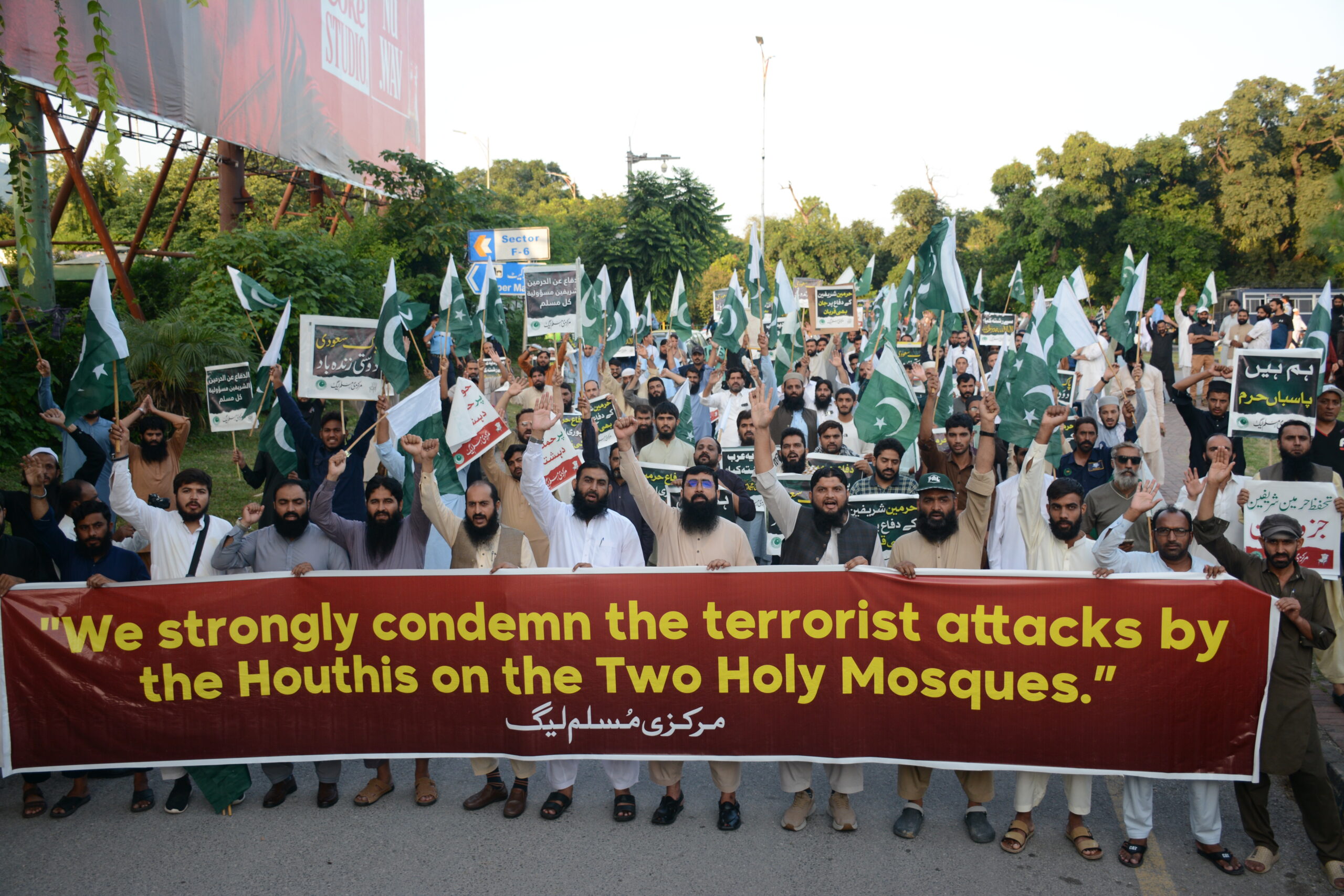
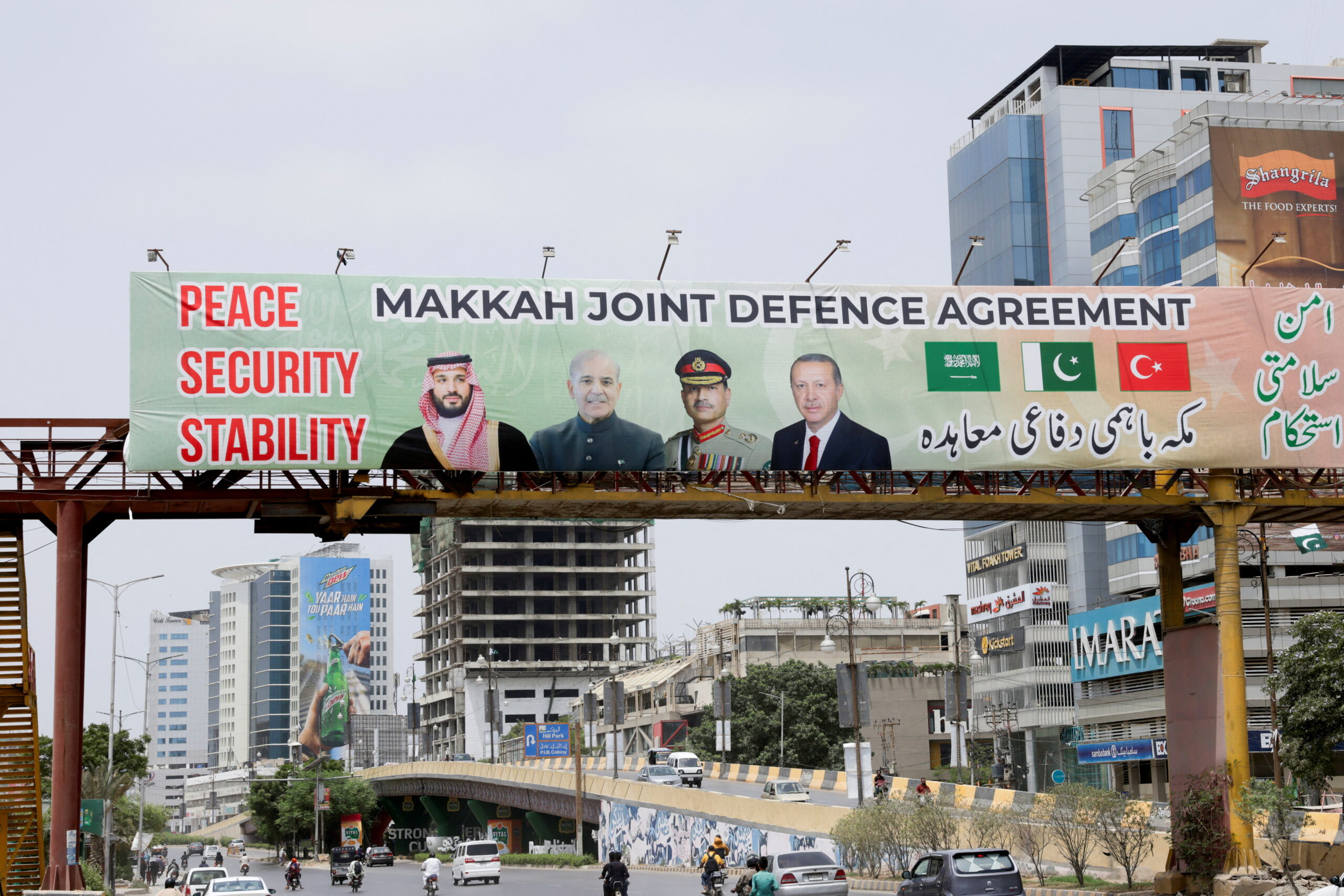
Members of the Pakistan Markazi Muslim League hold national flags during a protest condemning attacks by the Houthis on two mosques in Saudi Arabia, in Islamabad, Pakistan, September 17. (Photo by Syed Mehdi/NurPhoto)
A video shown at a press conference for the Coalition Forces to Support Legitimacy in Yemen has the time markings of CCTV video. It imparts that sense of dread felt when looking in on a scene of normalcy while waiting for something awful to happen. Airport passengers are seen weaving slowly in a security line, most of them wearing the simple white cloth or Ihram denoting them as pilgrims on their way to Mecca for umrah. The scene is disrupted by a blinding flash and then smoke, and those who can scatter as parts of the airport roof collapse.
It is jarring to see such scenes of destruction and death; 13 people were reported killed in the October 10 Houthi missile attack on the King Khalid International Airport in Riyadh. And it is also surprising, given how few images have been shared by Gulf governments of Houthi or Iranian attacks on Saudi Arabia and other Gulf countries during the war. In this case, however, the Saudi government had a point to make. The Houthi strikes were on the land of the two holy mosques and endangered or even killed people preparing for religious pilgrimage. The video’s distribution served to amplify an earlier condemnation by the Saudi Foreign Ministry, later repeated by other Gulf foreign ministries and the Gulf Cooperation Council, of a drone strike by the Houthis allegedly targeting the holy city of Mecca on September 15. Such Houthi strikes and Saudi condemnations have continued, most recently on November 6.
The painting of the Houthis as terrorists shedding the blood of pilgrims aims to rally Saudi citizens behind the uncertain military campaign pushing back Houthi advances in the Bab el-Mandeb strait and to provoke outrage and sympathy for the kingdom from the global community of Muslims. It is a striking deployment of religious imagery and messaging in wartime, and it is not the first one in the current escalation of hostilities between the Saudis and Houthis.
The Saudi and Houthi Religious Appeal
Since the October 5 start of the Saudi-led military counteroffensive against the Houthis, launched in coordination with Yemen’s United Nations-recognized government, both the Saudi government and Houthi leadership have used religious officials and religious statements in their messaging.
On September 25, ahead of the military campaign, Grand Mufti of Saudi Arabia and Chairman of the Council of Senior Scholars Sheikh Saleh bin Fawzan al-Fawzan released a statement directly addressed to the Saudi and coalition forces, praising their honor while questioning the religious standing of the Houthis. He described the coalition forces’ defense of the land of the two holy mosques as a noble mission worthy of great reward:
Preserving this great entity, standing firm at its borders, repelling aggression against it, and punishing anyone who wants to touch an inch of it are among the greatest duties and finest acts of devotion and among those matters for which souls and lives are expended for the sake of satisfying God.
He denounced the Houthis as “an evil gang” that was “founded on corruption in both religious doctrine and methodology” and accused them of practicing sedition and dividing the land and its people. He implored:
Form a united front against this misguided sect and deviant group, which excommunicates the Companions of the Prophet, deems the blood of Muslims permissible, and ravages their mosques with demolition and destruction.
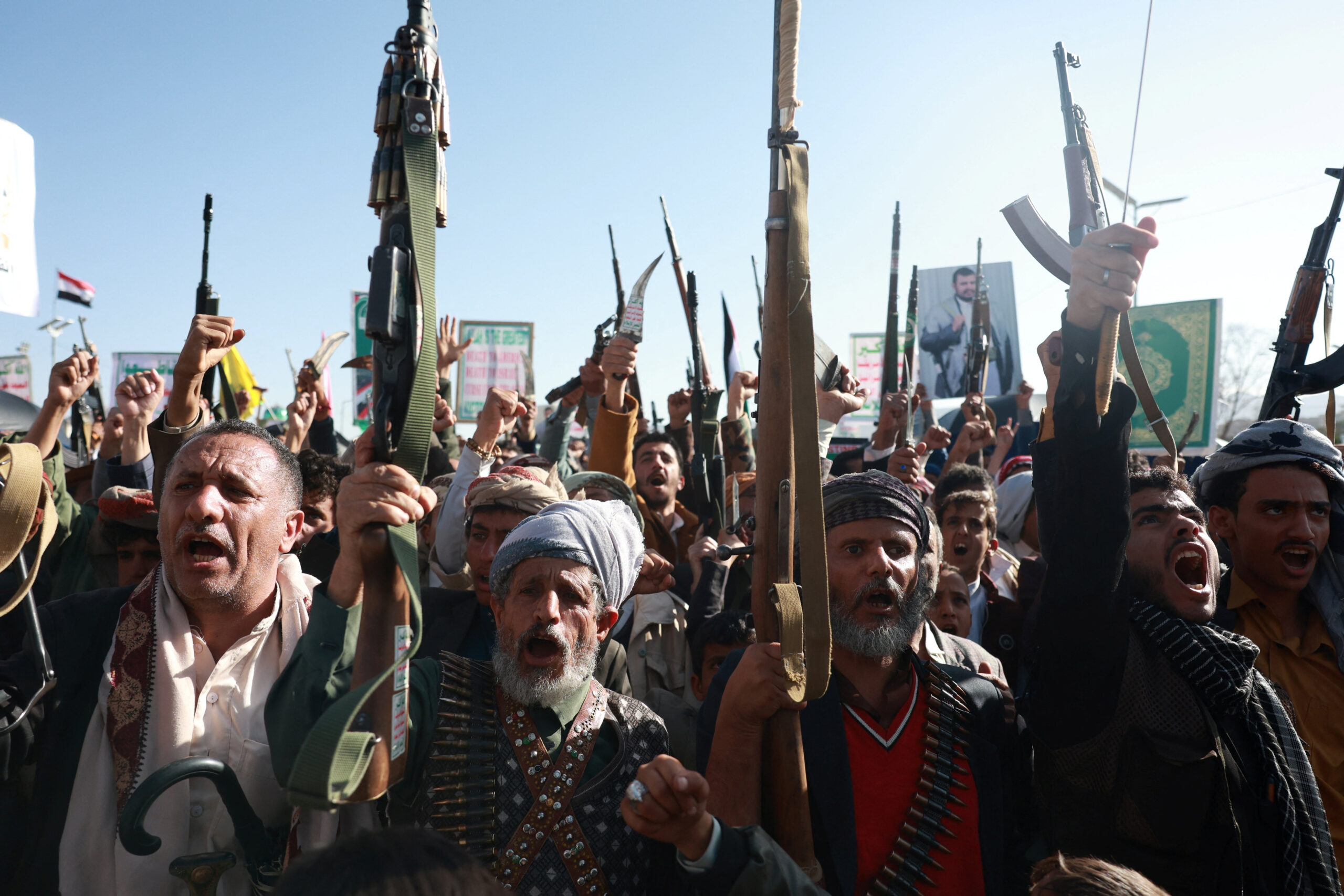
The Houthis have similarly sought to motivate their own fighters and generate sympathy from the broader Islamic community to their cause through their words and actions as an “Islamic resistance.” Most famous is the Houthi slogan “God is great, death to America, death to Israel, a curse upon the Jews, victory to Islam,” a political position they have made good on through their attacks on U.S. shipping and on Israel itself.
Houthi leaders frequently contrast this with the position of Saudi Arabia, which they depict as being under the sway of both the United States and Israel. They argue this undermines Saudi leaders’ credibility as leaders of the global Muslim Ummah (nation) and guardians of the two holy mosques. In an October 7 speech, Houthi leader Abdul Malik al-Houthi accused the Saudis of supporting efforts to assassinate the late Hezbollah leader Hassan Nasrallah and playing a role in the assassination of Imad Mughniyeh, who was responsible for the 1983 bombing of the U.S. Embassy in Beirut and indicted in the 1992 Israeli Embassy attack in Buenos Aires. His remarks openly supported both the Hezbollah political leadership and its militant wing. Abdul Malik al-Houthi said:
They act against Palestine and in favor of the U.S., and they create discord within the Muslim world.
These competing religiopolitical narratives were clear after the Houthi drone attack near Mecca, which the Saudis claimed was targeting the holy sites. Saudi papers were quick to respond:
For years, the Houthis have wrapped their wars in the language of religion, resistance, and the defense of Muslim causes. But the latest escalation in Saudi Arabia presents a stark contradiction: As Houthi missiles and drones strike Saudi cities, the shadow of that campaign is moving closer to the city toward which Muslims everywhere turn in prayer.
The spokesperson for the coalition forces, Turki al-Maliki stated emphatically that “The security of the Two Holy Mosques and the pilgrims is a red line,” a slogan that was taken up in numerous posts by prominent Saudis and social media influencers.
Abdul Malik al-Houthi responded directly to Saudi accusations of the Houthis targeting Mecca in a recorded speech posted on September 17. In it, he accused the Saudis of deploying “fabrications and blatant slander” to incite others to join them, justify their crimes against the Yemeni people, and distort their legitimate stance:
The party bearing full responsibility for stirring up discord within the Ummah and using various issues to exert pressure and provoke conflicts across the region is the Saudi regime, which serves and advances the interests of Zionism.
He concluded by calling the Yemeni people to demonstrate the following day, which indeed did occur in Sanaa under the banner of “exposing the lie of targeting Mecca.”
Nationalism vs. Sectarianism in the Saudi-Houthi Campaign
The return of religious language and symbolism in the reignited war between the Houthis and the Saudi-led coalition raises an important question: Could this revive the divisive sectarian environment of 2012-15, at the height of the Syrian civil war? This is particularly important considering the intentional turn away from religious extremism and toward nationalism under King Salman bin Abdulaziz and Crown Prince Mohammed bin Salman. While itself prone to political excess, as seen during the crackdown on activists from 2017-18 and the 2017-21 Qatar diplomatic crisis, nationalism has been key to the opening of public space and easing the political exclusion of Shia and women in the government and public life.
In the context of the Yemen war, religious provocation has been used, for example, in the Saudi grand mufti’s accusation that the Houthis consider the Prophet Muhammad’s companions – revered in Sunni Islam – as apostates. It has also been used more sharply, for instance, in a tweet by Saudi royal Abdulaziz bin Abdulrahman al-Saud:
They are enemies of the faith and of Arab identity – an Iranian tool attempting to impose the cursing of the Prophet’s Companions and the mothers of the believers.
The reformist Saudi preacher Adel Kalbani compared the Houthi attack on the holy sites with that of Abraha, the Abyssinian General and viceroy of Yemen in the early sixth century who attacked the Kaaba with an army, which included an elephant.
Yet the language has not sought to divide Saudis or demonize the Shia population. On the contrary, at the time of the attack on the pilgrims in King Khalid International Airport, the Saudi media revived and circulated a video of the late and prominent Shia scholar Ali al-Nasser al-Salman, praising the Saudi leadership for its care of the homeland and citizens and the kings of Saudi Arabia for securing the routes to the hajj and umrah.
Even the language from Saudi-based pan-Islamic institutions, such as the Muslim World League, has been more national than religious in tone. A Muslim World League statement supporting the Saudi campaign with the Yemeni government against the Houthis simply expressed solidarity with the kingdom as it deters aggression and assures the safety of its citizens and residents.
The State Has the Final Say
Thus far the highlighting of religion and mobilization of religious figures by the Saudi government amid the Houthi campaign appears to be strategically, and more narrowly, targeted. The difference from the overwhelmingly sectarian environment of the early 2010s is noticeable. In part, this is an important indication of the Saudi government’s increased control over both the religious sphere and the media. The Salafi satellite television channels and activist religious clerics that once were permitted to share in public commentary and media have mostly been co-opted or silenced. Those adding to the state narrative now mostly speak in the more nationalist voice of patriotic Saudis.
The views represented herein are the author's or speaker's own and do not necessarily reflect the views of AGSI, its staff, or its board of directors.
The Houthis don’t win because they are smarter or better fighters than their adversaries. They win because they are focused and unified, while their opponents tend to be divided and distracted.
Syria hopes to use the Iran war to deepen its connection to its Gulf Arab partners. Can it compete for inclusion within the regional security order and emerging trade corridors?
The imperative for Gulf states to unify their position has grown since the onset of Iranian attacks on their countries. Yet under conditions of uncertainty about the U.S. position and the war's outcome, Gulf states are demonstrating differing regional alignments and preferences for managing the crisis.
Caught between Iranian strikes and U.S.-Israeli pressure to join the fight, Gulf Arab states strive to maintain their autonomy over decision making, playing defense and preserving the space to maneuver when the war ends.