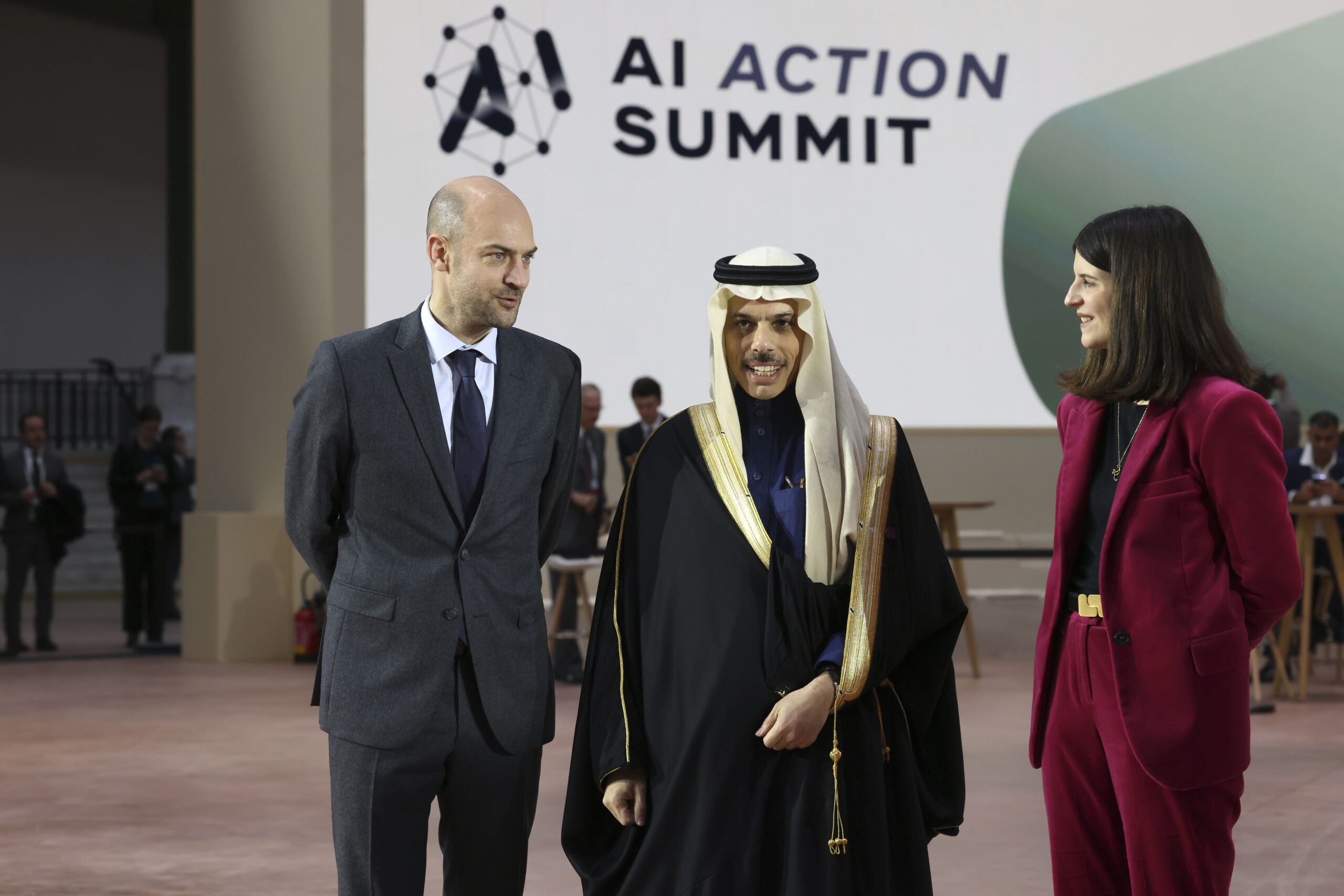
Saudi Foreign Minister Faisal bin Farhan, center, is welcomed by French Foreign Minister Jean-Noel Barrot, left, and French businesswoman Clara Chappaz at the Grand Palais during the Artificial Intelligence Action Summit in Paris, February 11, 2025. (AP Photo/Thomas Padilla)
Saudi Arabia and the United Arab Emirates have undertaken ambitious artificial intelligence infrastructure buildouts, using cheap energy and ample state capital to position themselves as compute hubs powering the next generation of AI. The U.S.-Israeli war with Iran is changing how they pursue that ambition. Iranian attacks on data centers have exposed the risks of concentrating infrastructure at home, prompting a rethink of where facilities should be built and how they should be protected. Europe offers a destination for Gulf investment and a source of customers for the compute the region is building.
In September, the UAE announced that it was reconsidering the design of its flagship AI campus, potentially geographically dispersing facilities and strengthening their protection. Abu Dhabi-based AI firm G42 maintained that construction was progressing as planned. The reported reassessment nevertheless underscores how Gulf governments are weighing the advantages of concentrating compute at home against the costs of protecting it. This reassessment has been accompanied by greater attention to AI investment abroad. Gulf actors were already financing overseas AI infrastructure before the war. The conflict strengthens the case for expanding those investments and allowing them to generate revenue beyond the region while attacks and uncertainty constrain returns at home.
There is also a strong commercial rationale. Saudi Arabia and the UAE need companies to use their data centers to make them profitable. U.S. restrictions accompanying U.S. hardware constrain whom they can serve. European AI companies offer a promising customer base because they exist within the U.S. AI ecosystem and can rent GPUs at scale without the same security concerns associated with Chinese access.
Investing in those European companies could help Gulf actors secure demand for domestic compute while acquiring a larger stake in AI development abroad. European firms, meanwhile, could gain financing and computing capacity as they seek greater sovereignty and alternatives to U.S. cloud providers.
The Push and Pull of Cooperation
Europe’s AI ambitions are an attractive pull factor for Gulf investors. The European Commission wants to at least triple European Union data center capacity within five to seven years. European developers are also seeking greater control over the infrastructure supporting their models. Gulf investors are already financing part of that expansion and may acquire a role in hosting some of the European demand. In June, France’s Bpifrance and Mistral AI and Abu Dhabi’s MGX announced plans to expand Campus AI to as much as 3 gigawatts across France, with Mistral receiving priority compute access. The venture includes NVIDIA, linking Gulf investment to infrastructure that supports France’s AI champion. Germany is also attracting Gulf capital to expand its technological capabilities. On September 10, the UAE announced a 40 billion euro (about $45 billion) investment package in Germany, including plans for approximately 1 GW of new data center capacity. In October, Oman and the United Kingdom signed an agreement for U.K.-founded infrastructure firm Yamna to develop an AI data center in Salalah, with more than $1.3 billion planned for its first phase. These packages demonstrate how Gulf investment could help finance the infrastructure underpinning Europe’s AI ambitions. In return, partnerships with European AI developers could bring customers to Gulf facilities.
Meanwhile, the war with Iran is a major push factor for the Gulf to look to the European market. Iranian attacks on AI infrastructure have unsettled the assumption that Gulf compute hubs could serve international customers from a secure regional base. For the UAE in particular, overseas infrastructure could complement efforts to harden and disperse its domestic facilities by providing future locations for deploying AI workloads abroad during times of crisis. G42’s Digital Embassies framework proposes government-to-government agreements to preserve authority over systems hosted abroad. Its Greenshield operating model is implemented through Core42, which says it already has sovereign AI clusters deployed in Europe, North America, and the UAE.
Europe faces a different menu of challenges. Europe’s push toward AI sovereignty requires more infrastructure, but building that infrastructure is becoming politically contentious. Protests against data centers highlight concerns among Europeans over electricity bills, water consumption, and the potential impact on local communities. This opposition creates a push factor that could encourage developers to offshore some of their computing needs. For companies seeking to reduce reliance on U.S. cloud providers, partners such as Canada or the Gulf Arab countries could offer alternatives.
For Europeans, the Gulf’s existing capacity, planned expansion, and energy advantages also provide an important pull factor. Affordable power and land may offer European customers a more competitive option for overseas workloads. The Gulf’s pitch is that it can deliver compute at significantly lower cost because energy is cheaper. A KAPSARC study cited total ownership costs for Saudi data center operators up to 30% below comparable international markets. If those savings pass through to customers, European developers could get cheaper compute, stretching development budgets and supporting expansion without financing their own data centers. Gulf operators, in turn, need customers whose activities satisfy the conditions attached to U.S. hardware. On August 24, Humain and Mistral announced a collaboration valued at hundreds of millions of dollars, with plans to develop Arabic models and applications for regulated industries. Mistral will also explore using Humain’s data centers to meet growing local compute demand. The partnership could help Mistral reach Gulf customers while bringing business to Humain’s infrastructure.
Pooling Middle Power Capabilities
In their proposal for AI breakout capacity, analysts Anton Leicht and Sam Winter-Levy emphasized cooperation among democracies to preserve the option of frontier development if foreign access becomes intolerably uncertain. They identified G42 and Mistral as probably the only middle power firms organizationally capable of such an effort. European and Gulf partners share an interest in developing alternatives to dominant providers at key points in the AI supply chain. Pooling their capabilities could make those alternatives more viable, with Gulf participation expanding the resources available for joint development and spreading its costs beyond a strictly democratic coalition.
Europe holds some of the most critical positions in the semiconductor supply chain, including ASML’s EUV lithography systems and ZEISS’s precision optics. Gulf-backed companies already help strengthen that industrial base. GlobalFoundries, majority-owned by Abu Dhabi’s Mubadala, announced a 1.1 billion euro ($1.2 billion) expansion in Dresden, targeting capacity of more than 1 million wafers – thin discs integral in manufacturing semiconductor chips –annually by the end of 2028.
Cooperation also brings European expertise into Gulf research institutions and industry. In February, Qatar Science and Technology Park announced it would host a regional research hub for Belgium’s imec to strengthen Qatar’s capabilities in developing advanced semiconductor design and technologies while also training new semiconductor engineers and researchers. Meanwhile, the Mohamed bin Zayed University of Artificial Intelligence has deepened ties with European universities and research centers. In 2025, MBZUAI and France’s École Polytechnique expanded their partnership to deepen AI research collaboration. This was followed by agreements between G42, and its portfolio company Analog, and France’s Advanced Machine Intelligence Labs to explore frontier advancements in physical AI, a subset of AI focused on systems capable of understanding, predicting, and interacting with the physical world. And, in early October, MBZUAI announced its first fellowship to train Emirati nationals at the University of Oxford for AI research.
These examples reflect a widening trend of research partnerships between the Gulf and Europe that, if successful, could lay the groundwork for pooling talent and research capabilities beyond financing and compute. They could also give Gulf and European partners a stronger collective position within the AI supply chain. A shared development effort would require commitments on the resources each partner contributes and access to the resulting technology. It could also make each side more valuable to the other and create incentives to sustain cooperation. However, whether those shared interests are sufficient to overcome perceived differences in political values remains a question.
Paving a Middle Power Path
Gulf-European partnerships offer financial backing to advance the middle power path to greater AI capability. Some analysts have argued for a broader democratic coalition that would pool the resources of the United States, European states, and partners, such as Canada, Japan, and Australia, to compete across the AI supply chain. But the infrastructure underpinning that coalition may not arrive soon enough to meet European developers’ needs. Lengthy construction timelines and delays in European compute initiatives leave an opening for Gulf capital to finance European facilities and Gulf operators to supply compute for eligible workloads.
Europe’s AI ambitions also face a financing constraint due to a shortage of long-term investment capital needed to finance its AI and data center buildout. In September, European Central Bank President Christine Lagarde estimated that closing Europe’s data center capacity gap could cost up to 600 billion euros ($6.7 billion) over the next decade. She argued that Europe needs more capital and a wider range of financing beyond bank lending. Gulf investors are already stepping in to help bridge those financing needs while acquiring a commercial stake in Europe’s expanding AI industry.
European AI sovereignty ambitions also complicate the assumption that European countries want deeper integration into a U.S.-led ecosystem. Recent statements from European leaders suggest the opposite. Germany’s digital minister, Karsten Wildberger, stated in May that “AI sovereignty requires our own infrastructure.” On September 14, Lagarde called for models running on European infrastructure “so that the threat of being cut off loses its force.” She warned that foreign providers could gain leverage over Europe by withdrawing AI access or changing terms. And, in his September 22 speech at the United Nations General Assembly, French President Emmanuel Macron rejected Europe becoming “the vassal of one of the great powers” in AI.
Overcoming the Hurdles to Cooperation
The principal long-term obstacle to deepening Gulf-Europe ties is a potential long-term misalignment of values. Advocates of a democratic AI coalition favor a values-aligned ecosystem closely connected to U.S. tech. Yet that vision offers no clear answer to European developers’ immediate need for compute or to middle powers’ reluctance to deepen their dependence on the United States.
Their concerns extend beyond near-term access to the long-term consequences of concentrating AI capability in the hands of two AI superpowers. Gulf partnerships offer a practical way to expand capacity and diversify providers, even where political values differ. As compute demand grows, Gulf capital could carry more weight than calls to restrict cooperation to democratic partners. For countries that see concentrated AI dependency as a greater risk than political differences with investors, Gulf partnerships may become increasingly attractive.
The views represented herein are the author's or speaker's own and do not necessarily reflect the views of AGSI, its staff, or its board of directors.
Silicon Valley is exploring offshoring some of its compute demand. Saudi Arabia and the United Arab Emirates are positioning themselves to capture some of it.
France is positioning to be a more influential actor across the Middle East, but the European powerhouse is most likely to see immediate traction on the economic tracks that run to and from the Gulf.
Silicon Valley is exploring offshoring some of its compute demand. Saudi Arabia and the United Arab Emirates are positioning themselves to capture some of it.
Saudi Arabia is eyeing the growth of a sovereign compute exchange model that, like OPEC for crude, would let it shape and stabilize long-term compute costs.