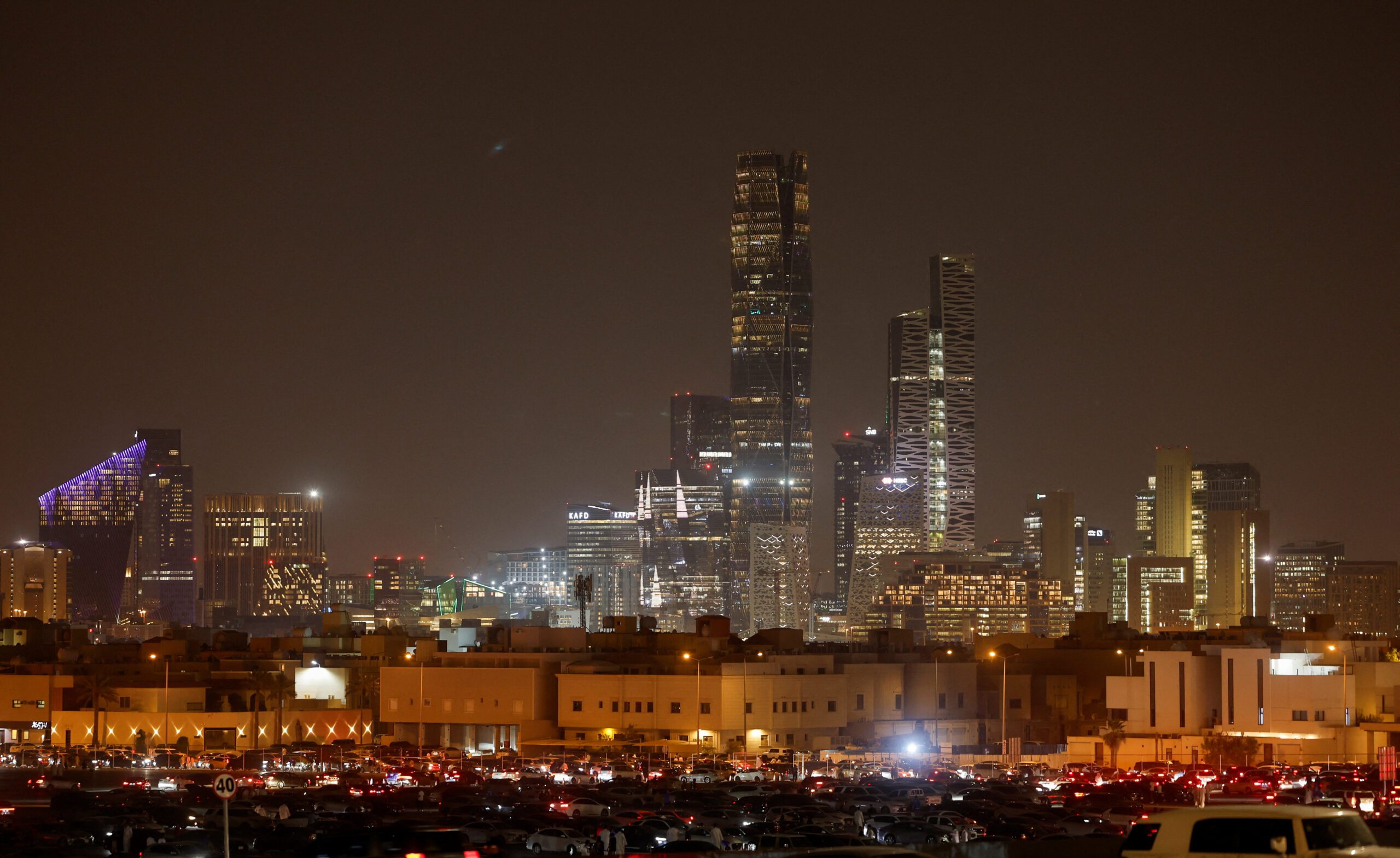
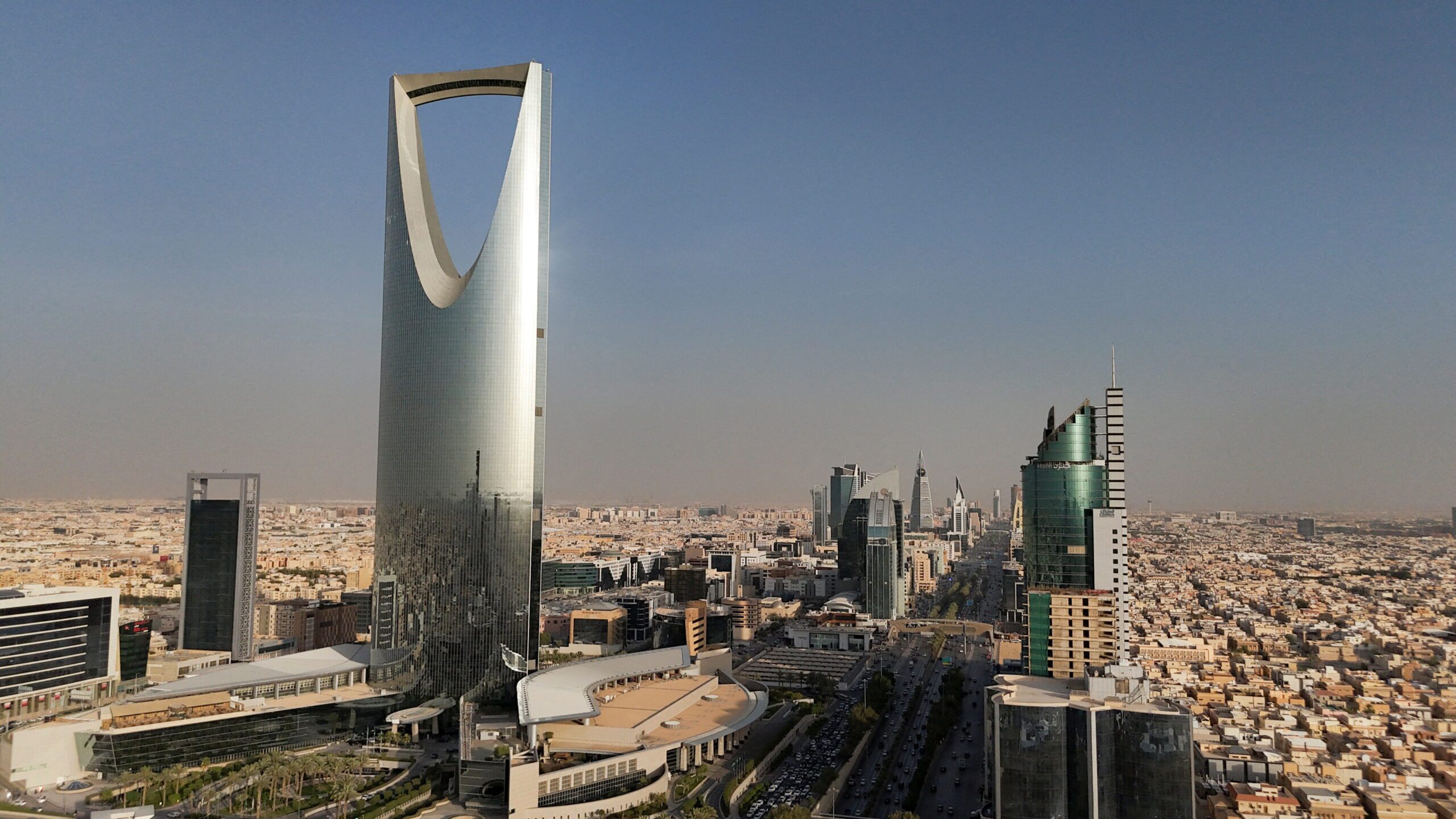
The King Abdullah Financial District during the early hours of the night in Riyadh, Saudi Arabia, August 29. (REUTERS/Hamad I Mohammed)
On July 31, the Saudi Ministry of Finance released its “Quarterly Budget Performance Report” for the second quarter of 2025. There are three key takeaways from the report regarding recent fiscal developments.
First, revenue is being significantly affected by lower oil prices. Revenue declined by 15% in the second quarter of 2025 (compared to the second quarter of 2024) and by 13% in the first half of the year (compared to the first half of 2024). Oil revenue has fallen by almost one-quarter over the past year. Encouragingly, non-oil revenue is continuing to grow robustly, a positive sign that efforts to diversify sources of government revenue away from oil are paying dividends.
Second, the government is beginning to adjust spending. Government spending was down by 9% in the second quarter of 2025 (compared to the second quarter of 2024) and by 2% in the first half of 2025 (compared to the first half of 2024). This decline was driven by lower spending on investment projects and subsidies, partly offset by higher spending on social benefits and interest payments on government debt.
Third, the 2025 fiscal deficit will be larger than budgeted. The deficit was 93 billion riyals ($25 billion) in the first half of 2025, already close to the budgeted 101 billion riyals ($27 billion) deficit for the full year.
Fiscal Outturn in 2025
The fiscal deficit in 2025 is likely to be around 190 billion riyals ($51 billion; 4% of GDP). Oil revenue is currently being driven by two competing forces – higher output as the OPEC+ alliance continues to unwind its earlier production cuts and lower oil prices as traders refocus on potential oversupply in the market later this year. Saudi oil production is likely to be at least 800,000 barrels per day higher in the second half of 2025 than in the first half, which will boost revenue. Oil prices, however, have weakened to between $66 per barrel and $68/bbl in recent weeks (compared to an average $77/bbl in the first half of the year). If prices stay at this level, it will largely offset the positive impact of higher production and oil revenue will not be much different in the second half of the year compared to the first half. Non-oil revenue appears on track to hit the budget estimate in 2025. The government is beginning to adjust spending, although it will still be difficult to achieve the budget target of 1.3 trillion riyals ($343 billion) for 2025. Doing so would require spending to be about 10% lower in the second half of the year than in the second half of 2024, with investment spending potentially 40% below budget in 2025.
The “Annual Borrowing Plan” for 2025 called for borrowing 139 billion riyals ($37 billion), based on the budgeted fiscal deficit of 101 billion riyals and debt maturities of 38 billion riyals. Guidance provided by the National Debt Management Center was that this borrowing would be come from the domestic debt market (up to 25% of total), international debt markets (up to 45%), and private funding sources (up to 30%). By the end of June, net borrowing had reached 170 billion riyals ($45 billion). Since then, additional domestic and international sukuk issuance has totaled a further 31 billion riyals ($8.3 billion) This means that the higher projected fiscal deficit for 2025 is already financed. However, it seems that a much higher share of borrowing in the first half of the year (113 billion riyals or 66%) was through private funding rather than domestic and international bond and sukuk issuances. Private issuances are by their nature less transparent than public ones, and this raises questions about the motivation for this large volume of private issuance. Which investors purchased this debt is also not clear, but they could include the pension fund, banks, and wealthy private individuals.
Looking to 2026
The Ministry of Finance will publish its prebudget statement for 2026 by early October. The statement will contain the ministry’s latest estimates of key economic and fiscal outcomes in 2025 and provide a first look at projected outcomes and fiscal policy initiatives for 2026. The report will contain only aggregate revenue and expenditure data and forecasts, leaving analysts to try and infer what is being assumed about oil prices and oil production.
Projecting future oil revenue is fraught with uncertainty. There is considerable disagreement among major forecasters about how the global oil market will develop in 2026. While OPEC and Aramco paint a relatively bullish picture, arguing that oil demand is firm, inventories are low, and supply growth from outside OPEC+ is slowing, the Energy Information Agency and International Energy Agency are more pessimistic. The IEA expects oil demand to grow by only 700,000 barrels per day in 2026, half of OPEC’s 1.4 million barrel per day growth forecast. The EIA and IEA point to recent production increases by OPEC+ as contributing to the prospect of excess supply developing in the market toward the end of 2025 and into 2026. Indeed, the EIA forecasts that Brent oil prices will average only $51/bbl in 2026.
If it is assumed that the oil price averages $65/bbl, Saudi oil production averages 10 mb/d, and Aramco’s dividend grows by 3%, then oil revenue would be around 600 billion riyals ($160 billion) in 2026. If there are no significant changes in tax policy, non-oil revenue should grow in line with projected non-oil nominal gross domestic product. Together, this would put total government revenue at around 1.15 trillion riyals ($307 billion) in 2026. Turning to expenditure, the projection in the 2025 budget was that spending growth in 2026 would be 3.3%, which would put spending at 1.36 trillion riyals ($363 billion), and the fiscal deficit would be about 200 billion riyals (53 billion) in 2026. If oil prices are $10/bbl higher or lower than assumed above, this would respectively reduce or increase the deficit by 80 billion riyals or 50 billion riyals assuming no change in spending, oil production, or Aramco’s dividend (the asymmetric impact is due to the specifics of the royalty regime).
The government will either issue debt or sell assets to finance the deficit. Government debt remains low (less than 30% of GDP), and it also has deposits at the central bank that it could liquidate. The International Monetary Fund’s 2025 Article IV report noted that there are “complex tradeoffs between making greater use of fiscal buffers in the form of central government deposits (about 9.3% of GDP in 2024) and new bond issuances” to finance the fiscal deficit but also noted the authorities’ view that government deposits at the central bank are “a strategic buffer that enhances market confidence, supports lower sovereign spreads, and reinforces resilience” and should therefore “only be drawn under exceptional circumstances.” This strongly suggests that the 2026 deficit will be financed by borrowing rather than deposit drawdown.
Oil Prices Hold the Key to Borrowing Needs
The future trajectory of oil revenue remains critical to the Saudi budget outcome even as non-oil revenue grows. Lower oil revenue (as implied by the EIA and IEA outlooks) will result in a larger fiscal deficit or the scaling back of government spending, particularly on investment projects, given the difficulty of reducing outlays on wages and social benefits. On the other hand, if the more optimistic OPEC scenario plays out, a smaller budget deficit can be expected together with stronger government investment spending. In both scenarios, government debt will continue to rise (but by more with lower oil revenue), albeit from a still low level. The issuing environment for Saudi debt in global markets will be determined partly by oil prices themselves – oil exporter debt is more attractive to investors at higher oil prices – and by developments in the U.S. Treasury market. If global economic uncertainty translates to greater financial market volatility, Saudi borrowing costs may rise even if policy interest rates in the United States and Saudi Arabia fall. Last, greater transparency about the reasons for tapping private financing sources in 2025 would give investors greater confidence about the financing situation going forward.
The views represented herein are the author's or speaker's own and do not necessarily reflect the views of AGSI, its staff, or its board of directors.
Payments by Aramco are still the key driver of government revenue in Saudi Arabia despite the notable increase in non-oil revenue, particularly from the value-added tax, in recent years.
Saudi Arabia has continued to make progress in diversifying its economy, although lower oil revenue, higher imports, and stronger remittance outflows pushed the current account into a small deficit in 2024.
Attacks on the East-West oil pipeline and other targets in Saudi Arabia will result in a larger-than-expected economic contraction in the kingdom this year.
The outbreak of the Iran war has halted the deepening of the economic relationship between the United States and the Gulf countries. While likely temporary, it could take some time before the upward trajectory is restored.
The impact of the Iran war on the Saudi economy has been mitigated by investments in “economic resiliency,” including the East-West oil pipeline, relatively prudent fiscal policy, and the accumulation of a large stock of foreign financial assets.
On January 8, AGSI hosted a virtual roundtable with its leadership and scholars as they look ahead and assess trends likely to shape the Gulf region and U.S. foreign policy during the coming year.