The Boutiqaat Saga: Balancing Innovation and Corporate Governance
Implementing stronger corporate governance frameworks that apply to regional startups is a good starting point to increase investor confidence in a challenging economic climate.
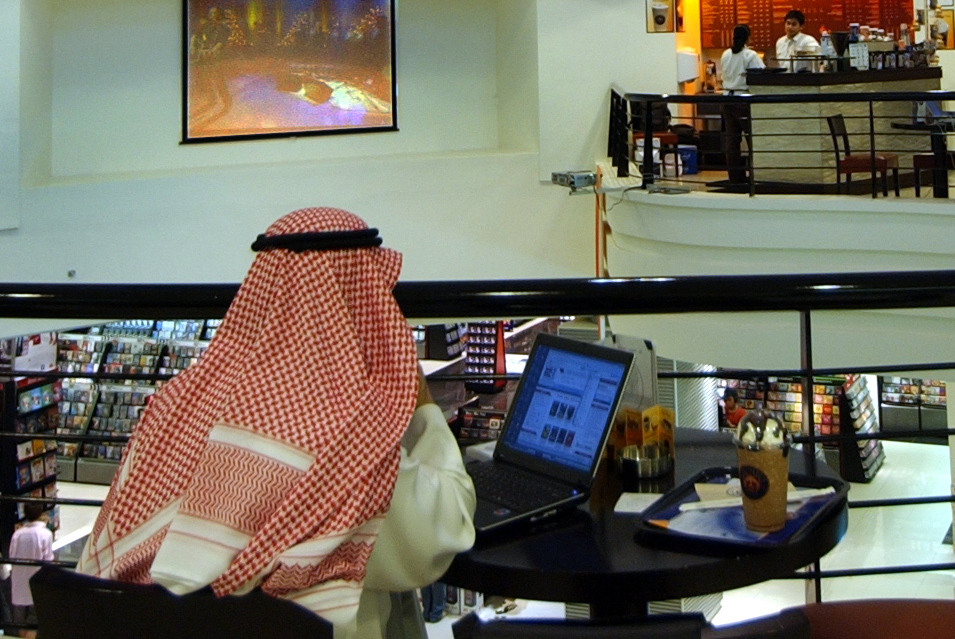
A Kuwaiti man browses online at a coffee shop in a shopping mall in Salmiyah, Kuwait City, November 2007. (AP Photo/Gustavo Ferrari)
Boutiqaat, a promising Kuwaiti e-commerce platform, hired Citigroup in June to help raise funding at a valuation of as much as $1 billion. By July, the e-commerce firm was mired in a money laundering scandal involving the very social media influencers who form the bedrock of the company’s business model. Rather than serving as the “Middle East’s Favourite Online Beauty Destination,” Boutiqaat is likely to become a cautionary lesson in the need for balancing technology-focused innovation with good corporate governance.
The appeal of Boutiqaat rests largely upon its combination of social media techniques, an e-commerce platform, and financial technologies. Founded by Kuwaiti entrepreneur Abdulwahab Alessa in 2015, the startup enables social media influencers and other celebrities from the Arab region to recommend and sell products in virtual storefronts. In January 2018, Boubyan Petrochemical Company invested $45 million in Boutiqaat. While beginning as an e-commerce cosmetics and fashion retailer in Kuwait, the platform’s popularity led the company to strive toward unicorn status – a startup company with a value exceeding $1 billion.
However, a financial scandal put the brakes on the startup’s commercial success. Kuwait’s Ministry of Interior released the names of several social media influencers suspected of using Boutiqaat for money laundering purposes. The attorney general ordered travel bans on the suspects, and the country’s central bank froze accounts associated with the suspects as well as those of Boutiqaat and its founder.
The scandal emerged during a difficult period for Gulf entrepreneurs. According to a joint study by MAGNiTT and INSEAD, 72% of startup founders in the Middle East and North Africa reported a monthly revenue drop of at least 25% in the first half of 2020. The coronavirus outbreak has likewise affected investor preferences – in terms of industry focus and the scale of investments. Some Gulf-based startups will capitalize on the coronavirus-induced acceleration of digital transformation in the region, but many others will struggle to adapt to the new commercial environment.
The economic crises of 2020 will test the commitment of Gulf Arab governments to support entrepreneurship initiatives. State-led entrepreneurship promotion materialized forcefully after the tumultuous periods of 2011 and 2014-15, and this policy mechanism remains a key element of Gulf country strategies and visions. Multibillion-dollar acquisitions of Gulf startups, such as Uber’s $3.1 billion acquisition of Careem, shed light on the region’s startup and entrepreneurial ecosystem. However, it is the strong performance of smaller startups – like Kuwait’s Talabat or Carriage – that demonstrates the region’s entrepreneurial potential. Despite economic constraints, Gulf Arab governments are likely to continue prioritizing entrepreneurship promotion as it supports fast-growing industries and can also relieve some local employment pressures.
Gulf Arab governments are actively supporting initiatives that incorporate advanced media, e-commerce, and financial technologies. In June, the ruler of Dubai, Mohammed bin Rashid al-Maktoum, launched a New Media Academy to prepare graduates for careers in digital marketing. The academy offers educational programs for young YouTubers and social media professionals. Dubai also possesses two e-commerce-focused free zones. Saudi officials plan to build a media city in Riyadh, where eWTP Capital, a tech-focused fund with links to China’s Alibaba Group, agreed to locate its headquarters. Bahrain FinTech Bay serves as a critical element of the Bahraini government’s ambition to revamp its mature finance and banking sector.
Ambitious development strategies and a desire for innovation-led growth in the Gulf have benefited many Gulf entrepreneurs. Abu Dhabi Global Market hosts Hub 71, a government-sponsored technology ecosystem that offers a generous incentive program for select startups. Moreover, several government-owned funds of funds in the Gulf aim to expand the funding opportunities available to startups in the region.
Yet Gulf policymakers also face criticism for their cautious approaches toward new technologies. Many Gulf central banks have adopted a cautionary approach toward the proliferation of cryptocurrencies in their economies. Foreign government officials, especially those from the United States, worry that malicious actors may exploit financial systems and networks in Gulf Arab states. The U.S. Justice Department announced on August 13 that it had seized millions of dollars from cryptocurrency accounts, Facebook pages, and other websites used to facilitate online terrorist fundraising. Indeed, the Boutiqaat saga reveals that local officials and their foreign counterparts have justifiable concerns.
Despite these concerns, public health measures related to the coronavirus and economic pressures owing to the economic downturn will make it difficult – and undesirable – for governments to put the brakes on innovative startups, especially fintech companies. A majority of UAE residents are positive about moving toward a cashless society, according to a survey by YouGov. Prior to the coronavirus pandemic, electronic payments accounted for approximately one-third of all retail payments in Saudi Arabia, but the Saudi government hopes to boost the rate of noncash transactions to 70% by 2030. Private sector actors, upon which Gulf governments rely on to identify and capitalize on fast-changing market needs, possess a different threat perception of new technologies.
In addition to governmental support, Gulf entrepreneurs used to rely heavily on angel investors. More family-owned businesses are beginning to view startups as promising investment opportunities, despite being traditionally risk-averse. Increasing the availability of venture capital and private equity in the region has been progressing slowly, albeit with heavy state involvement. However, the challenging economic climate and emergence of new scandals may make it harder to attract Gulf-focused investments. Implementing stronger corporate governance frameworks and industry standards that apply to regional startups is a good starting point.
In a 2018 interview, Boutiqaat’s founder said, “Boutiqaat is an original concept that is entirely made in Kuwait … Creating something from scratch that matches our society will have a greater potential than replicating concepts from abroad in our region.” Genuine innovation can spring forth from the unique characteristics of a given society, but good corporate governance protects against the less desirable behaviors of social actors.
The views represented herein are the author's or speaker's own and do not necessarily reflect the views of AGSI, its staff, or its board of directors.
In “The Social Commerce System,” it is defined as “the expansion of e-commerce in the social networks on the Internet, in which social factors are significant, and consumers use the right to create content through the media via forums, ratings, reviews, and recommendations on different platforms.”
E-commerce development initiatives align closely with high-priority government agendas to build technology-focused, knowledge-driven economies. However, challenges related to payments, regulation, and delivery threaten e-commerce growth prospects across the region.
France is positioning to be a more influential actor across the Middle East, but the European powerhouse is most likely to see immediate traction on the economic tracks that run to and from the Gulf.