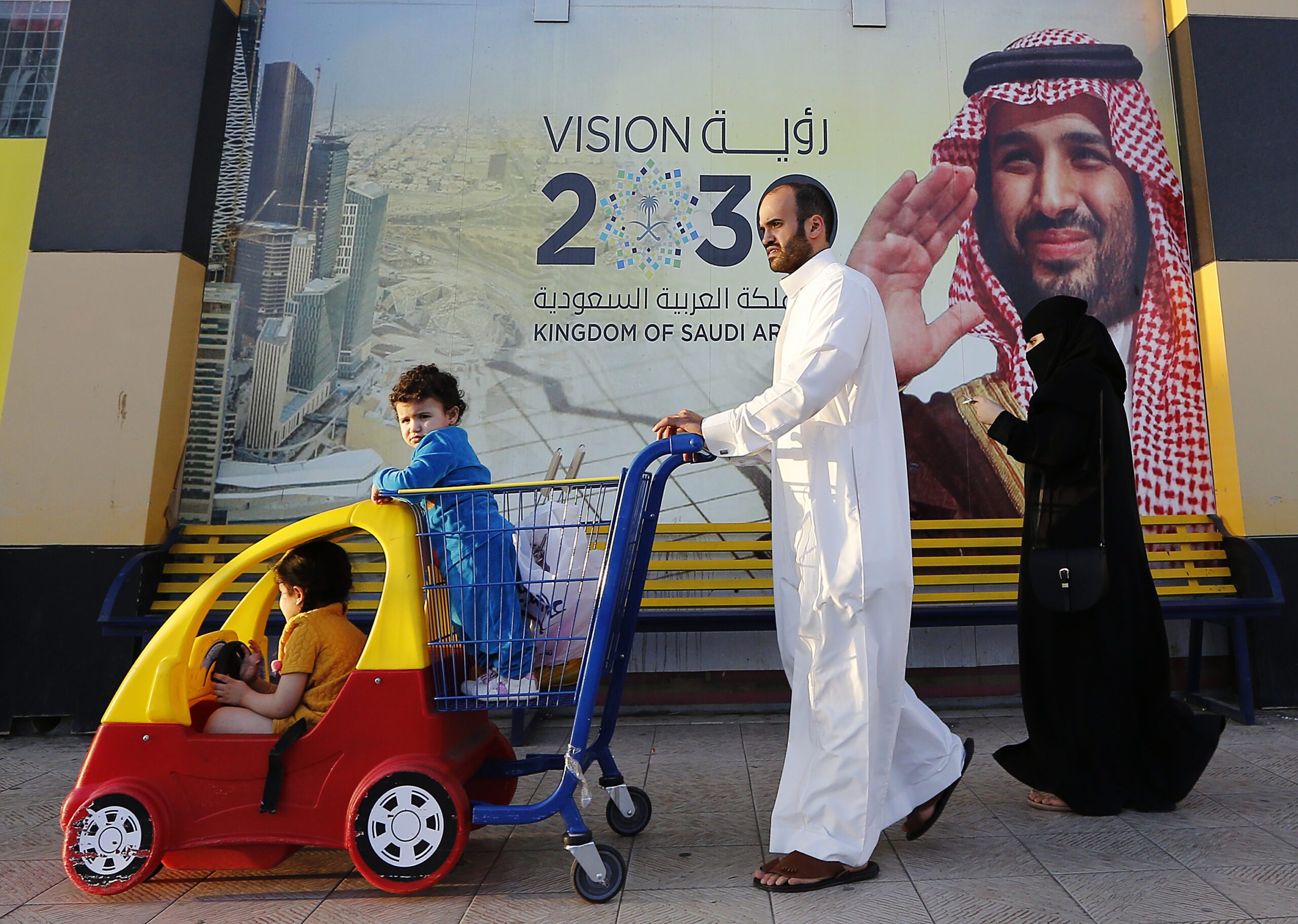
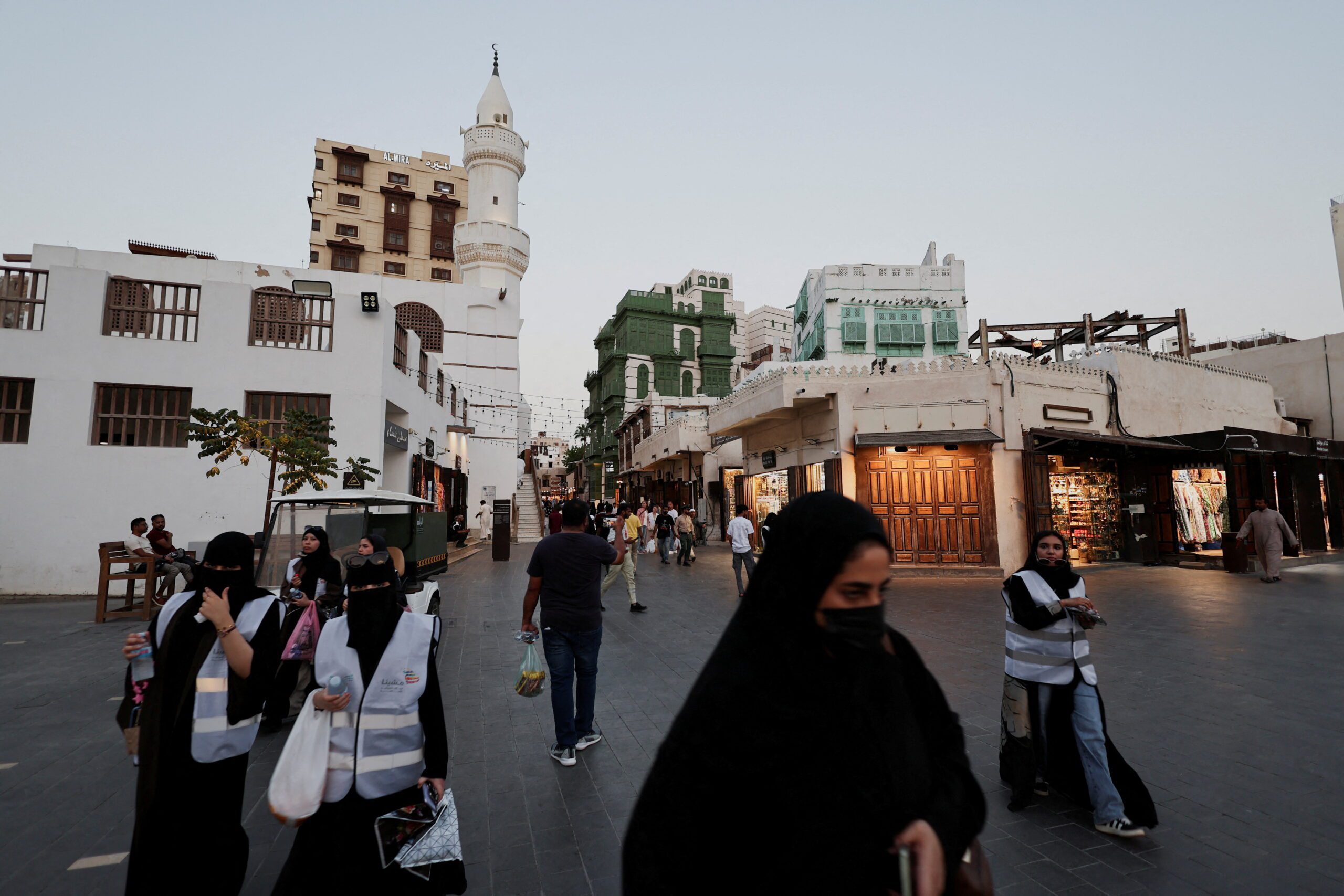
People walk past a banner showing Saudi Crown Prince Mohammed bin Salman outside a mall in Jeddah, Saudi Arabia, Feb. 5, 2020. (AP Photo/Amr Nabil)
Countries as heavily reliant on oil exports as Saudi Arabia have found economic diversification very difficult. Few, however, have approached the challenge with such strong political commitment, such a comprehensive plan, and the vast resources to finance the needed investment as Saudi Arabia. The government has implemented an impressive list of economic reforms under Vision 2030, including improving the business climate and legal framework, reducing restrictions on women’s employment, strengthening domestic capital markets, reducing energy subsidies, and developing new sectors of the economy, such as tourism. There is considerable interest in whether these reforms are working to diversify the Saudi economy away from oil and create a more dynamic private sector. Evaluating progress across four dimensions – exports, output, government revenue, and employment – reveals that, although oil remains a dominant force in the Saudi economy, the kingdom’s diversification efforts appear to be starting to bear fruit.
A Simple Way to Look at Diversification
Oil is dominant in the Saudi economy, and oil prices and production vary considerably year to year. This can make it difficult to discern trends in diversification because progress in growing the non-oil sector can be overshadowed by developments in the oil sector. One simple way of accounting for the impact of year-to-year swings in oil export revenue, and therefore better examine longer-term developments, is to compare years with similar levels of oil exports.
In 2022, Saudi Arabia’s oil export revenue was exceptionally high, at around $325 billion, as the war in Ukraine pushed oil prices above $100 per barrel for part of the year. To assess diversification trends against the background of high 2022 oil revenue, diversification indicators in 2022 are compared to those in 2012-13, the last time Saudi oil export revenue reached a similarly high level.
Progress on Four Dimensions
Exports
Oil (crude and refined products) still dominated the Saudi economy in 2022, accounting for 74% of total exports of goods and services, but this is well below the 84% average share in 2012-13. Most of the decline in the share of oil in Saudi exports is due to the expansion of petrochemical exports and tourism. The share of petrochemicals rose from 9% of goods and service exports in 2012-13 to 12% in 2022. Travel exports (what Saudi Arabia receives from non-nationals visiting the country) increased from 2% in 2012-13 to 5% in 2022.
Output
The private sector’s share of the kingdom’s nominal gross domestic product grew from 37% in 2012-13 to 39% in 2022. The non-oil sector, which includes the public and private sectors, made up 56% of GDP in 2022, up from just under 52% in 2012-13. Correspondingly, the private sector’s share of GDP in real terms (after adjusting for price effects) was 41% in 2022, compared to 39% in 2012-13. Within private non-oil activities, real estate, retail and wholesale trade, manufacturing (likely mostly petrochemicals), and community, social, and personal services had the most significant growth. The correlation between non-oil private sector GDP and oil prices remains high but has fallen since 2013. This decline is suggestive of private sector economic activity becoming less dependent on oil prices than in the past.
Sources: GASTAT, SAMA, and author calculations.
Government Revenue
Saudi Arabia has made significant progress in diversifying the sources of government budget revenue. Non-oil revenue rose to 32% of total government revenue in 2022, up from less than 10% in 2012-13. The introduction of the value-added tax in 2018 and the rate increase from 5% to 15% in 2020 have provided most of the boost to non-oil revenue.
Employment
Diversification in the labor market is more difficult to define than in the three areas considered above. Here, labor market diversification is equated to a reduced reliance by private companies on non-Saudi workers and a lower reliance by Saudi nationals on employment in the public sector. Across both dimensions, progress has been made, although data limitations prevent a complete analysis. Saudi workers accounted for 23% of total employment (Saudi and non-Saudi) in the private sector at the end of 2022, compared to 16% in 2016 (the earliest year for which data is available). The share of Saudi workers identified as employed in the public sector fell to 42% at the end of 2022, down from 45% in 2016. While this data understates the number of Saudis working in the public sector as it excludes those working in the military and security services, it also excludes private sector workers not registered with the general organization for social insurance, such as “gig” workers. It is not clear how these omissions affect the share of public sector employment reported here.
Cautious Optimism for Diversification
Saudi Arabia’s diversification efforts do seem to be bearing fruit, with progress in all four areas considered. Nevertheless, oil remains the dominant source of Saudi export and fiscal revenue and directly accounts for 40% of output. There is also debate about whether the expansion of the petrochemical sector, a key driver of non-oil export growth, represents true diversification given the sector’s close links to oil, although future petrochemical demand will be driven by different factors than those associated with oil demand, and the sector provides additional value added.
Looking forward, continued progress with economic diversification will require the deepening of ongoing reforms and their consistent implementation to raise productivity in the economy. To achieve this, efforts to attract more foreign investment and the technology transfer it will bring will be essential. Despite welcome progress in increasing the participation of women in the economy, there is more to be done. Improved education and training for Saudi nationals will also be critical to expand existing sectors and develop new ones. Last, a careful balance will need to be struck between pursuing public sector-led initiatives through the Public Investment Fund and ensuring there is room for a dynamic and independent private sector to develop. New sectors with large upfront capital needs will require public sector support, but overreach of the public sector into all aspects of the economy will stymie needed private sector development.
The views represented herein are the author's or speaker's own and do not necessarily reflect the views of AGSI, its staff, or its board of directors.
The financial windfall from oil and gas exports may boost regional officials’ ambitious economic diversification plans but doesn’t make them foolproof.
Labor market data from the 2022 census is still to be published but once released could have important implications for the central goals of Vision 2030 given the recent large downward revision to population estimates.
Saudi equity prices have risen since the start of the Iran conflict, outperforming many regional and global markets. Whether this continues will depend on how and when the conflict ends.
The conflict with Iran has curtailed the supply of oil from the Gulf, pushing up the price of the medium and heavier grades it usually exports relative to lighter grades.
With young Saudis continuing to enter their working age years in large numbers, robust employment gains need to continue, but slower non-oil growth may present a challenge.
On January 8, AGSI hosted a virtual roundtable with its leadership and scholars as they look ahead and assess trends likely to shape the Gulf region and U.S. foreign policy during the coming year.