Presidential Election in Iran: Low Turnout Boosts Jalili’s Chances
While Masoud Pezeshkian faces considerable challenges in the second round of the election, the pro-regime vote is likely to ensure Saeed Jalili's victory.
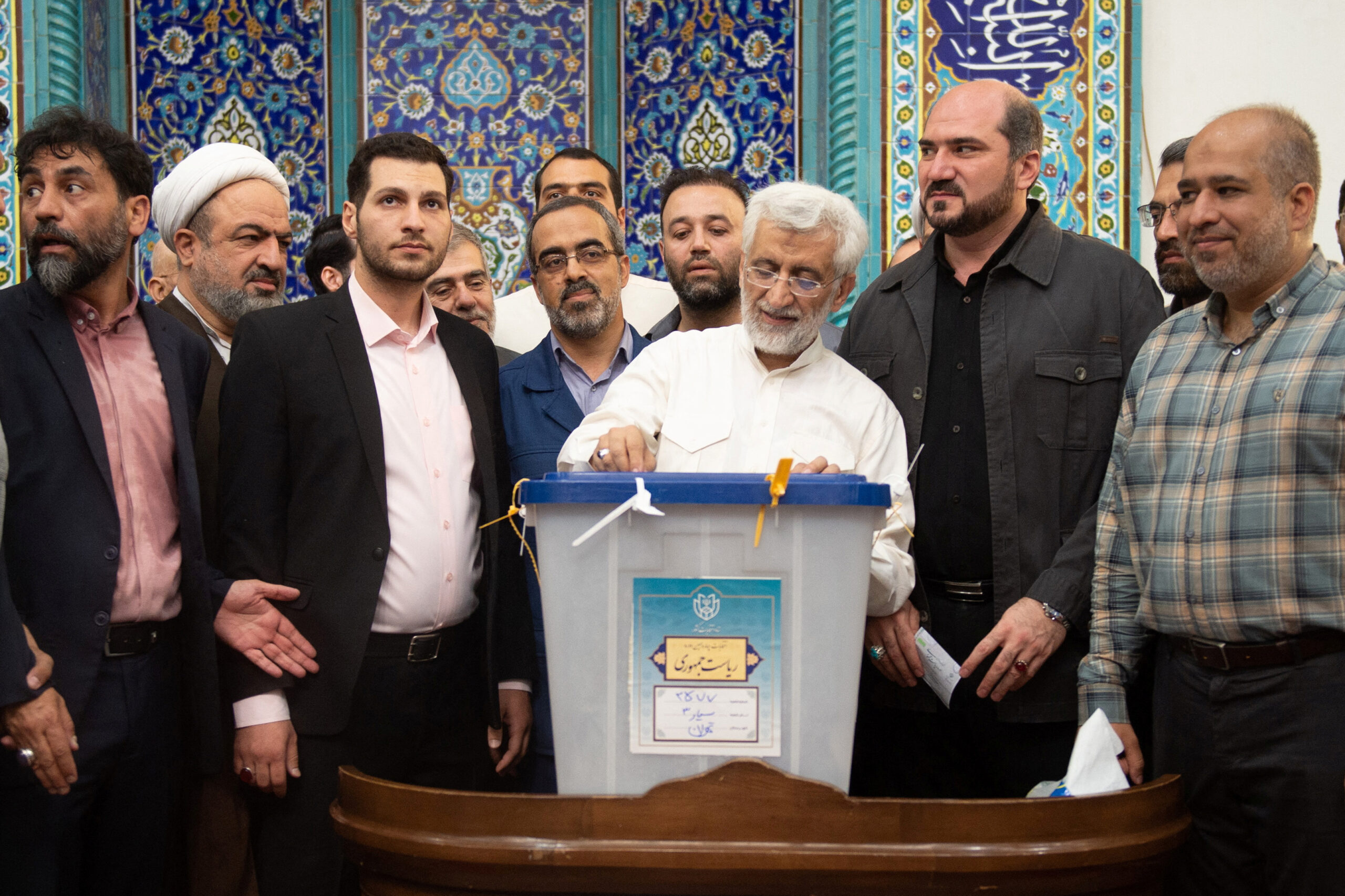
Presidential candidate Saeed Jalili votes at a polling station in a snap presidential election to choose a successor to Ebrahim Raisi, in Tehran, Iran, June 28. (Stringer/WANA via REUTERS)
“The Strength of the Islamic Republic depends on electoral participation,” Supreme Leader Ayatollah Ali Khamenei said immediately after casting his vote June 28 in Iran’s presidential election. According to this logic, the 40% voter turnout, the lowest in the history of the Islamic Republic, should indicate the regime’s weakness. However, while the low voter turnout and declining popular legitimacy of the Islamic Republic are embarrassing for the regime, they do not necessarily signal an increased possibility of regime collapse in the short or medium term. Khamenei’s public statements too may not reflect his private considerations. After all, the Guardian Council’s filtering of presidential candidates was bound to lower the voter turnout, benefiting Khamenei’s presumed favorite, Saeed Jalili, who could count on the pro-regime vote to advance him to the second round of elections July 5 and ultimately help him to occupy the Office of the President in Tehran.
For now, Khamenei’s election engineering appears to have achieved its objectives. Among Iran’s 61.5 million eligible voters, only 24.5 million – roughly 40% – cast their votes June 28. Masoud Pezeshkian appeared on top of the ballot with 10.4 million votes, followed by Jalili’s 9.5 million votes, Mohammad-Bagher Qalibaf’s 3.4 million votes, and Mostafa Pourmohammadi’s modest 206,000 votes, significantly fewer than the 1.5 million ballots deemed invalid – these ballots often mark the protest vote, in which the voters write the names of candidates disqualified by the Guardian Council, such as former President Mahmoud Ahmadinejad, pop singers, the Shia Messiah, and the like. Qalibaf has since endorsed Jalili, and unless Pezeshkian, in an unlikely turn of events, manages to mobilize the remaining 60% of the apathetic electorate, Jalili is likely to win the race.
A Pezeshkian victory is unlikely for several reasons.
Since 1979, all Iranian presidential elections were won with one candidate achieving the majority of the vote in the first round, with one exception. After the June 17, 2005 presidential election, Tehran Mayor Mahmoud Ahmadinejad and former President Akbar Hashemi Rafsanjani proceeded to a June 24 run-off; nearly 63% of the electorate voted in the first round, and nearly 60% voted in the second round. A similar decline in the voter turnout on July 5 is likely to benefit Jalili, who can count on the pro-regime vote, and hurt Pezeshkian, who must increase the voter turnout to match Jalili’s vote, which will be bolstered by some former Qalibaf supporters.
Challenges to Pezeshkian’s bid are not limited to the countrywide voter turnout. There has been a specific disproportionately steep decline in voting in Pezeshkian-friendly provinces, compared with the 2021 presidential elections: Throughout the campaign, Pezeshkian consistently appealed to Iran’s ethnic and religious minorities. However, the voter turnout was almost halved in Iran’s Kurdistan province, home to Iran’s Kurdish minority; Khuzestan, which boasts of a significant ethnic Arab population; and Sistan and Baluchistan province, home of the Baluch minority. These same provinces also witnessed armed anti-government uprisings in the wake of the killing of Mahsa Amini in the custody of the so-called morality police in September 2022.
Pezeshkian may also have maxed out the voters he can mobilize in populous provinces: According to the limited early data available from the governorates, Pezeshkian, an ethnic Azeri, unsurprisingly garnered significant support in Azeri-populated areas: In East Azerbaijan, where the voter turnout was 44%, Pezeshkian got one million votes, compared to Jalili’s less than 250,000 votes. Similarly, in Ardabil, where the voter turnout was 49%, Pezeshkian received 380,000 votes, compared with Jalili’s 72,000 votes. In Persian-populated Isfahan, on the other hand, where the voter turnout was 41%, Jalili received almost 900,000 votes compared with Pezeshkian’s nearly 430,000 votes.
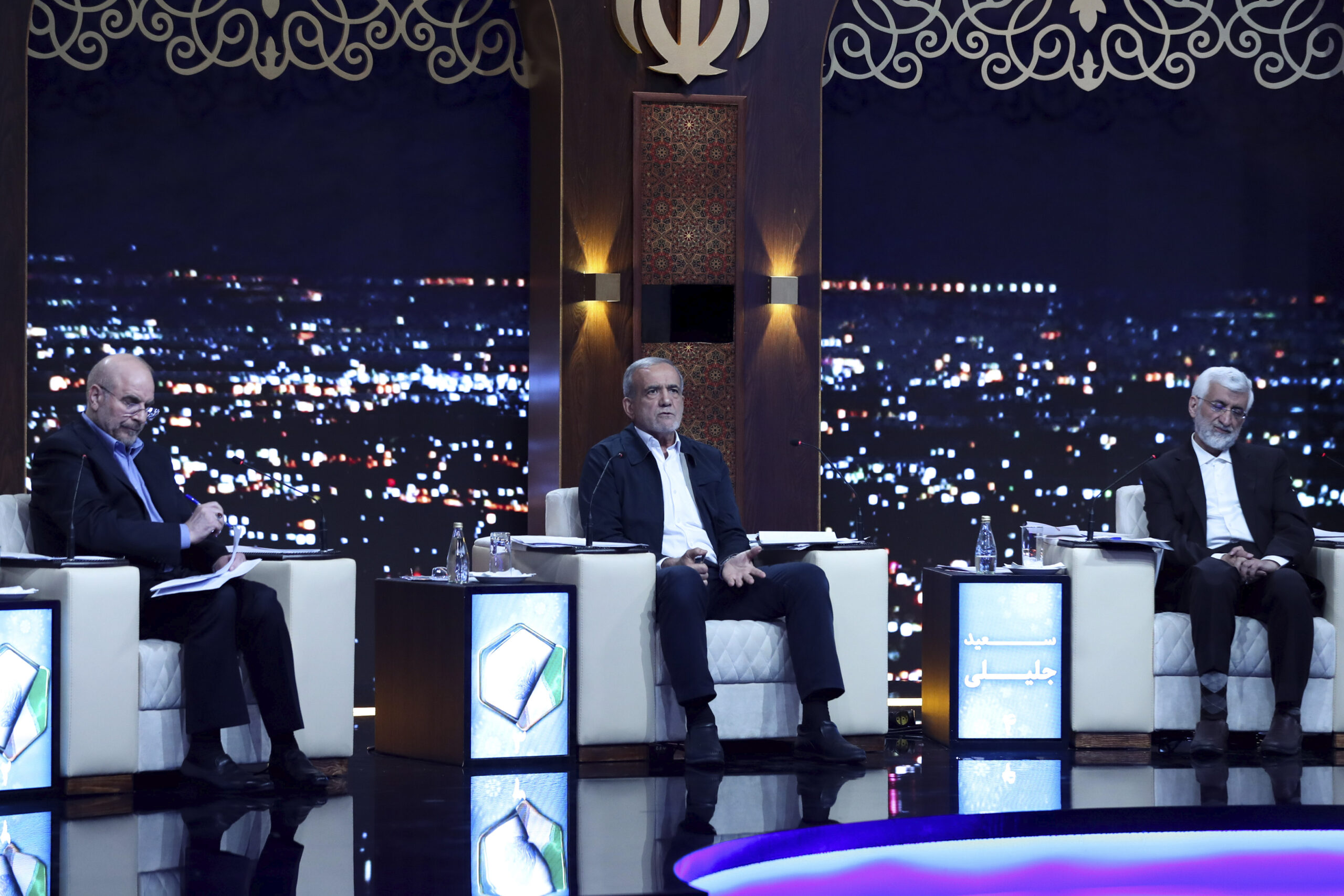
Pezeshkian’s only chance of mobilizing the apathetic election boycotters is through the remaining two televised presidential debates on July 2 and July 3, along with his final televised address on July 4. On these occasions, Pezeshkian must take considerable risks, perhaps even address the Azeri voters in the Azeri language and make other emotional appeals to the voters, to change the tide and improve his chances. Each of those appeals, however, will be used against him with allegations of support for separatist movements threatening the territorial integrity of Iran and other such allegations. Jalili, on the other hand, can afford to continue on autopilot – repeating regime slogans and talking points – and ultimately perform poorly as he counts on the pro-regime vote.
The views represented herein are the author's or speaker's own and do not necessarily reflect the views of AGSI, its staff, or its board of directors.
Three candidates have a realistic chance in Iran’s presidential election: strongman Qalibaf, reformist surgeon Pezeshkian, and zealot pen pusher Jalili.
The Guardian Council has again presented the Iranian public with presidential candidates who lack a political program, a social base, and the ability to mobilize voters.
Regardless of who becomes Iran’s next president or who succeeds Khamenei as head of state, there is little prospect for significant change in Iran's foreign and security policy.
Iran may still call itself an Islamic Republic. In practice, however, it increasingly resembles a state in which the military governs from behind clerical robes.
Ayatollah Ali Khamenei was killed in his office in Tehran at age 86, leaving behind a country in ruins and on the verge of civil war and potential disintegration.
Iran is signaling that it will not absorb attacks passively. But whether this strategy ensures the regime’s survival, seals its fate, or accelerates a broader catastrophe will shape the region for years to come.
The erosion of the regime’s legitimacy across broad segments of society, combined with the breadth of the 2025-26 protest coalition, raises the possibility that a new confrontation could trigger renewed anti-regime mobilization.
On January 8, AGSI hosted a virtual roundtable with its leadership and scholars as they look ahead and assess trends likely to shape the Gulf region and U.S. foreign policy during the coming year.