As anti-government protests spread like wildfire threatening the Islamic Republic’s allies and proxies, Iran’s Supreme Leader Ayatollah Ali Khamenei faces a dilemma: use Iran’s scarce resources to stabilize regional protests or leave them to their own devices and risk a fight with the IRGC.
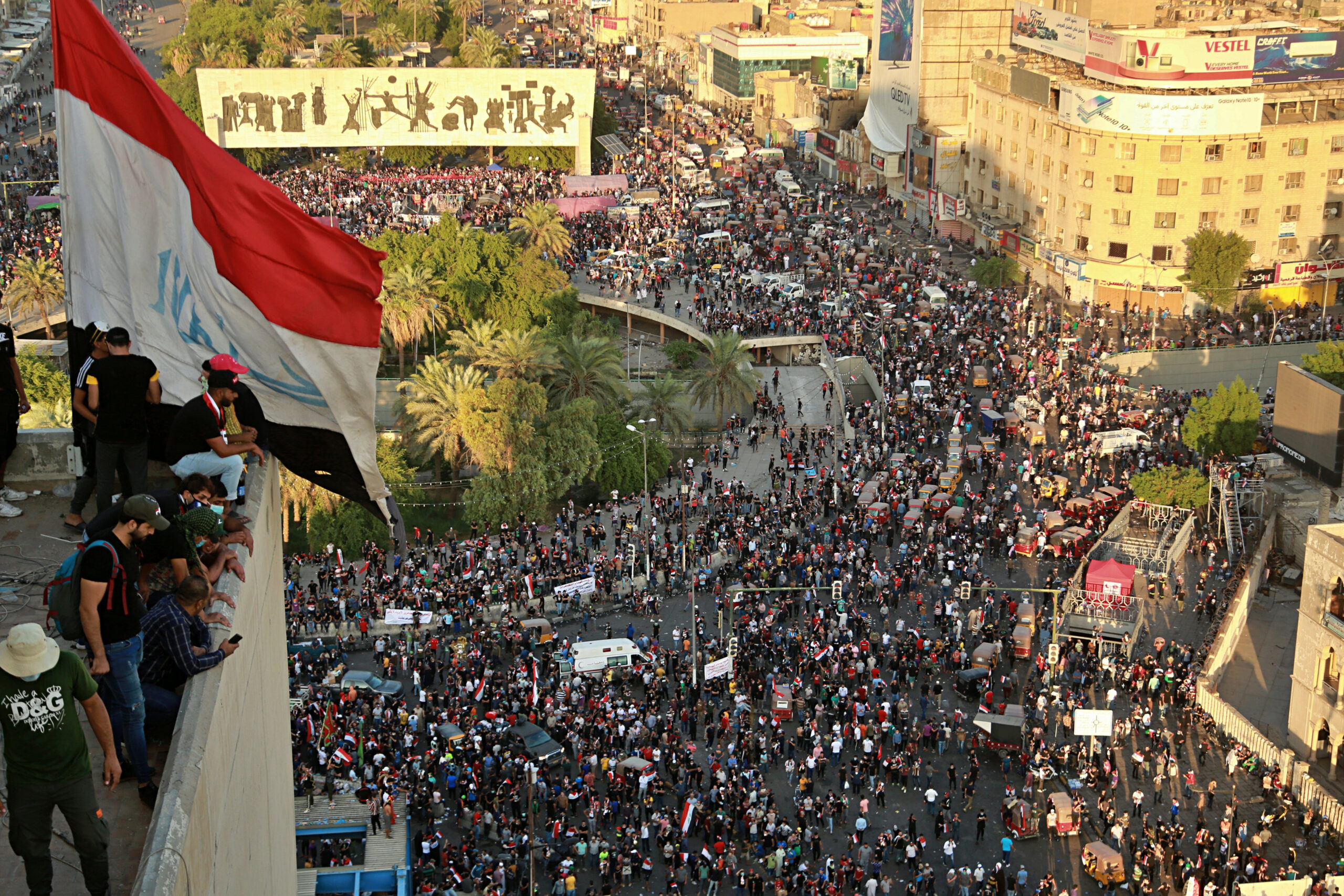
Anti-government protesters gather in Tahrir Square during a demonstration in Baghdad, Iraq, Oct. 26. (AP Photo/Hadi Mizban)
From Iraq to Lebanon, Iran’s hard-won empire is ablaze. As anti-government protests spread like wildfire threatening the Islamic Republic’s allies and proxies, Iran’s Supreme Leader Ayatollah Ali Khamenei is facing a dilemma: Should Iran, itself subjected to severe U.S. economic sanctions, use its scarce resources to stabilize allies and proxies in the region and thereby risk worse conditions and social unrest within Iran, or leave them to their own devices and risk a fight with the Islamic Revolutionary Guard Corps on whose support Khamenei’s survival depends?
Statements made by commanders of the IRGC show their preference for supporting their allies and proxies, and Khamenei’s first comments on the subject indicate he is inclined to align himself with the IRGC. He also appears to be redefining the role of Iran’s regular military to adapt to the changed threat environment but perhaps also aiming to reduce the dependence of his regime on the IRGC. Regardless of Khamenei’s efforts, he may be facing Iran’s moment of imperial overreach, one which propels the Islamic Republic toward economic collapse.
In Iraq, demonstrations began on October 1, protesting corruption and unemployment, but before long they escalated into calls to overthrow the government and stop Iranian meddling in internal Iraqi affairs. Neither government promises of hiring more public servants nor attempts at a crackdown against the protesters and a rising death toll have persuaded the demonstrators to leave the streets. Whether Iraqi Prime Minister Adel Abdul Mahdi’s proffered resignation helps to defuse the unrest remains to be seen.
Protests in Lebanon began on October 17, following several months of public dissatisfaction with Prime Minister Saad Hariri’s austerity budget and ignited by a government proposal to impose a tax on the popular messaging and voice service WhatsApp. Contrary to the wishes of Lebanese Hezbollah, Hariri announced his resignation in a televised address October 29. The protests, however, continue and there are reports of clashes between Hezbollah supporters and protesters.
These developments are causing great concern in the Islamic Republic, which not only fears for the plight of its allies and proxies in Iraq and Lebanon, but also for the spread of the protests to Iran itself, which experienced countrywide public protests in December 2017 and January 2018.
Commanders of the IRGC readily accuse foreign powers for being the main drivers behind the protests. Brigadier General Esmail Kowsari, deputy chief of the IRGC Sarallah Headquarters, which is tasked with safeguarding Iran’s internal security, on October 27 claimed: “In Lebanon and Iraq, people have legitimate demands, but Saudi Arabia, the United States and the Zionist regime have their [own] people among the protesters who see to it that they deviate from their own demands.”
In the same vein, Hossein Amir-Abdollahian, international affairs assistant to the parliamentary speaker, Ali Larijani, on October 29 likened the developments with the prelude to the civil war in Yemen and accused the United States and Saudi Arabia of engaging in “political terrorism.”
Hassan Hanizadeh, a political analyst quoted by Fars News Agency, itself a mouthpiece of the IRGC, on October 30 warned against “conspiracy against the ‘Axis of Resistance’” a reference to the Islamic Republic’s allies in Lebanon, Iraq, and Syria. Hanizadeh also claimed “the hands of the elements of the Baath regime and Shia movements dependent on the American Embassy [in Baghdad] are completely visible in recent demonstrations and gatherings in Iraq.”
Khamenei’s first statements on the subject are not very different than those of the IRGC commanders and spokesmen. Addressing the Air Defense Force Officer Academy on October 30, Khamenei urged “those who care about Iraq and Lebanon” to “remedy insecurity” and added: “The people of these countries should know that the enemy is trying to create a void by disrupting the legal structures. The only path for the people to achieve their legitimate demands is by pursuing them within the legal structures.”
Khamenei also commented on Iran’s own experiences with political protests: “The enemies had similar designs for dear Iran, but luckily, the vigilant nation entered the arena in time. The armed forces, too, were prepared and the conspiracy was neutralized.” Finally, Khamenei talked of the “special mission for the armed forces,” asserting that they “must be careful of sedition and must have the necessary posture and preparedness to counter it … since sedition is worse than massacre and murder.”
It is unclear if these senior officials believe their own conspiracy theories about foreign powers instigating unrest in the Middle East, or if the conspiracy theories just serve propaganda purposes. But, in particular, Khamenei’s reference to preparedness of the “armed forces” in the fight against “sedition” indicates a new role for the regular Iranian military at home and abroad.
The Armed Forces of the Islamic Republic of Iran comprise the army, IRGC, and Law Enforcement Force (police). In its 40-year history, the Islamic Republic has never used the army to suppress political opponents at home, and the army played a minor role in Iran’s military intervention in the war in Syria. The police, too, have, at least until December 2017, played a very limited role in suppression of the domestic opposition. The IRGC, rather than the army or the police, has secured the survival of the regime in the face of domestic opposition and acted as the strong arm of the regime in military operations abroad.
Desperate times clearly call for desperate measures, and Khamenei’s statements may reflect his willingness to break the IRGC’s monopoly on suppression of the opposition at home and perhaps even the IRGC’s monopoly on operating beyond Iran’s borders.
The IRGC may not like the breach of its monopolies, but under growing domestic and international pressure, it might benefit from the added manpower provided by the army.
But there is also an economic reality. According to an Israeli estimate, the Islamic Republic’s 7-year involvement in the war in Syria has cost Iran $16 billion. Taking into consideration the worsened economic conditions in Iran in the wake of the United States’ “maximum pressure campaign,” can the Islamic Republic afford to engage in new conflicts in Iraq or Lebanon? After all, every single dollar the Islamic Republic spends to extinguish the wildfire of protests in Iraq and Lebanon is taken away from scarce resources needed to administer Iran.
Yet the Islamic Republic may do exactly that: use scarce resources abroad and risk unrest at home. IRGC Major General Qassim Suleimani, chief of the extraterritorial operations Quds Force, is reportedly engaged in an active effort to prevent the ousting of Iraq’s prime minister, support he is doubtlessly also willing to lend to Hezbollah’s secretary general, Hassan Nasrallah.
Writing on the collapse of the Soviet Union, Yegor Gaidar, a Russian economist, discusses how the Soviet leadership adopted a policy of effectively disregarding the problem of collapsing crude oil prices in the 1980s rather than addressing it by dismantling the Eastern European empire or implementing radical cuts in the military-industrial complex, which would have caused too much trouble for the relations between the Communist Party and the military. Khamenei, like the erstwhile Soviet leadership, appears to have effectively chosen to disregard Iran’s economic woes, and his regime risks the same fate as that of the Soviet Union.
The views represented herein are the author's or speaker's own and do not necessarily reflect the views of AGSI, its staff, or its board of directors.
Iranian attacks on Omani ports and oil tankers are straining Oman’s long-standing “friend to all” regional foreign policy, but Muscat still has a part to play in achieving peace.
Iran may still call itself an Islamic Republic. In practice, however, it increasingly resembles a state in which the military governs from behind clerical robes.
Iran may still call itself an Islamic Republic. In practice, however, it increasingly resembles a state in which the military governs from behind clerical robes.
Ayatollah Ali Khamenei was killed in his office in Tehran at age 86, leaving behind a country in ruins and on the verge of civil war and potential disintegration.
Iran is signaling that it will not absorb attacks passively. But whether this strategy ensures the regime’s survival, seals its fate, or accelerates a broader catastrophe will shape the region for years to come.
The erosion of the regime’s legitimacy across broad segments of society, combined with the breadth of the 2025-26 protest coalition, raises the possibility that a new confrontation could trigger renewed anti-regime mobilization.
On January 8, AGSI hosted a virtual roundtable with its leadership and scholars as they look ahead and assess trends likely to shape the Gulf region and U.S. foreign policy during the coming year.