How the Khashoggi Affair is Straining Turkish-Saudi Relations
With Erdogan trying to exploit the Khashoggi affair and Riyadh in damage-control mode, the controversy is inflaming the Saudi-Turkish geopolitical and ideological rivalry.
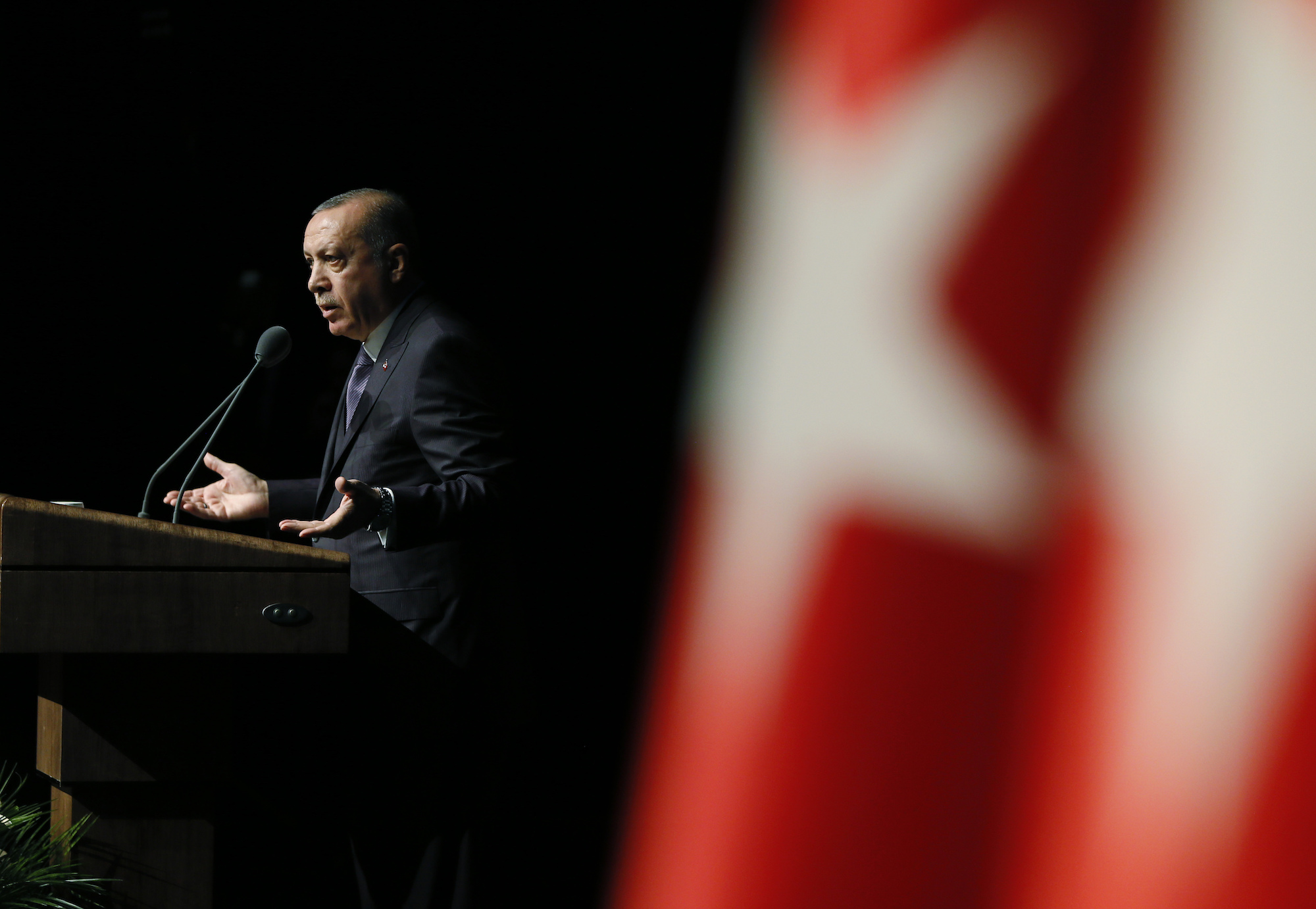
Turkish President Recep Tayyip Erdogan speaks at a symposium in Ankara, Turkey, Oct. 24. (Presidential Press Service via AP)
A much-anticipated speech on October 23 by Turkish President Recep Tayyip Erdogan on the death of Saudi journalist Jamal Khashoggi has further strained, but carefully avoided anything that would categorically rupture, Turkish-Saudi relations. Since Khashoggi disappeared after entering the Saudi consulate in Istanbul on October 2, an exchange of angry accusations and mutual recriminations has characterized the biggest crisis between the two countries in many years. But both sides have also been careful not to go too far and neither party wants to allow their rivalry to deteriorate into enmity or a confrontation. That careful calibration is likely to continue, particularly with Washington now fully engaged in the process of defusing the diplomatic crisis.
Erdogan emphasized two key points. First, he insisted that, contrary to Saudi accounts, the incident was a premeditated murder rather than an accident or a botched abduction or interrogation. Second, while Erdogan did not mention Saudi Crown Prince Mohammed bin Salman by name, several parts of his speech clearly pointed in his direction. Instead, he addressed all his questions and demands to King Salman bin Abdulaziz, rather than his son, Mohammed bin Salman. This kept the conversation at a more formal, head-of-state, level. But it also may have been subtly calibrated to isolate Mohammed bin Salman, and exploit any real or potential divisions between the monarch and his heir apparent. Therefore, the effort to keep up pressure was intentional and calibrated.
Through a series of questions about the incident directed toward the Saudi government in general, Erdogan adopted the role of a prosecutor laying out an indictment. From the outset of this affair, Erdogan and the Turkish government have presented themselves as neutral arbiters simply trying to determine the truth. But, of course, they have actually been pursuing a complex set of political and national objectives and taking advantage of an unanticipated opportunity to make significant headway on a number of crucial fronts.
Most important, perhaps, is the effort to utilize this crisis to aid the international rehabilitation of Erdogan himself. The widespread crackdown on political opposition in Turkey since the failed coup of July 2016 has prompted a growing chorus of global criticism. But Erdogan presents himself to the Turkish public and the world as a champion of order and legitimacy pushing back against the forces of chaos and violence. The Khashoggi affair was tailor-made to advance this perception not only in Turkey, but internationally. But to produce this effect, Erdogan has had to appear measured in most of his public pronouncements, leaving the more incendiary charges to his subordinates, usually anonymously quoted in Turkish media.
Second, Erdogan and Turkey are using the crisis to advance broader claims of global religious and cultural Islamic leadership, particularly in the Sunni Muslim world. In that regard, Saudi Arabia is one of Turkey’s most formidable competitors. On October 15, Erdogan proclaimed that “Turkey is the only country that can lead the Muslim world.” Saudi Arabia, of course, claims exactly such global Islamic leadership on the grounds of its history and geography, particularly as the birthplace of Islam and the site of the two holy sanctuaries, Mecca and Medina.
But this rivalry isn’t merely religious and national. It also has a powerful ideological dimension. Saudi Arabia, the United Arab Emirates, and others argue that the Middle East isn’t just divided between those aligned with and against Iran, an avowedly theocratic Shia power. They hold that there is a third ideological camp of Sunni Islamists, led by Turkey and Qatar, which includes Muslim Brotherhood movements. In effect, there are now two key strategic and political fault lines in the Middle East: support or opposition to growing Iranian power and a struggle for predominance in the Sunni Muslim world between pro- and anti-Islamist forces. Turkey is the most prominent and influential of what amounts to a Sunni pro-Islamist camp, while Saudi Arabia effectively leads an anti-Islamist one. In the Turkish-Saudi relationship, this contemporary ideological schism builds on long-standing suspicions that date back to the Ottoman Empire and Saudi efforts to establish and maintain national independence despite Turkish imperial opposition.
The boycott of Qatar is, perhaps, the most dramatic example of how this struggle is being waged in the Arab world at the moment, with Riyadh leading the effort to squeeze Doha, while Ankara serves as Qatar’s most committed ally. Indeed, the growing Turkish military presence in Qatar was an important part of the boycotting quartet’s complaints against Doha and removing it was among their core demands for ending the impasse. One of Riyadh’s key foreign-policy goals in recent years has been curtailing Turkey’s efforts to reassert regional influence, especially in the Arab world, as Ankara has turned its attention away from Europe and toward the Middle East, as well as fending off Turkey’s ambitions to lead the Sunni Muslim world. The Turkish alliance with Qatar in Saudi eyes combines both themes – countering the growth of a Sunni Islamist bloc in the Middle East and limiting the spread of Turkish influence, particularly in the Gulf region.
Erdogan’s reaction to the Khashoggi affair has been significantly shaped by this rivalry. The slow drip of allegations was designed to keep the story in the public eye and steadily increase the pressure on Saudi Arabia but without leading to a total break in relations. Turkey does not want a full-blown confrontation with Saudi Arabia and its allies and must be cognizant of nonpolitical factors such as extensive Saudi investments in the Turkish real estate market.
The leaks were also designed to bring the United States into the mix. Turkey did not want to face Saudi Arabia entirely on its own and wanted and needed U.S. help. Moreover, by forcing Washington to make this a three-way conversation, Turkey was also able to gain leverage over the United States as well as Saudi Arabia. From Saudi Arabia, Turkey will want financial benefits (or at least no cutoff of Saudi investment in Turkey) which it will probably secure. Turkey will also ask Saudi Arabia to pull back from supporting Kurdish groups in Syria, which is a taller order, and possibly to ease the boycott of Qatar, which is extremely unlikely. Any prospects for those more ambitious goals may depend on the quantity and quality of whatever evidence Turkish authorities are holding in reserve. Ankara will also try to ensure that Saudi Arabia won’t retaliate in any significant manner for the extreme embarrassment and discomfort resulting from Turkish accusations in recent weeks. Finally, by bringing the United States into the conversation and releasing the jailed American pastor Andrew Brunson, Erdogan is hoping to advance his own international rehabilitation.
Erdogan doesn’t want a total rupture of relations with Saudi Arabia, and particularly not another crisis with Washington. But he does see Saudi Arabia as a key rival that he would like to weaken as much as possible without instigating uncontrolled instability. So, from the outset he has seen this episode as a golden opportunity to weaken and corner Saudi Arabia, and thereby the entire Sunni anti-Islamist camp, to Ankara’s advantage. Moreover, he’s trying to stoke maximal international outrage toward Saudi Arabia and, especially, Mohammed bin Salman, including by pointedly not naming him in his speech even though other Turkish officials have gone to considerable lengths to link the crown prince’s inner circle to the suspects they identified.
The Turkish president’s primary goals are to render the Saudi crown prince personally and politically toxic, while promoting his own image and international rehabilitation. Both the Saudi government and Mohammed bin Salman are in damage-control mode and may have to calculate what they will be willing to offer Erdogan to stop him from publicizing additional damaging allegations or, especially, evidence, and to move past the incident. As usual in the contemporary Middle East, it’s nearly impossible, on both sides of this standoff, to untangle the leaders’ personal and political concerns from the broader national interests at stake.
The views represented herein are the author's or speaker's own and do not necessarily reflect the views of AGSI, its staff, or its board of directors.
Iranian attacks on Omani ports and oil tankers are straining Oman’s long-standing “friend to all” regional foreign policy, but Muscat still has a part to play in achieving peace.
Iran may still call itself an Islamic Republic. In practice, however, it increasingly resembles a state in which the military governs from behind clerical robes.
Though they were unsuccessful in preventing the current conflict, and, as expected, have been dragged into the U.S.-Israeli confrontation with Iran, Gulf Arab countries remain crucial to hopes for limiting the war and bringing it to a quick resolution.
After decades of tolerating Hezbollah’s warmaking independence, the current crisis has compelled Lebanese leaders to ban its military activities; this project will do much to determine the reach Iran can maintain in the Arab world.
Gulf Arab countries urged the United States not to strike Iran, but now that is happening, they are in danger of being sucked into a conflict they cannot control but that will likely reshape their present and future realities.
When quickly debunked rumors in the Israeli media that the UAE was seeking to manage postconflict Gaza were widely welcomed in Israel, it demonstrated both the trust the UAE has built among Israelis but also their lack of understanding of Emirati policies and interests.
On January 8, AGSI hosted a virtual roundtable with its leadership and scholars as they look ahead and assess trends likely to shape the Gulf region and U.S. foreign policy during the coming year.