How Trump’s National Security Strategy Will be Read in the Gulf
When Donald J. Trump was elected president of the United States just over a year ago, Washington’s Gulf Arab allies were generally optimistic. They were so alienated by President Barack Obama’s second term that almost any change would have been welcome. They expected to hear fewer complaints about democracy, and human and women’s rights, from...
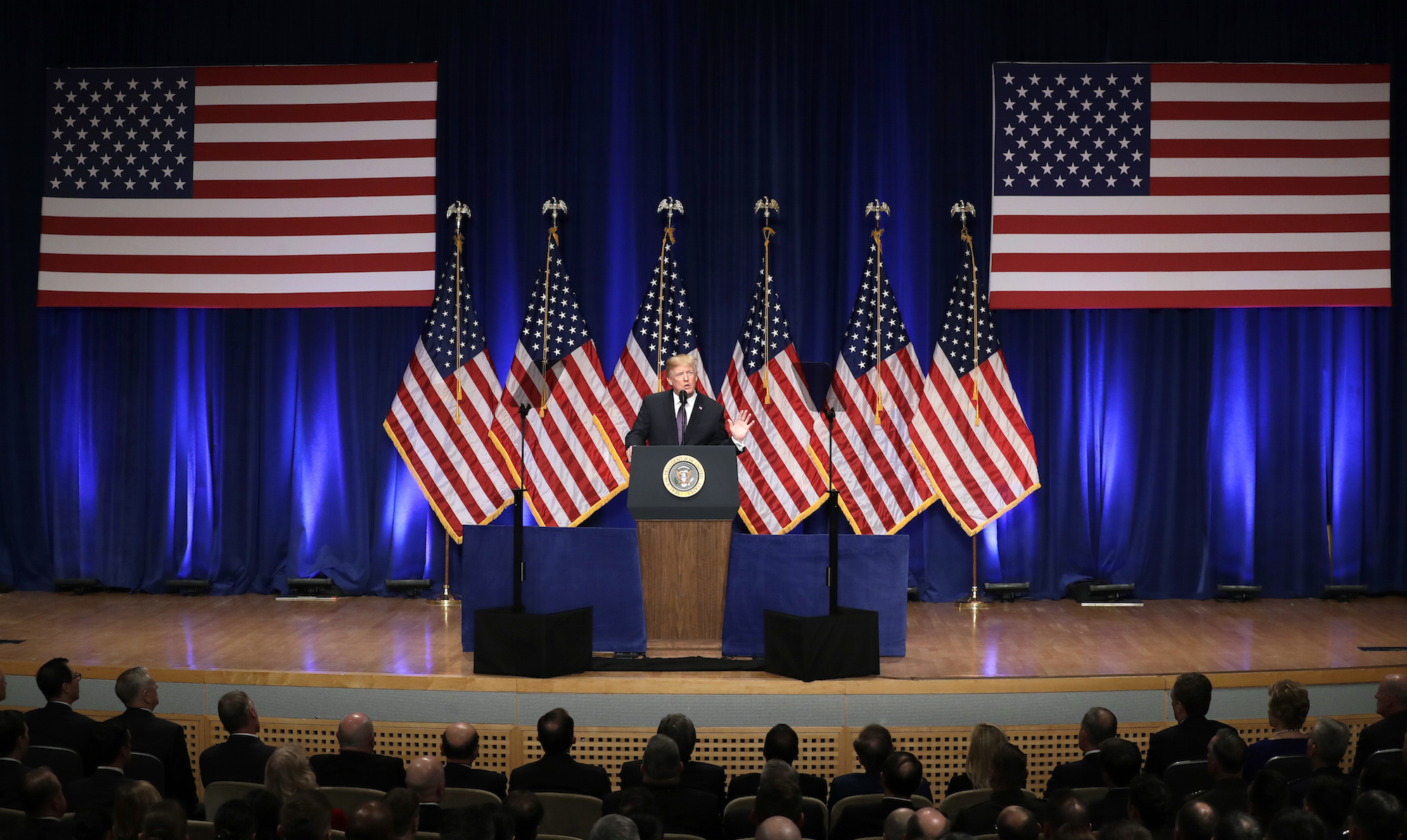
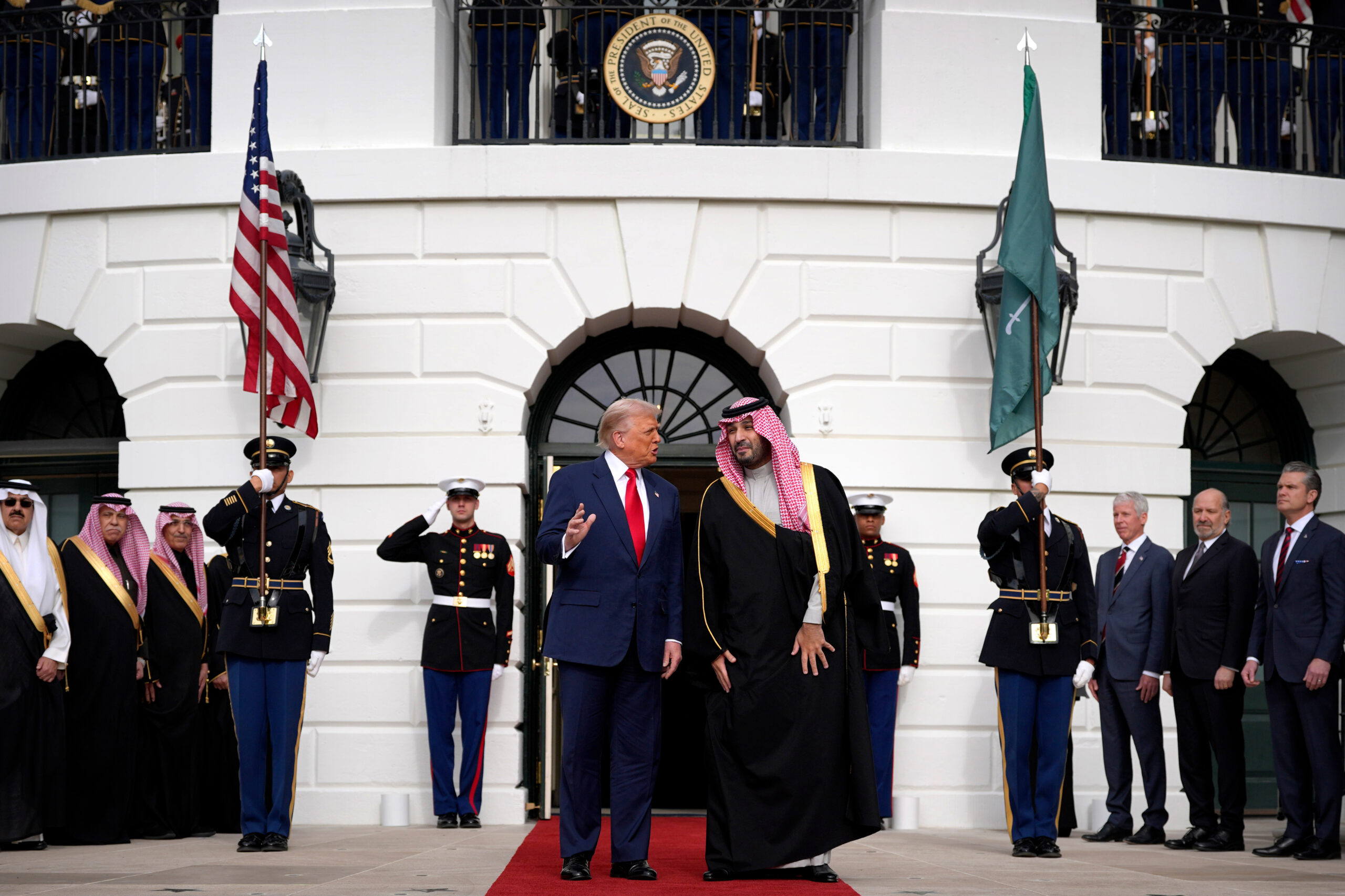
'U.S. President Donald J. Trump lays out a national security strategy in Washington, DC, Dec. 18. (AP Photo/Evan Vucci)'
When Donald J. Trump was elected president of the United States just over a year ago, Washington’s Gulf Arab allies were generally optimistic. They were so alienated by President Barack Obama’s second term that almost any change would have been welcome. They expected to hear fewer complaints about democracy, and human and women’s rights, from a Trump administration than from a traditional Republican or Democratic White House. And, especially, they were buoyed by Trump’s strong campaign rhetoric against Iran.
Thus far, they have not been disappointed. And they will, in general, welcome the contents of the administration’s National Security Strategy (NSS), released December 18, outlining the focus of U.S. foreign policy under Trump. The three main goals for the Middle East – combating “jihadist terrorists,” preventing the domination of “any power hostile to the United States,” and ensuring “a stable global energy market” – are fully consistent with the national interests of all of the Gulf Arab countries.
What the Gulf Countries Will Read into the NSS
The Gulf Arab countries will pay little attention to the ideological and often sharp domestic political content in the NSS. And they will be less perturbed than some other states, particularly in Europe, by apparent contradictions between passages reiterating a traditional values and rules-based U.S. approach and new elements reflecting a Trumpian “America First” agenda. Gulf Arab interests are quite specific, and therefore they will generally focus on those aspects of the NSS that appear to most directly address their relatively narrow concerns.
Above all, as with many U.S. partners around the world, they will strongly welcome the clear commitment in the new NSS to valuing, respecting, and prioritizing U.S. partnerships around the world and, especially, to Washington’s global leadership role. “America First” is plainly not being interpreted by the administration as a kind of neo-isolationism, as some of Trump’s supporters advocated and many others feared, and as might have been implied by the deep history of the phrase itself. Instead, the NSS unequivocally commits Washington to maintain, and in some cases even expand, its global and regional commitments.
If there appears to be a contradiction throughout the document – evident in the first paragraph of its introduction – between “a strategy of principled realism that is guided by outcomes, not ideology,” that is somehow also simultaneously “grounded in the realization that American principles are a lasting force for good in the world,” this will not raise many eyebrows in the Gulf region. Indeed, Washington’s Gulf Arab allies are likely to welcome the repeated assertions that “the American way of life cannot be imposed upon others,” and that values will not be a defining feature of Washington’s partnerships around the world, whereas shared interests and desired outcomes will be. In particular, they will welcome the assertion that “We are not going to impose our values on others. Our alliances, partnerships, and coalitions are built on free will and shared interests.”
Gulf Arab countries are likely to give more weight to those passages that emphasize the transactional character of Washington’s partnerships rather than more familiar recitations of the need to spread human rights, democracy, and other traditional American values. Yet even the passages that emphasize such values, particularly on women’s rights, will be even less problematic than statements made in the past, particularly in Saudi Arabia, given the significant reforms on gender discrimination currently underway in the kingdom.
Moreover, most Gulf countries will strongly welcome the assertion in the NSS that “The United States has learned that neither aspirations for democratic transformation nor disengagement can insulate us from the region’s problems.” This passage strongly implies that Washington has drawn what Gulf countries would regard as the correct lessons from the Arab Spring upheavals, yet understands that a continued strong U.S. role in the Middle East and the Gulf is indispensable. That is precisely what most of these governments (with the possible exception of Qatar, because of its support of the Muslim Brotherhood in Egypt and other Arab republics) would wish to hear. The additional observation that “We must be realistic about our expectations for the region,” will likely be viewed as further reinforcement of the dominant narrative in most Gulf countries, which champions carefully calibrated and managed, top-down, social and political transformations as opposed to uncontrolled revolutionary tumult. To emphasize this point, the NSS confirms “Whenever possible, we will encourage gradual reforms.”
The Fundamentals of Partnership
There is much in the NSS to reassure Washington’s Gulf Arab allies about the value the Trump administration places on alliances with traditional Middle East partners. Indeed, Trump’s introductory note boasts that “We have renewed our friendships in the Middle East,” which is precisely what Gulf Arab countries were hoping for following years of alienation from the Obama administration. They will especially welcome the commitment that “We will retain the necessary American military presence in the region to protect the United States and our allies from terrorist attacks and preserve a favorable regional balance of power.” There is no reference to a major U.S. “pivot to Asia” – an Obama-era concept that prompted considerable anxiety in the Gulf.
The unusual focus of this NSS on U.S. prosperity and economic security should work to the advantage of Gulf countries. Most of them have excellent trade balances with the United States, and serve as major markets for U.S. exports in general and in defense-related goods and services in particular. Insofar as the Trump administration judges its international relations based on a mercantile balance of payments, the Gulf countries are well-positioned to argue their case for being exemplary partners. Moreover, repeated calls for greater “burden sharing” by U.S. partners around the world and admonitions to “modernize, acquire necessary capabilities, improve readiness, [and] expand the size of their forces” will help bolster their case for more technology transfer and cutting-edge weapons sales. The United Arab Emirates, for example, is angling to purchase fifth-generation F-35 fighter jets and Saudi Arabia is seeking the Terminal High Altitude Area Defense (THAAD) anti-missile system. Burden sharing rhetoric also bolsters the case for the Saudi-led intervention in Yemen, which is increasingly being characterized in Washington discourse as a military quagmire and a breathtaking humanitarian crisis. Yet, if burden sharing is to be taken seriously, the Yemen campaign, whatever its drawbacks and failings, must in part be seen as a meaningful response to such a demand.
Gulf Arab countries might be expected to dislike passages in the NSS identifying “energy dominance” as a new U.S. national security goal. In fact, this is very unlikely to cause any concern, let alone friction. The text defines the rather grandiose term “energy dominance” in a surprisingly modest, practical manner: “America’s central position in the global energy system as a leading producer, consumer, and innovator.” This is neither new nor problematic for Gulf Arab countries. Moreover, the United States has long since ceased to be a major export market for most Gulf energy products, whereas their markets in South and East Asia do not appear to be threatened. The technological and other changes that have resulted in a global energy glut were unavoidable, and because most energy products and money are fungible, U.S. “energy dominance” as defined in this way poses no economic or security threat to Gulf Arab energy exporters. Indeed, pledges in the NSS to “work with allies and partners to protect global energy infrastructure from cyber and physical threats,” and “encourage other countries to develop their own” strategic petroleum stocks will be fundamentally reassuring.
Iran
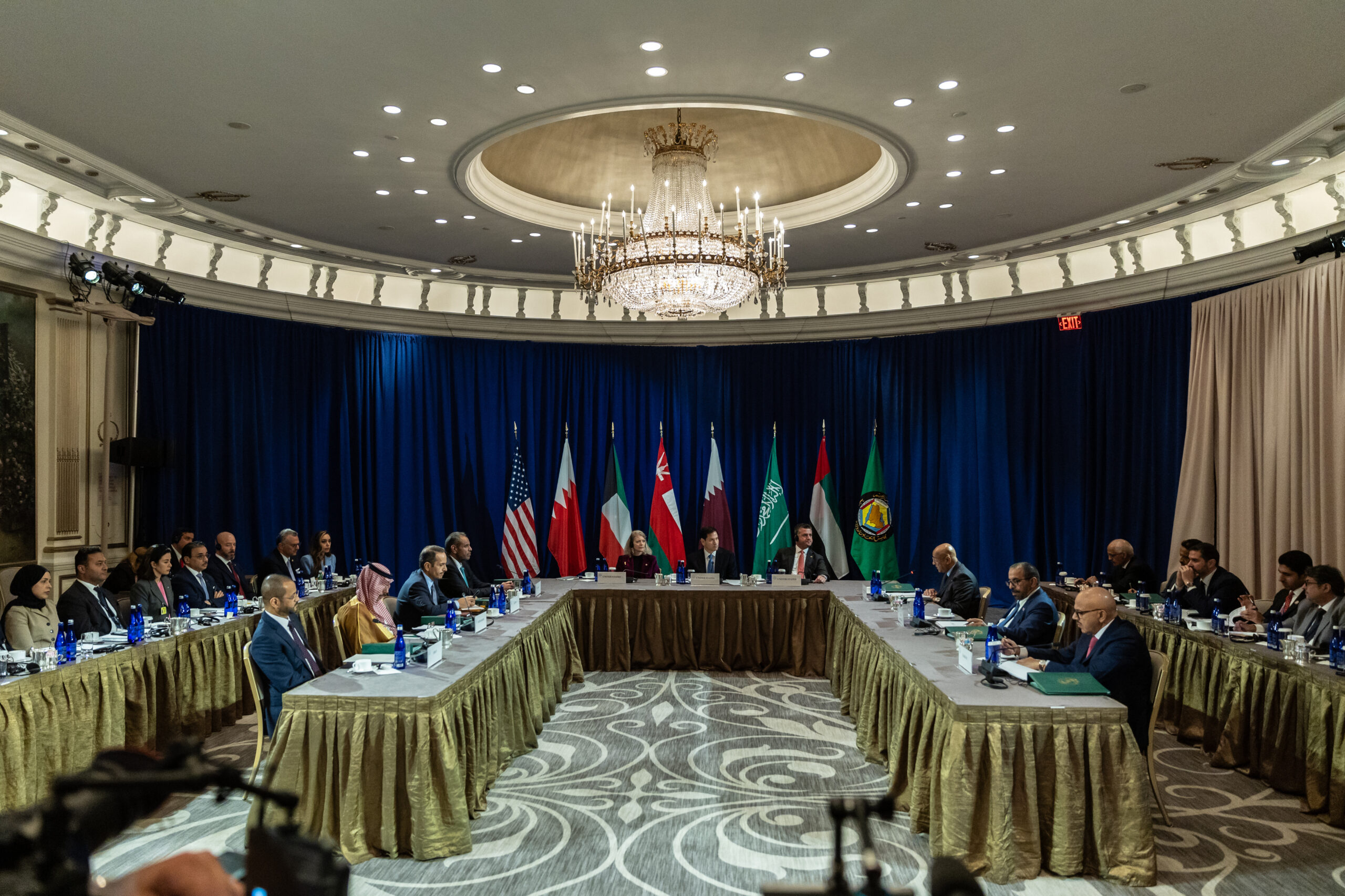
The Gulf Cooperation Council countries, all close partners of the United States, have numerous differences, perhaps most dramatically illustrated by the ongoing boycott of Qatar by Saudi Arabia, the UAE, Bahrain, and Egypt. But they essentially agree that Iran poses the most serious strategic threat to their interests and to the region. There is much in the NSS to reinforce their belief that the Trump administration is taking a tougher line toward Tehran and its proxies, at least rhetorically. Iran and North Korea are repeatedly identified as “rogue regimes,” a phrase that had been jettisoned during the entire eight years of the Obama administration. Iran stands directly accused of sponsoring “terrorism around the world,” “developing more capable ballistic missiles,” and potentially resuming its nuclear weapons research and development. Gulf Arab countries will certainly welcome repeated pledges to combat “Iranian-backed groups such as Lebanese Hezbollah.”
Despite the strong language about Iran in the NSS, the document does not suggest any actionable strategy for confronting Iran and its proxies or rolling back their influence. It does not seriously consider Iran’s role in Syria or Iraq, or acknowledge the recent acquisition by Tehran and its proxies of key areas along the Iraqi-Syrian border, which, if consolidated, could create a long-sought land bridge between Iran and the Mediterranean Sea. The NSS complains that “Iran, the world’s leading state sponsor of terrorism, has taken advantage of instability to expand its influence through partners and proxies, weapons proliferation, and funding.” But this and several similar passages are essentially descriptive rather than prescriptive, and do not indicate in any meaningful way what, beyond strengthening regional partnerships and maintaining its military presence, Washington intends to do to disrupt or reverse this expansion.
The GCC
The NSS repeats Washington’s commitment to “a strong and integrated Gulf Cooperation Council,” which, in context, appears to be a subtle and implicit encouragement to resolve the dispute with Qatar. While National Security Advisor H.R. McMaster has been accusing Turkey and Qatar – implicitly in coordination – of becoming the new primary sponsors and funders of groups promoting violent Islamic extremism, there is nothing in the NSS reflecting this perspective. It affirms that “Some of our partners are working together to reject radical ideologies,” which certainly refers to Saudi Arabia and the UAE, but may or may not be intended to include Qatar and others. It again suggests that Washington’s “partners procure interoperable missile defense” capabilities, a long-standing U.S. goal for the GCC, which shows no signs of being advanced in practice in any serious way.
Israel and Jerusalem
The latest irritant between Washington and its Gulf Arab partners is the recent announcement by Trump that the United States recognizes Jerusalem as the capital of Israel. The administration has been pursuing the prospect of an “outside-in” approach to Middle East peace by bringing Gulf Arab countries, among others, into the peace process and creating an expanded dialogue with Israel about resolving the Palestinian issue and confronting Iran. This has been greatly complicated by the Jerusalem announcement. The NSS does not reference this issue directly, but states that while “the conflict between Israel and the Palestinians has been understood as the prime irritant preventing peace and prosperity in the region,” now “the threats from jihadist terrorist organizations and the threat from Iran are creating the realization that Israel is not the cause of the region’s problems.” This passage implies that Washington still intends to promote an outside-in agenda based on the mutual threats from terrorism and Iran, and does not believe that Israel’s occupation, even in Jerusalem, is a major issue over the long run for many Arab countries, especially in the Gulf. Such expectations may underestimate the continued political, religious, and diplomatic significance of Palestinian issues, and particularly Jerusalem, in the Arab and Islamic worlds, including in the Gulf.
The Gulf Will Want Deeds to Follow Words
Overall, the NSS will be strongly welcomed in the Gulf, despite the lack of specifics regarding what the United States intends to do, practically, to combat the spread of Iranian influence in the region. But the repeated assurances that traditional alliances are vital, not predicated on the spread of American values, centered around transactional and instrumental outcomes, and based on shared interests rather than ideologies will be most welcome. Jarring notes such as the passage asserting that “jihadist terrorists attempt to force those under their influence to submit to Sharia law” will be dismissed, probably correctly, as nods to domestic constituencies that respond to such inapposite buzzwords. Because most of its content is so closely aligned with their own interests, Washington’s Gulf Arab allies will be hoping that the key themes of the NSS prove not to be limited to rhetoric and aspiration, but are translated into practical, effective policies.
The views represented herein are the author's or speaker's own and do not necessarily reflect the views of AGSI, its staff, or its board of directors.
Iran may still call itself an Islamic Republic. In practice, however, it increasingly resembles a state in which the military governs from behind clerical robes.
Iran’s attacks have perhaps irrevocably damaged Qatari-Iranian bilateral relations and erased the last few years of broader rapprochement efforts between Iran and the GCC states.
Though they were unsuccessful in preventing the current conflict, and, as expected, have been dragged into the U.S.-Israeli confrontation with Iran, Gulf Arab countries remain crucial to hopes for limiting the war and bringing it to a quick resolution.
After decades of tolerating Hezbollah’s warmaking independence, the current crisis has compelled Lebanese leaders to ban its military activities; this project will do much to determine the reach Iran can maintain in the Arab world.
Gulf Arab countries urged the United States not to strike Iran, but now that is happening, they are in danger of being sucked into a conflict they cannot control but that will likely reshape their present and future realities.
When quickly debunked rumors in the Israeli media that the UAE was seeking to manage postconflict Gaza were widely welcomed in Israel, it demonstrated both the trust the UAE has built among Israelis but also their lack of understanding of Emirati policies and interests.
On January 8, AGSI hosted a virtual roundtable with its leadership and scholars as they look ahead and assess trends likely to shape the Gulf region and U.S. foreign policy during the coming year.