Hearing Them Softly: Emirati Discourse Management Works the Rift
To respond to harsh Saudi criticisms, the Emiratis have sought to reframe, deflect, and calibrate, avoiding escalation while also benefitting from powerful advocates, including Senator Lindsey Graham.
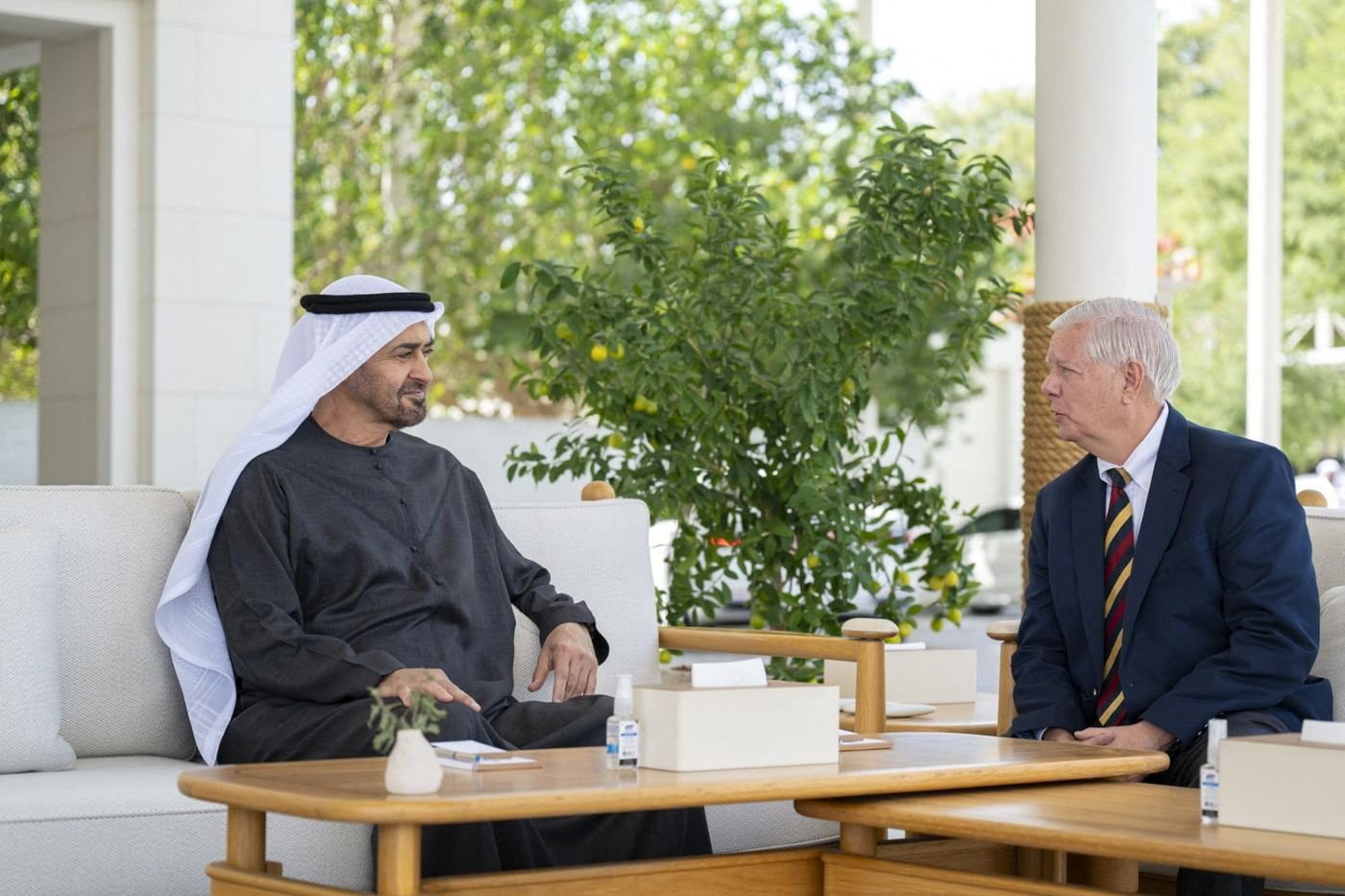
United Arab Emirates President Mohammed bin Zayed al-Nahyan meets with Senator Lindsey Graham in Abu Dhabi, UAE, February 18. (WAM NEWS AGENCY/Handout via REUTERS)
The now 2-month-old rift between the United Arab Emirates and Saudi Arabia continues, although in the past 10 days or so the fault line has not looked quite as treacherous as it did in January. The February 18-19 visit of Republican Senator Lindsey Graham, first to Abu Dhabi and then Riyadh, made clear the controversy still has Washington’s attention. The Abu Dhabi portion of the visit also clarified that the UAE has a powerful advocate in its corner. In his public comments before and after his meeting with UAE President Mohammed bin Zayed al-Nahyan, Graham pushed back forcefully against Saudi criticisms, official and in the media, dismissing them as “false narratives against the United Arab Emirates.” Graham took particular umbrage at Saudi criticism, voiced most forcefully by the former Shura Council member and former dean of King Saud University, Ahmed Altuwaijri, that the UAE was pursuing normalization with Israel to undermine Saudi regional interests and serve Israeli strategic objectives. Graham demanded that the critics “knock it off” continuing that he is “tired of this crap” and issued a warning that they would be held to account if such criticism continued. Graham described the UAE’s decision to embrace the Abraham Accords and pursue regional integration as exceptionally consequential and brave.
Graham also traveled to Riyadh, meeting with Saudi Crown Prince Mohammed bin Salman, afterward praising Saudi Arabia as “the key to the puzzle.” He expressed hope that a dialogue between Saudi Arabia and the UAE could be started as soon as possible to resolve their disputes on Yemen and Sudan. Referring only in oblique terms to the sharp disagreement he expressed in Abu Dhabi, focused on Saudi criticism of Emirati normalization with Israel, Graham stressed that Mohammed bin Salman remained committed “to his original vision that includes regional integration” and to “a dignified solution for the Palestinian people.”
While the Graham visit was overtly evenhanded, the choice to visit Abu Dhabi first was noteworthy, and a good deal of the senator’s more forceful language also seemed designed to bolster Abu Dhabi and to put pressure on Riyadh to temper its public criticisms of the UAE and open a channel of dialogue. In that sense, the Emiratis relied on the kindness of a powerful friend, with the ear of President Donald J. Trump. It is a tactic they have been able to deploy with telling effect as they have accumulated power and influence in the region over the past several decades. Of course, as each side has relied on friends or direct access to the White House, at different stages of the dispute, but apparently not much on direct communication with each other, the possibility of miscommunication exacerbating either or both sides’ reactions cannot be ruled out.
The Emiratis Break Out Their Discourse Management Playbook
In addition to benefitting from powerful advocates like Graham, the Emiratis have also drawn from their discourse management playbook in revealing ways to contain the rift with Saudi Arabia. First, the Emirati response leaned on silence for the most heated charges leveled by Saudi pundits in the media or by social media users. To avoid escalation, Emirati responses have generally avoided taking up or directly countering the sharpest Saudi rhetoric, for example, charges of being a “Zionist trojan horse” or of acting in ways that subordinated Arab and Islamic solidarity to strategic ambition. The strategy has been to avoid escalation and counteraccusations while declining to validate the premise of these sharp, unofficial criticisms.
The Emiratis have also sought to reframe criticisms, including those focused on normalization and cooperation with Israel, and ease them into a strategic framework, with technocratic language that emphasizes sovereign decision making, regional security, and pragmatic engagement. The emphasis is often on functionality as opposed to identity. They have also relied on a different rhythm of response. If the Saudi rhetorical attacks seemed to come in waves – with official criticism, media escalation, and ideological framing – the Emiratis altered the rhythm in responding, opting for absorbing, deflecting, and waiting.
Managing Discourse to Mitigate Reputational Risk
The Emiratis also sometimes changed language, getting responses out in English in ways that widened the international prism of the dispute, brought in allies, and helped them, for example, move into the safer rhetorical waters of a cool “Gulf policy dispute” rather than a heated “controversy” over degree of faithfulness to Arab and Muslim communities of interest that could heighten reputational risk. For a middle power operating with outsized influence internationally, discourse management and mitigating against strategic reputational risk are key tools of statecraft, shaping everything from power projection and partnerships to vital security linkages and foreign investment.
Brotherly Ties Remain the Watchword
Even as they have absorbed, deflected, altered response rhythms, and internationalized, the Emiratis have also consistently reaffirmed their “brotherly ties” with Saudi Arabia and their shared strategic interests as neighbors. Emirati sources, including in official statements during the dispute, have made clear they recognize those “fraternal and historical relations between the two countries constitute a cornerstone of regional stability.” Linked to this reaffirmation of brotherly relations enveloping this dispute, the December 30, 2025 statement points to shared interests in fighting terrorism and extremism, preserving security and stability, and protecting sovereignty as well as to shared approaches relying on coordination and seeking opportunities for de-escalation. Echoing a broader point made on December 30, 2025 by Anwar Gargash, an Emirati presidential advisor, the statement underscores the need for restraint and wisdom, implying it too is a shared approach that is urgently needed. Influential Saudi voices eventually picked up this theme of brotherly relations, signaling continuity as well as shared history and identity, in tandem with the need for dialogue, even in the midst of the dispute.
With careful discourse management – and, occasionally, a little help from their friends – the Emiratis have approached the dispute with the Saudis as something to be statecrafted rather than fought out in public. The strategic differences are real and will not disappear. But keeping the argument contained, buffered by external relationships, has been the first line of effort.
The views represented herein are the author's or speaker's own and do not necessarily reflect the views of AGSI, its staff, or its board of directors.
Disputes in the Gulf tend to be structurally constrained by dense interdependence, established patterns of dispute management, and various shades of elite empathy among leaderships.
February talks between Saudi Arabia and Turkey signaled the emergence of a pragmatic regional order grounded in economic complementarity, defense cooperation, and shared anxieties about instability.
Disputes in the Gulf tend to be structurally constrained by dense interdependence, established patterns of dispute management, and various shades of elite empathy among leaderships.
Syria’s challenge moving ahead will be the difficult effort to develop a political system that will empower Syria’s people to embrace the more pedestrian but necessary political compromises upon which inclusion and representative government are based.
The recent visit by the Saudi crown prince to Washington turbocharged prospects for U.S.-led mediation on Sudan, but the case for skepticism remains compelling.
While the Syrian president is the one coming to Washington, he and President Trump each have flipped the script, surprising skeptics with bold action and fresh approaches, opening a desperately needed conversation on Syria.
On January 8, AGSI hosted a virtual roundtable with its leadership and scholars as they look ahead and assess trends likely to shape the Gulf region and U.S. foreign policy during the coming year.