Demographics Mean That Job Creation Is Top of the Saudi Economic Policy Agenda
With young Saudis continuing to enter their working age years in large numbers, robust employment gains need to continue, but slower non-oil growth may present a challenge.
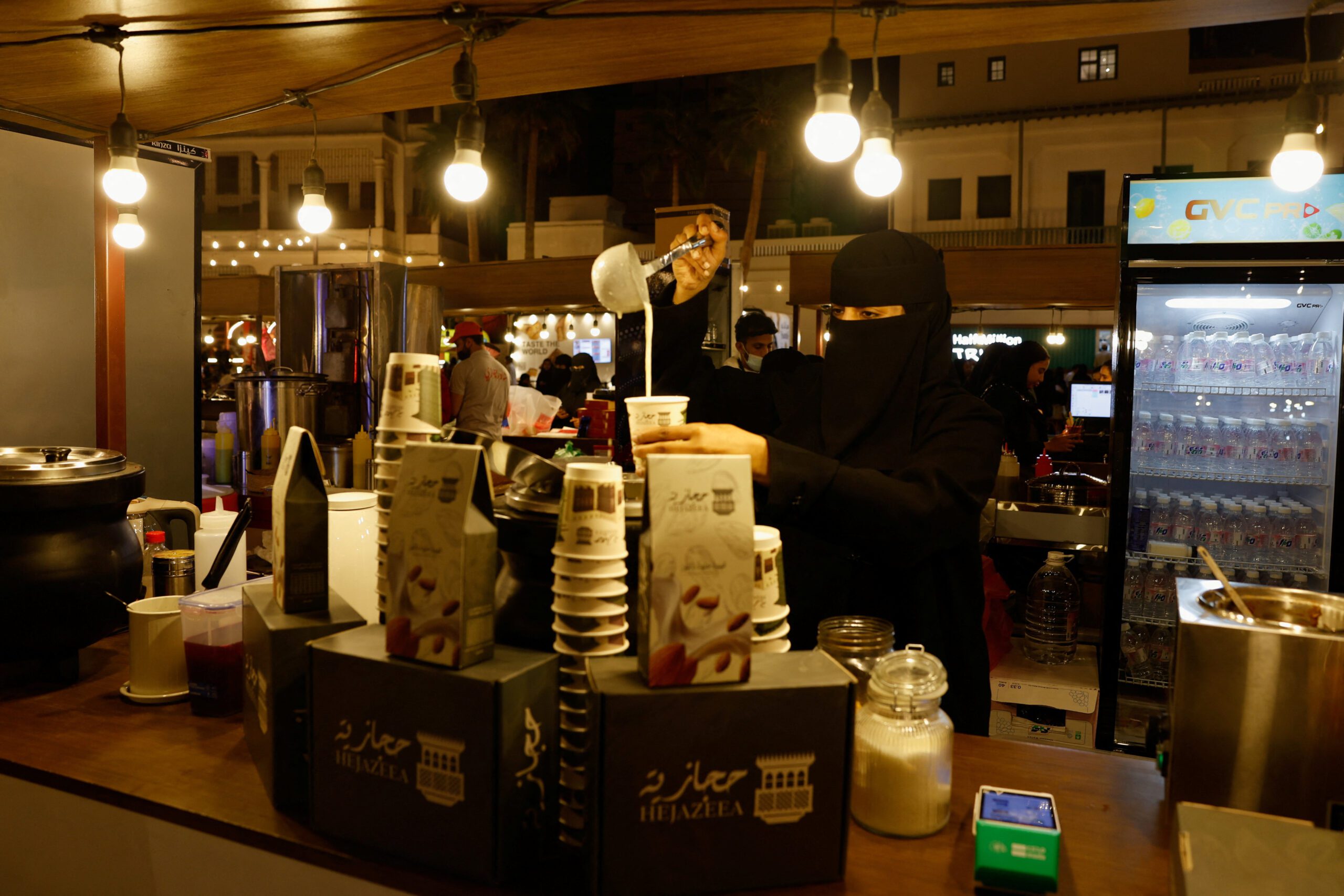
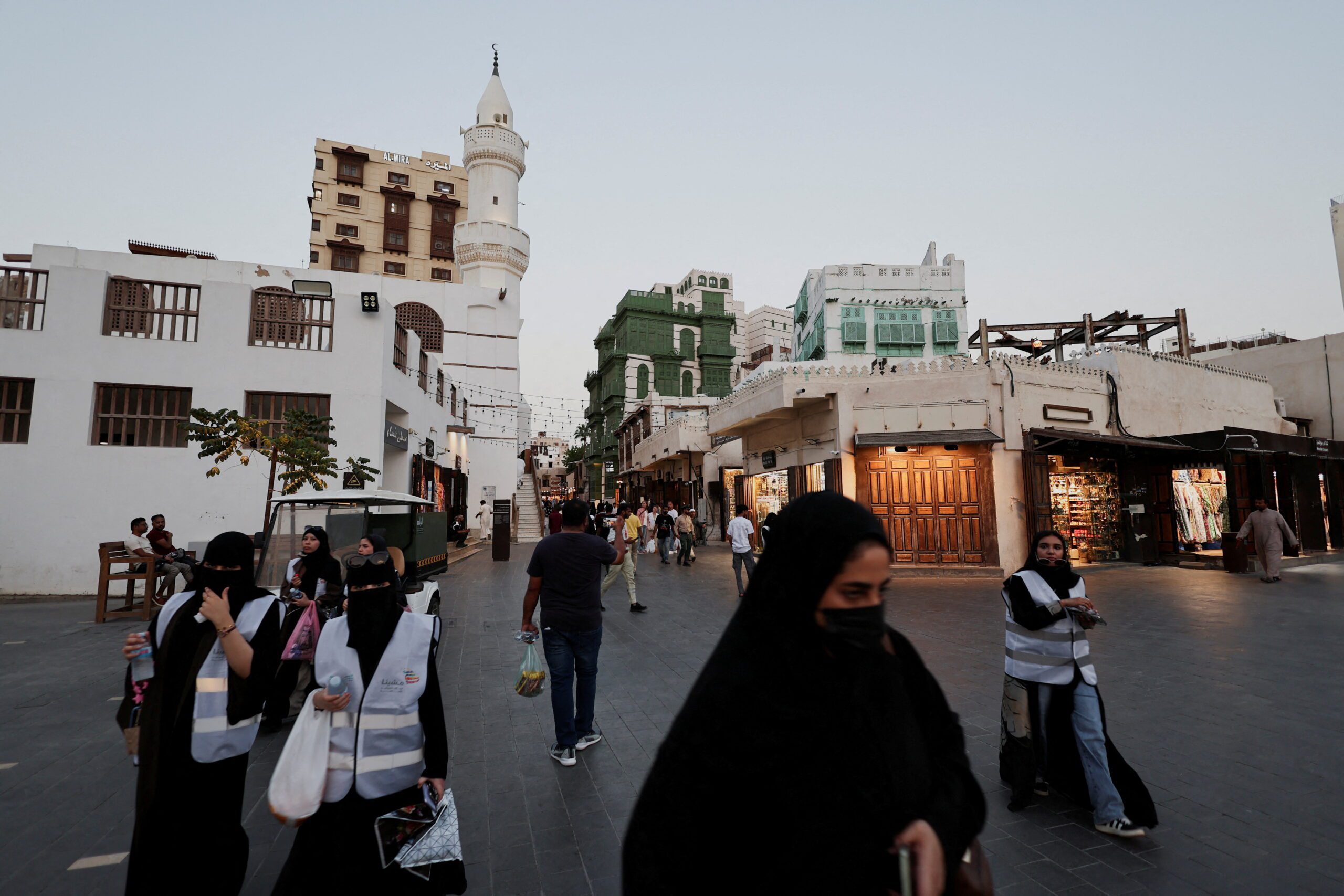
A woman prepares beverages in the historic old city of Al-Balad in Jeddah, Saudi Arabia, February 24. (REUTERS/Ibraheem Abu Mustafa)
Saudi Arabia has a young population. Over one-half of Saudis (10.3 million people) are below the age of 25 and two-thirds of these (6.6 million) are younger than 15 years old. This pool of current and future young workers provides Saudi Arabia with the opportunity to reap a “demographic dividend” if demand for labor increases with the expanding labor supply. This opportunity, however, comes with risks. If insufficient jobs are created, unemployment will rise with associated negative social and economic implications.
The Saudi government is therefore putting considerable emphasis on creating jobs for Saudis. The Ministry of Human Resources and Social Development has announced the launch of the next phase of the Nitaqat Mutawar Program. Nitaqat sets minimum shares of Saudi employment for companies, depending largely on the sector they operate in and the size of the firm. The next phase of the program is designed to expand the number of Saudis working in the private sector by 340,000 over the next three years. The program has announced how the shares of Saudi employment will increase over the next three years to allow companies time to plan and adjust. The Nitaqat program is one of numerous interventions the government has made in the labor market to boost Saudi employment in the private sector. These interventions include offering wage subsidies and training support to Saudis, increasing the cost of employing expatriate labor, and providing support to women workers, including to defray transportation and child care costs.
The goal of creating 340,000 new jobs may sound ambitious, but it will not be enough to absorb the expected growth in the labor force in the coming years. The good news is that the number of Saudis who found work in the private sector during the previous phase of the Nitaqat program far exceeded the initial target (also 340,000 over three years), as economic growth exceeded expectations. The bad news is that growth in the private non-oil economy is unlikely to be as strong over the next three years as it was during 2022-25. This means the challenge of job creation will get more difficult.
Private Sector at the Forefront of Job Creation
The unemployment rate among Saudi nationals has fallen sharply in recent years. This decline has come at a time when the working age population has grown strongly, by 3.2% or around 400,000 annually. Strong job creation has allowed new labor market participants and some of those previously unemployed to get jobs.
The number of employed Saudis increased by 690,000 between the end of 2021 and the third quarter of 2025, reaching 4.1 million according to the register-based data published by the General Authority for Statistics. This data does not include military and security personnel nor workers who are not registered with the General Organization for Social Insurance, including the self-employed and freelancers. With these additional workers included, the total number of employed Saudis is estimated to be around 6.2 million (author estimate as the statistics authority does not publish this broader measure of employment).
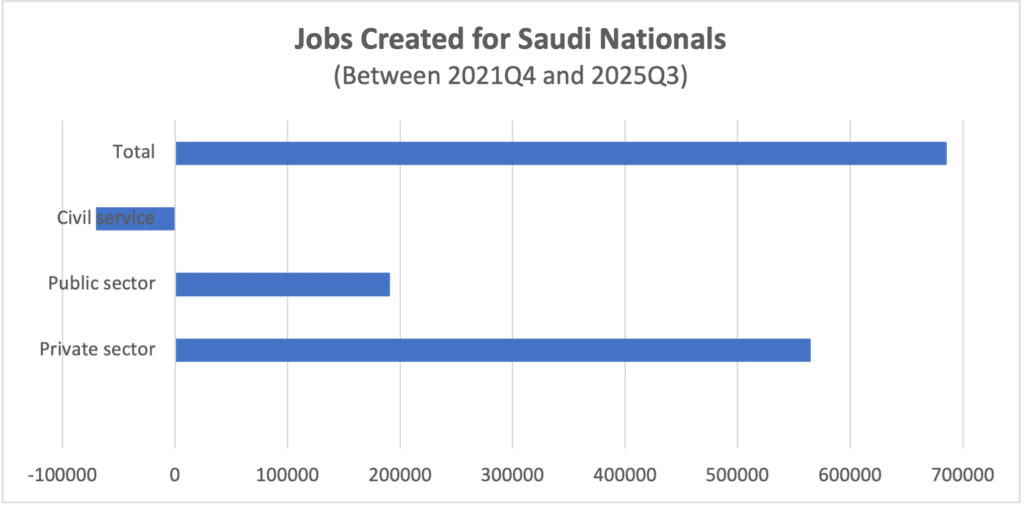
What is striking is that most of the job creation has been in the private sector, where more Saudis are working than ever before. This is visible when visiting the kingdom and is evident in the employment data. Of the 4.1 million working Saudis in the register-based data, 2.5 million were reported as being employed in the private sector in the third quarter of 2025 compared to 1.9 million in 2021. Over the same period, employment in the civil service declined by 70,000 to 1.1 million, and other public sector employment (which could include contractual appointments with the government and people working for public sector entities) increased by 191,000 to 518,000. Gains in employment in the private sector accounted for over 80% of the total increase in Saudi employment.
Sources: General Authority for Statistics; General Organization for Social Insurance
The increase in Saudi employment in the private sector reflects four factors:
Strong economic growth: During 2022-25, real private non-oil gross domestic product and Saudi employment in the private sector both grew by 30%. Each 1% of economic growth was associated with a 1% increase in Saudi employment.
Decline in civil service employment: Civil service jobs have been harder to come by as the government has made efforts to contain its wage bill. The 6% decline in civil service employment over the past four years compares to growth of 3% during 2017-21 and 28% growth during 2011-15.
Saudization: Government policy has encouraged companies to hire more Saudi workers. Saudization requirements under the Nitaqat program have been tightened, meaning that companies have had to employ more Saudi workers or face penalties.
Increased women’s participation: Legal and cultural restrictions on Saudi women working and participating in economic activities have largely been removed. This has resulted in an increased supply of well-educated and motivated workers becoming available to employers. Since the end of 2022, women have made up 60% of the increase in Saudi employment.
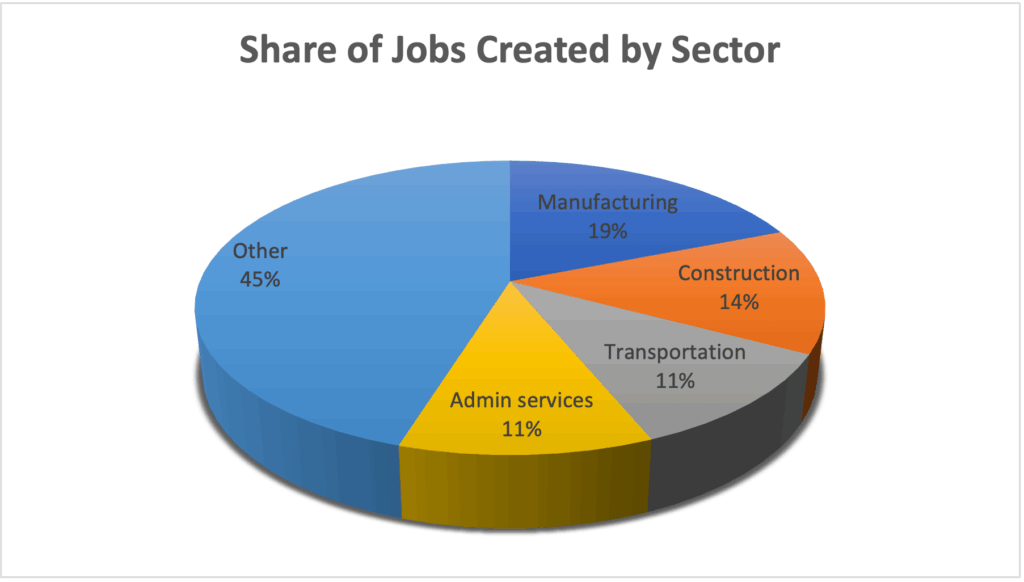
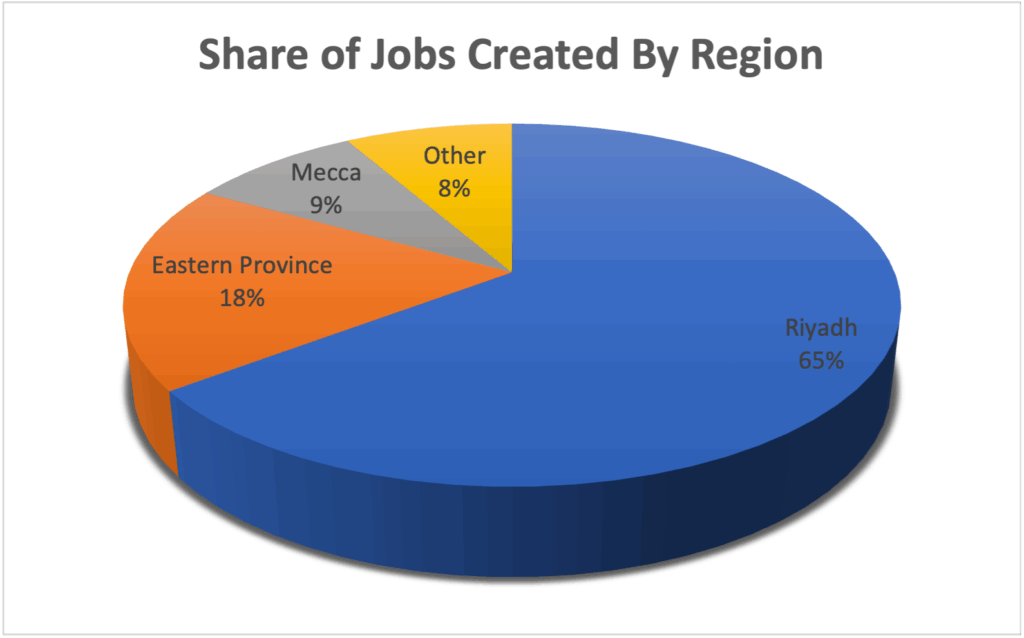
Four areas have accounted for over 50% of the increase in Saudi employment – manufacturing (19%), construction (14%), transportation and communication (11%), and administrative services (11%). Surprisingly, both the “retail and wholesale” and “accommodation and food services” sectors have shed Saudi jobs. The Riyadh region has been the center of employment creation, with 65% of new jobs being created there. This employment growth in Riyadh is consistent with other evidence of the strong economy in the region, including real estate price growth, which has been twice the national average since the end of 2021, and consumer price inflation, which has been three-quarters of a percentage point higher each year than the national average.
Sources: General Authority for Statistics; author calculations
Sources: General Authority for Statistics; author calculations
While impressive, the gains in Saudi employment need to be put in perspective. Over the same period, the number of nonnationals employed increased by 4 million – nearly six jobs have been created for nonnationals for every one new job for Saudis. The strong growth in expatriate employment has largely been driven by construction, although manufacturing, transportation and communication, and “other activities” have also grown strongly. The fact that there is overlap between the sectors with high job growth for nationals and nonnationals suggests there is complementarity between the two sources of labor input, which is at least partly driven by the requirements of Nitaqat (to increase the employment of nonnationals, firms have to increase Saudi employment to maintain required Saudization percentages).
A potential caveat to the above analysis is that it is not clear how “private sector” is defined in the statistics. A particularly important question is whether the Public Investment Fund and its subsidiary companies are treated as “private” or “public” entities. If the former, the growth in private employment may be overestimated (and public sector underestimated). A related issue is how many of the private sector jobs are in companies reliant on public sector contracts. While these would appropriately be classified as private sector, these jobs are reliant on public sector spending and will be susceptible to any spending cutbacks.
More Jobs Needed
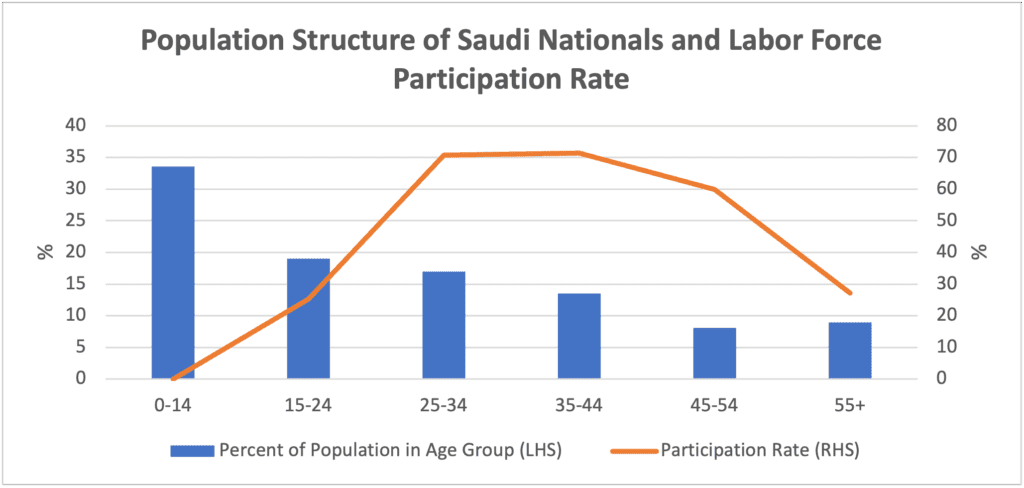
Given the demographics of Saudi Arabia, strong employment growth will need to continue. Not only will there be a large volume of new entrants into the working age population in the coming years, but also many people will be moving into the age range where labor force participation rates rise. The average labor force participation rate in the 25-34 age group is around 70% compared to 25% in the 15-24 age group. This means that the labor force is going to continue to grow rapidly in the coming years.
Sources: General Authority for Statistics; author calculations
Assuming the current age-specific participation rates do not change, the Saudi labor force could increase by some 950,000 people between mid-2024 (the last date for which population data is available) and mid-2029. If the age-specific participation rates were to each increase by 2 percentage points from their current levels, the labor force increase could be closer to 1.25 million people. To maintain the Saudi unemployment rate at its current level, this would mean that between 880,000 and 1.17 million new jobs for Saudis would need to be created.
Policy Challenges Ahead
Creating 1 million new jobs by mid-2029 sounds like a tall order, although a good start has been made with 43,000 new jobs being created on average each quarter since mid-2024. Nevertheless, there are likely to be two constraints to maintaining this pace of job creation. First, private non-oil GDP growth is likely to be slower in the period ahead than it has been in the recent past. If private non-oil growth averages 4% per year going forward, this would generate around 400,000 private sector jobs for Saudis over the next four years (if 1% growth translates to 1% employment growth). Second, the growth in public sector employment of recent years may not be repeated, as the need to set up new bodies and agencies to help implement Vision 2030 is abating.
Labor market policies are going to have to step up to enable more Saudis to secure jobs. Part of this will involve policies to enhance the skills and productivity of Saudi workers, including through better education and training. However, while vital to the success of the economy, improving education is a long-term endeavor. Better on-the-job training programs are a potential shorter-term solution, and the expansion of these is already being pursued through partnerships with foreign companies and training institutes. A trickier issue is whether there is room to further tweak policies to encourage companies to hire Saudi rather than foreign workers. Here difficult trade-offs are apparent because of different skills, costs, and productivity of the workers. Pushing too far with such policies will undermine the growth and profitability of companies, and ultimately this will negatively affect employment; pushing too little will likely result in rising unemployment. The Ministry of Human Resources and Social Development balanced these trade-offs as it developed the Saudization targets under the new phase of the Nitaqat program, but it remains an open question whether the program can help create sufficient jobs in the coming years to satisfy the employment needs of the population.
The views represented herein are the author's or speaker's own and do not necessarily reflect the views of AGSI, its staff, or its board of directors.
The recent increase in the Saudi unemployment rate is puzzling and may be due to statistical issues with the Labor Force Survey rather than a reflection of economic conditions.
As the Gulf countries transition to a new energy order, creating “good jobs” in high-value export-oriented services that provide citizens with adequate benefits, economic security, and career ladders will help these economies diversify and achieve increased growth.
As Gulf governments accelerate domestic development agendas, local job creation and tax revenue are measurable indicators of successful economic policymaking.
Saudi equity prices have risen since the start of the Iran conflict, outperforming many regional and global markets. Whether this continues will depend on how and when the conflict ends.
The conflict with Iran has curtailed the supply of oil from the Gulf, pushing up the price of the medium and heavier grades it usually exports relative to lighter grades.
The 2025 budget deficit was larger than expected. The 2026 deficit is also likely to exceed the budget target, but higher oil prices may help contain any overrun.
On January 8, AGSI hosted a virtual roundtable with its leadership and scholars as they look ahead and assess trends likely to shape the Gulf region and U.S. foreign policy during the coming year.