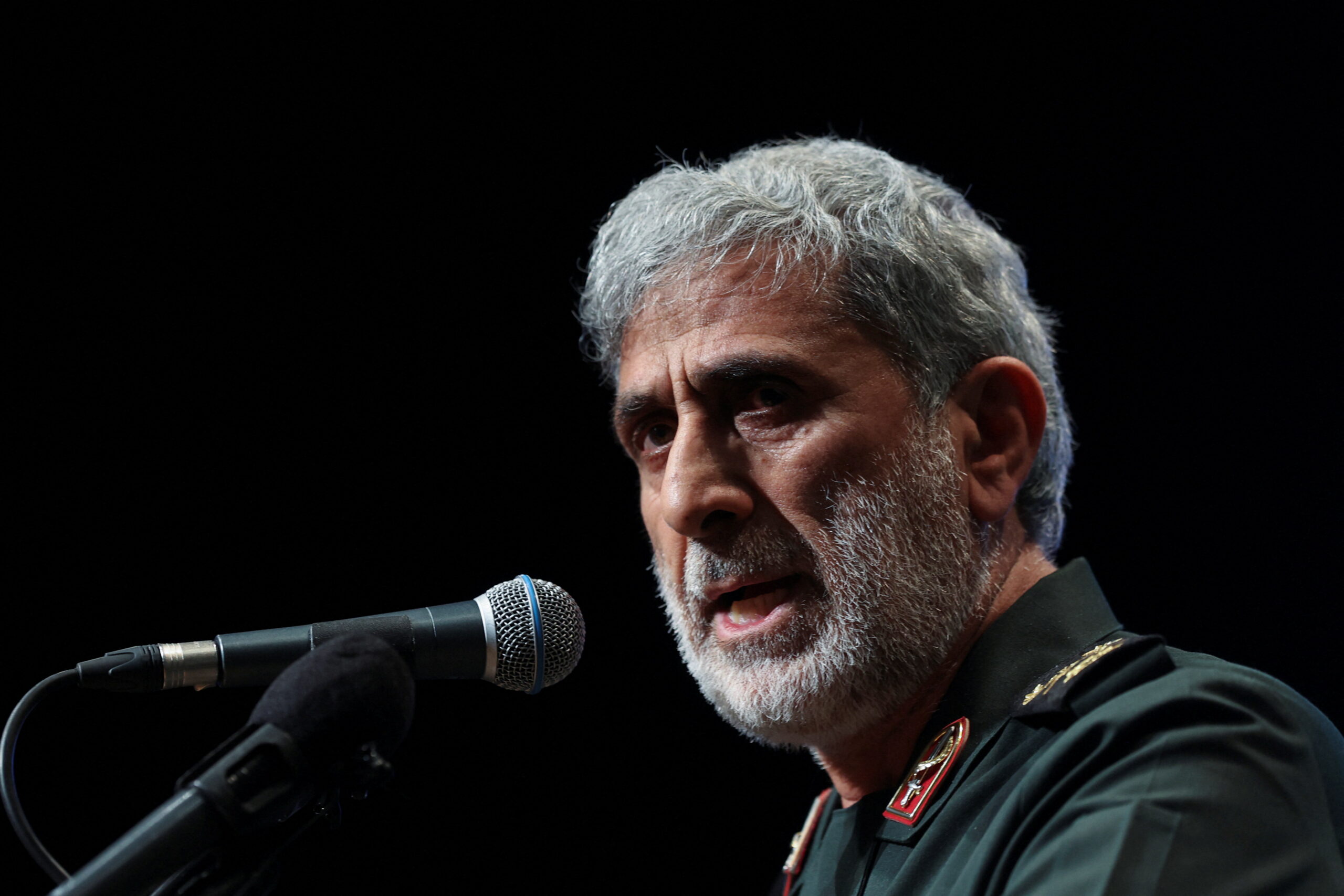
Brigadier General Esmail Qaani, the head of the Revolutionary Guards' Quds Force, speaks during a ceremony marking the anniversary of the death of senior Iranian military commander Mohammad Hejazi, in Tehran, Iran April 14, 2022. (Majid Asgaripour/West Asia News Agency via REUTERS)
On January 20, 2020, a visibly emotional Brigadier General Ismail Qaani received Supreme Leader Ayatollah Ali Khamenei’s decree appointing him commander of the extraterritorial operations Quds Force of the Islamic Revolutionary Guard Corps. “God is great! Let my life be sacrificed for the sake of the leader!” he said, with a firm voice, and shook hands with the top Iranian commanders at the ceremony. Next, Qaani moved back to his assigned position on the stage and took a deep breath. Was this the deep breath of the second in command of the Quds Force since 1998, who, unaccustomed to ceremonial occasions, suddenly found himself in the limelight? Or was this the deep breath of a commander realizing the enormity of responsibility of filling the boots of his predecessor, Major General Qassim Suleimani?
At the time of Qaani’s appointment, there were commentators who argued Suleimani was “irreplaceable” perhaps “even more irreplaceable” than Khamenei, while others claimed that within the IRGC, “struggle may already be underway to clip the Quds Force’s wings.” For a time, they appeared to be right: Israel continued its bombardment of Iranian and allied positions in Syria without Iran retaliating; Israel’s Mossad assassinated nuclear scientists and a Quds Force officer and allegedly interrogated another Quds Force officer on Iranian soil, recorded it, and released the video on the London-based, Saudi-financed Iran International television channel. Much worse than total humiliation of Iran’s security and military apparatus, the attacks and the broadcasts were probably also meant to encourage a popular uprising against a seemingly incompetent regime.
The October 7 Hamas incursion into Israel, however, marked a much-needed victory for Qaani and the Quds Force, although considerable confusion prevails concerning Iran and the Quds Force’s role in the conflict.
On October 8, The Wall Street Journal, quoting unnamed Hezbollah and Hamas sources, claimed Iran “helped plot” the attack on Israel, holding several meetings since August. This article was countered on the same day by London-based Amwaj Media, which has unique access to official Iranian regime sources. Quoting unnamed “informed sources,” Amwaj reported: “Iran was not involved in the planning or execution of the Hamas movement’s attack on Israel.” Interviewed by CNN on October 8, Secretary of State Antony Blinken said, “We have not yet seen evidence that Iran directed or was behind this particular attack, but there is certainly a long relationship.” Acting Deputy Secretary of State Victoria Nuland, and John Kirby, coordinator for strategic communications at the National Security Council, said the same thing, but both also added the evidence may surface at some point. On October 9, a spokesperson for the Israel Defense Forces, Major Niv Dinar, said that Israel had “no evidence or proof” that Iran was directly behind the attack, but said, “We are 100 percent sure that the Iranians were not surprised.” And in an October 10 address, Khamenei himself praised Hamas but dismissed Iran’s involvement.
Iran finances Hamas for a reason, and Khamenei’s public praise of Hamas’ war on Israel more than indicates what that reason is. But those who deny to some degree – or fail to acknowledge – Iran’s direct involvement may each have their own reasons: With a year to the presidential election, the administration of President Joseph R. Biden Jr. has little incentive to fight Israel’s war with Iran and therefore does not want to know about Iranian involvement. The Israeli government, which would prefer the United States to fight its war with Iran, also dismisses Iranian involvement, perhaps in an attempt to dampen demands among the Israeli public for revenge against Iran. Khamenei too dismisses Iran’s involvement so that Israel and the United States are not compelled to attack Iran. With the exception of The Wall Street Journal, everyone else appears happy with some untruth or at least clouding of the issues, whether or not deliberate.
If the nature or degree of Iran’s involvement is disputed, Tehran gains from the conflict in several ways, which sheds light on the Quds Force’s motives:
First, the normalization of diplomatic relations between Saudi Arabia and Israel, which Iran opposes and perceives as building an anti-Iranian alliance, is indefinitely postponed due to the outbreak of the conflict. The first public statement from Saudi Arabia’s Foreign Ministry did not condemn Hamas but noted Saudi Arabia had repeatedly warned against the explosive potentials of “occupation, the deprivation of the Palestinian people of their legitimate rights, and the repetition of systemic provocations against its sanctities.” With the conflict ongoing, the negotiations between Saudi Arabia and Israel will remain on pause, Reuters concluded.
Second, Hamas’ incursion into Israeli territory is likely to go down in history as an intelligence failure not dissimilar to the October 1973 war. Following years of humiliations Iran has suffered at the hands of the Mossad, the regime in Tehran doubtlessly finds considerable satisfaction in Israel’s military and security establishment losing face.
Third, the attack shattered the myth of invulnerability of the Israeli state, whose Iron Dome and concrete walls helped it abandon the idea of peace with Palestinians as a precondition for normalizing diplomatic relations with Arab states.
Fourth, exacting revenge, the Israel Defense Forces will most likely bombard, invade, and reoccupy Gaza to neutralize Hamas. While perfectly feasible, such an operation is likely to entail considerable Palestinian civilian losses, which would create bad media coverage for Israel internationally and may also destabilize Palestinian President Mahmoud Abbas’ regime in the West Bank. A Hamas-like organization may well surface in its place to challenge Israel. The Gaza attack, regardless of its length, will reinforce already potent hatred of the forces of occupation – fences, high-tech surveillance, and border guards – that imprison Gazans.
Fifth, at least for now and except for a few shelling exchanges, Iran has managed to keep Lebanese Hezbollah out of the conflict with Israel. In doing so, Iran complicates Israel’s calculations: Should Israel want to retaliate against Iran, Lebanese Hezbollah’s vast and sophisticated missile arsenal is likely to target Israel, involving the Jewish state in a three-front war. Therefore, Hezbollah appears to be fulfilling its role as an effective deterrent.
Clearly, Suleimani was not irreplaceable and the Quds Force’s wings were not clipped. The organization is thriving under Qaani’s leadership, which differs from his predecessor’s in style but is just as effective and just as ruthless in its treatment of Palestinians as expendable pawns in Iran’s grand chess game. Circumstances may change, and Iran’s fortune with them, but regardless of the atrocities committed by Hamas against Israeli civilians, and no matter what awaits the Gazans and Palestinian organizations, this latest Arab-Israeli tragedy is a considerable victory for Qaani, the Quds Force, and the Islamic Republic of Iran at large.
The views represented herein are the author's or speaker's own and do not necessarily reflect the views of AGSI, its staff, or its board of directors.
Under its new leadership, the Quds Force is no longer a popular mobilization force but commands a multinational Shia army and remains the dominant force within the Islamic Revolutionary Guard Corps.
The role of Admiral Ali Shamkhani, the secretary of Iran’s Supreme National Security Council, in the Iranian-Saudi talks is a strong indication of the supreme leader’s direct influence over Iran’s foreign policy decision making.
Iran may still call itself an Islamic Republic. In practice, however, it increasingly resembles a state in which the military governs from behind clerical robes.
Ayatollah Ali Khamenei was killed in his office in Tehran at age 86, leaving behind a country in ruins and on the verge of civil war and potential disintegration.
Iran is signaling that it will not absorb attacks passively. But whether this strategy ensures the regime’s survival, seals its fate, or accelerates a broader catastrophe will shape the region for years to come.