Wartime pressure has temporarily aligned the leadership’s overriding interest in regime survival, even as its members continue to differ over the costs, methods, and ultimate objectives of the war.
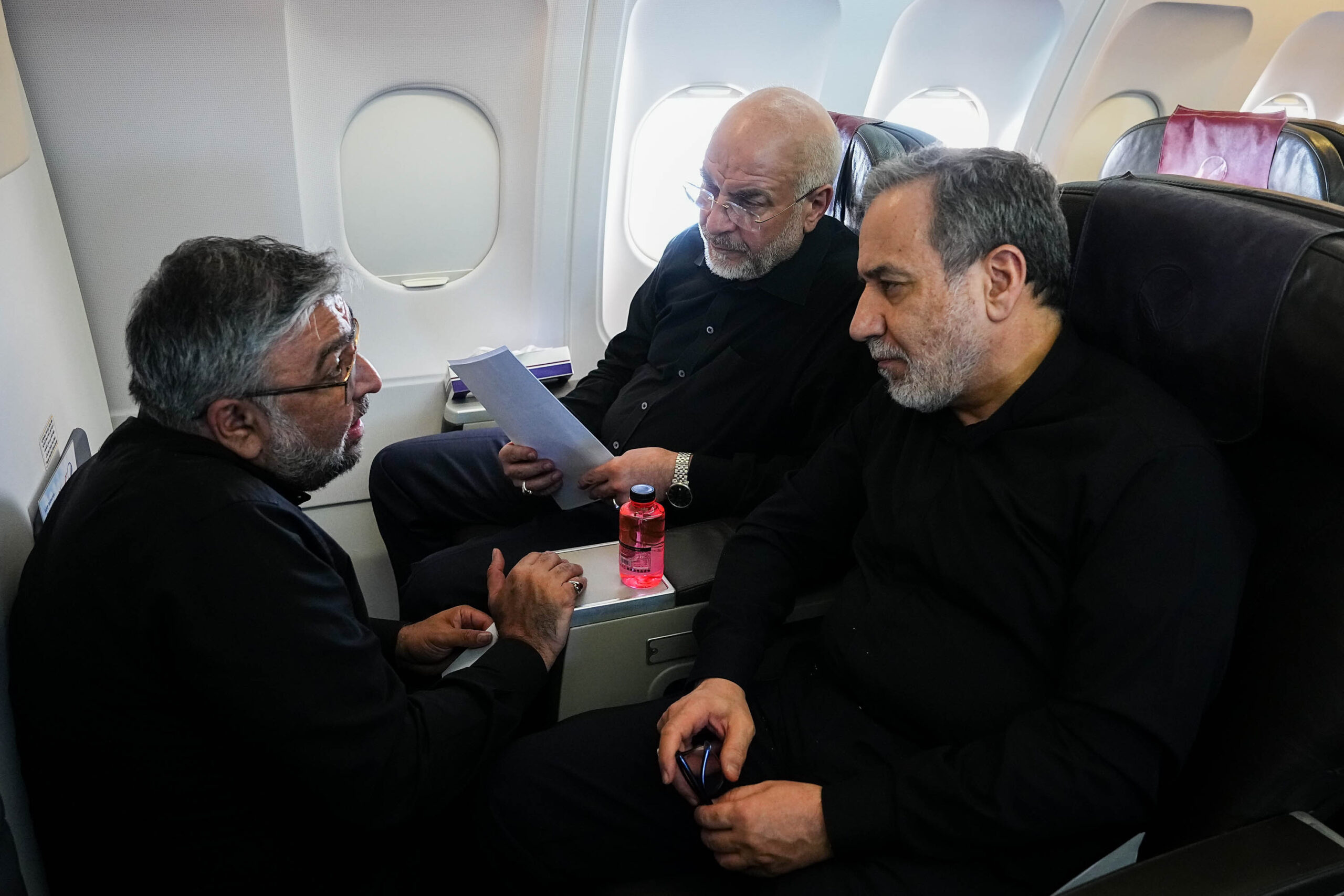
Iran's parliamentary speaker and top negotiator, Mohammad-Bagher Qalibaf, and foreign minister, Abbas Araghchi, listen to Abolfazl Amouei, Qalibaf's international affairs assistant, during a flight to Switzerland, June 21. (Hamed Malekpour/ICANA via AP)
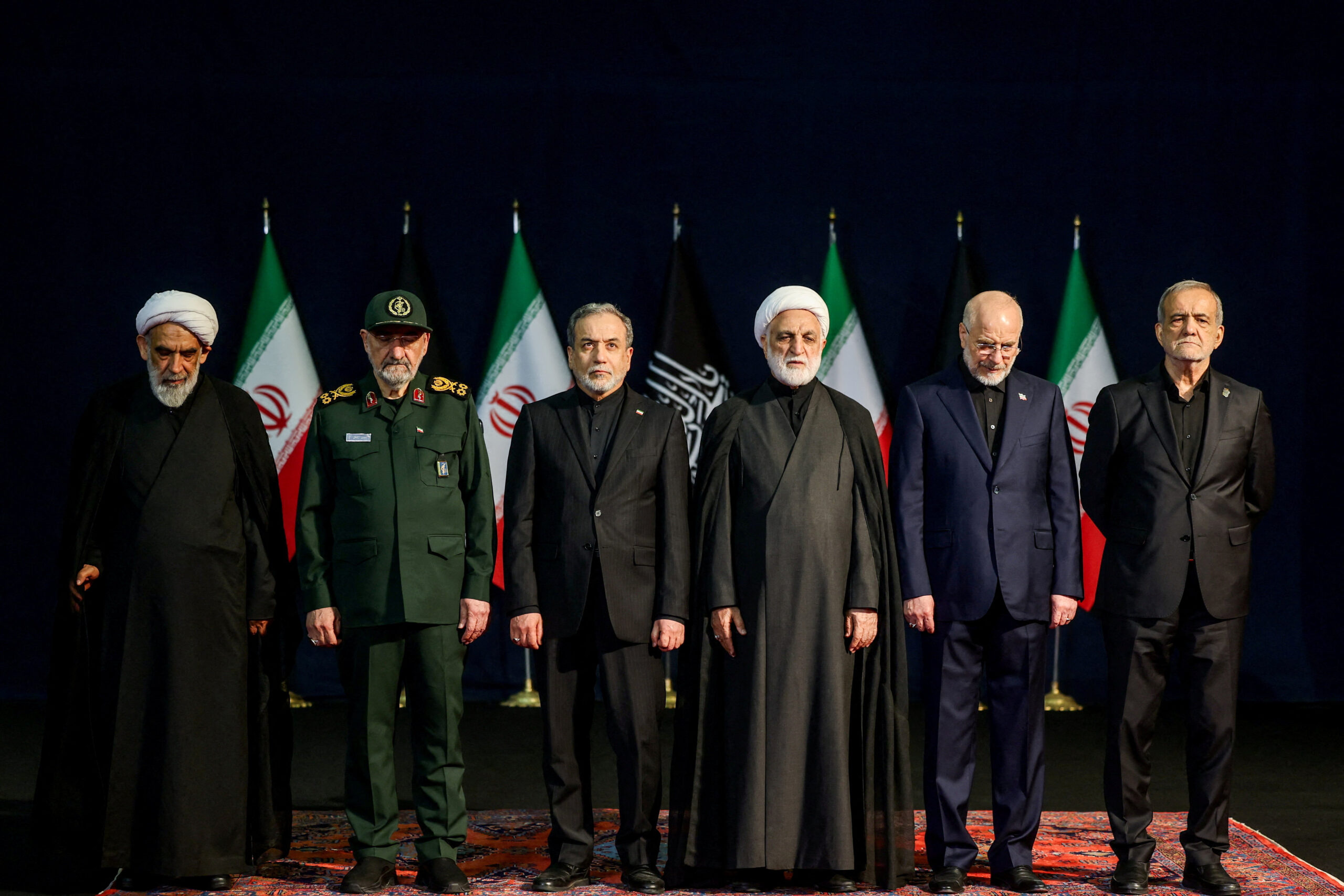
Analyzing strategic decision making in the Islamic Republic of Iran was difficult even in peacetime; wartime restrictions and censorship have made the task considerably more arduous. Nevertheless, examining how the process functioned in peacetime – and adapting that model to wartime conditions, with some unavoidable speculation – offers valuable insight into decision making under Iran’s emerging collective leadership. This leadership comprises the heads of the executive, legislative, and judicial branches alongside one representative each from the Islamic Revolutionary Guard Corps and the regular military. For now, the elimination of much of Iran’s political and military leadership, combined with external and internal threats that the regime considers existential, appears to have imposed greater cohesion on strategic decision making.
Since the 1989 amendment of the Constitution of the Islamic Republic of Iran, Article 176 has provided the institutional framework for strategic decision making. It established the Supreme National Security Council, presided over by the president and comprising the “heads of three branches of the government, chief of the Supreme Command Council of the Armed Forces, the officer in charge of the planning and budget affairs, two representatives nominated by the Leader, ministers of foreign affairs, interior, and information … the highest ranking officials from the Armed Forces and the Islamic Revolutionary Guard Corps,” and, in the case of an emergency, a minister related to the subject at hand.
The SNSC is charged with “determining the defense and national security policies within the framework of general policies determined by the Leader”; coordinating political, intelligence, social, cultural, and economic activities related to defense and national security policy; and mobilizing the country’s “material and intellectual resources” against internal and external threats. The constitution also authorizes the formation of subcouncils and ad hoc committees. These provisions have led to the creation of bodies such as the National Security Council, which addresses internal security; the Intelligence Coordination Council, which coordinates the activities of Iran’s intelligence agencies; the Defense Council, established after the June 2025 conflict; and committees responsible for nuclear negotiations and other specific policy matters.
The SNSC’s proceedings are not public. Insight into its operations is largely limited to the journals of former President Ali Akbar Hashemi Rafsanjani; former Foreign Minister Mohammad Javad Zarif’s memoir “The Audacity of Resilience”; and scattered accounts by other Iranian officials, including former President Hassan Rouhani and former SNSC Secretary Saeed Jalili. These sources nevertheless permit a basic reconstruction of Iran’s national security decision-making process and its internal dynamics.
Loosely modeled on the U.S. National Security Council, the SNSC operates as a kind of shadow cabinet in which representatives of Iran’s state bureaucracies present their respective – and often conflicting – policy recommendations. Debate within the council appears to be genuine, reflecting the competing interests, priorities, and institutional biases of the agencies represented. Ideally, the SNSC secretary synthesizes these competing proposals into several distinct policy options and presents them faithfully to the president, without imposing an independent agenda. The president, sometimes accompanied by the secretary, then meets personally with the supreme leader to convey the recommendations. Once the supreme leader approves a policy option, the SNSC secretary is responsible for coordinating its implementation across the state bureaucracy.
Sources suggest that the late supreme leader, Ayatollah Ali Khamenei, generally approved proposals that enjoyed majority support within the SNSC. His reluctance to impose his own preferences may have reflected a desire to avoid personal responsibility if a policy he dictated ended in failure. Yet open-source materials also provide numerous examples of Khamenei publicly distancing himself from policies he had privately approved, often claiming that “they” – meaning the executive branch and president – had failed to follow his guidance.
More consequentially, Khamenei would sometimes reverse himself under pressure from a vocal minority within the SNSC, usually the IRGC, and authorize that minority to undermine policies adopted by the council. At other times, he silently acquiesced in the IRGC’s obstruction of those policies. In doing so, Khamenei short-circuited the formal strategic decision-making process, to the enduring frustration of successive presidents who, unlike him, were publicly accountable for its outcomes.
Regarding the IRGC’s role, Zarif’s book amounts to a sustained lament over Admiral Ali Shamkhani’s tenure as SNSC secretary. Under Shamkhani, Zarif argues, the SNSC bureaucracy expanded, developed policy preferences of its own, and sought to impose those policies on the wider government bureaucracy rather than merely serving as a forum for debate and faithfully conveying policy options to the supreme leader.
Zarif also complains about the imbalance of power within the SNSC and the council’s gradual militarization, a process that long predated the June 2025 conflict and the continuing war with Israel and the United States. According to Zarif, representatives of the armed forces dominated SNSC deliberations and exercised greater influence over policy than civilian members. He further alleges that the SNSC Secretariat sometimes “colluded” with the military representatives to keep the Foreign Ministry in the dark. Shamkhani’s continued involvement in strategic decision making after his dismissal as SNSC secretary – and his subsequent role in the Defense Council following the June 2025 conflict – lends some support to Zarif’s broader contention that the security establishment had acquired institutional weight extending well beyond its formal mandate.
Shamkhani was killed in the February 28 U.S. and Israeli strikes and can no longer defend his record. Zarif, for his part, candidly acknowledges that rivalry between Iran’s Foreign Ministry and the SNSC is not fundamentally different from the interagency rivalries found in other political systems, including that of the United States. Nevertheless, there is reason to credit both of his central allegations: that the SNSC Secretariat developed policy preferences of its own rather than functioning solely as a policy-coordination forum and that the IRGC came to dominate strategic decision making within the council.
The February 28 strikes eliminated much of the Islamic Republic’s political and military leadership, but they did not destroy its institutions, which remain intact. The assassination of senior officeholders, the appointment of their successors, and wartime exigencies must nevertheless have altered both the process and the balance of power within strategic decision making.
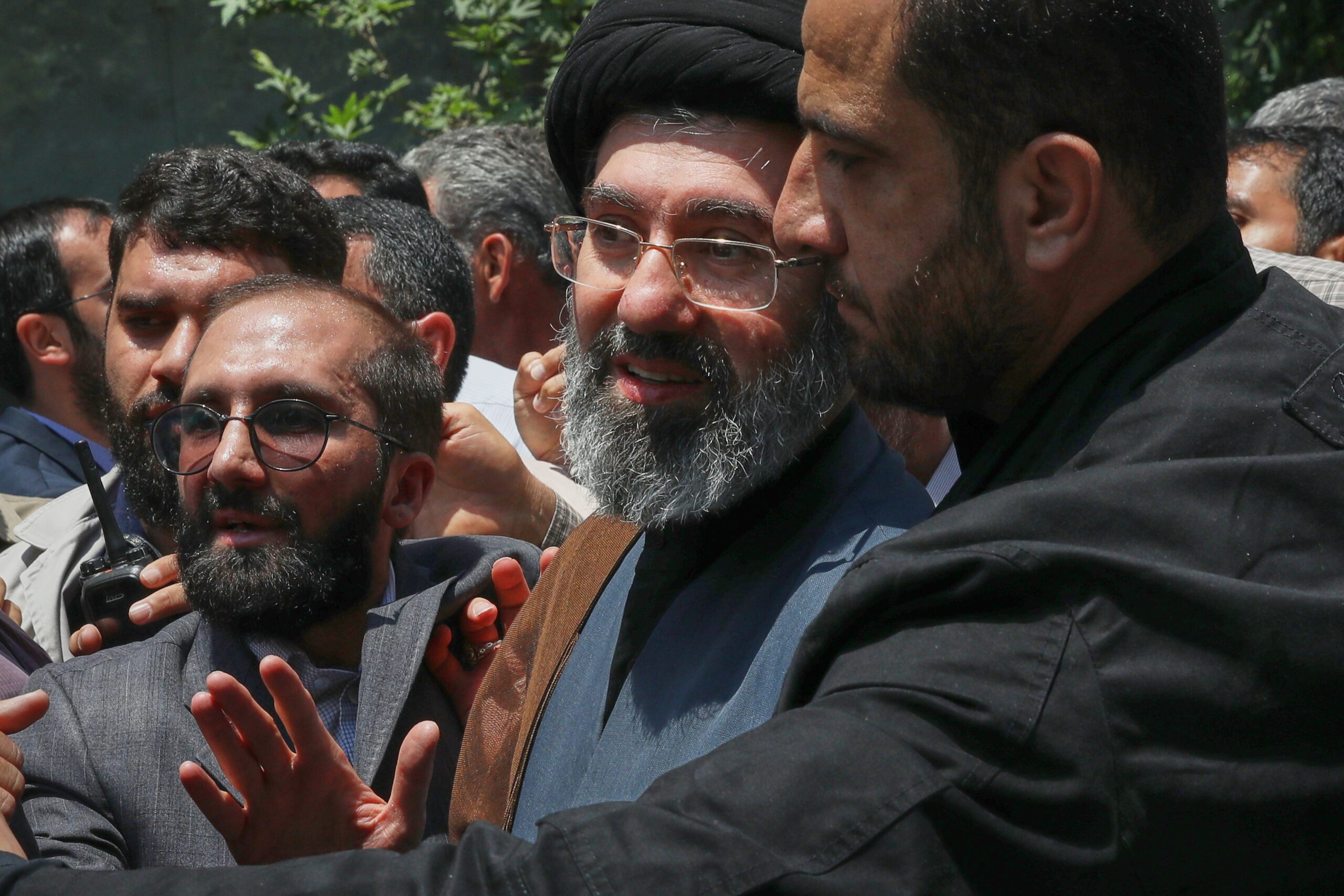
Despite the publication of numerous statements in his name, Supreme Leader Ayatollah Mojtaba Khamenei has not been seen in public since February 28, giving rise to persistent rumors about his death, incapacitation, or deep isolation from strategic decision making. If he is indeed absent from the process, this may have removed one source of arbitrary intervention and made it more difficult for the supreme leader to replicate his father’s practice of circumventing or reversing collective decisions.
Under this interpretation, SNSC Secretary Brigadier General Mohammad-Bagher Zolqadr solicits policy options from the bureaucracy and presents them not to Mojtaba Khamenei but to a five-member collective leadership comprising the heads of the three branches of government and representatives of the IRGC and the regular military. Collective ownership of policy may make it harder for any one member to disavow an adopted decision or undermine it without producing a broader rupture within the leadership. This arrangement may therefore generate greater cohesion, although the opacity of wartime decision making makes it impossible to determine whether it has also produced greater speed or effectiveness.
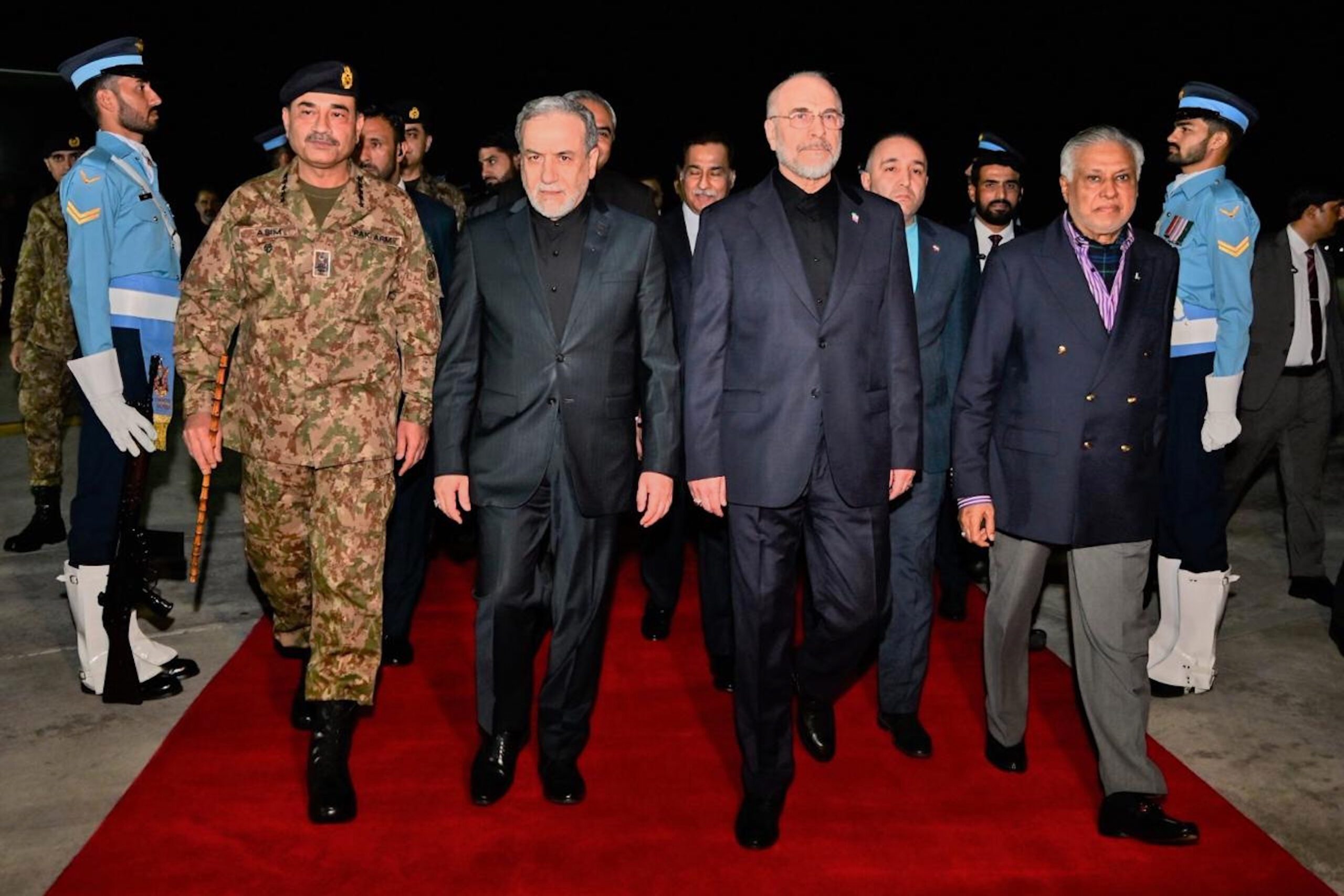
Political differences and institutional biases clearly persist within this collective leadership. The most visible divide is likely between elected officials – President Masoud Pezeshkian and Parliamentary Speaker Brigadier General Mohammad-Bagher Qalibaf – who must take some account of the needs of a war-stricken public, and appointed officials, such as Judiciary Chief Gholam-Hossein Mohseni Ejei and the representatives of the IRGC and the regular military. Yet this division should not be overstated: Qalibaf’s background in the IRGC and close relationship with the security establishment distinguish him sharply from Pezeshkian.
At times, disagreements surface in public. Examples include Pezeshkian’s apologetic statements to Iran’s Arab neighbors during the first phase of the war as well as his more recent and insistent expressions of concern about popular livelihoods and Foreign Minister Abbas Araghchi’s remarkable suggestion that Iran might have avoided the February 28 strikes had the regime reached an agreement with the United States after the June 2025 conflict. These statements reveal differing assessments of the costs of continued confrontation.
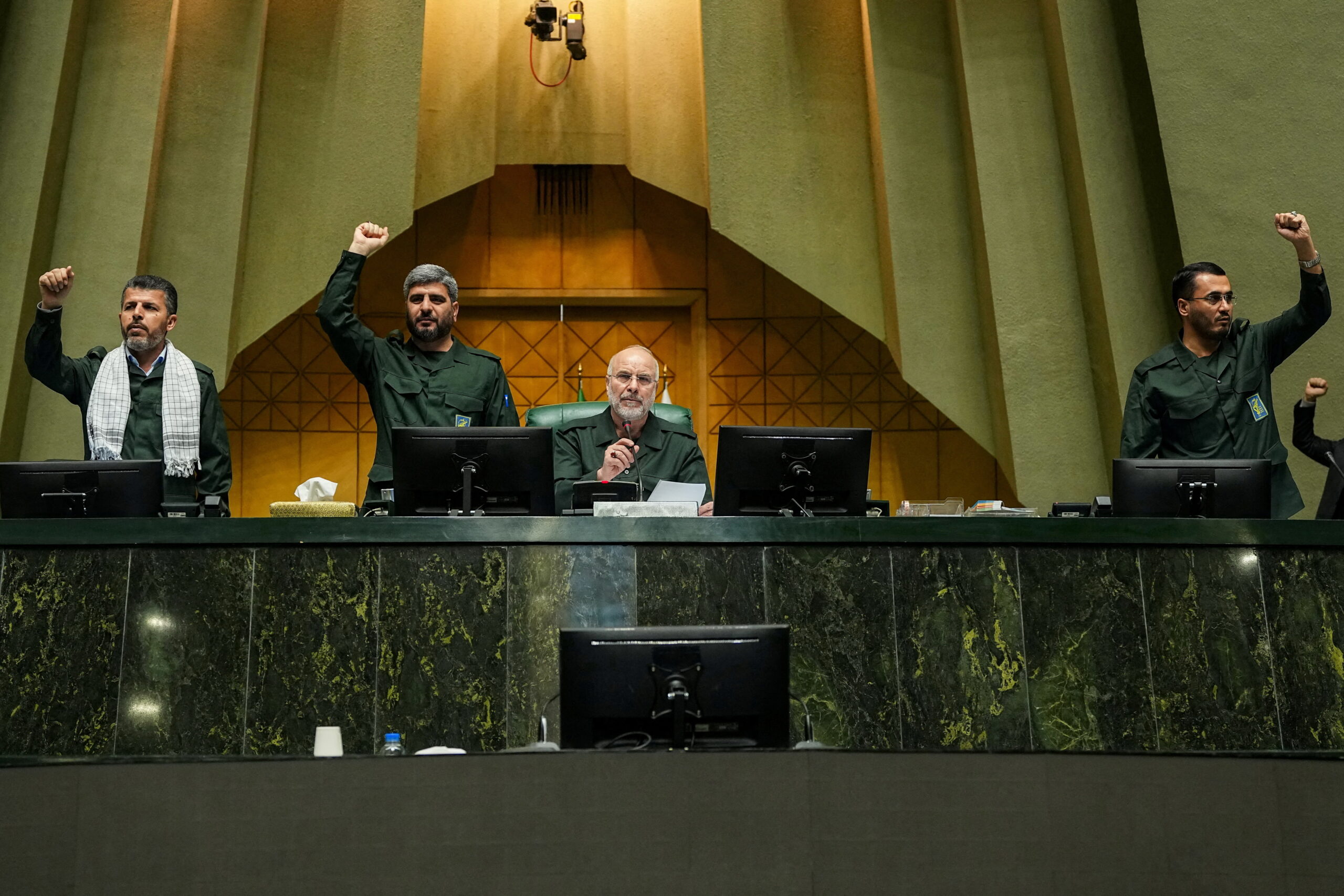
The IRGC, meanwhile, appears to have found useful partners in Qalibaf, a strategically minded politician with deep roots in the security establishment, and Mohseni Ejei, under whom the judiciary has become an increasingly effective instrument for suppressing internal dissent. Even Pezeshkian serves a function within the wartime order: His mixed Azeri-Kurdish background allows the regime to project inclusion toward ethnic minorities at a time when foreign adversaries seek to foment civil war inside Iran, as demonstrated in President Donald J. Trump’s persistent calls for the Kurds in Iraq to rise against Iran.
Under these circumstances, there is little evidence of a creeping IRGC coup. The IRGC already exercises decisive influence without assuming exclusive ownership of the state. Seizing total power would also saddle it with sole responsibility for battlefield setbacks, economic deterioration, and failures of governance. The IRGC therefore appears to prefer dominance within a power-sharing arrangement with civilian institutions over an outright military dictatorship.
At least for now, the perceived existential threat from Israel and the United States, combined with the danger of renewed antiregime protests and what Tehran portrays as an Israeli- and U.S.-sponsored civil war, is likely to keep the collective leadership together. This cohesion should not be mistaken for the disappearance of factional or institutional conflict. Rather, wartime pressure has temporarily aligned the leadership’s overriding interest in regime survival, even as its members continue to differ over the costs, methods, and ultimate objectives of the war.
The views represented herein are the author's or speaker's own and do not necessarily reflect the views of AGSI, its staff, or its board of directors.
While there is historical precedent for collective leadership in Iran, today’s leadership includes representatives of the IRGC and regular military – a reflection of the IRGC’s expanding role and the necessities of governing under wartime conditions.
Iran may still call itself an Islamic Republic. In practice, however, it increasingly resembles a state in which the military governs from behind clerical robes.
After U.S.-Israeli strikes killed Supreme Leader Ayatollah Ali Khamenei on February 28, Iran’s collective leadership has concluded that the best defense is a good offense.
While there is historical precedent for collective leadership in Iran, today’s leadership includes representatives of the IRGC and regular military – a reflection of the IRGC’s expanding role and the necessities of governing under wartime conditions.
Iran may still call itself an Islamic Republic. In practice, however, it increasingly resembles a state in which the military governs from behind clerical robes.