The Landlord Question: What Petro-Compute Actually Buys Saudi Arabia
Saudi Arabia is eyeing the growth of a sovereign compute exchange model that, like OPEC for crude, would let it shape and stabilize long-term compute costs.
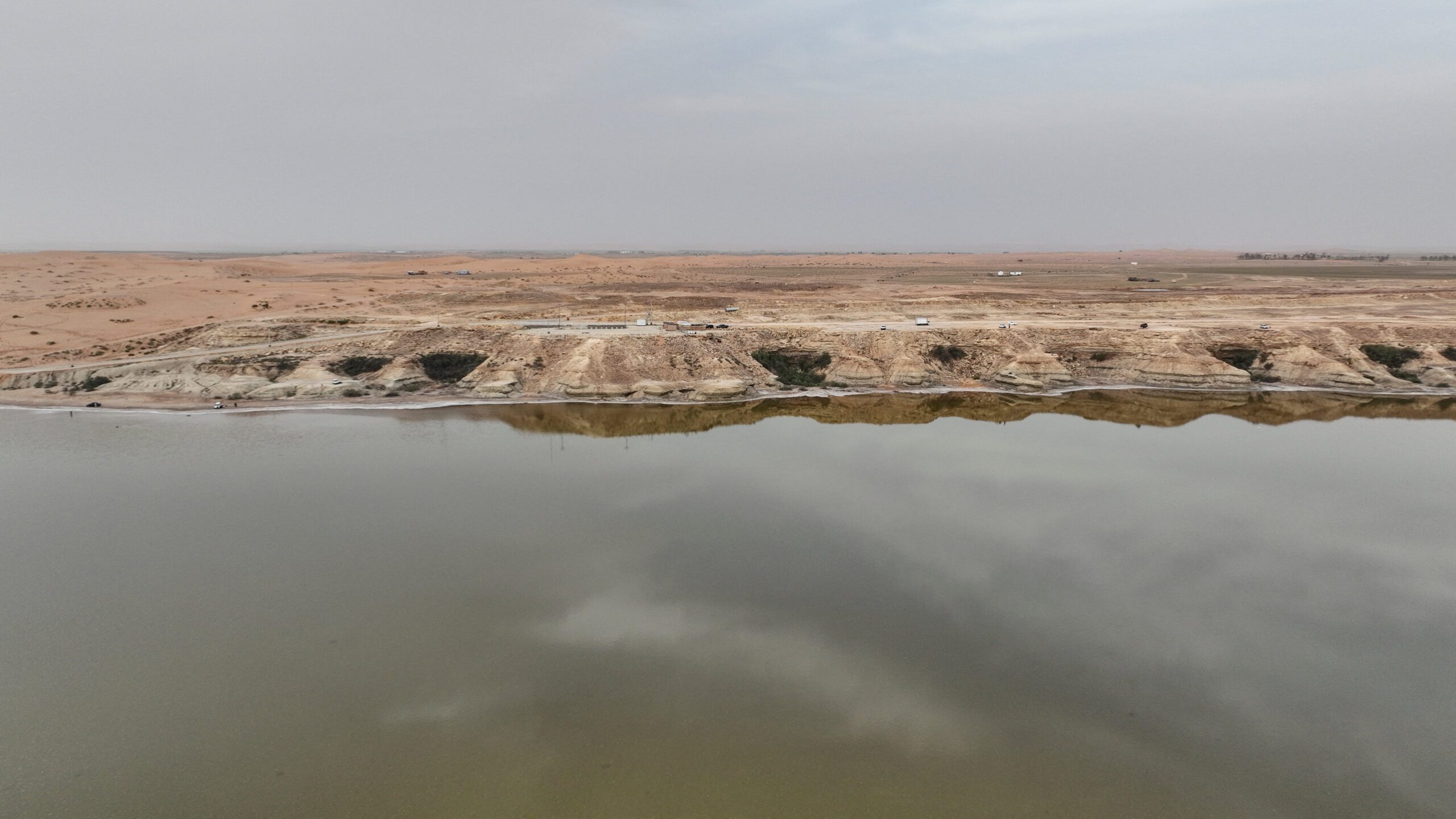
General view of a temporary lake formed from seasonal rainfall, north of Riyadh, Saudi Arabia, May 15. (REUTERS/Mohammed Benmansour)
For small businesses and artificial intelligence-native startups, access to affordable compute has led many to rent GPU capacity rather than buy it. The model gives small operators access to open-source models running on current-generation hardware while keeping their data on local servers, and it makes the economics viable for firms that would otherwise be priced out of running AI workloads at all. The GPU-for-hire market is getting more attention now that compute is becoming a commodity rather than a luxury. A few platforms have popped up in recent months, aiming to build compute exchanges that arbitrage compute prices across providers. The affordability of compute as an exchanged or rented commodity is tied directly to the energy available to run data centers. In the United States, the AI giants running expensive proprietary models largely compete on price against each other because the exclusivity of their products insulates them from outside competition.
The Gulf AI buildout is centered on the premise that countries in the region can convert cheap energy into computational power faster than others. Their structural advantages in sovereign capital, accelerated permitting, and, in the case of Saudi Arabia, land availability, make this ambitious but plausible at gigawatt scale. The United Arab Emirates and Saudi Arabia are pursuing this premise differently. The UAE, though a major player in AI infrastructure, has distributed its investments across the layers of the stack rather than concentrating them on compute infrastructure, a posture reinforced after Iranian targeting of that infrastructure after the United States and Israel began launching attacks against Iran on February 28.
Saudi Arabia, by contrast, is attempting to build a national compute platform through an AI infrastructure buildout in efforts to position the kingdom as the next major site for data center construction. The kingdom has been able to secure buy-in from major financial firms, such as Goldman Sachs. The key question is how this positions Saudi Arabia in the global AI race.
Evaluating the Petro-Compute Premise
Saudi Arabia is eyeing the growth of a sovereign compute platform that, like OPEC does for crude, would let it shape and stabilize long-term compute costs. Essentially, Saudi Arabia is moving toward becoming an AI landlord. The landlord owns the building, provides the power, and writes the lease, while the tenant brings the chips, models, and customers. This is a narrower position than the third-pole ambition that often frames discussion of Gulf AI alongside the United States and China. Four variables will determine how durable the landlord position becomes, and each will come into sharper focus in the next 12-18 months.
The first question is whether Gulf electricity remains cost competitive at scale. According to the King Abdullah Petroleum Studies and Research Center, Saudi cloud computing tariffs sit at $0.048 per kilowatt hour and industrial tariffs at $0.053 per kWh, compared to a U.S. industrial average near $0.09 per kWh. KAPSARC estimates this translates for the Saudis to a 30% reduction in total cost of ownership, the all-in lifetime cost of building and running a data center. These figures reflect average cost on existing supply. Gigawatt-scale AI buildouts will require substantial new generation, transmission, and desalination capacity for cooling. Saudi Arabia is currently underwriting the conversion through three sovereign channels working in parallel: The Public Investment Fund is financing Humain’s data center buildout directly; the National Infrastructure Fund has committed $1.2 billion in framework financing to expand AI infrastructure capacity; and the Ministry of Energy is building out generation capacity to feed the data centers. The state, in other words, is paying itself to absorb the costs of cheap energy and sovereign finance to de-risk the early AI infrastructure buildout and create the incentive structure to attract private equity, infrastructure funds, and other outside private capital. KAPSARC’s scenario analysis projects AI data centers could consume up to 11.6% of Saudi national electricity by 2030 under high-growth assumptions. When data centers account for 1% of the national energy demand, the state can absorb the difference between published tariffs and the actual cost of generation. At 11%, that difference may become a fiscal liability if the increased demand for energy and subsidies forces the state to shift the cost burden, for example, to utilities, industrial users, or households. If more of that burden is passed to operators, Saudi Arabia’s affordability advantage over U.S. data center markets will narrow.
The second variable is whether Saudi data centers can sell GPU-for-hire capacity at the volumes the buildout requires. The Gulf buildout assumes a global high-growth demand that the region can capture a share of. U.S. frontier labs have locked up most of their training compute through 2027 in long-term commitments with Microsoft, Google, Amazon, and Broadcom, leaving only marginal training runs available to locate elsewhere. Enterprise inference – the deployment of AI as a business service – is a larger market, but it is price and latency sensitive, and Gulf data centers will compete against hyperscaler capacity in Virginia, Dublin, and Singapore. Gulf workloads and regional enterprise customers offer reliable demand but may fall short of the volume required to meet Humain’s targets of 1.9 GW by 2030 and 6 GW by 2034. In other words, the Gulf is building infrastructure for a Western customer base that may not be deep enough to fill it.
The third variable follows directly from the second. The customer segment that would most naturally fill Gulf capacity would be Chinese. Chinese AI labs face their own compute constraints and would benefit from cheaper rates in the Gulf. Washington’s concerns about Chinese companies operating on or near its tech stack and compute capacity would create immediate red flags among U.S. policymakers. The now-defunct diffusion framework and Pax Silica of the administration of former President Joseph R. Biden Jr. were designed to prevent any Chinese benefit from materializing from U.S. chips. Saudi Arabia’s Humain has said it will not build on Chinese technology, but this does not restrict future Chinese companies from renting space on Saudi Arabia’s U.S.-made GPUs. The operational question is whether Humain’s pipeline will eventually contain Chinese customers that Washington may eventually require it to cut off in order to continue accessing U.S. compute hardware.
The fourth variable is whether the Gulf data centers are intended for training frontier models or running enterprise inference, and whether the legal architecture exists to support either. Inference is migratory and price sensitive, with a broader market for competition among other data centers. It also does not require top-of-line compute components. Frontier training, by contrast, has concentrated demand among a small number of AI labs running multibillion-dollar training jobs. It requires sustained access to current-generation chips (with pathways to access next-generation chips) and creates customer lock-in over the long term. Saudi data centers are positioned to do both. Lower compute costs for inference will make the region more competitive with enterprise customers, but it will be much harder to convince top AI labs to shift their model training to the Middle East.
The legal architecture is the harder problem. U.S. labs deciding whether to locate training runs in the Gulf must weigh intellectual property risk, legal jurisdiction, and the political durability of U.S.-Gulf compute agreements, especially if a future U.S. administration takes a less accommodating posture toward Gulf AI ambitions. Saudi Arabia’s Personal Data Protection Law contains localization provisions, but these were written for personal not frontier model data. What happens to the data when a U.S. lab trains a model in a Saudi data center? Whose law governs the resulting weights? If Washington demands that Riyadh disclose a model trained on Gulf soil through U.S. GPUs, can Riyadh block it? And what happens when the demand runs the other way, when Washington wants assurance that Chinese firms are not training on the same hardware through indirect channels? None of these questions has a settled answer, but Saudi Arabia’s governance will need to evolve rapidly to establish a legal baseline that will build the prerequisite trust for AI labs that might consider outsourcing to Saudi data centers. The legal uncertainty is part of why the announced training partnerships are thin and the volume of inference contracts is substantially larger.
The Gulf Landlord Model
Landlord status in compute is more consequential than landlord status in oil. The tenant cannot switch suppliers the way an oil customer can. Data, weights, customer relationships, and latency-sensitive workloads are physically located on the landlord’s property, and the switching costs are high. The landlord captures rent, builds adjacent industries in construction, power, and cooling, and acquires the optionality to move up the stack. The U.S.-China competition in the Gulf is largely a competition over who occupies the landlord’s property, and the legal jurisdiction that ultimately governs what happens there may be up to negotiation.
The key long-term question is whether the landlord’s rent can be reinvested into turning Saudi Arabia into a full-stack AI hub. Singapore did this with semiconductors for over 30 years through deliberate investment in universities, talent retention, and indigenous design houses. Ireland did not and remains a cloud landlord with shallow technological depth despite decades of hyperscaler presence. The kingdom has the capital to follow the Singapore path. The path depends on institutional patience, the development of a local talent base, and sustaining foreign technical talent.
Saudi Arabia’s major AI institutions, the King Abdullah University of Science and Technology AI Initiative, the National Center for Artificial Intelligence under the Saudi Data and Artificial Intelligence Authority, and Humain are early signals that Gulf actors understand the problem. The ratio of capital flowing into pure infrastructure to capital flowing into indigenous research suggests that the landlord trajectory remains dominant, for now. Breaking out of this requires transforming infrastructure investment into frontier capabilities. Either petro-compute funds the climb up the stack, or it funds an increasingly sophisticated and lucrative rental business.
The views represented herein are the author's or speaker's own and do not necessarily reflect the views of AGSI, its staff, or its board of directors.
With the Iran war, large AI projects now sit inside a regional battlespace. The next phase of Gulf AI strategy will need to focus on resilience, continuity, and trusted infrastructure, not only capital and scale.
U.S. authorizations for exporting advanced chips to the leading Gulf technology firms is sure to please regional authorities, who will push to broaden and accelerate technology collaboration with the United States.
The convergence of Gulf capital and energy with U.S. technology leadership signals the emergence of a U.S.-Gulf AI axis with global economic and geopolitical implications.