Iran War Provides Decisive Test for Lebanon to Assert Authority Over Hezbollah
After decades of tolerating Hezbollah’s warmaking independence, the current crisis has compelled Lebanese leaders to ban its military activities; this project will do much to determine the reach Iran can maintain in the Arab world.
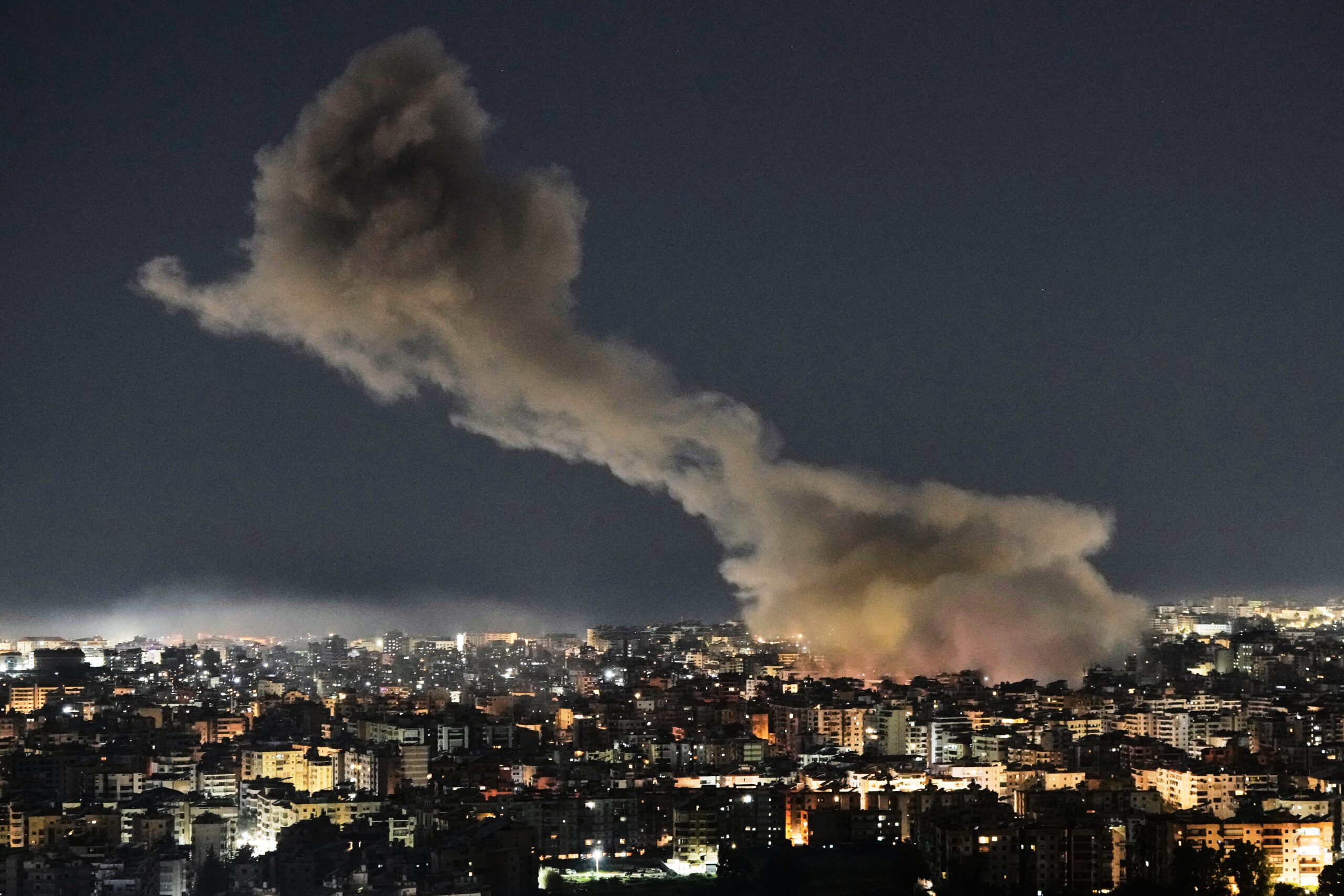
Smoke rises from Israeli airstrikes that struck a building housing Al-Manar channel studios in Dahiyeh, a southern suburb of Beirut, Lebanon, March 3. (AP Photo/Bilal Hussein)
Early March 2, thousands of people in Beirut were abruptly awakened by the familiar sounds of major explosions – Israeli strikes aimed at Hezbollah. The Lebanese militia group boasted that it struck Israel with a modest salvo of missiles and drones, and the Israeli response was predictably harsh. Does this mean that the war has decisively spread to Lebanon? Will it bring in other Arab countries that are beset by pro-Iranian militia groups, notably Iraq and Yemen?
Israeli officials have said that they will open a major front against Hezbollah, including using ground forces. And on March 3, those troops began a limited incursion into southern Lebanon before reportedly pulling back, but with the prospect of a deeper Israeli ground campaign looming. There is tremendous pressure on Hezbollah in Lebanon to desist from further attacks on Israel. Lebanon cannot afford another pointless war, as it is still rebuilding from the civil war that began in 1975 and several Hezbollah wars with Israel, including in 2024. Israel warned that it would spare virtually nothing and target not just Hezbollah assets but Lebanese national infrastructure, including the airport. That has not happened yet. So far, the Israeli strikes have been targeted at Hezbollah and its supporters, much like the 2024 conflict.
The Lebanese government has moved quickly to try to rein Hezbollah in with unprecedented measures. After an emergency Cabinet meeting March 2, Prime Minister Nawaf Salam said the government is instituting a “ban on Hezbollah’s military activities” and the group can only operate within “the political sphere.” The government flatly said that Hezbollah was operating outside the law and that its attacks on Israel were “illegal.” Salam insisted the group must “surrender its illegal weapons.” On March 3, President Joseph Aoun told Western diplomats that the decision to reassert the monopoly of the state over matters of war and peace is “sovereign and final,” and effectively irrevocable.
This is an unprecedented development in Lebanon, which has tolerated Hezbollah’s independent military and decision making since all other militia groups effectively disarmed after the Taif Agreement to end the civil war in 1989. Israel was continuing to maintain a brutal and sustained occupation of much of southern Lebanon at the time, and Hezbollah’s argument that it needed to remain armed and militarily active to liberate a huge chunk of the country was widely accepted, including by many people who did not like the organization or trust its Iranian sponsors.
However, by May 2000, Hezbollah finally succeeded in driving Israel out of Lebanon for good. The Israelis maintained control over a tiny group of disputed areas in the border region, and this gave Hezbollah a rationalization for continuing to maintain its private arms and independent foreign and military policy. In May 2008, the Lebanese government tried to seize control of Hezbollah’s independent military communication system and other strategic assets that plainly infringed on state authority. This triggered Hezbollah to do something it swore it never would: turn its arms inward and fight other Lebanese groups to maintain its power. Hezbollah remained simply too powerful to be brought within the framework of the law.
However, Israel’s decimation of Hezbollah, including its arsenal, leadership, and military commanders, in 2024 significantly altered the balance of power in Lebanon. Aoun and Salam have been forthright in openly pursuing the disarmament of Hezbollah’s military and its reintegration into the legal and constitutional state framework as a political party without an independent army and, therefore, an independent foreign and defense policy. This has been a challenging project, because the group remains potent and is still strongly supported by Iran. The large and powerful Shia community in Lebanon is not only jealous of the clout that Hezbollah has provided for its constituency but also traumatized by the heavy losses and pain inflicted by Israel in 2024. It is one thing to prevent Hezbollah from rebuilding major military assets that were destroyed in that conflict but quite something else to actively strip the organization and its constituency of the assets they still possess. Such bold moves must be carried out with great agility and caution, because there is always the threat of starting another major civil conflict in a country that simply cannot afford any additional destruction.
However, Hezbollah’s willingness to fire projectiles into Israel to performatively signal solidarity with Iran and its slain supreme leader underscores the urgent need for Lebanon to complete the transformation of Hezbollah from a large military force with a political wing into a primarily political party with, at most, a modest security force for its protection. If the Lebanese state is to be fully functional and advance the process of rebuilding from the series of calamities that commenced with the civil war, the government must regain control over military and security matters. There cannot be a private army with an independent foreign and defense policy, with the ability to make national decisions about issues such as war and peace without consulting anybody else and largely of the service of another country thousands of miles away.
The recent developments bring the Lebanese state closer than ever to a direct confrontation with Hezbollah. Declaring Hezbollah’s military activities illegal is the closest the Lebanese government has come since Hezbollah was formed following the 1982 Israeli invasion to an open confrontation with the group. The state is trying to assert its monopoly of force and its exclusive right to determine questions of war and peace.
Will this work? Hezbollah is deeply damaged but remains heavily armed and still dangerous. It is unlikely to simply abide by this ruling, although it may use it as a rationalization to back down, telling its Iranian friends that pulling back from the brink in this case is necessary to remain politically viable in the coming decades inside of Lebanon. Alternatively, the group may decide to challenge this decision by dramatically flouting it.
Lebanon is suddenly in a state of war, and the government is doing what it can to drag the country out of it as soon as possible. If it can succeed in compelling, convincing, or coercing Hezbollah to pull back from the brink and get out of the current conflict, it will be arguably the biggest single step toward freeing Lebanon from the grip of Hezbollah and Iran in decades. Success would suggest that the dominant power of the militia group is finally being undone and that the process of transforming it into a law-abiding political party, or some approximation of that, is finally underway.
It is a major test of the Lebanese government’s ability to take advantage of the weakness of Hezbollah and the desperation of an overwhelming majority of Lebanese, including many Shias, to avoid joining the current war, and contain and transform Hezbollah. The ban on its military activities is gutsy and risky. But Lebanese leaders deserve enormous credit for stepping into the breach and laying down the law. If they succeed, it will be a major breakthrough in freeing Lebanon from the Iranian proxy grip and a demonstration that Tehran’s predatory prowess in the Arab world has dramatically and, perhaps, decisively weakened.
The views represented herein are the author's or speaker's own and do not necessarily reflect the views of AGSI, its staff, or its board of directors.
Gulf Arab countries urged the United States not to strike Iran, but now that is happening, they are in danger of being sucked into a conflict they cannot control but that will likely reshape their present and future realities.
The U.S.-Israeli attack on Iran has exposed Iraq’s structural fragilities: territorial permeability, economic monoculture, energy dependence, and politically mediated sovereignty.
A new government and the movement to disarm a weakened Hezbollah are increasing Gulf states’ trust in Lebanon, but Gulf-Lebanese rapprochement is not yet right around the corner.
President Trump has led the United States into an impossible dilemma in which resuming and intensifying the war presents one set of alarming consequences while ending it under current circumstances offers at least as many disasters for Washington.
The Trump administration has positioned the United States at a crossroads between a new regime of containment against Iran or a historic drawdown of U.S. influence in the Gulf and broader Middle East.
Riyadh and Abu Dhabi urged President Trump not to attack Iran, but now that the war is into its second month, leaving the current situation in place would be an unthinkable fiasco for them.
Though they were unsuccessful in preventing the current conflict, and, as expected, have been dragged into the U.S.-Israeli confrontation with Iran, Gulf Arab countries remain crucial to hopes for limiting the war and bringing it to a quick resolution.