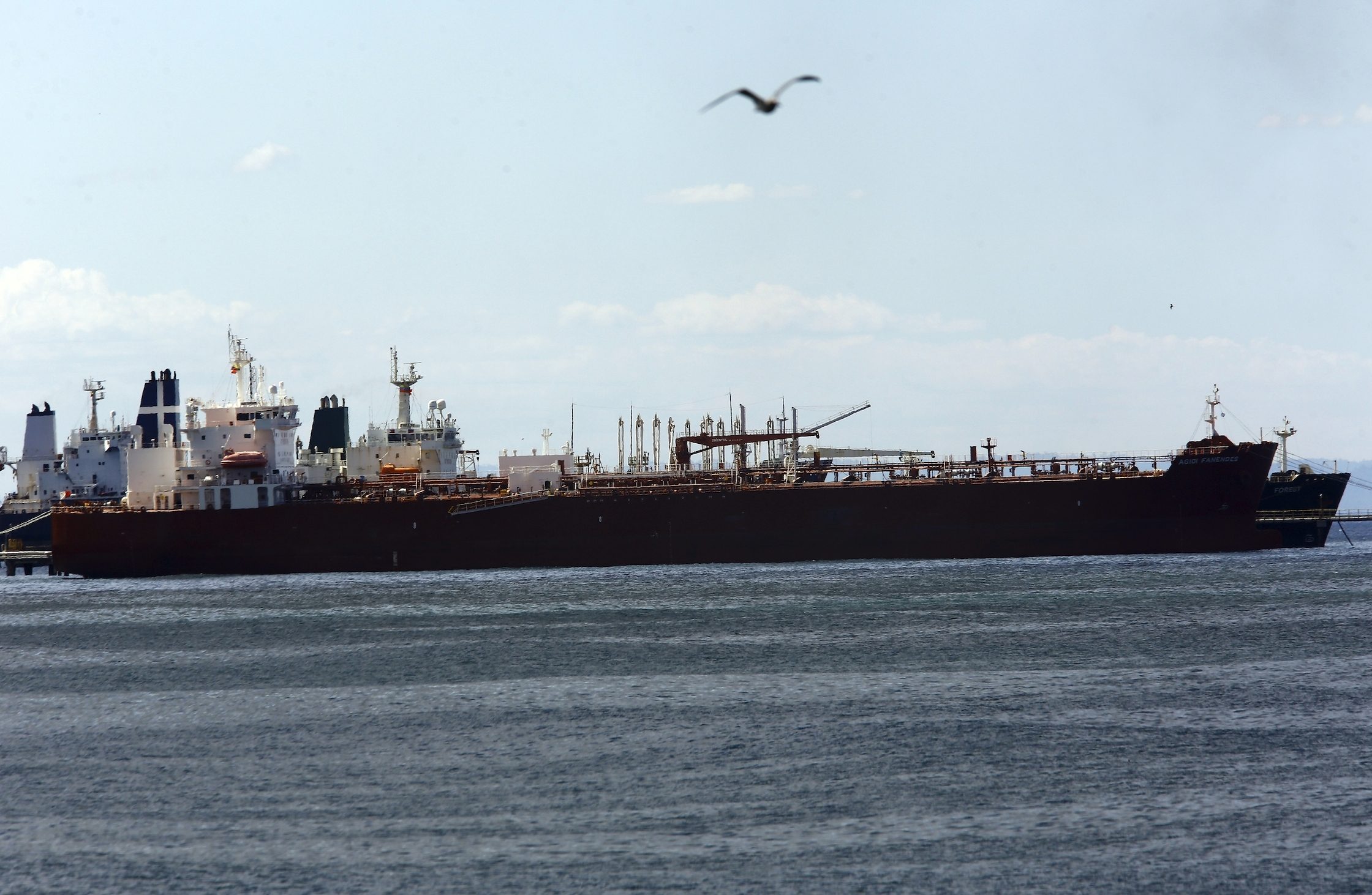
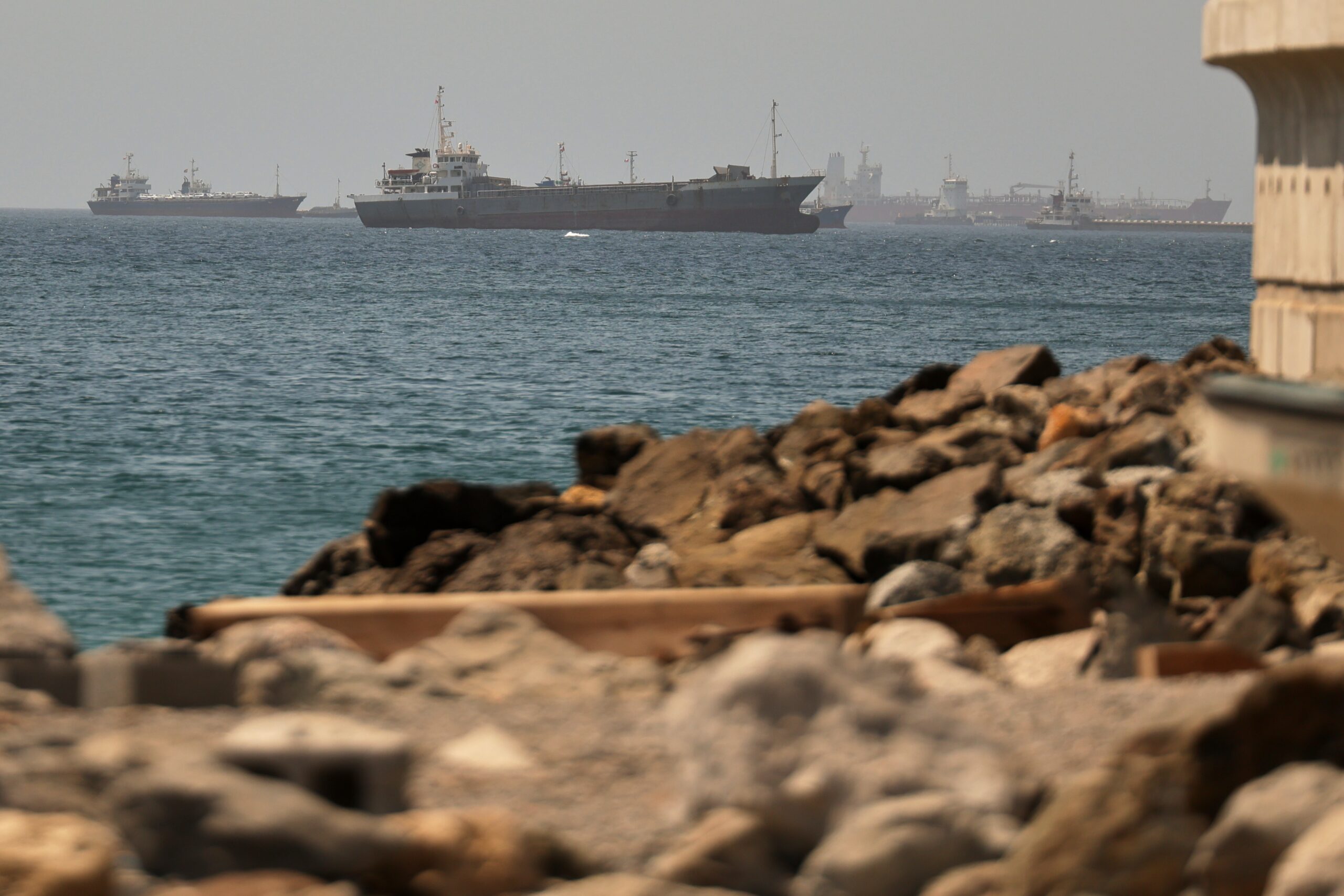
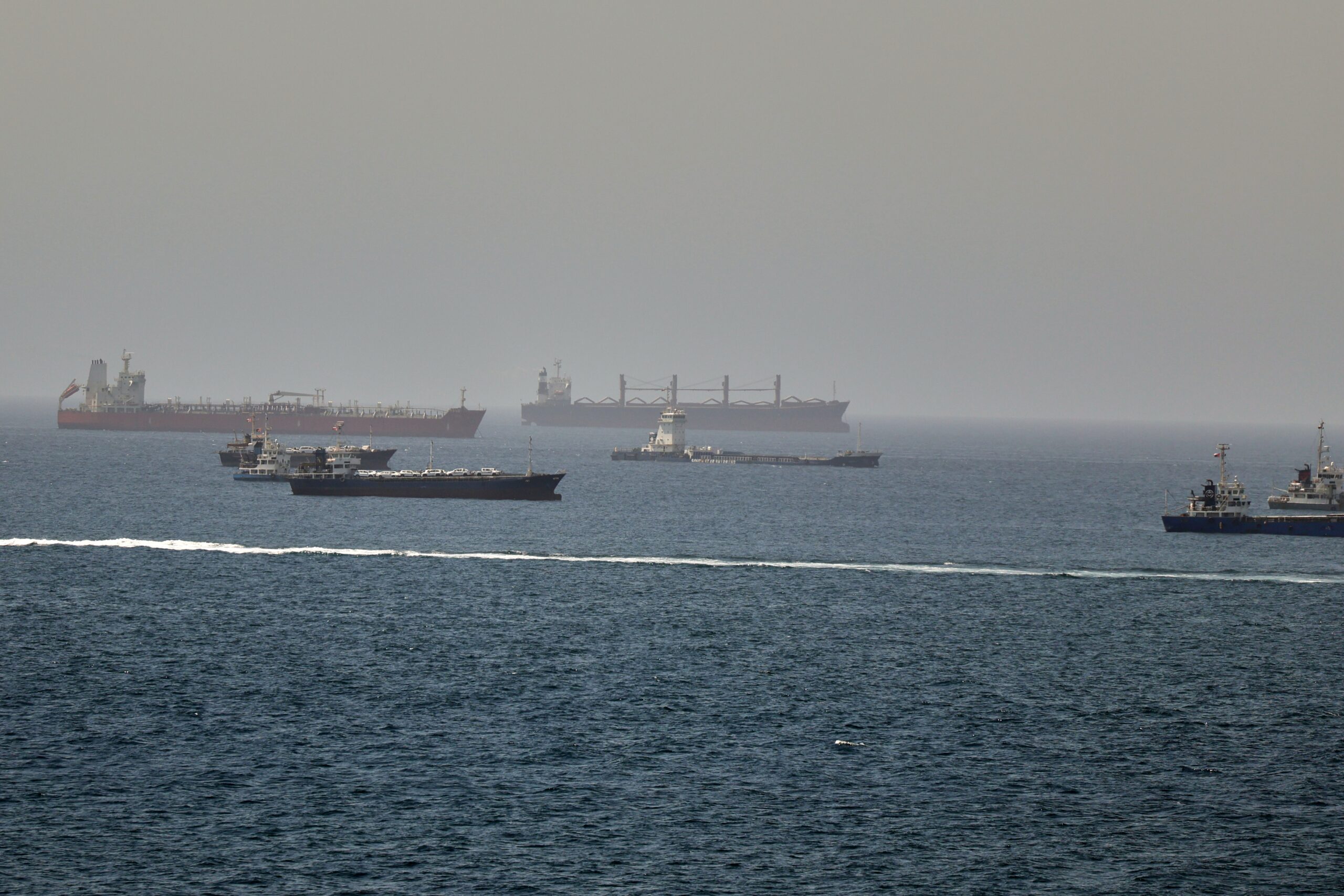
The Iranian oil tanker Forest is anchored off the dock of El Palito refinery near Puerto Cabello, Venezuela, Sept 29, 2020. (AP Photo/Juan Carlos Hernandez)
News slowly filtering out of Iran suggests that the regime has perpetrated a massacre of many thousands of protesters, ranking among the worst Middle East atrocities of the post-WW1 period. A U.S. “armada” has assembled nearby and is conducting threatening exercises. The country’s energy industry, mismanaged and hit by sanctions, is still crucial for the government in Tehran and important on the global stage.
Whatever the exact political and military process, Iran’s petroleum sector could see three broad outcomes: complete disruption; muddling through similar to the post-2020 period; or resurgence under new leadership and a better relationship with the United States and regional neighbors.
Disruption
In the most disruptive situation, greatly intensified sanctions, maritime interdiction, military action, or civil unrest might shut off Iran’s oil exports. That would remove at most 1.7 million barrels per day of crude and condensate exports, nearly all of which goes to China, and another 500,000 b/d or so of refined products.
The International Energy Agency forecasts a surplus in the global oil market in 2026 of 3.7 mb/d, while the U.S. Energy Information Administration projects 2.8 mb/d. OPEC, by contrast, sees a much smaller oversupply, averaging 600,000 b/d. The IEA’s view seems unduly pessimistic, while OPEC’s is probably much too optimistic.
Still, the complete interruption of Iranian exports would probably move the market close to balance or even deficit. That also depends on what happens with other wild cards, notably Russia, Kazakhstan, and Venezuela. Other OPEC states, mostly Saudi Arabia and the United Arab Emirates (with some assistance from Iraq and Kuwait), could more than cover, although spare capacity would drop substantially and prices would rise, plausibly by up to $15 per barrel. The full impact would also depend on whether the interruption was temporary or whether physical damage or political disruption implied a very lengthy closure.
Despite some suggestions, the loss of Iranian supplies would not be a huge financial blow to China. Its disguised imports from Iran amounted to about 1.5 mb/d in 2025, about 13% of its total oil purchases. Although heavily discounted, a large part of this discount is swallowed up in costs for logistics and sanctions evasion or disappears into the pockets of regime-connected intermediaries. China might plausibly be saving some $5 billion per year – helpful to individual refineries but only about 2% of its total oil import bill.
A large part of the 2025 surplus was soaked up by China, which stored around 500,000 b/d to 1 mb/d in its tanks. If Iranian supplies were cut off, China could slow its stockpiling, take more discounted Russian oil, or simply pay the higher price to other oil exporters.
This assumes, of course, that other oil exporters or transit routes in the region are not seriously affected by conflict. Iraq’s sales of about 3.6 mb/d could certainly be vulnerable given the influence of Iran-aligned parties during its tricky process of government formation and its reliance for exports on aging oil terminals crowded into its narrow slice of the Gulf waters.
The impact on gas would be much less. Iran’s exports to Iraq have already been interrupted since December 2025. And Iran exports less than the contractually set 9.6 billion cubic meters per year to Turkey, about 20% of Turkish consumption. The growing additional supply of liquefied natural gas on the world market during this year and next, and Turkey’s own rising domestic output, should accommodate for such a loss without serious effects.
Muddling Through
In the muddling through scenario, Iran’s oil exports would remain around current levels of 1.7 mb/d. Iran would continue to use evasion methods and the “shadow fleet” to move its oil to China. That would itself be an achievement of sorts given the tougher U.S. attitude. Under the current budget, the National Iranian Oil Company was supposed to receive 14.5% of oil and gas export earnings, implying about $6 billion. But with the new budget slashing estimates for oil exports and price, and NIOC’s share dropping to 10% after an allocation to the Islamic Revolutionary Guard Corps, the state oil company would see just $2 billion. Even allowing for investment by IRGC-linked entities and semiprivate corporations, this is clearly woefully inadequate to fund NIOC’s ongoing operations let alone new field developments.
Resurgence
In the case of resurgence, production could gain 300,000 b/d to 500,000 b/d quite quickly, by regaining access to markets beyond China and performing elementary maintenance and some additional drilling. That would take output to about 3.8 mb/d to 4 mb/d.
To boost production much beyond this, NIOC and Iran’s private and semiprivate oil sector would need to invest heavily. Most likely, major international involvement would also be necessary. This would require that most sanctions are lifted or at least suspended, as in Venezuela, and that Tehran significantly sweetens its contractual terms and greatly improves the welcome for investors. As in Iraq, Chinese state and private companies would likely be prominent, alongside Western supermajors Shell, TotalEnergies, ENI, and perhaps BP as well as Japanese, Indian, and other Asian national companies, such as Malaysia’s Petronas. The possible role of U.S. corporations, ExxonMobil, Chevron, ConocoPhillips, and others, would of course depend on the political situation, as contrariwise would that of the Russians.
During earlier periods of relative openness, as in the late 1990s to early 2000s, and under the implementation of the Joint Comprehensive Plan of Action agreement from 2016-18, Iran made little progress in awarding contracts to international firms because of interminable negotiations, unattractive contract terms, and political opposition.
Various Iranian officials have spoken of a production target from 5.5 mb/d to 5.7 mb/d, almost the 1974 peak, or even 7 mb/d. But these seem implausible. Natural decline rates in its mature fields mean Iran loses at least 300,000 b/d of capacity each year, which has to be compensated for by new field developments and improved and enhanced recovery projects.
NIOC itself planned to spend $3 billion to boost output by 400,000 b/d to reach 4 mb/d, and, in March 2024, it signed $13 billion in contracts for the development of six fields, to add 350,000 b/d to 400,000 b/d: the giant Azadegan on the Iraqi border; the smaller Azar, Saman, Soumar, and Delavaran fields; and production optimization at Masjed-e Soleiman, the country’s first ever field. The West Karoun area (which includes Azadegan and also Yaran and Yadavaran on the Iraqi border, along with the smaller Jofair, Sepehr, and other fields) is crucial to Iran’s future production plans, as all these fields are relatively young compared to its aging super giants.
Another key target is the development of the deeper Khami reservoirs, which sit below the Asmari and Bangestan reservoir formations that have provided the bulk of Iran’s historic production. But as they are deep, have lower porosity and permeability, and often contain high-pressure sour (hydrogen sulfide-bearing) gas, they are not a quick fix. Giant heavy oil fields such as Kuh-e Mand, near Bushehr on the Gulf coast, could contribute. New exploration in the Zagros mountain belt with modern 3D seismic techniques would probably discover significant new fields but, again, it takes time.
Iran also injects natural gas to boost recovery from the big older fields, such as Marun, Gachsaran, Agha Jari, and Rag-e Sefid. But Iran’s injection of up to 14 billion cubic meters per year is far below the required levels of 110 BCM. The use of gas for reinjection faces competition from domestic demand for electricity, home heating and industry, and exports. Iran’s struggle to meet its gas needs would probably continue even in a much more positive political environment. If it does succeed in stepping up reinjection, it still faces the problem that it takes several years for oil output to respond positively due to the giant size and unusual fractured reservoir behavior of these fields.
Taking all these factors into account, an optimistic target of about 4.5 mb/d by 2030 looks achievable, in a resurgence scenario. Iran might push above 5 mb/d after that, but the pre-revolutionary highs look unattainable. Still, such gains, along with potential expansions in Venezuela, Libya, and Iraq, would constrain the plans of the core Gulf Cooperation Council oil producers, Saudi Arabia, the UAE, and Kuwait. The diplomatic and military developments of the next few weeks will determine which of these scenarios comes to pass.
The views represented herein are the author's or speaker's own and do not necessarily reflect the views of AGSI, its staff, or its board of directors.
A founding member of OPEC is now effectively under external control, raising questions about sovereignty, influence, and the resilience of producer-led market management.
Saudi Arabia seeks a U.S. security umbrella strong enough to deter Iran but a diplomatic posture measured enough to avoid provoking Iran unnecessarily.
Oman has benefitted from the U.S.-Israeli war with Iran, but continued conflict and Oman’s highwire neutrality balancing act mean that the sultanate’s economic windfall is still in danger.
As Qatar looks to the future, it will have to assess the battered landscape of the global LNG industry, reassure its customer base, and rethink its approach for a very different market.
Exports of power from the Gulf’s thriving renewables and battery sector could become a key driver of the economy, but restrained grid interconnectivity with neighbors limits any breakthrough.
On March 10, AGSIW hosted a discussion examining the impact of the Ukraine crisis on global oil and gas markets and the direct effects on the Gulf region.