Would the F-35 Address Saudi Arabia’s Air Defense Gaps?
If the U.S. F-35 sale goes through, it will add a new layer to Saudi airpower. But the fifth-generation fighter by itself will not address Saudi Arabia’s present and future vulnerabilities.
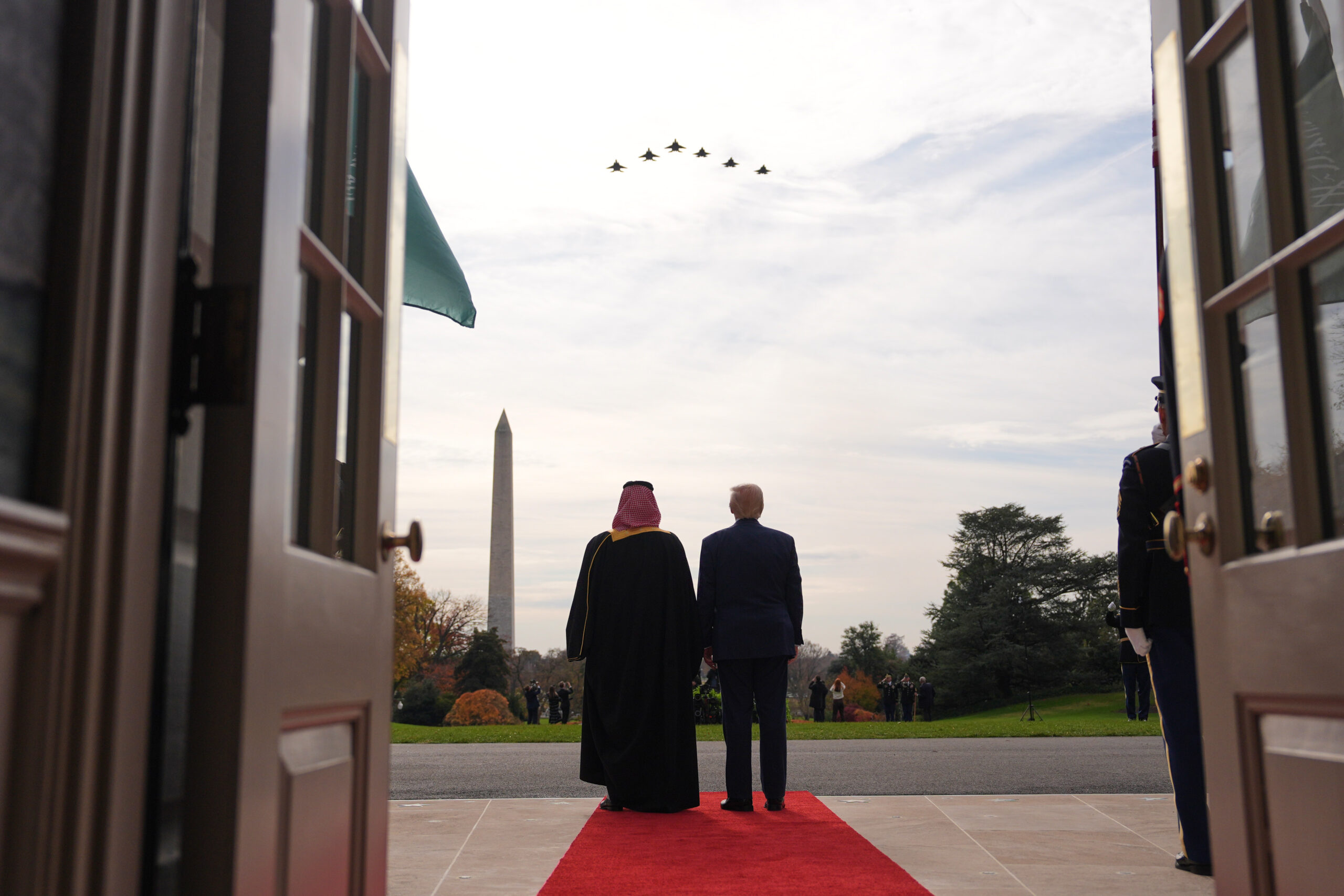
President Donald J. Trump and Saudi Crown Prince Mohammed bin Salman watch a flight of F-35s and F-15s during a welcome ceremony on the South Lawn of the White House, November 18, 2025, in Washington. (AP Photo/Evan Vucci)
The U.S. State Department has approved a possible $24.3 billion foreign military sale to Saudi Arabia for 48 F-35 Lightning II fighter jets. The decision advances Riyadh’s long-standing effort to acquire the aircraft, potentially strengthening its air power and integration into the U.S. regional security architecture.
The F-35’s expected contribution to Saudi Arabia’s broader defense picture, however, appears limited, as it only partially answers the multilayered spectrum of conventional and asymmetric airborne threats undermining Saudi national security. On top of that, congressional scrutiny, lengthy training timelines, and a demanding integration process could further delay its tangible military impact.
Still, the deal carries immediate political weight beyond its future combat utility, testing Washington’s ability to deepen defense ties with Riyadh while preserving Israel’s qualitative military edge.
Navigating the U.S. Arms Sales Machine
On September 17, the State Department formally notified Congress of the proposed F-35 sale, thereby initiating the statutory review period. Such a major deal through the U.S. Foreign Military Sales system passes through several stages involving multiple U.S. government institutions before becoming a contract.
The prospective F-35 sale just passed the first step, an informal consultation between the State Department and Congress, known as “tiered review,” during which congressional committees of jurisdiction can inquire about the deal.
Once this process is complete, the Defense Security Cooperation Agency submits the formal notification, beginning the statutory review process, which for Saudi Arabia is about 30 days. Under the Arms Export Control Act, Congress can seek to block the sale through a Joint Resolution of Disapproval, although such a resolution would need to pass both chambers and survive presidential veto, which could eventually be overridden with a two-thirds majority in both the House and Senate, almost insuperable hurdles for any formal congressional opposition.
Congress can also use ordinary legislation to restrict, condition, or modify arms transfers. This would not be confined to a specific notification-review window and could affect sales at later stages, including delivery.
The UAE Case
The case of the United Arab Emirates’ bid for the F-35 illustrates how even an authorized sale can get delayed or derailed. Abu Dhabi’s prospective acquisition was likely facilitated by the UAE’s normalization of diplomatic relations with Israel through the Abraham Accords; nonetheless, Abu Dhabi still faced substantial political and procedural obstacles. Under the administration of President Joseph R. Biden Jr., negotiations became entangled in U.S. concerns over the UAE’s expanding military and technological ties with China and disagreements over safeguards for sensitive F-35 technology. Although the White House informed Congress of its intention to proceed with the sale, procurement talks ultimately stalled, with the UAE suspending negotiations in 2021.
Israel’s Qualitative Military Edge
The Arms Export Control Act includes statutory requirements ensuring that U.S. defense exports to Middle Eastern countries do not adversely affect Israel’s qualitative military edge. As Israel is currently the only F-35 operator in the region, the prospective sale to Saudi Arabia raises the challenge of transferring fifth-generation fighters to Riyadh while preserving Israel’s military advantage.
Israel operates a unique F-35A variant – the F-35I “Adir.” Compared with other F-35A operators, Israel has been granted unusual latitude to modify the aircraft and integrate indigenous systems, including an open-architecture system, electronic-warfare suites, and locally designed weaponry and modifications.
Israel currently has two F-35I squadrons, about 50 aircraft, and ongoing plans to expand its combat-aviation buildup. Israel signed a contract for a third F-35 squadron in 2024, and a fourth was approved in 2026, potentially bringing its contracted fleet to roughly 100 aircraft once all planned acquisitions are completed.
For Washington, balancing the Saudi F-35 sale and Israel’s military superiority requires careful calibration, which could be achieved through a combination of options.
First, the precise configuration of the prospective Saudi F-35 has not been publicly disclosed, but the United States could limit access to some of the software, electronic-warfare, and weapons-integration capabilities that distinguish the Israeli aircraft while retaining the F-35’s core fifth-generation characteristics.
Second, the F-35I’s distinctive value partly reflects the latitude Israel has been granted to integrate domestic systems and weapons. Even if Saudi Arabia purchases F-35As, it would unlikely receive comparable freedom to make country-specific modifications.
Third, Israel’s qualitative military edge concerns an assessment of the broader regional military balance rather than a one-for-one comparison of individual platforms. Preserving it may be less about downgrading the prospective Saudi F-35 than about reinforcing the wider Israeli force structure through additional capabilities, training, sustainment, or other measures that offset the new fifth-generation capability transferred to Riyadh.
The Saudi Air Force Mix
Among Washington’s Middle Eastern partners, Saudi Arabia has historically maintained a large and advanced air force. The Royal Saudi Air Force currently operates a mixed fighter fleet, comprising more than 200 F-15C/D and F-15S/SA variants, around 80 Tornado aircraft, and more than 70 Eurofighter Typhoons. Despite differences in age and modernization, these platforms are predominantly fourth- and 4.5-generation combat aircraft.
For Riyadh, the prospective F-35 acquisition would be more consequential than simply adding another fighter type to an already sizable fleet. It would introduce a fifth-generation combat platform built around capabilities largely absent from its air force’s existing inventory, from low observability to advanced sensor fusion and passive sensing, thereby adding a qualitatively superior layer to its airpower.
Balancing Political Stakes
Beyond its military implications, the prospective sale carries significant political ramifications. The monthslong U.S.-Israeli war with Iran directly exposed Saudi Arabia to the fallout of regional escalation. With sustained missile attacks calling into question the reliability of U.S. protection, the prospective F-35 sale represents a meaningful political gain for Saudi Arabia. Although still falling short of a mutual-defense agreement, the F-35 decision signals Washington’s willingness to keep investing in the bilateral defense relationship at a moment when Riyadh is reassessing its reliance on U.S. security protection.
The decision holds even greater significance because Washington appears to have separated the F-35 track from discussion of Saudi-Israeli diplomatic normalization. This breaks with the logic that appeared to underpin the UAE’s earlier F-35 pursuit, suggesting that the U.S.-Saudi defense relationship can deepen independently of normalization.
From Acquisition to Capability
Even if the sale goes through, it will take time for Saudi Arabia to integrate the F-35 into its air force. This timeline will depend primarily on three factors.
First, the F-35 is a top-tier combat asset, but it remains only one platform within a multilayered air-defense architecture. The fifth-generation aircraft has accumulated extensive combat experience in the Middle East, but it would offer only a partial response to the vulnerabilities exposed by Iranian missile attacks targeting Saudi Arabia alongside renewed threats from Yemen’s Houthis. Rather than addressing the full spectrum of Saudi air-defense requirements, the F-35 would add a high-end layer to an ecosystem that must still contend with relatively inexpensive and distributed threats.
Still, its principal added value is not greater air-to-air capability, longer range, or heavier payload; it is its ability to change the tactical geometry of combat. By combining stealth, sensor fusion, and passive sensing capabilities, the F-35 can function as a node within information-centric, networked warfare. For Saudi Arabia, this could substantially improve the integration of its airpower, but it would not close persistent gaps in its wider air-defense architecture, particularly against low-cost, distributed threats, such as drones.
Second, operating the F-35 requires a demanding training pipeline, creating a potential personnel bottleneck for Riyadh. Qualification combines academic curriculum, simulated training, and hands-on flying. Beyond aircraft handling, the challenge for pilots is to master its sensors, software, and weapons as an integrated system. Training pipelines range from roughly five months for experienced pilots to six-to-eight months for basic courses. Building a mature national capability would take considerably longer. Saudi Arabia would need instructor pilots capable of training subsequent cohorts and developing a national training pipeline. Its long familiarity with U.S. training practices, coupled with Lockheed Martin’s programs to produce national instructors for partner air forces, may ease this process. Nevertheless, the first Saudi cadre would need time to acquire sufficient experience and develop tactics tailored to Riyadh’s operational requirements.
Third, a fully operational F-35 squadron requires more than qualified pilots and aircraft. It rests on a wider architecture encompassing trained maintainers, mission planners, and intelligence personnel as well as the provision of spare parts and enabling capabilities, such as aerial refueling. The F-35’s combat edge, therefore, depends on what surrounds and supports it.
Its potential to transform Saudi airpower will rest on Riyadh’s capacity to integrate the F-35 into its broader air-defense architecture, spanning from lower-generation fighter jets to airborne early-warning aircraft and ground-based systems, and build a personnel and institutional support ecosystem around the aircraft.
What’s Next?
A host of factors suggest that the F-35 would offer a medium- to long-term capability in response to present security concerns for Riyadh. The notification’s strategic significance, therefore, appears to lie more in its near-term political signaling than in a tangible improvement in current military capability.
For Saudi Arabia, the prospective F-35 acquisition represents a meaningful but partial, and potentially reversible, gain, if Congress opposes the sale. While adding a qualitatively new layer to Saudi airpower, the fifth-generation fighter does not by itself address Saudi Arabia’s present and future vulnerabilities. Ultimately, the F-35’s long-term value will depend less on the aircraft alone than on Riyadh’s ability to integrate it into a broader air-defense architecture.
The views represented herein are the author's or speaker's own and do not necessarily reflect the views of AGSI, its staff, or its board of directors.
As Iranian strikes exposed structural gaps, Gulf states are expanding their air defense architecture through new suppliers, lower-cost systems, and operational partnerships.
The war is demonstrating that missile defense can blunt Iran’s strategy – but only if the United States and its regional partners ensure that their defenses can keep pace with the scale and speed of future conflicts.
U.S. force projection in the Gulf is increasingly relying on artificial intelligence, unmanned platforms, and space technology, using these systems to augment existing military infrastructure.
With an aging and largely untested fleet, U.S. mine clearing operations can restore maritime access but only under favorable political and operational conditions.
NATO’s Operation Ocean Shield helped secure freedom of navigation in the Red Sea, but diplomatic fractures and naval constraints mean its success is unlikely to be repeated in the Strait of Hormuz.