Following the high of the inaugural Art Basel Qatar, and the low of the ongoing Iran war, Qatar is doubling down on global and regional cultural diplomacy.
In the first week of February, a flurry of art world heavyweights from the Middle East and across the world arrived in Doha for the inaugural Art Basel Qatar. The opening of a Middle East outpost of the most prestigious and important global art fair was a bright spot in an otherwise depressed global art market and confirmation that serious art business can be done in the Gulf. Even skeptics were taking the region’s art ambitions more seriously.
The arrival of Art Basel was only the most recent and significant cultural advance for the Gulf region. New museum openings in Abu Dhabi, Riyadh, and Doha have been accompanied on the commercial side with auction houses staging their first auctions in the Saudi capital and foreign art dealers and advisories opening new posts in several Gulf states. The arrival of Art Basel Qatar expanded the commercial playground for the region and the world.
At a media event February 3, the fair’s first VIP day, Sheikha Al Mayassa Hamad bin Khalifa al-Thani, chair of Qatar Museums and architect behind Qatar’s cultural ecosystem, called the art fair “a special moment” that “uplifts the creativity of an entire region.” The event signaled the emergence of what she called a regional “art valley” that would “foster global dialogue and regional creativity.”
Just a few weeks later, on February 28, Iran launched missiles and drones at Gulf Arab states, including Qatar, and the region found itself in the crossfire of the U.S. and Israeli war with Iran. Airspace closures limiting flights to the region, Iran’s blockade of shipping lanes, and skyrocketing fuel costs have posed massive disruptions to global art logistics and resulted in severe hurdles especially for Gulf Arab states. Can Qatar and the wider Gulf art community navigate this latest setback?
A New Art Fair for the Gulf
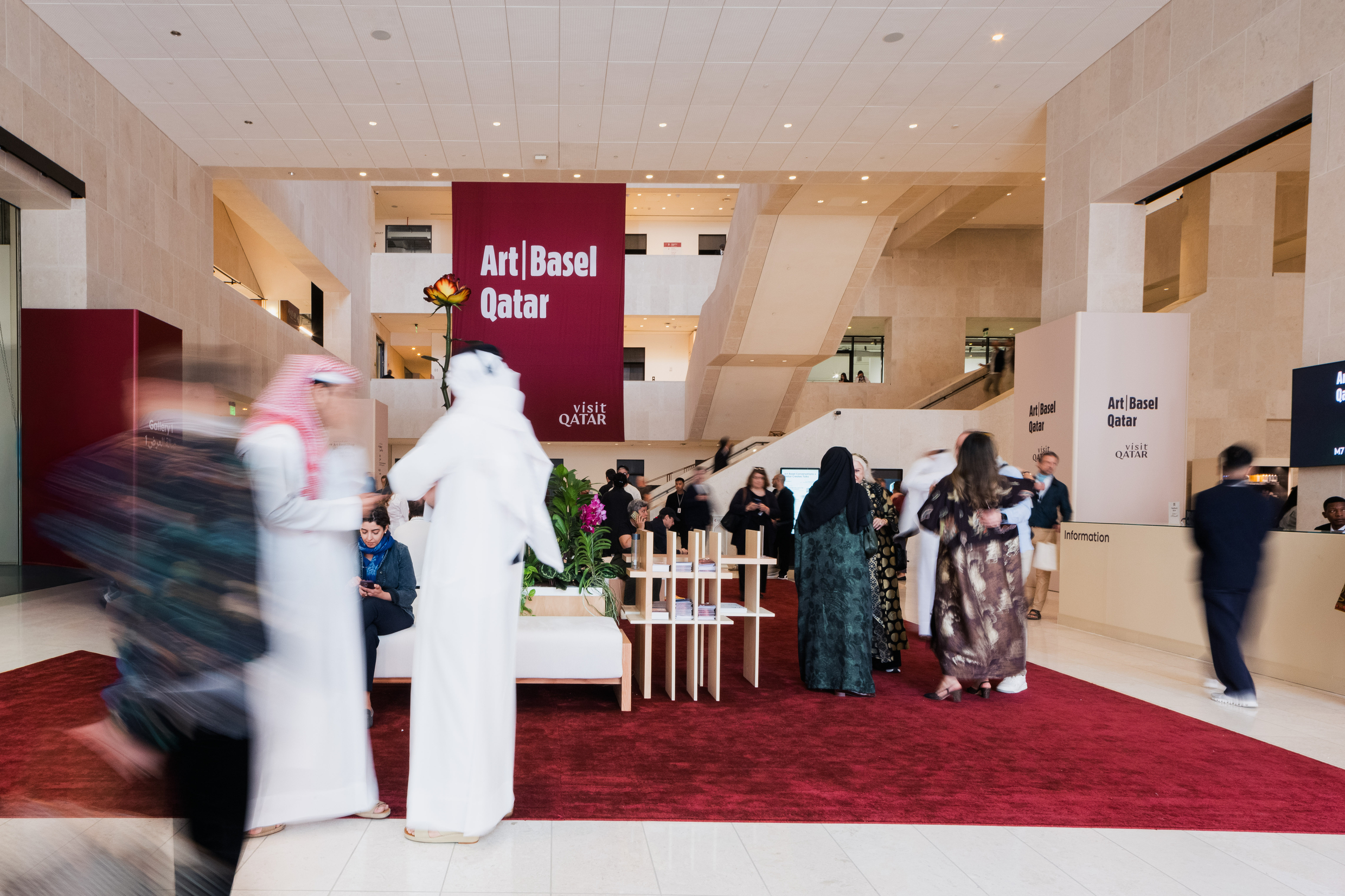
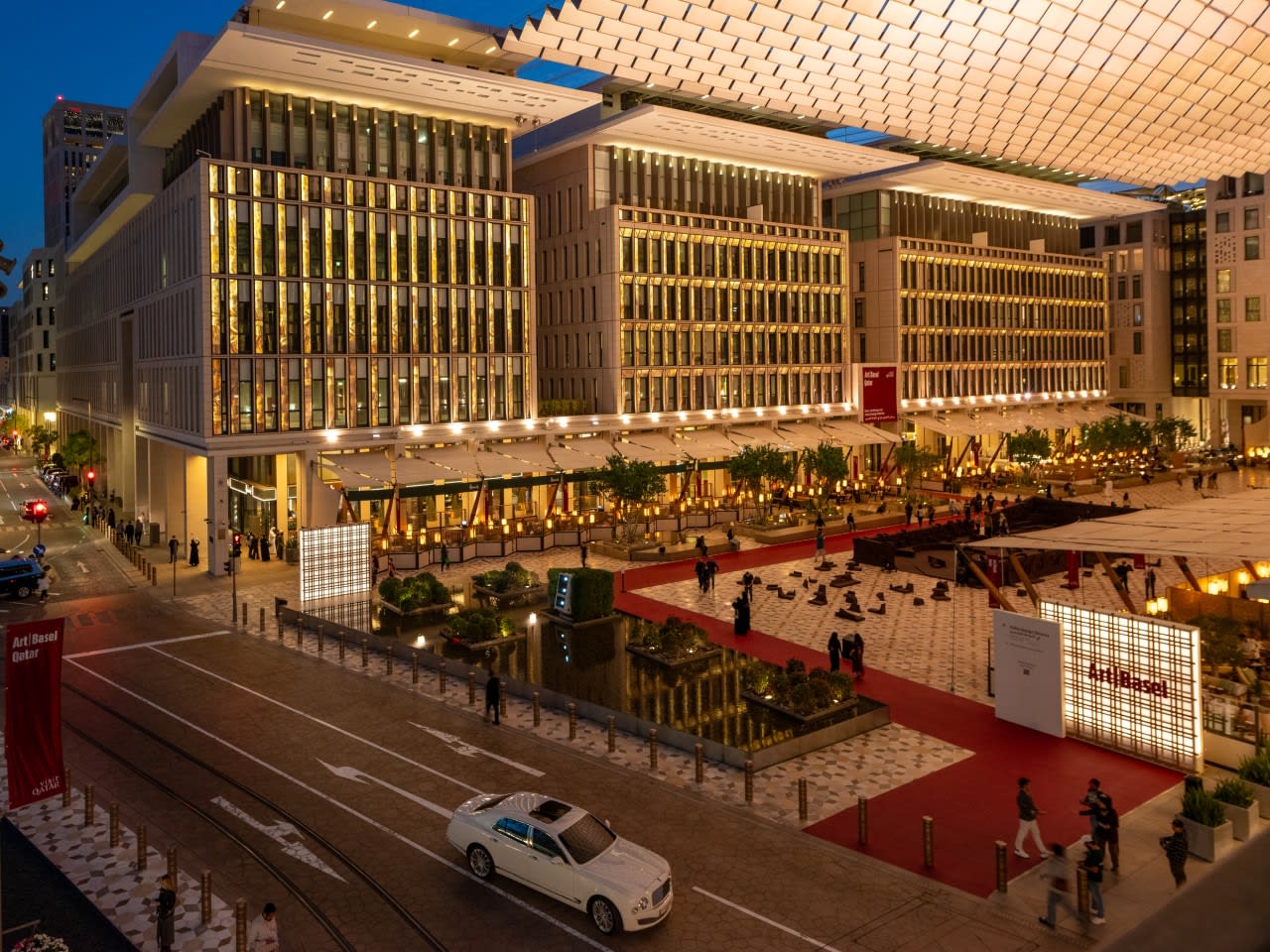
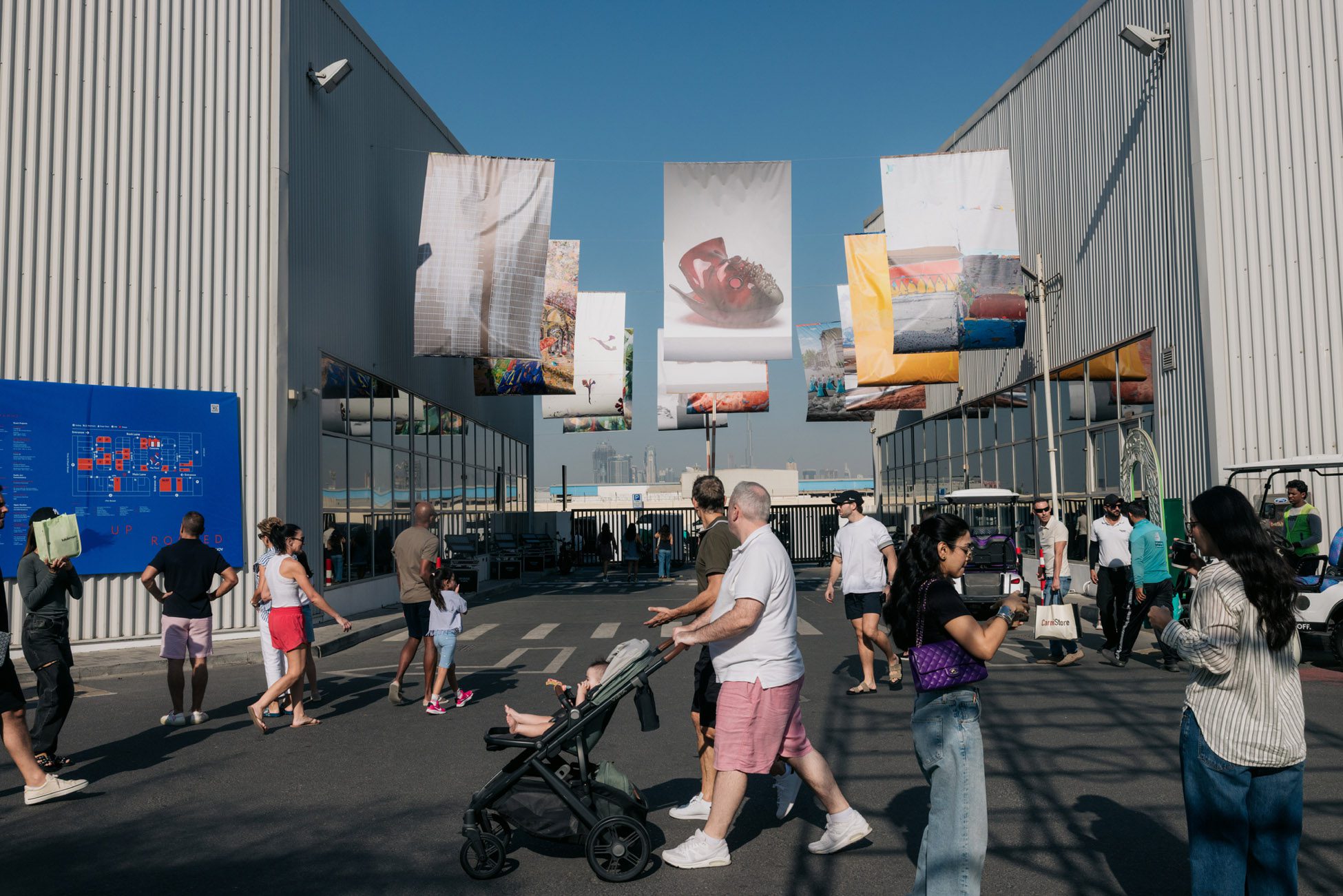
The opening of Art Basel Qatar was met with positive energy and praise from visitors. The 87-exhibitor fair spanned three floors of the sleek M7 building and Doha Design District in the Qatari capital’s Msheireb district, adopting a new format for the Swiss art fair.
For the first time, its offerings were exhibited without booths, with each gallery presenting only a single artist. Art Basel CEO Noah Horowitz described this new model as “intentionally different.” While the new format made the visitor experience more akin to that of a museum quality art exhibition or art biennale, Horowitz stressed: “Don’t forget that everything is also for sale.”
Works by both emerging and established regional artists were interspersed alongside preeminent figures from postwar and contemporary art, offering a balance between a regional grounding and global offering.
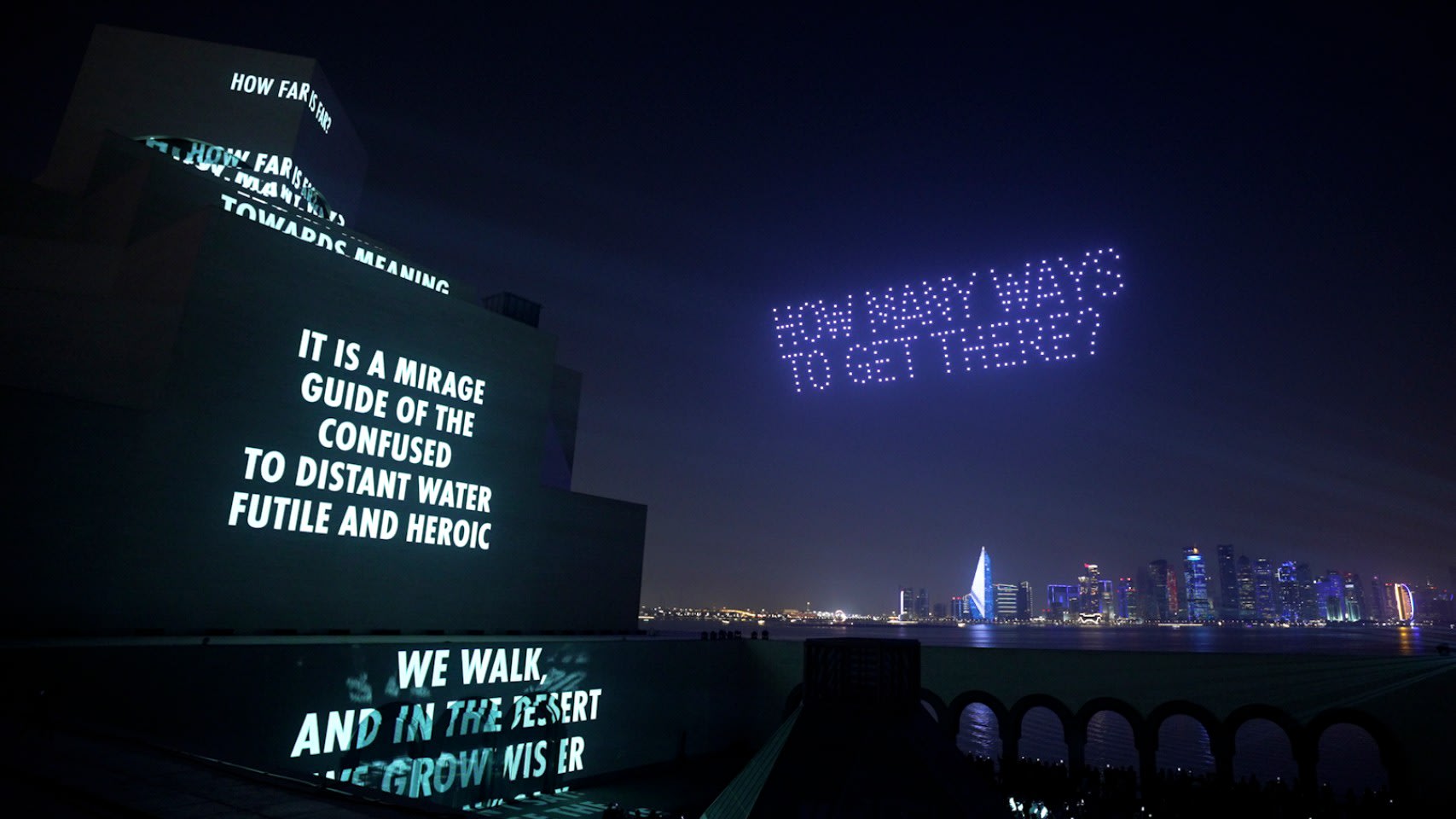
The dazzling paintings of Jean-Michel Basquiat and Philip Guston were exhibited with poignant mixed media works of Gaza-born Dubai-based artist Hazem Harb, highlighting fragments from the destroyed Gaza International Airport. Other notable works included Qatari American Sophia Al Maria’s “HILUX,” a body of mixed media work exploring Gulf identity amid the region’s rapid transformation; late Lebanese artist and poet Etel Adnan’s luminous oil paintings; Libyan artist Nour Jaouda’s installation of a rest home exploring themes of displacement; and American conceptual artist Jenny Holzer’s surprise drone performance and large-scale text projection at the Museum of Islamic Art.
Egyptian artist Wael Shawky, the fair’s appointed artistic director, worked alongside Vincenzo de Bellis, Art Basel’s chief artistic officer and global director of fairs, in consultation with a selection committee of leading regional and international gallerists, to present a curatorially driven fair. Shawky explained how he worked with de Bellis and the selection committee to focus on the theme “Becoming,” curating around ideas of transformation and movement rather than a fixed narrative or identity. “The whole concept of the art fair has been questioned from every angle,” said Shawky. “It is a difficult and challenging experience for galleries. The idea was to break this idea that the art fair can only be a marketplace. The galleries exist, sales exist, but it is also an exhibition that is curated.”
Shawky worked to include as many voices from the Middle East and North Africa as possible. “I wanted to create a dialogue between all the galleries and the artists – between artists that are from the Middle East but not as well-known elsewhere. For example, at the fair a Palestinian artist was positioned in front of works by South African painter Marlene Dumas.”
Indeed, half of the artists featured, according to de Bellis, were from the Middle East, North Africa, and South Asia. De Bellis emphasized that the goal of this inaugural fair was “to slow down the pace, which is another important cultural experience of the region: the gathering together of people.”
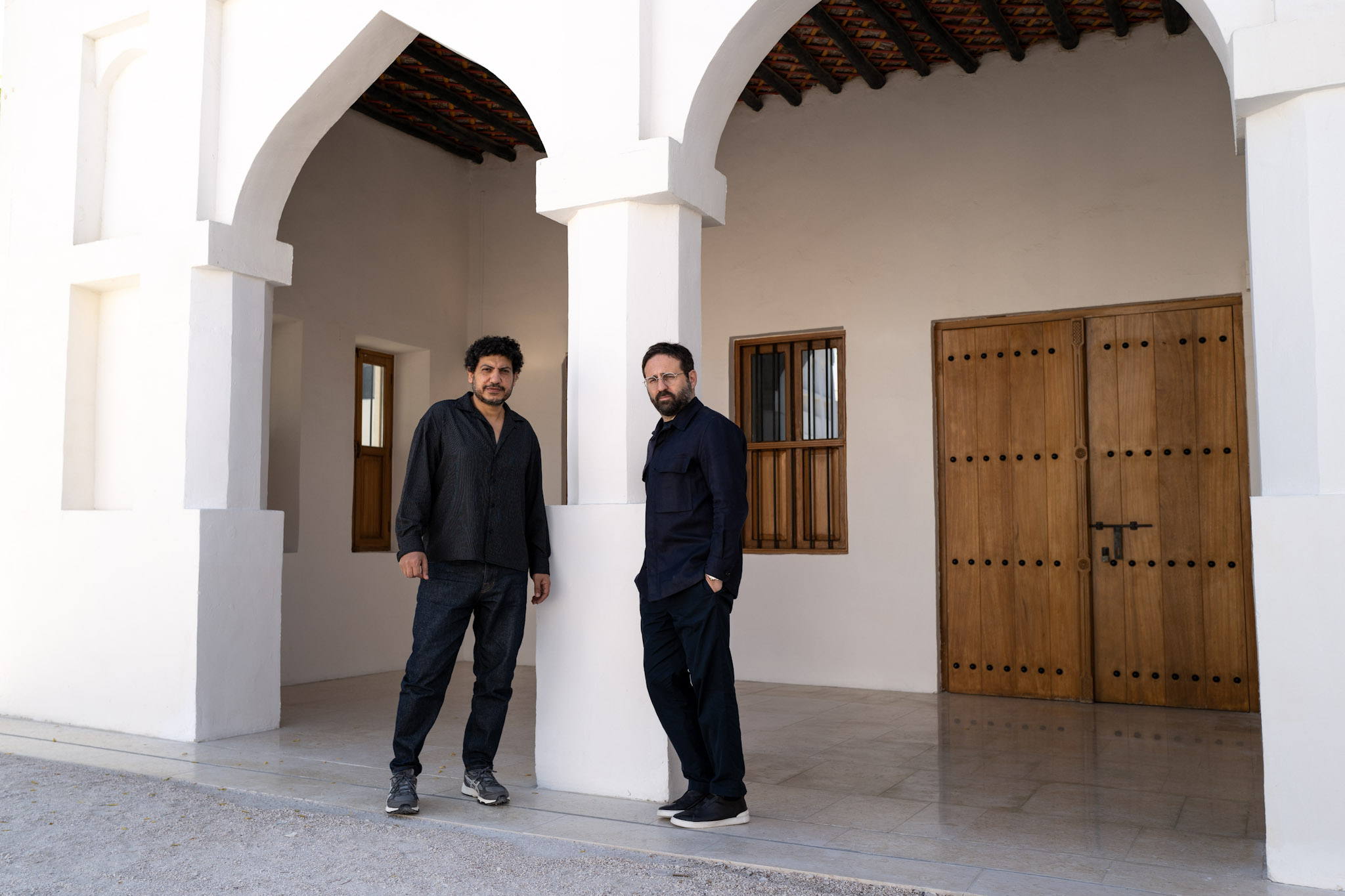
Vincenzo de Bellis, right, and Wael Shawky, left. (Image courtesy of Art Basel. Photo by Jinane Ennasri)
For the most part, gallerists from abroad and within the region praised the new format. “Art fairs tend to compress artistic practices into tightly packed presentations where proximity can blur nuance,” said Maliha Tabari, founder of Tabari Artspace, which presented a solo exhibition dedicated to Harb’s work. “The decision to adopt a solo format created rare conditions for depth. Every artist and gallery was afforded the space to articulate a coherent position within a defined conceptual and material framework. For artists, exhibitors, and audiences alike, this translated into meaningful engagement rather than fleeting consumption.”
This wasn’t a typical Art Basel fair where collectors rush to buy as soon as the doors open. Art Basel Qatar offered a quieter, more discerning approach to buying, fostering at first an appreciation for the art at hand and its deliberate cross-cultural curation. While nearly everyone praised the single-artist format, a few dealers quipped quietly: “Where are the sales?”
While sales were few during the fair’s opening days, they continued throughout the fair. These included 11 works priced between $45,000 and $220,000 by Saudi artist Ahmed Mater at Saudi Arabia’s ATHR Gallery, which were part of his “Temporal Migration” photographic project exploring the rapid transformation of Mecca, Saudi Arabia. Eight Georg Baselitz bronze hand sculptures at 800,000 euros ($951,576) each were sold at White Cube. And at least one painting by Philip Guston from three 1970s pieces priced up to $14 million at Hauser & Wirth sold. Lebanese artist and filmmaker Ali Cherri sold watercolor works for $35,000 each and sculptural works for up to $153,000 at Almine Rech. Some of the most expensive works at the fair – such as a $42 million Pablo Picasso painting presented by Acquavella – were in the fair’s private viewing rooms.
“The Middle East is a region that we would like to be more active in,” Alia al-Assaad, the Middle East representative for Almine Rech, said. “As with everything, it is important to challenge the norms of the Western canon.” French gallerist Emmanuel Perrotin said the fair symbolized how “the region is not just participating in the art world but helping to shape it.”
Fostering an Art Private Sector
The fair was produced in partnership with Qatar Sports Investments and QC+, the commercial arm of Qatar Museums. According to de Bellis, each gallery was offered a package including a fixed price for the presentation, hotel accommodations, and shipping, handling, and installation of the works of art. This support, a unique arrangement in contrast to other Art Basel fairs, offered a nearly risk-free experience for galleries and evoked a more laid-back feel than others. One collector noted wryly: “This is how it should be.”
Yet a major goal of attracting Art Basel to Qatar was to deepen the involvement of the private sector in in a field that has been dominated by state support. “We represent the private sector and a catalyst for the private sector,” stated de Bellis. “One of our objectives is to support the growth of the private sector in the region.”
Local collectors were undoubtedly proud. “The fair symbolizes a new frontier for art,” said Qatari businessman, art patron, and collector Tariq Al-Jaidah. “I think the majority in attendance were from the Middle East. Many galleries sold out by the end of the fair; the vibe was phenomenal!”
Still Jaidah also suggested that more time is needed to cultivate a local collector base. “I think the challenge will be to try and encourage people to pay the big numbers,” he said. “People here have the money; they own cars at the same value as the art, but they’re not yet ready to move toward buying art at the same value. We must emphasize the commercial visibility and that this type of investment is very sustainable.”
Despite the promising beginning, it is unclear if there remains a strong enough private sector within the Gulf’s largely state-led and financed cultural ecosystem to sustain a fair like Art Basel Qatar for the long term. In the more immediate term, Art Basel, alongside others in the region, such as Art Dubai and Frieze Abu Dhabi, will be watching the ongoing conflict and political insecurity with trepidation and attempting to gauge its impact on these broader sustainability concerns for efforts like Art Basel Qatar.
“It was important to see how the Gulf is starting to play the global cultural game,” said Maria Gracia de Pedro, the founder of Artepreneur, a boutique cultural human resources company in Spain, who traveled to Qatar for the first time for the fair. “Since graduating, I have always traveled to Art Basel in Switzerland. When I heard the fair was taking place in Doha, I didn’t think twice. I thought it was very important for me to be there.”
(Courtesy of Art Basel)
Maintaining Qatar’s Cultural Mission in a Time of Uncertainty
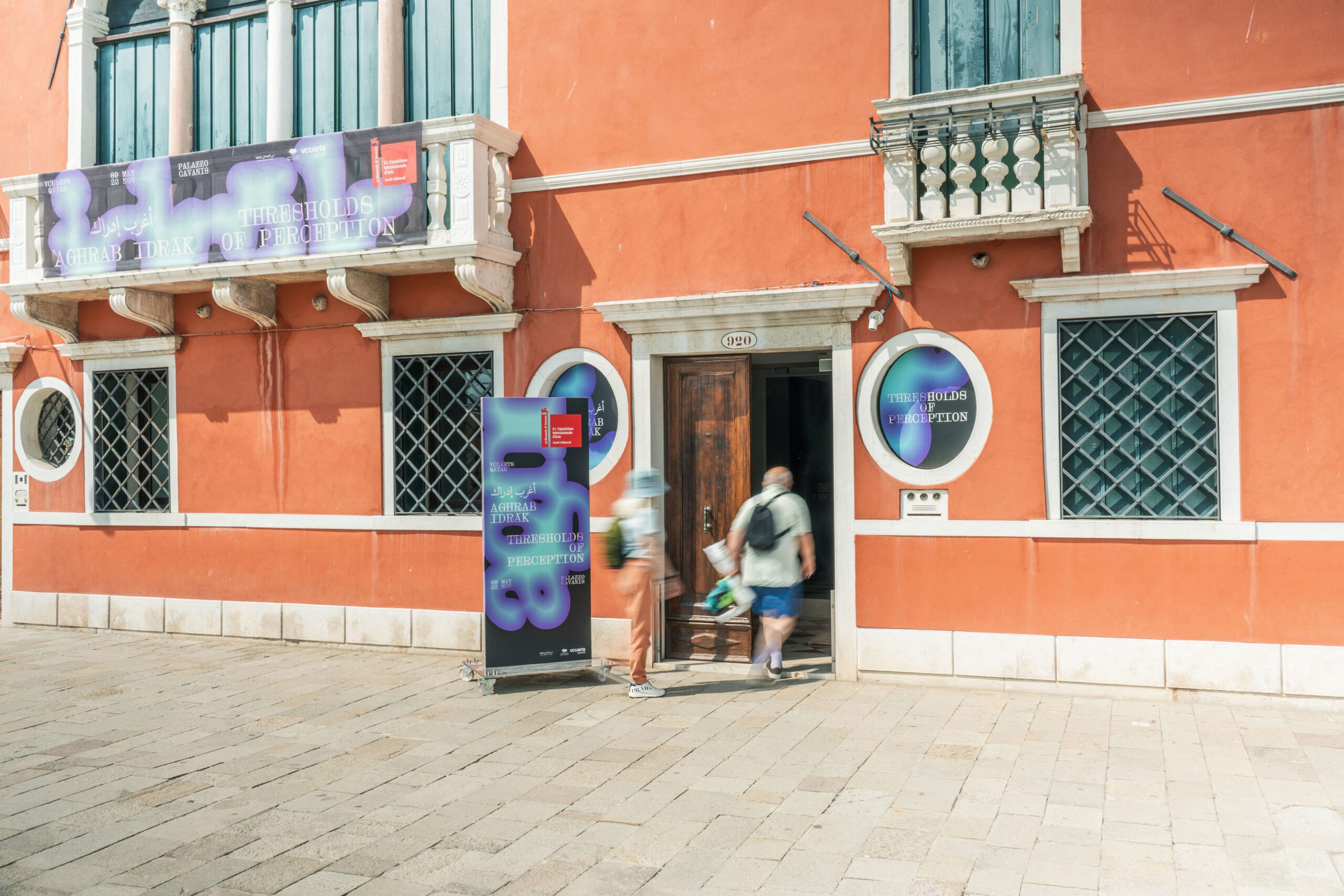
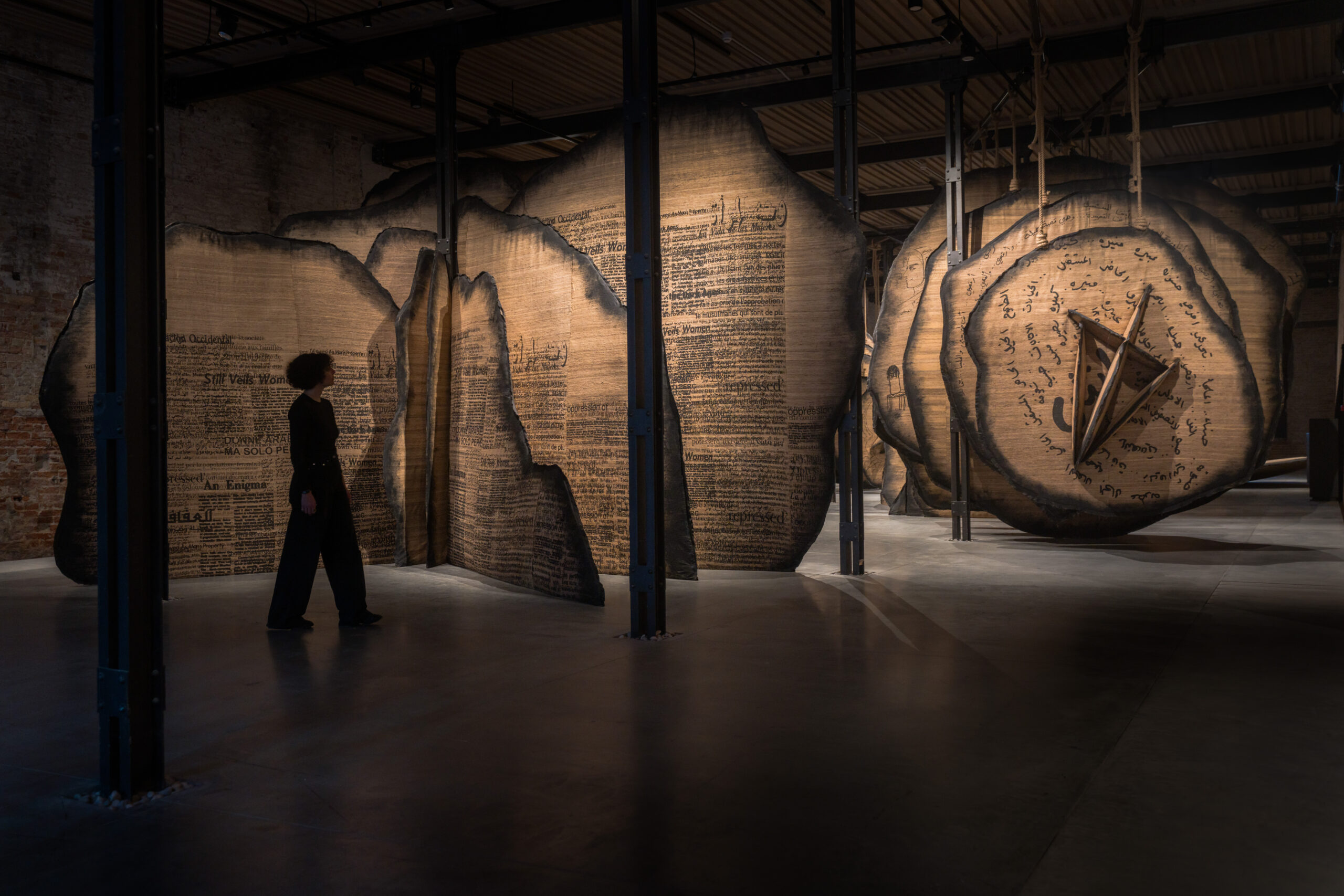
Despite the disruption of the U.S. and Israeli conflict with Iran, Qatar has persevered with its ambitious arts agenda abroad. Qatar National Pavilion opened during the Venice Biennale with the show “untitled 2026 (a gathering of remarkable people)” highlighting the theme of resilience during challenging times. VCUarts Qatar, a branch campus of Virginia Commonwealth University’s School of the Arts, is staging its first official collateral event during the 61st Venice Biennale at the historic Palazzo Cavanis. Due to shipping delays and other adjustments caused by the war, the event opened late on June 1.
Despite the sharp decline in tourism throughout the Gulf, including Doha, Qatar continues to move forward with its cultural programming. Its upcoming 2026 fall season presents a dense schedule of events, including the staging of the second Design Doha Biennial, originally scheduled to take place from April 16 to June 30; the inaugural Rubaiya Qatar contemporary art quadrennial; a major retrospective on the Baghdad Modern Art Group at the Mathaf Arab Museum of Modern Art; an exhibition of Italian artist Giuseppe Penone at the National Museum of Qatar; and the Doha Film Festival.
During the conflict, Doha maintained a role as a key negotiator between Washington and Tehran. Its cultural scene seemingly follows the same premise, steering its cultural and soft power resources toward its national identity as a facilitator for communication and understanding among diverse cultures and countries.
During a discussion on cultural patronage during Art Basel Qatar in February, Sheikha Al Mayassa made the case for Qatar’s cultural mission: “It’s important for us to trace our past and claim it and share it to the rest of the world but also show the connectivity that Qatar had historically and the important role it has been playing in diplomacy.”
The idea was evocatively expressed in architect Sumayya Vally’s installation “Assembly of Lovers,” inspired by a traditional Arab gathering room, or majlis, positioned between M7 and Design Doha District buildings, making it an unmissable site for fairgoers. The large-scale installation paid homage to lost and destroyed communal spaces across the Islamic world and offered room for communal dialogue, talks, and poetry readings. It was yet another example of how the fair sought to transcend its commercial function and insist on the act of gathering or becoming: with hope, love, and resilience across cultural and national divides. Qatar’s slew of upcoming cultural events intends to show the same resolve and resilience.
The views represented herein are the author's or speaker's own and do not necessarily reflect the views of AGSI, its staff, or its board of directors.
The Diriyah Contemporary Art Biennale returned a third time with intergenerational dialogues that created a timeline of change, adaptation, and reflection in Saudi Arabia.
The war has hit the United Arab Emirates during a period of cultural and economic flourishing. While life goes on amid continuous Iranian attacks, the country’s residents rally for its postwar return.