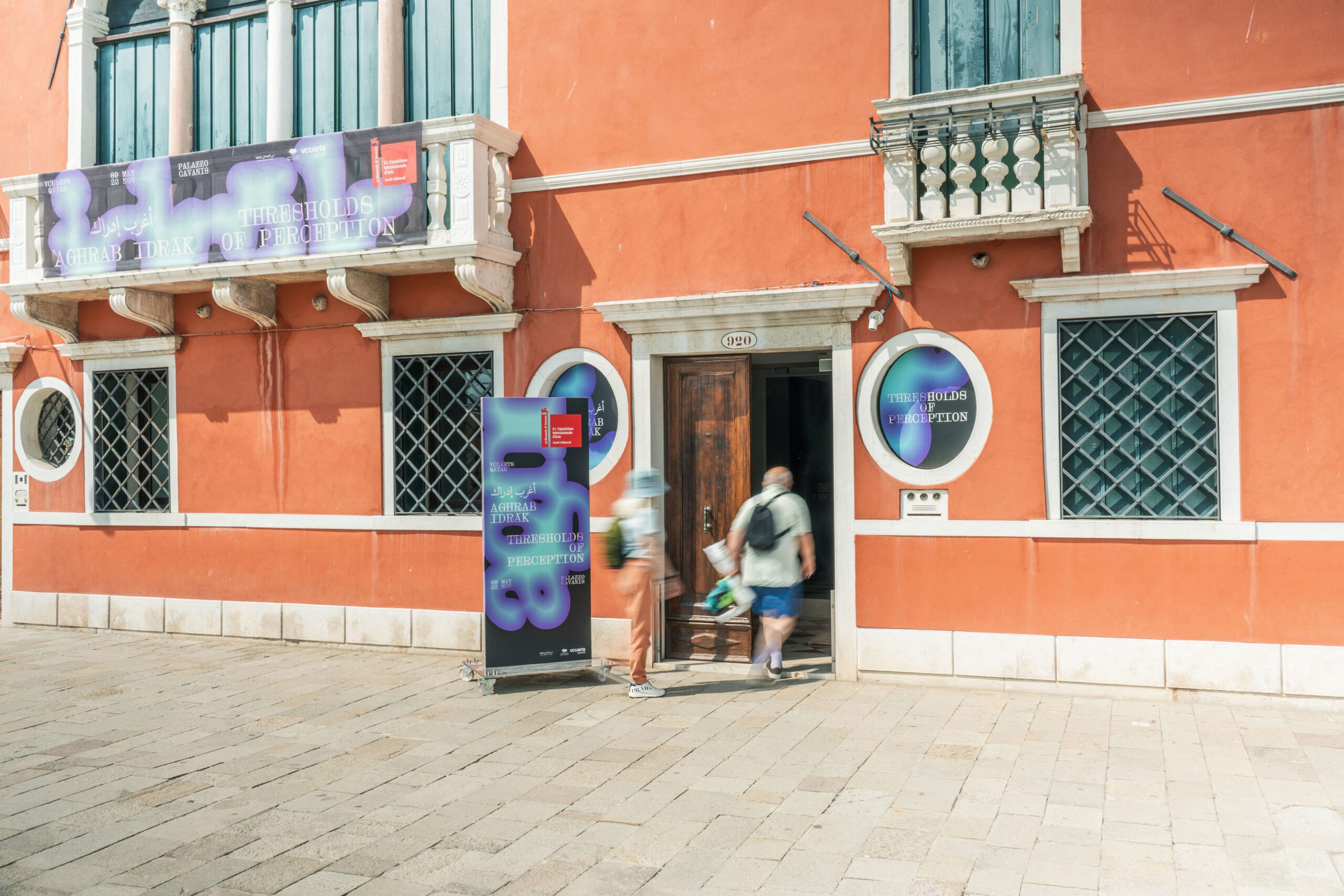
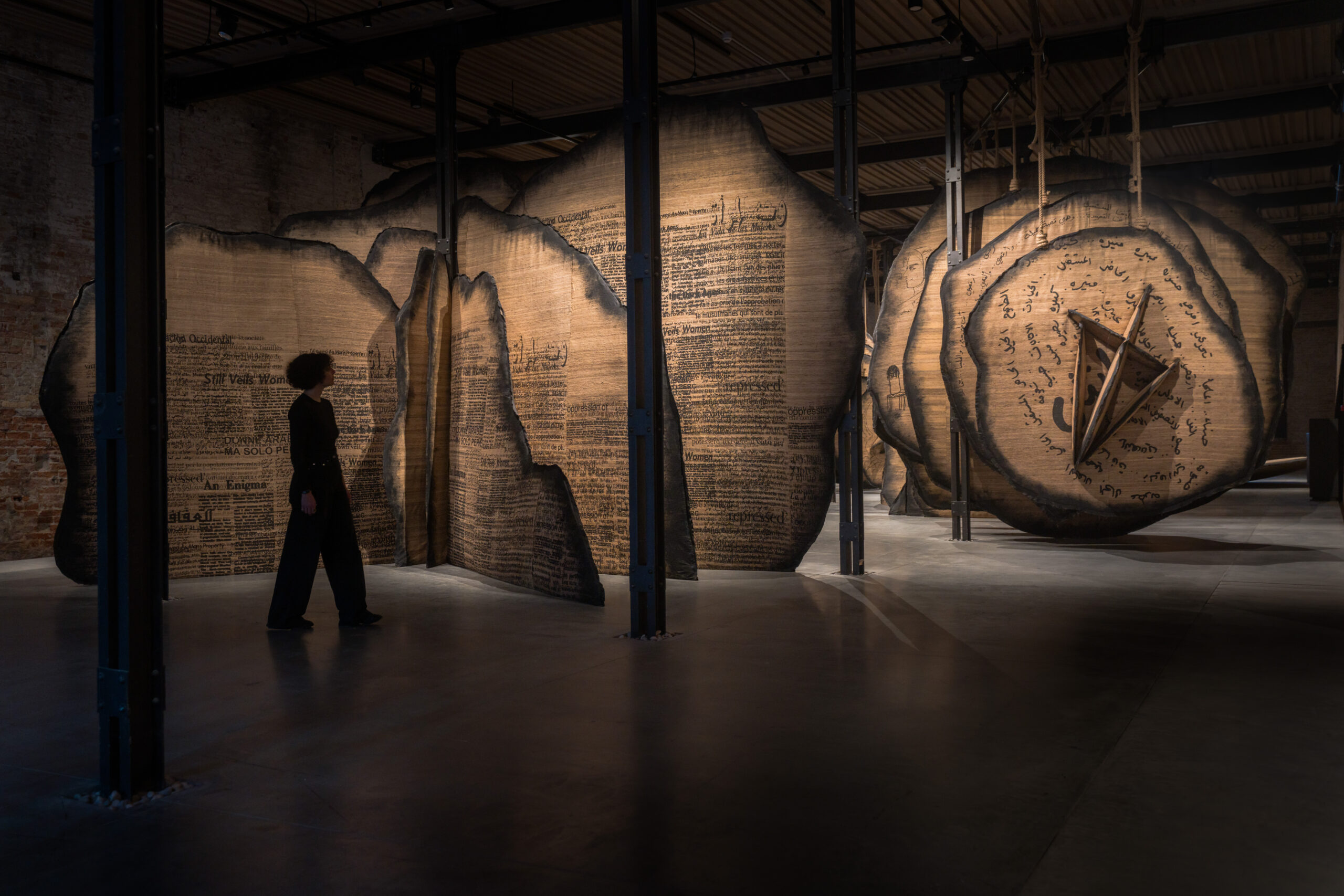
A view of the gallery housing "Aghrab Idrak: Thresholds of Perception" in Venice, Italy. (Courtesy of VCUarts Qatar)
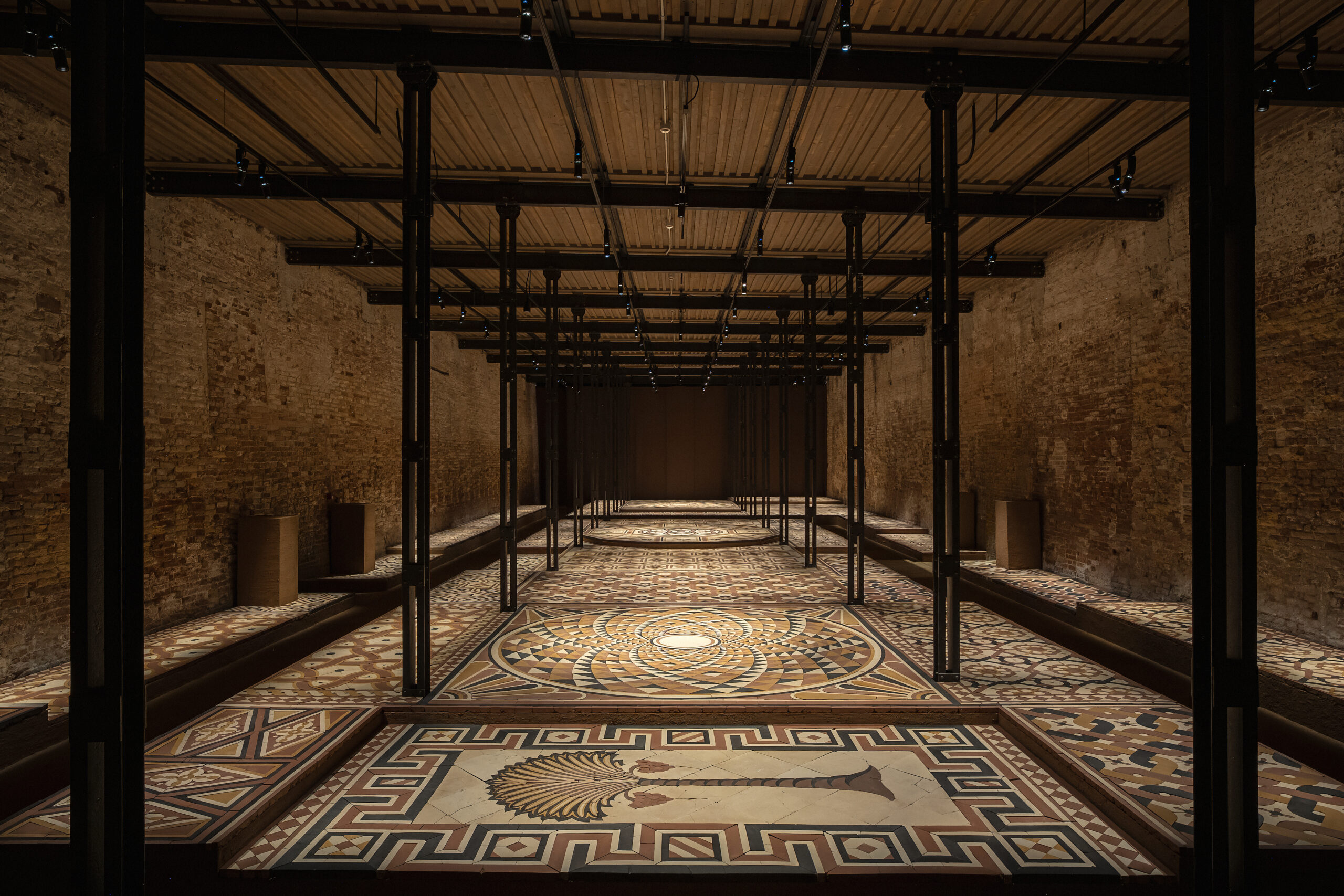
Thousands of clay bricks forming the decorative motifs of damaged or destroyed heritage monuments across the Middle East transform the Saudi national pavilion in Venice into a reimagined archaeological site. Saudi Palestinian artist Dana Awartani’s emotionally charged installation “May your tears never dry, you who weep over stones,” seeks to preserve and remember destroyed cultural heritage sites across the Arab world but also to grieve the loss of their memory, presence, and impending erasure. While the exhibition, curated by Antonia Carver, director of Art Jameel, and Assistant Curator Hafsa Alkhudairi, evokes a calm, almost meditative space, outside the pavilion protesters march and chant for a “free Palestine.” The juxtaposition between a state of calm contemplative immersion and one of tumult characterized the 61st International Art Exhibition of La Biennale di Venezia, which opened to the public May 9 and runs until November 22.
It was a biennale fated for controversy. The event was staged during a series of crises and curated by Swiss Cameroonian curator Koyo Kouoh, who passed away suddenly in May 2025 just months after she was named artistic director of the biennale. Marking the first African woman ever appointed to the position, despite her untimely death, her final curatorial vision, “In Minor Keys,” was fully realized by her dedicated team. It presents artworks that highlight a quiet form of resistance, exploring personal stories of history and trauma, largely from Africa and other regions traditionally underrepresented in the global art market. The contemplative resistance Kouoh aimed for was overtaken during the opening week as protests gripped the event, particularly against the participation of the national pavilions of Russia and Israel. The highly politicized lead-up to the biennale included calls for a boycott of the U.S., Russian, and Israeli pavilions and the resignation of the biennale jury one week prior to the event’s opening, making this arguably the most politically controversial biennale since it was first staged in 1895.
Additionally, the ongoing Iran war and closure of the Strait of Hormuz caused logistical challenges for many participants, particularly for those from the Gulf Arab states, including Saudi Arabia, Qatar, and the United Arab Emirates. “Staging the show during the war was a human feat,” said Carver. “Originally, we were planning to bring the work to Venice by ship to try and support sustainability goals. The second plan was to fly to Dubai, which couldn’t happen. We ended up flying with Saudia airlines from Riyadh to Jeddah and Jeddah to Frankfurt and then transported the work by road from Frankfurt to Venice. We ended up with a compressed installation schedule and had to receive special permission from La Biennale to work late into the night.”
Cultural Preservation Amid Instability
Awartani’s work “May your tears never dry, you who weep over stones,” Carver said, “is very much a kind of resistance against erasure and a protest against forgetting.” The installation is made from 29,221 clay bricks in four distinct hues of natural earth sourced from diverse Saudi geographic regions and handcrafted outside Riyadh by 32 artisans from the Arab world and South Asia. The evocative patterns reference damaged or destroyed heritage sites across the region, including the Grand Mosque of Aleppo, ancient bathhouses and buildings in Gaza, and heritage sites in Lebanon. “At any given moment over the past 3,000 years, which is how far back in history these mosaics reference, there have been waves of war, conflict, and destruction,” added Carver. “This work would have been of absolute urgency at any time over the past three millennia.”
“May your tears never dry, you who weep over stones.” (Photo by Alvise Busetto, courtesy of the Visual Arts Commission, Ministry of Culture)
The installation continues research Awartani began in earlier works, including “Standing by the Ruins,” a site-specific floor installation exploring love, loss, and the devastation of cultural heritage. The artist spent months researching mosaics from sites that had been damaged or destroyed in Gaza, Lebanon, Iraq, and Syria. “I wanted something that resonates with an audience in Italy,” Awartani said, underlining how the point of connection is mosaics. “I found it fascinating to learn that the first ever mosaic created was in Mesopotamia or modern-day Iraq. The art of mosaics then moved to Europe, where it flourished under the Roman Empire. It was during the Byzantine Empire that the art of mosaics was brought to the Arab world. All the patterns you see here are from historical UNESCO heritage sites that are either damaged or destroyed due to manmade conflict and violence.” “May your tears never dry, you who weep over stones” celebrates a shared history between the East and West even as it seeks to uphold the memory of what has been lost.
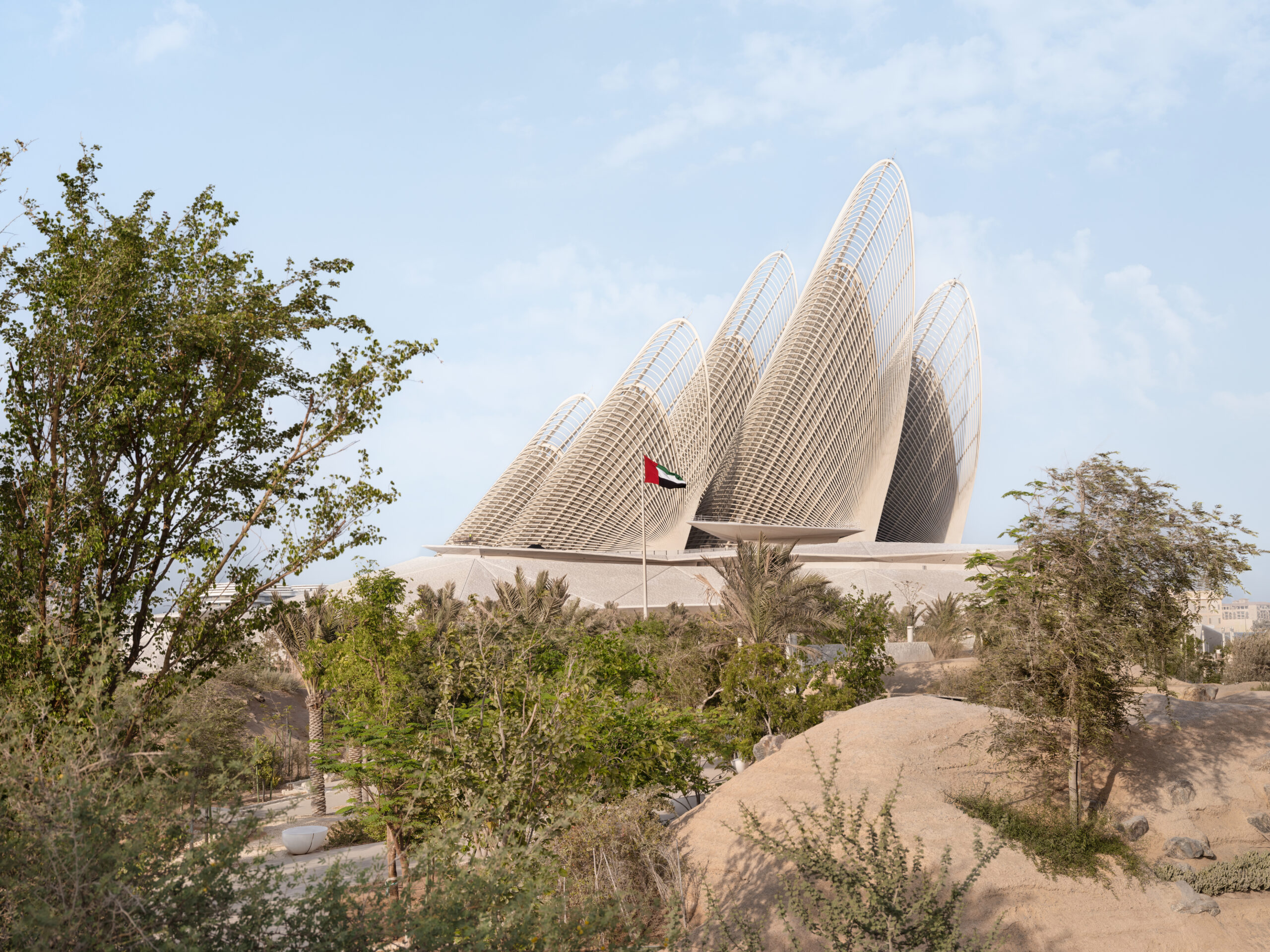
Just as Awartani’s work strives to commemorate the loss of cultural heritage and material memory in the Arab world, the themes of other Gulf pavilions seek to uphold local heritage amid regional and global instability. Inside the UAE national pavilion, sound becomes a means to connect various artistic disciplines, engaging poetry, storytelling, and other intangible cultural heritage. The exhibition, “Washwasha,” which means “whispering” in Arabic, is curated by Bana Kattan, curator and associate head of exhibitions at the Guggenheim Abu Dhabi, and Assistant Curator Tala Nasser, who works at the Isabella Stewart Gardner Museum in Boston as a curator and researcher. The exhibition features works by six artists with strong ties to the UAE: Mays Albaik, Jawad Al Malhi, Farah Al Qasimi, Alaa Edris, Lamya Gargash, and Taus Makhacheva.
“Washwasha,” curated by Bana Kattan. (Photo by Ismail Noor of Seeing Things, courtesy of National Pavilion-UAE – La Biennale di Venezia)
Kattan explained how the exhibition explores the way sound carries traces of the UAE’s rapid evolution. “With the discovery of oil, followed by the founding of the nation, the country saw swift transformation and rapid changes to its sonic environment. Against this backdrop, the early history of radio in the UAE offers a telling counterpoint. In 1961, Salem Obaid Alaleeli, then only 12 years old, helped establish Ajman’s first radio station alongside his cousin Rashid bin Abdullah bin Hamdah. This was in fact one of the first areas of research we explored while developing the exhibition, so the curatorial process really began with the UAE and this history in mind.”
Standout works in the exhibition include Farah Al Qassimi’s “The Curse,” a multimedia installation that includes an 18-minute video alongside sound and vinyl print pieces to explore children’s understanding of guilt and the historic and contemporary methods people use to communicate. There is also “Wiswas” (“whispers” in Arabic) by Alaa Edris, a complex sensory work that focuses on noise, sound, and the exhaustion of hyperconnectivity to explore how contemporary modes of communication are interfering with human connection. Also displayed are images from Lamya Gargash’s “Majlis,” a documentary C-print photographic series intimately capturing various traditional and evolving domestic seating areas across the UAE.
The artworks presented involved little shipping and hence logistical challenges related to the Iran war did not affect the mounting of the exhibition, stated Kattan. However, given the overarching theme of sound, she said: “We couldn’t help but think through the current sounds in our cities as the contemporary sound environment continues to change,” referring to how the sounds of missile and drone interceptions, war planes, and frequent helicopters patrolling UAE airspace have changed the country’s sonic landscape since the war broke out February 28. “We think that some of the best art is not reactive but reflective and responsive, so, in a few years, we’ll see what art comes out of this period in time,” added Kattan.
Championing Cultural Resilience
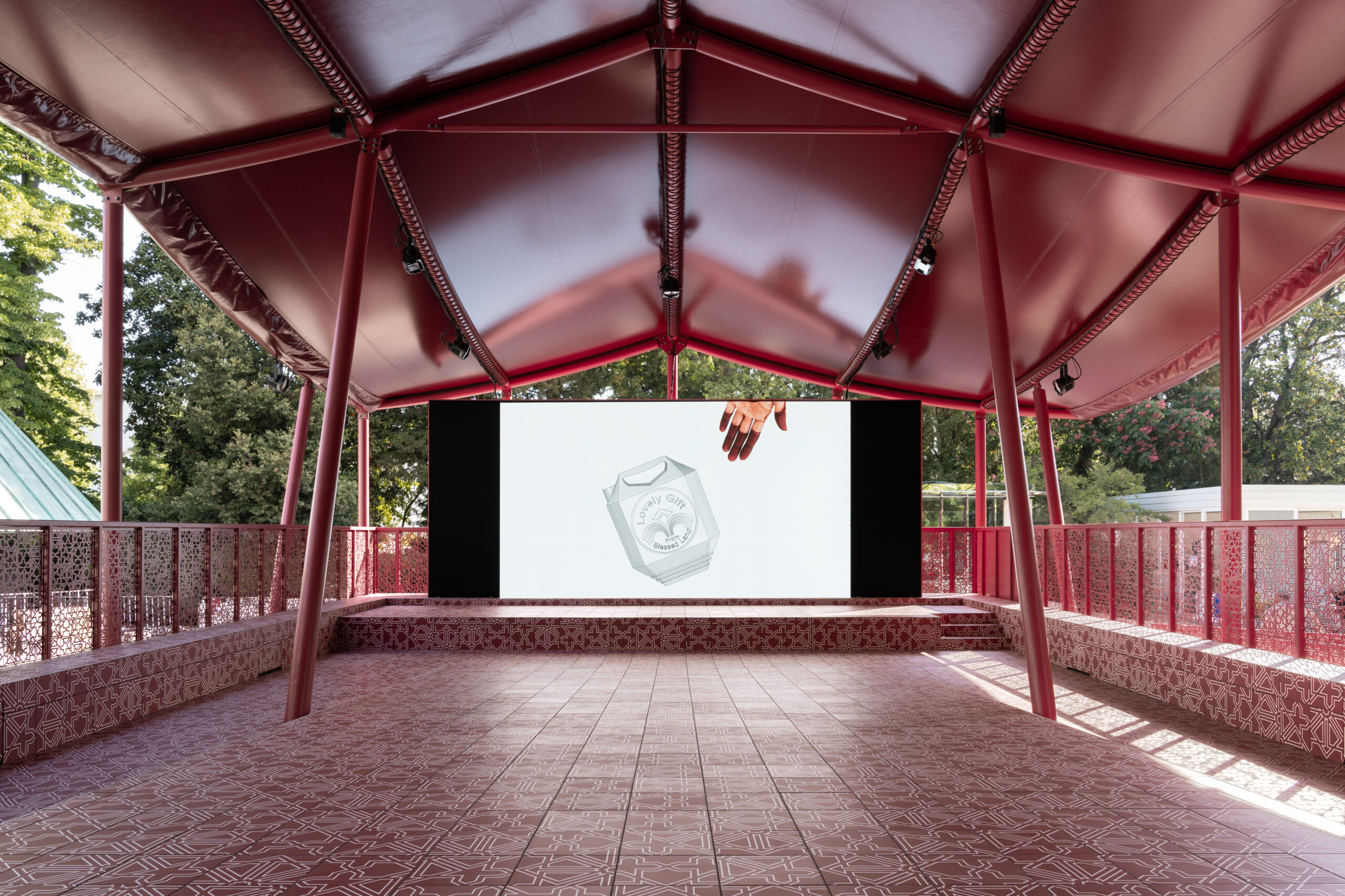
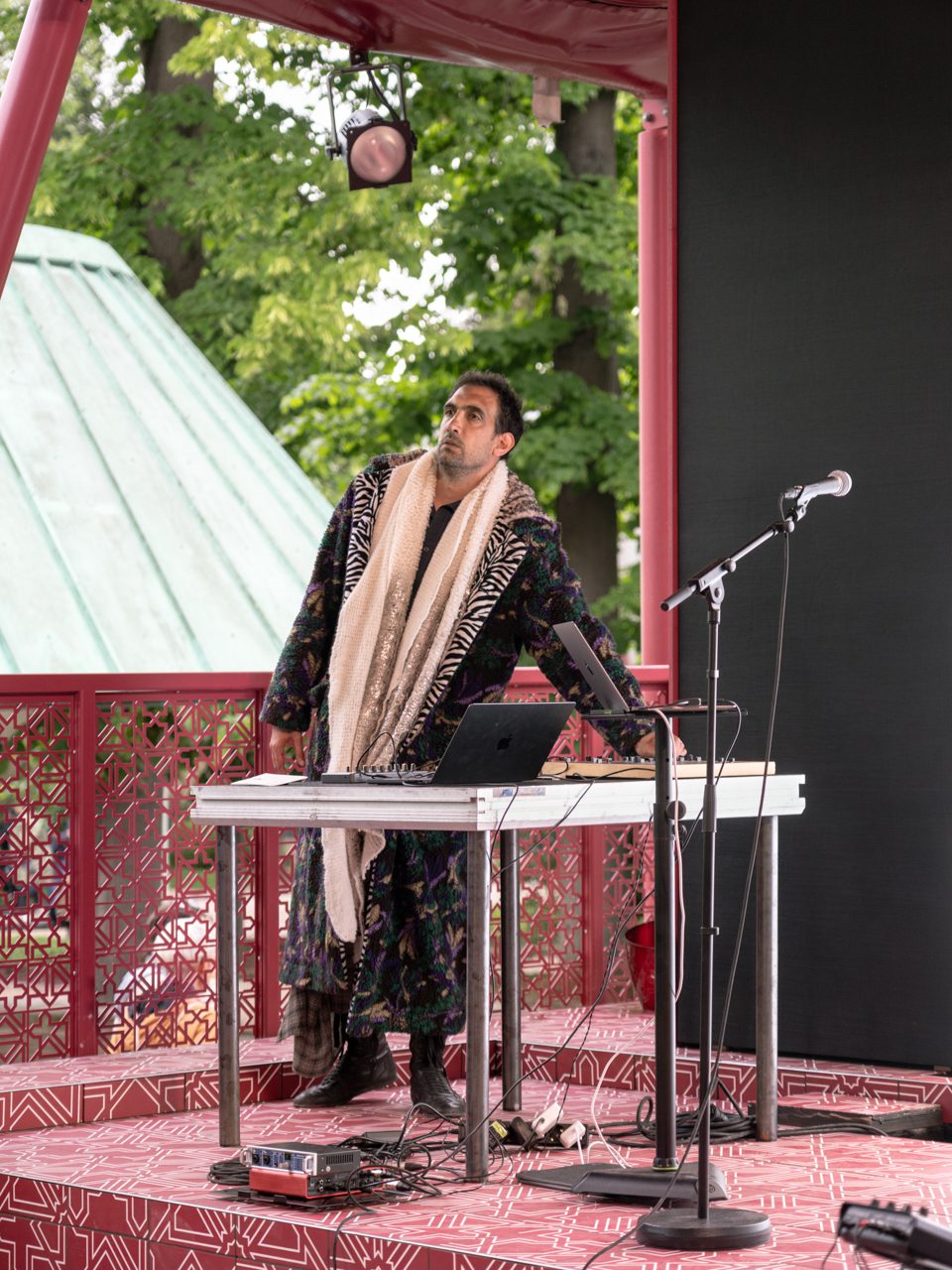
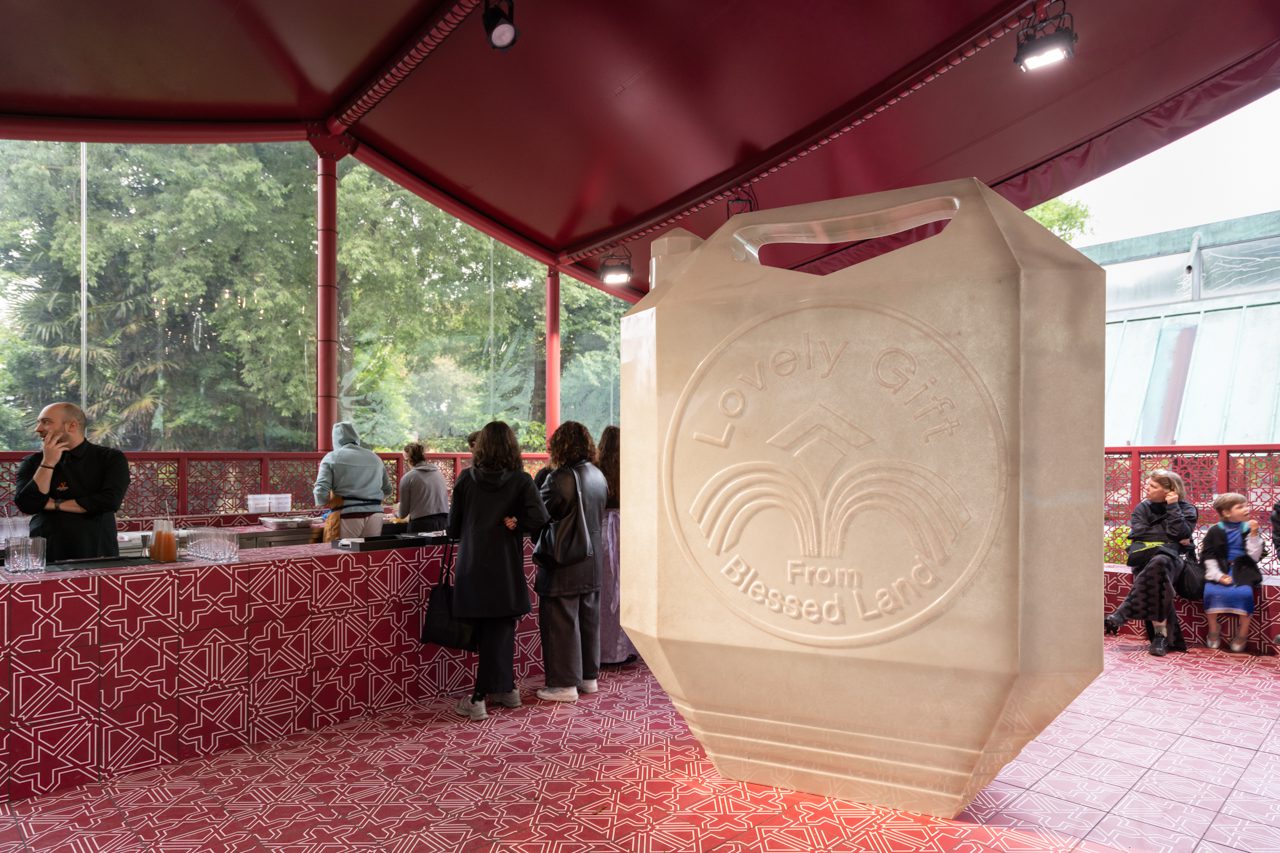
Sounds in the form of talking, film, and music reverberate from the Qatari national pavilion through the exhibition “untitled 2026 (a gathering of remarkable people).” During the exhibition’s opening, an experimental narrative film by Qatari American artist Sophia Al Maria, “DAMAR TV,” follows a protagonist on a dreamlike journey accompanied by a live, improvisational musical performance by Lebanese artist Tarek Atoui inspired by classical Arabic music traditions, such as the takht (classical Arabic orchestra) and wasla (musical suite). Located in the Giardini within a massive, temporary structure by artist Rirkrit Tiravanija, the show also includes “Jerrican,” by Kuwaiti Puerto Rican artist Alia Farid, a large, lacquered fiberglass sculpture, part of a series reinterpreting everyday containers used for water in the Gulf, and a culinary program curated by Palestinian chef Fadi Kattan, which gathered chefs from across the Middle East and North Africa to create a dining experience focused on memory, hospitality, and regional flavors.
Installation view of “DAMAR TV” by Sophia Al Maria in “untitled 2026 (a gathering of remarkable people).” (Giuseppe Miotto/Marco Cappelletti Studio)
The pavilion, curated by Tom Eccles, executive director of the Center for Curatorial Studies and the Hessel Museum of Art at Bard College, New York, and Ruba Katrib, chief curator and director of Curatorial Affairs at MoMA PS1 in New York City, was designed to address and counter regional and global instability through the staging of a communal space for performance, visual art, and dining. “The project explores themes of migration, travel, preservation, and transformation through different forms of cultural production,” explained Eccles. “Sophia Al Maria’s newly commissioned film points to current geopolitical situations and the role of the media while offering music and sound as a way of finding truth. Tarek Atoui’s musical program brings together musicians whose practices reflect the circulation of sounds, traditions, and knowledge across generations and geographies. And Fadi Kattan’s culinary program similarly foregrounds food as a living cultural form, one that carries histories, adapts through contact, and creates opportunities for togetherness.” Rather than presenting these themes through a conventional exhibition format, Katrib emphasized, “The pavilion enacts them in real time and will unfold over the course of the biennale.”
Tarek Atoui performing in “untitled 2026 (a gathering of remarkable people).” (Giuseppe Miotto/Marco Cappelletti Studio)
Upholding ideas of resilience and tradition in the Gulf, Alia Farid’s “Jerrican” acts as an anchor within the pavilion, taking the form of an oversized utilitarian water container, an object associated with sustenance, labor, and survival, drawn from traditional containers used to carry, store, and offer water to travelers crossing the desert. It is embossed and imbued with the heartwarming words “Lovely Gift From,” reflecting the ingrained tradition of local hospitality across the Gulf.
Installation of “Jerrican” by Alia Farid in “untitled 2026 (a gathering of remarkable people).” (Giuseppe Miotto/Marco Cappelletti Studio)
During a time of great uncertainty both regionally and globally, the pavilion seeks to demonstrate the versatility and resilience of culture. “I would also say that there is also a persistence to the project; it is about locating the resilience – sociability, culinary traditions and innovations, sonic influences, etc. – that can be found in how culture continues and adapts,” added Eccles.
The Gulf and Venice: Toward Cultural Exchange
Due to shipping delays and other logistical issues caused by the Iran war, the opening for the exhibition “Aghrab Idrāk: Thresholds of Perception, a Collateral Event” was delayed to June 1 at Palazzo Cavanis, Zattere. Marking Virginia Commonwealth University School of the Arts in Qatar’s first participation in the Venice Biennale, the exhibition showcases faculty-led creative research from its Institute for Creative Research. The exhibition emphasizes VCUarts Qatar’s role as a research-driven art and design school from Doha and entry into global cultural discourse. An inaugural event was staged June 22 and a public symposium, “Relational Ecologies: Perception, Mobility and Collective Form,” from June 23-24.
Perception and sensory attention are at the heart of the exhibition, which was co-curated by Chase Westfall, head of gallery at VCUarts Qatar, and Hesperia Iliadou, director of the Museums & Exhibitions Studies Society in Venice. The exhibition explores the idea of perception as a relational way of knowing and unfolds through a series of spatial experiences shaped by light, shadow, sound, movement, and material presence. Collectively, the experiences reflect how creative research can generate knowledge through sensory attention, collective inquiry, and cultural exchange. Illiadou said she hopes that audiences will encounter the exhibition “as an invitation to rethink perception itself – not as a passive act of observation but as a relational process shaped by history, culture, memory, movement, and exchange.”
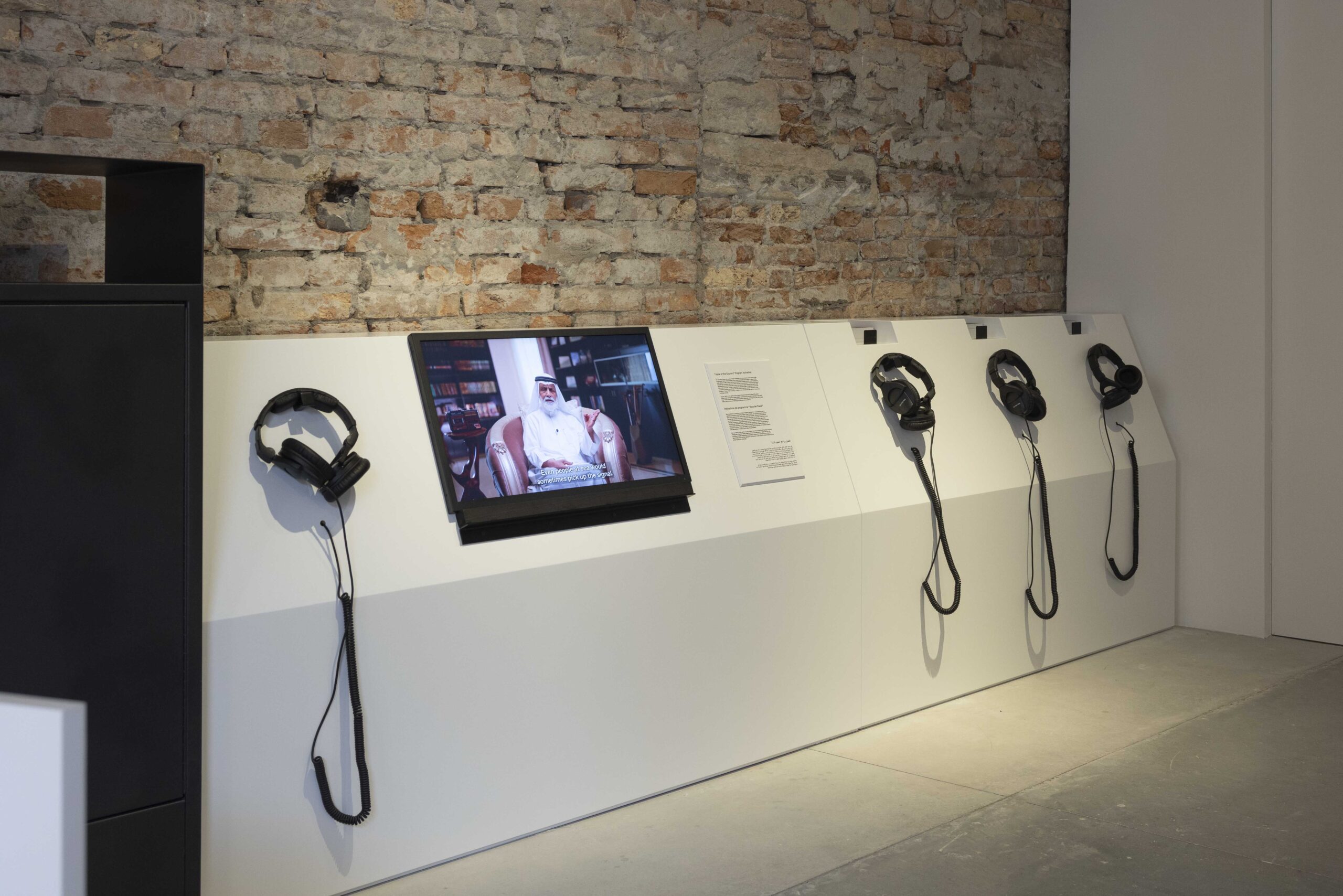
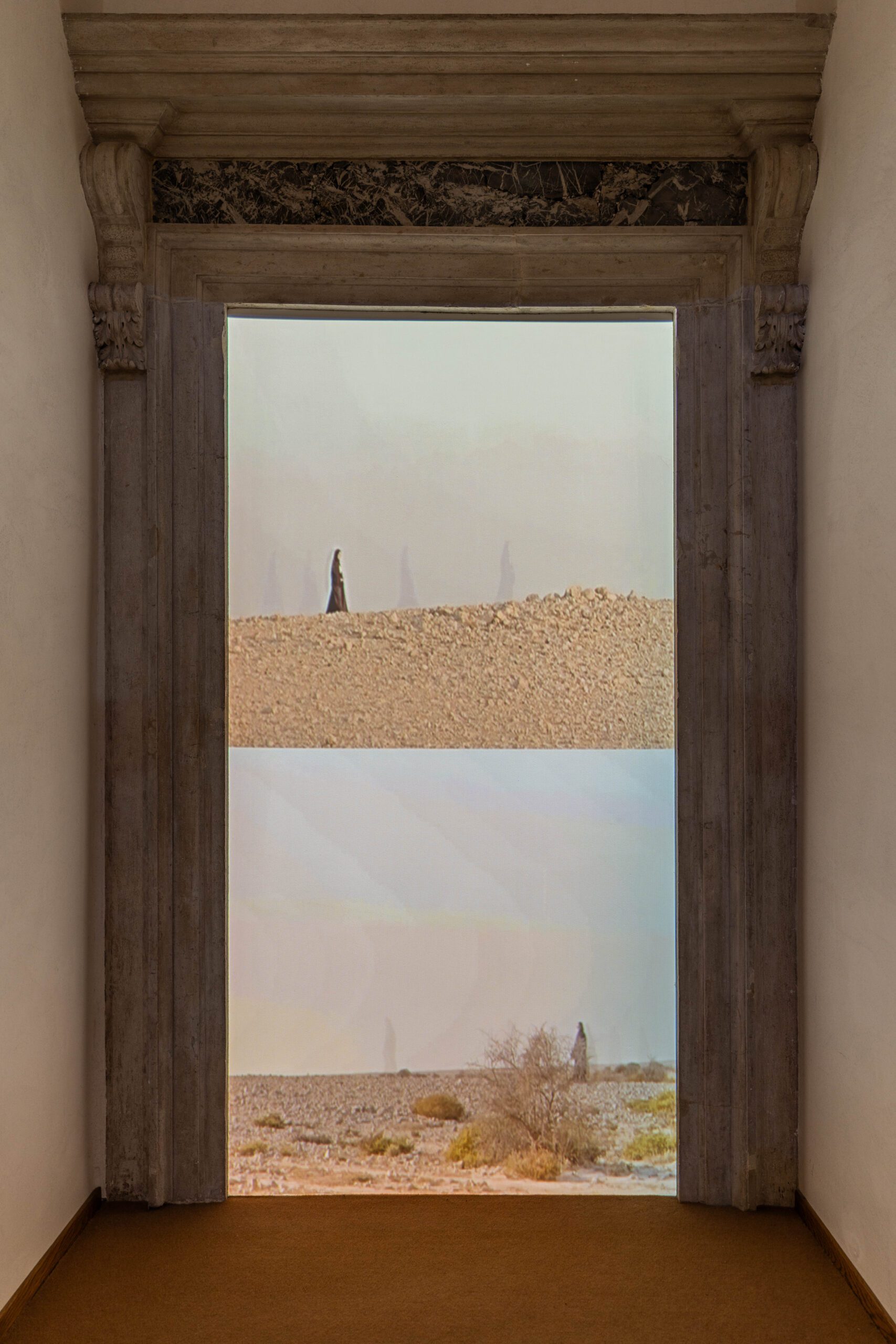
Among the highlights of the exhibition are “Mapping Migration Memories,” which traces Qatar’s historical journeys between desert and sea through oral histories, sound, and light; “Bandhani Arabi: From Thread to Word,” which explores the intersections of South Asian textile traditions and Arabic calligraphy; and “Oceans & Lands: Drifting Senses and Knowledges,” an immersive sound environment that reflects on connections between Asia and Africa. Together, these works reveal histories of movement and exchange that have shaped the Gulf for centuries.
“Mapping Migration Memories.” (Courtesy of VCUarts Qatar)
Just as the Gulf states have for centuries been influenced by their positioning at the nexus of continents, economies, and culture, so too has the city of Venice. “We share a history with Venice as a historic place of trade, cultural collisions, and exchanges,” said Westfall. “Thresholds of perception means inviting people to step up to the limits of how they have traditionally perceived these cultural spaces and encouraging them to cross those thresholds into new spaces of understanding.” During this time of utmost uncertainty, journeying beyond such thresholds – with art as a vehicle – offers vital and liberating new means of perception.
The views represented herein are the author's or speaker's own and do not necessarily reflect the views of AGSI, its staff, or its board of directors.
The Diriyah Contemporary Art Biennale returned a third time with intergenerational dialogues that created a timeline of change, adaptation, and reflection in Saudi Arabia.
Contemporary commissions at the Islamic Arts Biennale 2025 highlight young creatives from the region and beyond underscoring community, care, and spirituality.
The Esports World Cup’s staging in Paris showcased Saudi Arabia’s global gaming ambitions, and the booming sector is also helping to narrow the regional gender gap in technology and entertainment.
Following the high of the inaugural Art Basel Qatar, and the low of the ongoing Iran war, Qatar is doubling down on global and regional cultural diplomacy.
The war has hit the United Arab Emirates during a period of cultural and economic flourishing. While life goes on amid continuous Iranian attacks, the country’s residents rally for its postwar return.