Conversations Across Time: Diriyah Contemporary Art Biennale 2026
The Diriyah Contemporary Art Biennale returned a third time with intergenerational dialogues that created a timeline of change, adaptation, and reflection in Saudi Arabia.
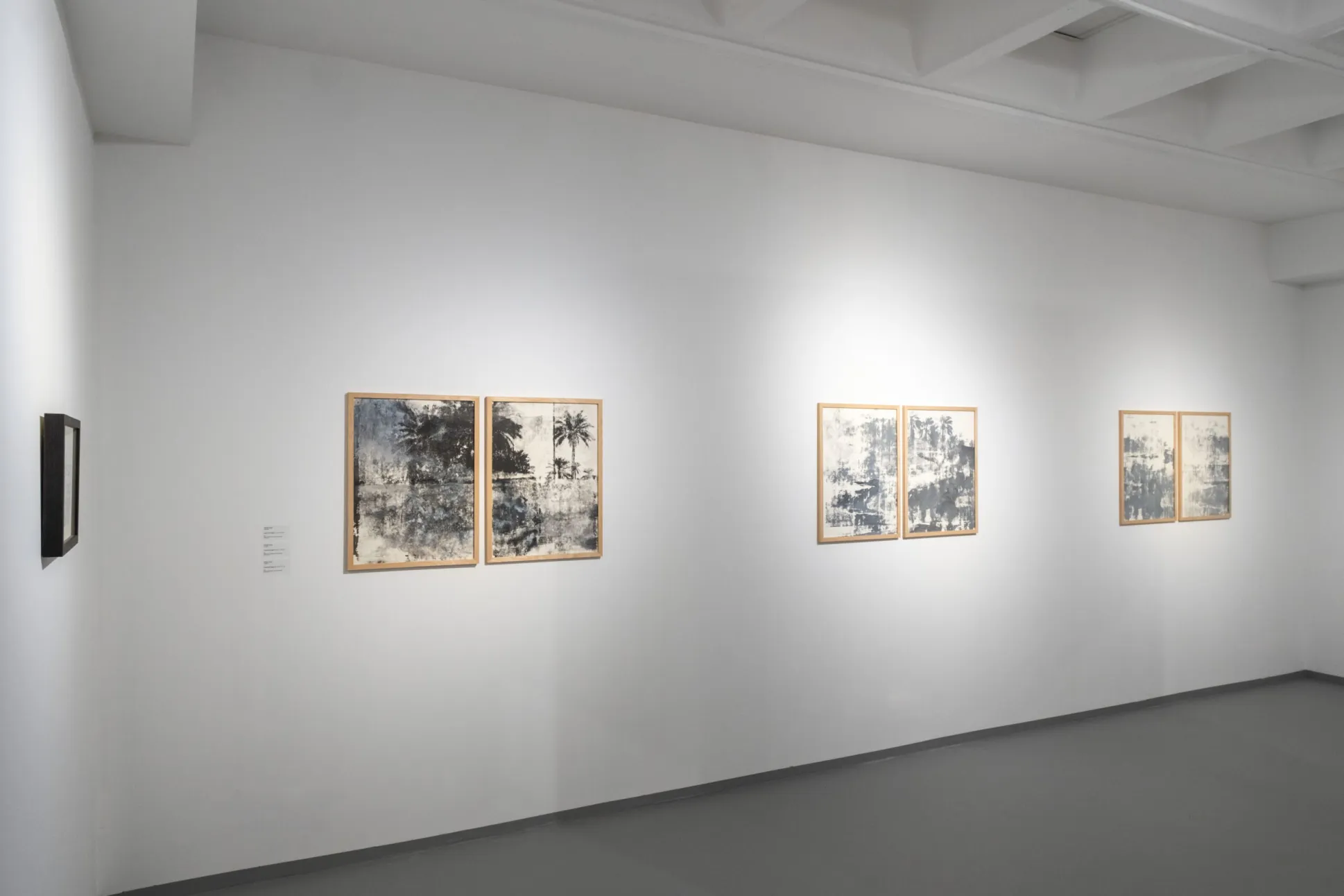
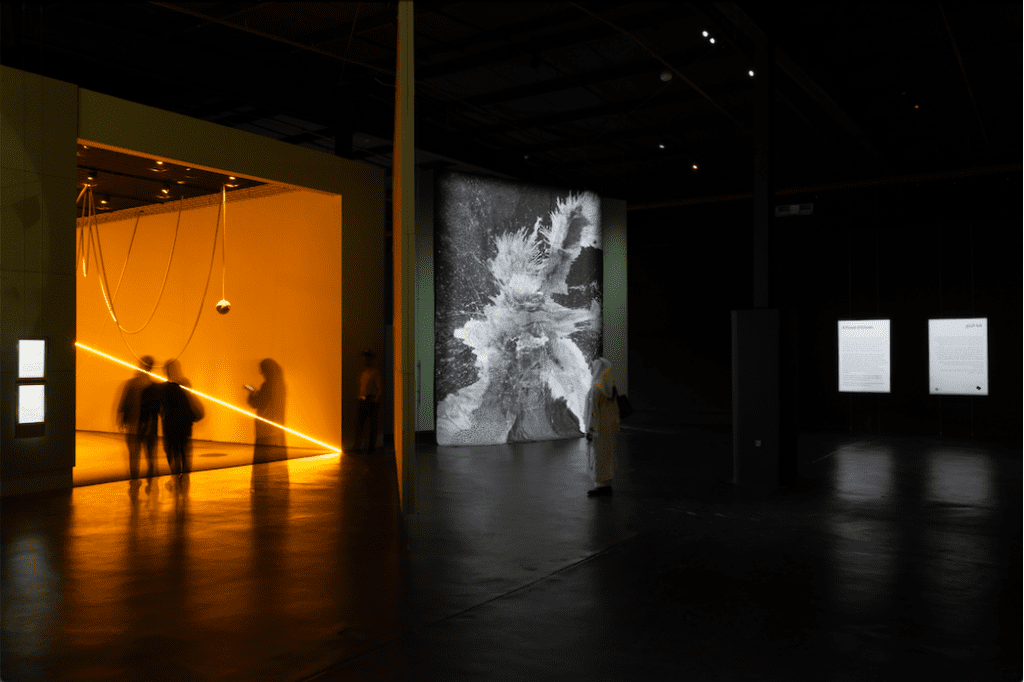
“In Interludes and Transitions,” Diriyah Contemporary Art Biennale 2026, installation view: left: Karan Shrestha, “sweet water rising,” “a flow disrupted; realigns,” “cloud babies”; right: Moshekwa Langa, “Collapsing Guide II.” (Photo by Alessandro Brasile, courtesy of the Diriyah Biennale Foundation)
Grounded in the Gulf’s rich history of sonic tradition and unfolding through musical metaphors, the third Diriyah Contemporary Art Biennale ran from January 30 through May 2 in Riyadh under the theme “In Interludes and Transitions.” The exhibition, led by artistic directors Nora Razian and Sabih Ahmed, took root in “the movements, migrations, and transformations that continue to connect the Gulf region with the world” – a particularly apt theme for a region shaped and defined by its nomadic history and flows of people, goods, knowledge, and narratives across time. In Arabic, the biennale’s title, “Fil Hil Wal Terhal,” derives from a saying that affirms companionship through steadiness and flux, thick and thin.
Situated across the biennale’s JAX District venues, “In Interludes and Transitions” brought together more than 65 artists whose practices span performance, film, photography, painting, installation, and more. As procession, movement, and musicality remained constant motifs throughout the exhibition – with references to songs, meters, and rhythms around which temporality and life in the region have been formed and framed – time-based media featured prominently throughout. Another, more subtle theme that emerged in the exhibition was an intergenerational conversation among artists considering the same subject from their perspectives across time. Through these dialogues, the artists explored modes of ancestral knowledge transmission, change and adaptation, and questions of societal future preparedness.
Faisal Samra, “Immortal Moment III (Post Shock Creatures 02),” 2026. (Photo by Alessandro Brasile, courtesy of the Diriyah Biennale Foundation)
Media, Technology, and Society
In one pairing, located in the exhibition’s “A Collective Observation” hall, artists Ayman Yousry Daydban and Ruba Al-Sweel presented works capturing shifts over time in the relationship of society to media and technology. While Daydban focused on mid-20th century cinema posters from the Arab world, Al-Sweel looked at “the architectures of accelerated connectivity” in the age of mass surveillance and a hypertechnologized world.
At “In Interludes and Transitions,” Daydban, a Palestinian Saudi artist, presented several works from his “Poster Series” (2015-18). Daydban cut, smeared, manipulated, and marked decades-old Arab cinema posters to reflect the public’s changing relationship to cultural symbols and norms over time. Once familiar objects reminiscent of a particular cultural moment and leisure activity, Daydban’s posters reveal how media becomes a tool to shape public consciousness where dominant moral discourses of the time are brought in relief. The display of the posters recall cinema house advertisements, creating a time capsule of an era that long predates the proliferation of streaming platforms and the changes that digital media has wrought on analog experiences and socialization.
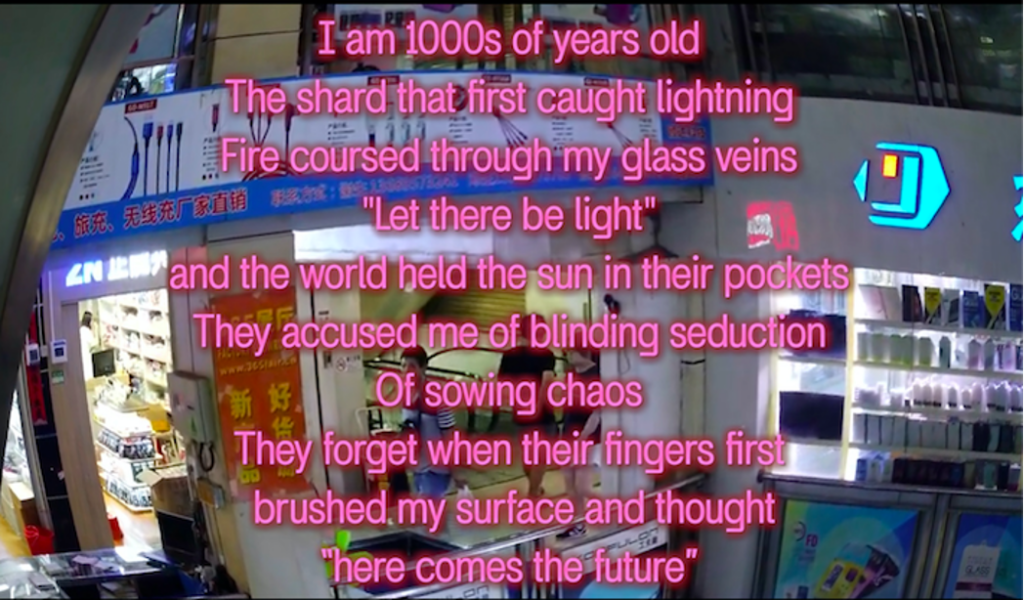
Ruba Al-Sweel, “Machine Tongues,” 2026. (Photo courtesy of the artist)
Across from Daydban’s work, Al-Sweel, a Dubai-based artist and writer focused on media theory and communications, presented “Machine Tongues” (2026), a docu-fictional film that pieces together footage from sources including surveillance camera footage, video calls, and recordings from artificial intelligence glasses to trace the afterlife of a stolen and resold mobile device. The film follows this device across the world in a disorienting and fragmented array of video clips that mirrored dissonances in contemporary technology and connectivity. The sound design and editing of the film created a visceral experience that dislodged the comfort otherwise afforded by modern smartphones, especially as they move through the secondhand market into worlds beyond the audience’s imagination.
Together, “Poster Series” and “Machine Tongues” condensed decades of media and tech innovation to reveal a timeline of how the mind, individual, and society adapt to rapidly evolving technological infrastructure.
Quiet Reflections
Other works in the biennale turned to inherited knowledge, indigenous cosmologies, and how communal networks enable individuals to cope with a world in constant flux. Scattered across several of the exhibition’s venues, these artists turned to quiet moments of reflection, meditation, and isolation in times of difficulty or change. Among them was Abdelkarim Qassem, an artist and psychologist born in Abha. His practice looks at the relationship of nationhood, history, and memory and is influenced by his role as a member of the Saudi armed forces. After being stationed at the Saudi-Yemeni border in 2009 and drawing on his training as a psychologist, Qassem’s work began to look more closely at how war and trauma impact the human psyche.
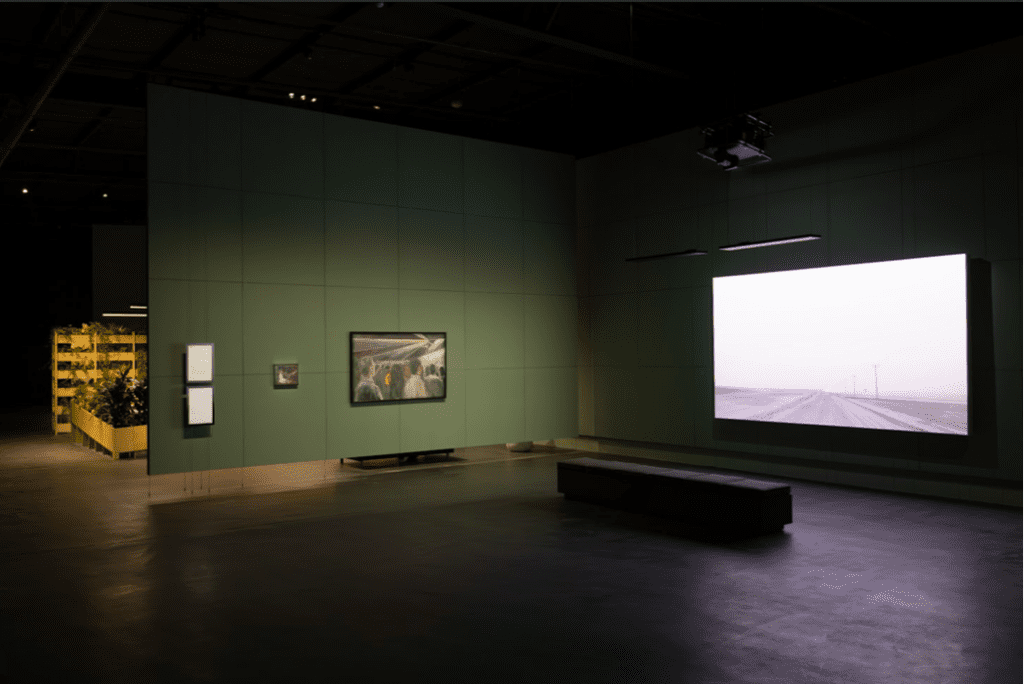
“In Interludes and Transitions,” Diriyah Contemporary Art Biennale 2026, installation view: left: Lulua Alyahya, “Untitled,” 2024, “Untitled,” 2026; right: Abdelkarim Qassem, “The Final Scene,” 2017. (Photo by Alessandro Brasile, courtesy of the Diriyah Biennale Foundation)
To the biennale, he brought “The Final Scene” (2017), a black-and-white video showing a desolate dirt road lined with telephone poles. The landscape remains unchanging while the protagonist passes through, bearing witness to all that occurred in its vicinity across time. The short yet disquieting video, taken on Qassem’s phone, bears an eeriness and uncertainty brought on by the absence of a visible destination. As the sound of heavy tires on gravel changes into a high-pitched ring at the end of the video, and the screen turns white, the viewer is left to sit in this discomfort, where sight and sound are distorted, and reflect on the enduring strength of the land.
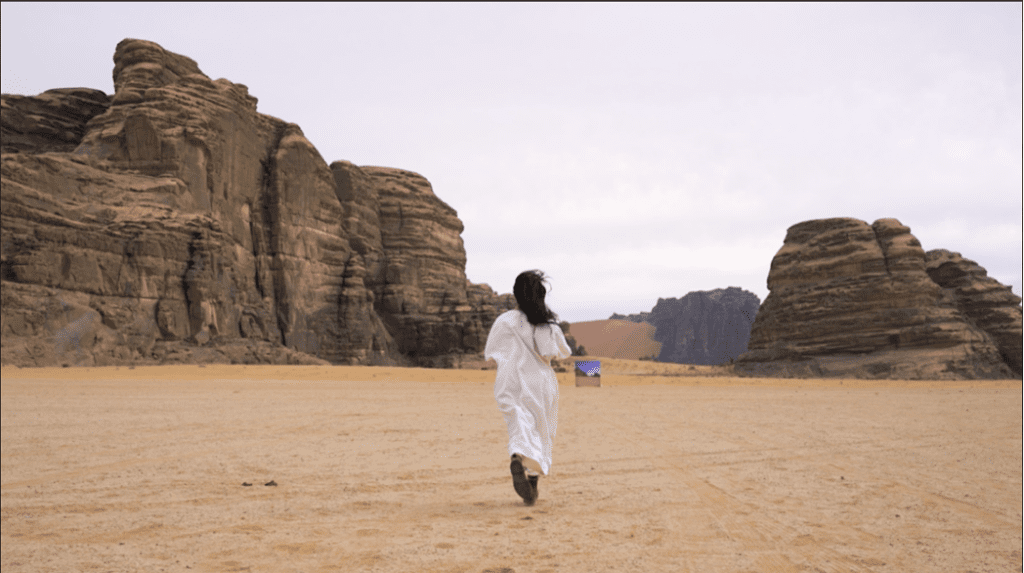
“The Final Scene” could be read in conversation with Ahaad Alamoudi’s “The Run” (2025), a video screening in another hall of the biennale. In this video, a protagonist was filmed running through a rocky desert landscape – the Neom site – while around her, static images displaying the surrounding landscape present a contrast to her persistent movement through the space. As the figure encounters, and runs through, these banners, the relationship among the individual, time, and potential become tangible. Like Qassem’s work, the protagonist is framed as a temporary presence on the land, the only immovable certainty in an otherwise volatile present.
Ahaad Alamoudi, “The Run,” 2025. (Photo courtesy of the artist)
Drawing a more visual connection to Qassem’s work, Alyahya, a Saudi painter based in Manama, presents two moments of meditation and reflection in contrasting settings: In “Untitled” (2024), a man sits with his legs crossed in meditation; and in “Untitled” (2026), a scene of concert-goers is frozen in time. “Conceptually, I tried to be really intuitive and follow ideas that feel like obvious, deadpan reflections of what characterizes our sociocultural landscape and expand that through the process of painting and abstraction. I wanted to take these ideas that feel very simplistic – that I see all the time or is something that people do all the time – into a place that feels more speculative or exists in a metaphysical realm that can only be sensed in this ineffable way,” Lulus explained to AGSI.
Both works use a subdued, monochromatic palette, with light descending from the upper righthand corner, exuding a serene melancholy somewhere between solitary reflection and collective elation. “I had this idea of painting a crowd at a concert in Riyadh for ages … I often just start with a black primed background, but this piece is particularly monochromatic and kind of dark, which is a combination of me wanting it to look like that and the way that I approach making the work: I’d sketched it with a white oil bar against a black background. I was thinking about light and dark in a metaphorical, poetic sense but also in a literal sense as just being a feature of a concert. Light features really define how that space feels and how the ambience affects people’s sense of their environment.”
Though the two paintings were made at different times and for different contexts, a spiritual undertone connects the two works. “Some people said it felt like a commemoration of something religious, someone else said that it felt like judgment day – a lot of people picked up on this heaviness, which I didn’t necessarily or consciously integrate into the concept behind painting a concert crowd in Riyadh, but I do like that relationship it ended up having between the sacred and the profane. I like offsetting what feels really profound, heavy, complex, and visceral with this attitude that’s more lighthearted, satirical, and absurdist. It’s such a balancing act, trying to figure out how much I want to reveal through words and how much I want people to just read what they will. There is that woman that is singled out, and I’ve rendered her with the most detail; she is wearing a veil. So maybe that kind of opens up that topic, but I really enjoy people’s own emotional projections and how that can affect the way that I’m then looking at the work once it’s out in the world.”
Art in the Kingdom Across Time
“In Interludes and Transitions” provides a window into some of the preeminent questions plaguing artists across generations – namely the evolution of social and communal ties, the encroachment of technology on every aspect of life, and moments of meditation in times of flux. Alongside the biennale, other exhibitions brought attention to an even earlier generation of artists in the kingdom to trace the continuity of artistic exploration in the country’s art scene. “Bedayat: Beginnings of Saudi Art Movement” opened in Riyadh in January showcasing works from the mid-20th century by 73 artists whose practices contributed to the notion of a “Modern Saudi” artistic genre. Working during a time of economic, political, and societal transformation in the country and region, these artists pioneered a distinctive visual language combining local heritage and symbols with broader artistic trends. The geopolitical, societal, and temporal points of reference anchoring works in the biennale and Bedayat may differ, but the core themes remain the same: navigating change and upheaval through moments of reflection, connection, and creativity.
The views represented herein are the author's or speaker's own and do not necessarily reflect the views of AGSI, its staff, or its board of directors.
Contemporary commissions at the Islamic Arts Biennale 2025 highlight young creatives from the region and beyond underscoring community, care, and spirituality.
Guided by the theme “After Rain," Gulf presentations at the Diriyah Contemporary Art Biennale approach ecological destruction, communal healing, and sociocultural change with a sense of hope.
Contemporary commissions at the Islamic Arts Biennale 2025 highlight young creatives from the region and beyond underscoring community, care, and spirituality.
In Hunna Art’s new space, Bahraini multimedia artist Mashael Alsaie takes visitors on a journey through a metaphorical whirlpool, hoping to inspire a gentleness toward the environment.

!["After Rain," Diriyah Contemporary Art Biennale 2024, installation view: Tiffany Chung, "Energy Policy vol.166: potential CO2 emissions until 2050 by key fossil fuel and coal extraction projects [each>1 Gt] worldwide" (2023), center; Simryn Gill, "Dalam" (2001), left background, on wall; Ade Darmawan, "Tuban"(2019), left background, on floor; Christine Fenzl, "Women of Riyadh" (2023), right background, on wall. Photo by Marco Cappelletti, courtesy of Diriyah Biennale Foundation.](https://agsi.org/wp-content/uploads/2024/05/IMAGE-1-scaled-10.webp)