Pezeshkian’s Proposed Cabinet: The Art of the Possible
The Cabinet picks of Iran’s new president, largely technocrats, reflects Pezeshkian’s preference for consensus and continuity of former President Hassan Rouhani's foreign and economic policies.
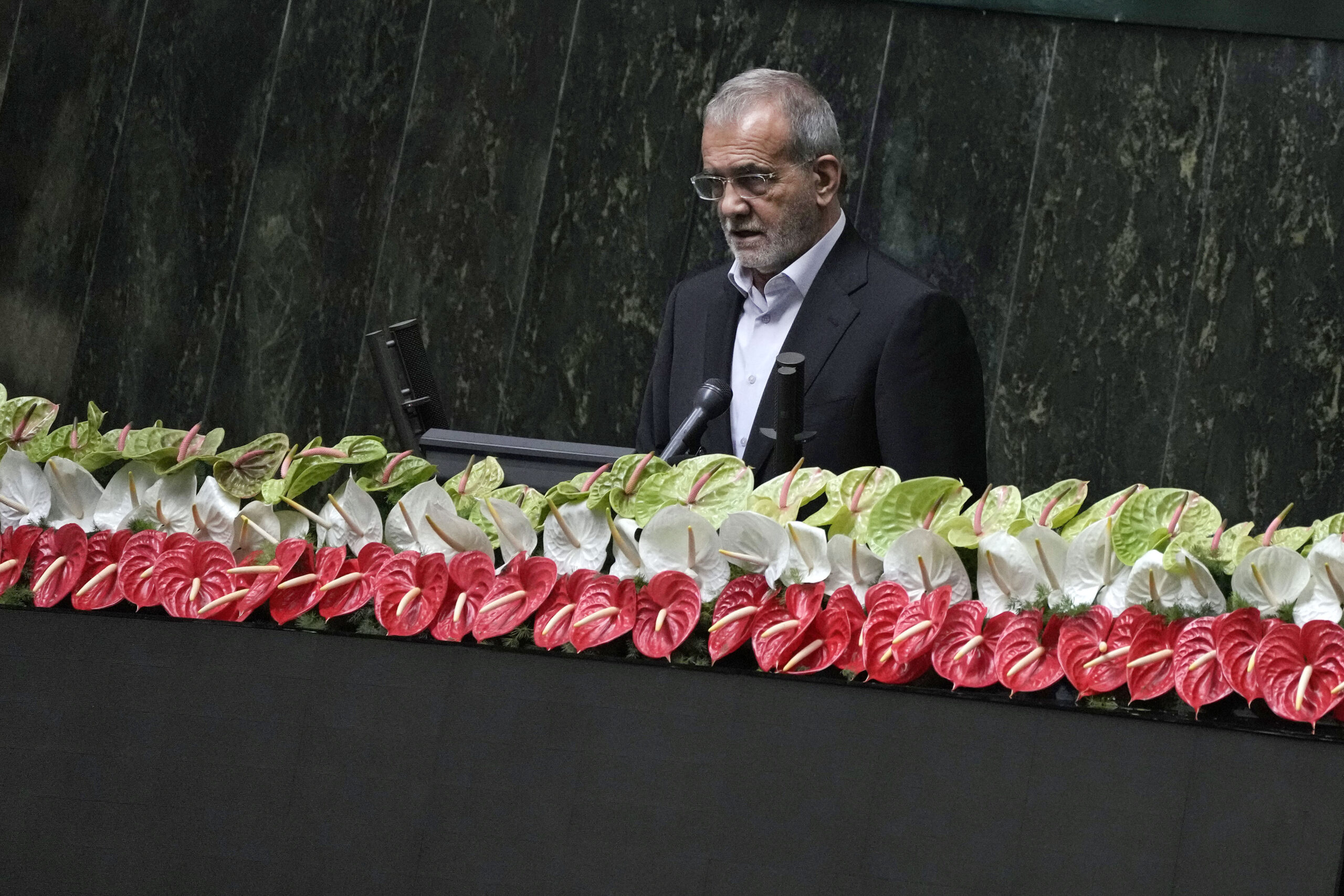
Newly-elected President Masoud Pezeshkian delivers a speech after taking his oath in a ceremony at the Parliament in Tehran, Iran, July 30. (AP Photo/Vahid Salemi)
On August 11, Iranian President Masoud Pezeshkian presented his Cabinet picks to the Parliament for a vote Pezeshkian’s proposed Cabinet, largely technocrats, provides some insight into his political skills and policy agenda, along with opportunities and threats emanating from a technocratic Cabinet.
Throughout the presidential campaign, Pezeshkian emphasized the need for popular participation in politics and the use of experts in government. This message resonated with voters tired of nepotism and ideological appointments to government offices. Following his words with deeds, Pezeshkian, in an unprecedented move, entrusted identification of potential ministers to an advisory council composed of select political grandees and representatives from academia, the business community, professional associations, local campaign managers, and ethnic and religious minorities. The advisory council, which was presided over by former Foreign Minister Mohammad Javad Zarif, reportedly identified 10 of the 19 members proposed by Pezeshkian. Regardless if these candidates receive a parliamentary vote of confidence or not, the mere establishment of the advisory council and the relative transparency concerning its activities are testaments to Pezeshkian’s commitment to inclusion and popular participation in political decision making.
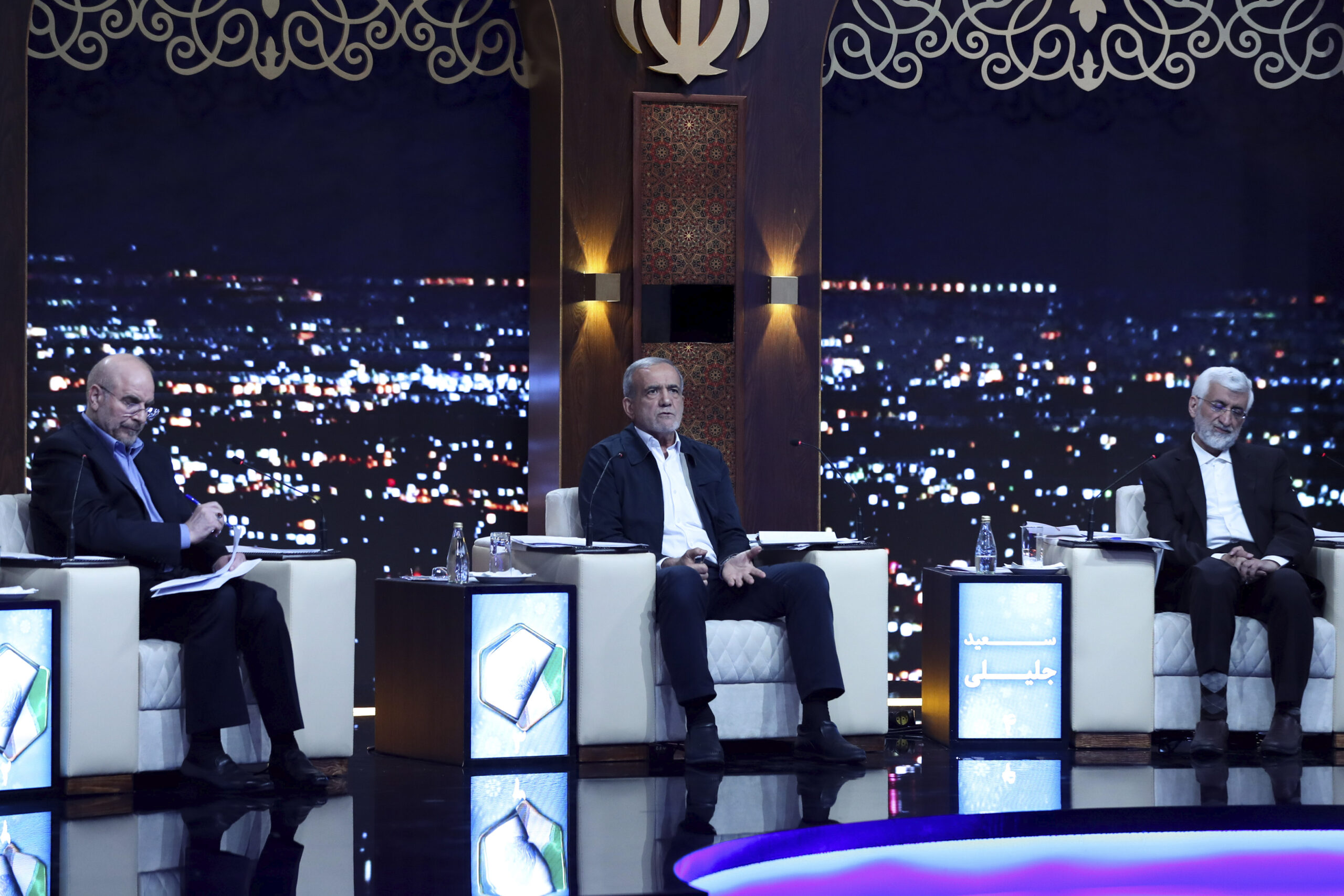
During the televised presidential debates, Pezeshkian blamed factionalism for much of the dysfunction in Iranian politics and indirectly called for the formation of a national unity Cabinet. He has already delivered on this promise, since three out of the 19 proposed Cabinet ministers served in the late President Ebrahim Raisi’s Cabinet: Pezeshkian proposed that Esmail Khatib remain intelligence minister and Amin Hossein Rahimi remain justice minister, while Abbas Aliabadi, who served as minister of industry, mines and trade in Raisi’s Cabinet, would take the post of minister of energy. Surrendering the Intelligence and Justice ministries to political opponents, however, cannot have been a significant sacrifice for Pezeshkian, since these Cabinet positions are customarily decided by Supreme Leader Ayatollah Ali Khamenei and not the president. Keeping Raisi’s energy minister in the Cabinet, however, shows Pezeshkian’s attempt at reaching out to the hard-line opposition.
Although Pezeshkian himself never served in President Hassan Rouhani’s Cabinet, he defended Rouhani’s track record in the course of the televised presidential debates, which indicated his preference for bureaucratic competence and some degree of political pragmatism. It is therefore not surprising that five proposed ministers either served in the Cabinet or had cabinet-level or deputy minister positions in Rouhani’s Cabinet. Abbas Saleh Shariati, the candidate for minister of culture and Islamic guidance, served as deputy minister. Mohammad-Reza Salehi Amiri, the candidate for minister of cultural heritage, handicrafts and tourism, served as a committee head in the Supreme National Security Council. Abdolnasser Hemmati, the candidate for finance minister, served as the governor of the Central Bank of Iran. Abbas Araghchi, the candidate for foreign minister, served as deputy minister and nuclear negotiator. Hossein Simaei Sarraf, the candidate for science, research and technology minister, served as deputy minister for legal affairs at the same ministry. While these appointments give credence to Pezeshkian critics, who jokingly accused him of bringing about Rouhani’s third term in office, Kargozaran Party Secretary-General Hossein Marashi, the backbone of Rouhani’s network, called the proposed Cabinet “the possible, rather than the desired Cabinet.” Regardless of the commentary, the presence of these ministers in the Cabinet demonstrates Pezeshkian’s commitment to continue Rouhani’s diplomatic and perhaps economic policies.
The presence of former Raisi Cabinet ministers among the list has been met with criticism from the reformist camp. Entekhab news agency warned “the reformist Cabinet is infiltrated” and argued that “some proposed Cabinet ministers not only lack a reformist track record, they even don’t belong among the centrists.” Entekhab further warned “radical Cabinet ministers” may pursue “radical policies” completely opposed to the president’s pragmatic line. Azar Mansouri, chairwoman of the Reformist Front, which mobilized supporters of former President Mohammad Khatami in favor of Pezeshkian, lamented the composition of the proposed Cabinet in a post on X, formerly known as Twitter: “This Cabinet was supposed to be a symbol of change and not the symbol of preservation of the status quo.”
Promoting women in public administration was another of Pezeshkian’s election promises. Should Farzaneh Sadegh Malvajerd, the candidate for roads and urban development minister receive a parliamentary vote of confidence, she will be the second woman to serve as a Cabinet member in the history of the Islamic Republic – the first was Marzieh Vahid Dastjerdi, who served as health minister in President Mahmoud Ahmadinejad’s Cabinet. A single woman among 19 ministers, however, is not likely to satisfy women voters, who paved Pezeshkian’s path to the presidency. Shahindokht Molaverdi, former vice president for women and family affairs, has already criticized Pezeshkian’s proposed Cabinet in an article in reformist Etemad newspaper: “Women expected at the very least two to three women candidates for the Cabinet so at least one of them gets the parliamentary vote.” Molaverdi also used the occasion to urge Pezeshkian to appoint women deputy ministers to compensate for the extreme statistical underrepresentation of women in the proposed Cabinet.
The Cabinet is also conspicuously unrepresentative of Iran’s Sunni minority and ethnic minorities, such as the Kurds and Baluchis. Mohsen Biglari, parliamentarian representing the Saqqez and Baneh constituencies in Kurdistan province, criticized the proposed Cabinet in an address he delivered from the tribune of the Parliament: “Kurdish compatriots and the Sunnis, who voted for you, harbored a thousand hopes. Today, when it is time for you to reciprocate, neither the Sunnis nor the Kurds got a share.” However, Biglari also showed Pezeshkian a way out by saying: “We hope the Sunnis and the Kurds can be appointed to positions at other levels” of government.
As for Pezeshkian’s promise of providing Iranian youth with career opportunities, it does not appear to have included the Cabinet: The average age of Pezeshkian’s proposed cabinet members is about 59 years: Sadegh Malvajerd, the candidate for roads and urban development minister, and Sattar Hashemi, the candidate for communications and information technology minister, both 47 years old, are the youngest, and 66-year-old Hemmati is the oldest.
The remaining nine Cabinet candidates Pezeshkian selected outside of those proposed by the advisory council are also technocrats, but two are also current members of parliament: Gholamreza Nouri Ghezeljeh, the candidate for agriculture minister, and Ahmad Donyamali, the candidate for sports minister, who is particularly close to Mohammad-Bagher Qalibaf and likely represents Pezeshkian’s attempt at gaining the good graces of the parliamentary speaker. Eskandar Momeni, an Islamic Revolutionary Guard Corps and later Law Enforcement Forces officer, who is the candidate to lead the Interior Ministry, appears to be another representative of the Qalibaf network in the Cabinet. The Defense Ministry, which used to be headed by IRGC officers, is once again likely to be led by a representative from Iran’s regular military: Brigadier General Aziz Nasirzadeh. Pezeshkian’s candidates for the ministries of education; health; industry, mines and trade; labor and social welfare; and petroleum all have experience in the central administration but not necessarily in executive positions.
Politics is the art of the possible, attainable, and next best, and Pezeshkian is an artist in his own right. His proposed Cabinet may not represent the first wishes of anyone, but it wins him support from the Raisi team. By incorporating ministers from Rouhani’s Cabinet, Pezeshkian has also inherited a more or less coherent foreign and economic policy, which he never managed to formulate clearly in the course of the presidential campaign. Pezeshkian’s Cabinet picks are also likely to keep Qalibaf happy. This is of particular importance for Pezeshkian to get a vote of confidence for his Cabinet, and, in the best case, also prevent future parliamentary obstruction of his policies. As for women, ethnic and religious minorities, and youth, who may have difficulties identifying with the Cabinet, Pezeshkian can follow Biglari and Molaverdi’s advice and make appointments in lower levels of government. Such appointments can be done without a parliamentary vote of confidence, and the president may have an easier time delivering on his promises regarding a more representative executive branch of government.
The views represented herein are the author's or speaker's own and do not necessarily reflect the views of AGSI, its staff, or its board of directors.
President-elect Masoud Pezeshkian has a popular mandate to pursue domestic reforms and rebalance Iran’s foreign policy, but he is likely to face opposition from powerful forces at home and abroad.
Three candidates have a realistic chance in Iran’s presidential election: strongman Qalibaf, reformist surgeon Pezeshkian, and zealot pen pusher Jalili.
After U.S.-Israeli strikes killed Supreme Leader Ayatollah Ali Khamenei on February 28, Iran’s collective leadership has concluded that the best defense is a good offense.
Wartime pressure has temporarily aligned the leadership’s overriding interest in regime survival, even as its members continue to differ over the costs, methods, and ultimate objectives of the war.
While there is historical precedent for collective leadership in Iran, today’s leadership includes representatives of the IRGC and regular military – a reflection of the IRGC’s expanding role and the necessities of governing under wartime conditions.