Connectivity Without Transformation in the Middle East
A misreading of the Belt and Road Initiative has prompted a regional scramble to develop economic corridors ahead of the more foundational development of integrated manufacturing and intraregional trade.
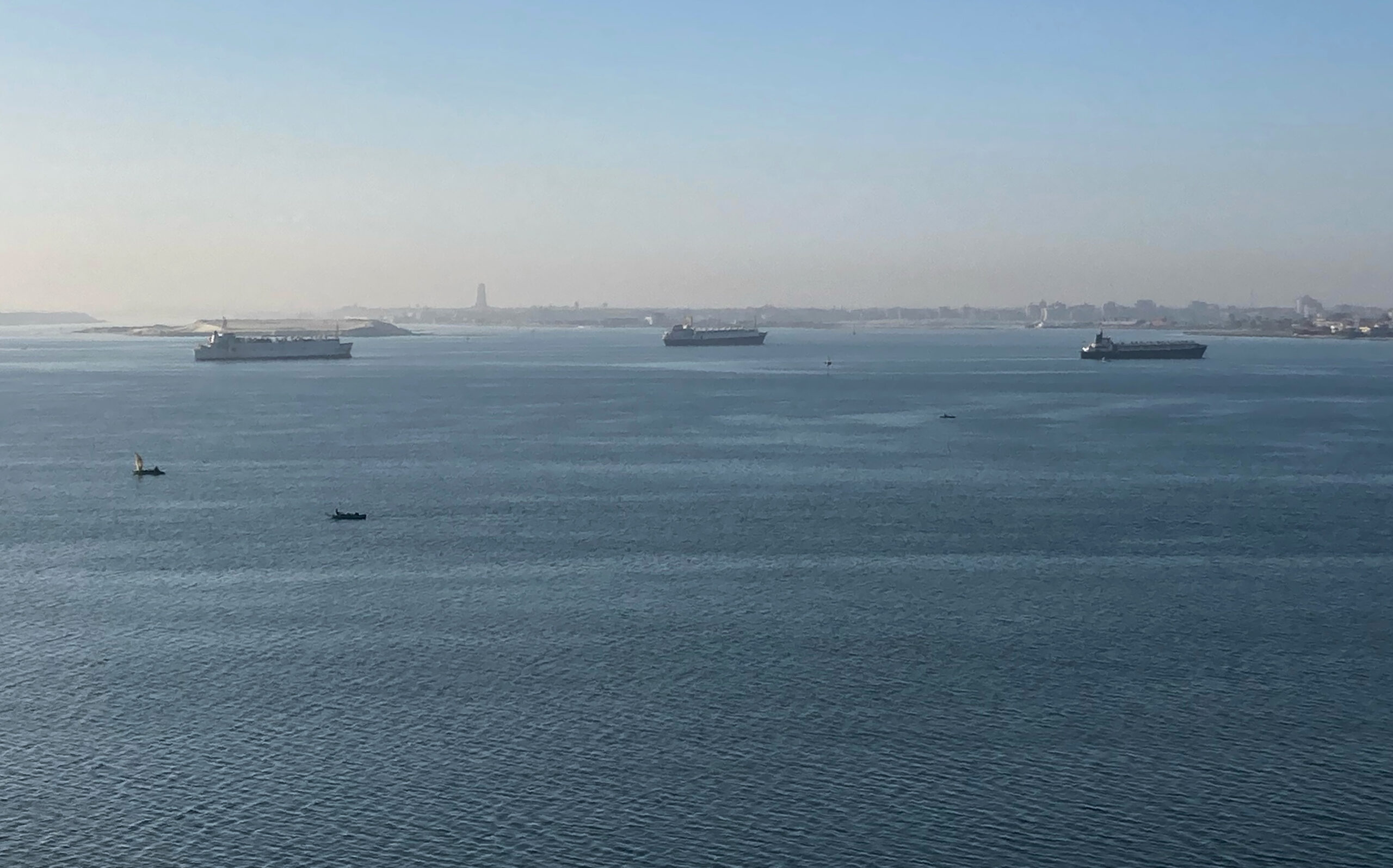
Ships anchor in Lake Timsah, Ismailia, halfway through Egypt’s Suez Canal, March 25, 2021. (Associated Press/ Sam Magdy)
Three economic corridor announcements have been made in the Middle East over the past three years. Each seemed not quite matched with evolving interests or became a casualty of poor timing. The India-Middle East-Europe Economic Corridor was declared in September 2023 before being effectively upended by the war in Gaza, which started a month later. Then came the Iraq-Turkey Development Road, an alternative routed through the Mesopotamian heartland to connect Turkish ports on the Mediterranean to Iraq’s Al-Faw Grand Port on the Gulf. Its appeal was that it bypassed the flashpoints of Israel’s wars in the eastern Mediterranean entirely, but it ended up hostage like IMEC to the Iran war with the closure of the Strait of Hormuz. As both corridors became less viable as their Gulf hub was threatened by insecurity, the Europe-Egypt-Neom-Gulf Cooperation Council corridor emerged. Despite some vulnerabilities with tensions in the Red Sea, this corridor – an evolving strategic concept built around real projects – appears to have a lower geopolitical risk premium than those linked to the Strait of Hormuz.
From the outset, analysts have viewed corridors in the Middle East as a way to form regional political blocs to enhance regional order. IMEC, in particular, was a geopolitical expression of an alliance more than an economic grouping. However, building more infrastructure in a fragile region does not necessarily solve its security dilemma but rather can offer more targets for actors wishing to sow instability. The repeated failure of these corridors to gain traction over the past three years also raises a more fundamental question that their political framing has largely deflected: What is their structural value over the long term, regardless of whether they can be made operationally safe? And how can this new corridor avoid the mistakes of the past?
The region has occupied one of the world’s most central maritime locations for centuries. Egypt has operated the Suez Canal for over 150 years. The United Arab Emirates’ Jebel Ali and Khalifa ports, Oman’s Salalah Port, and Qatar’s Hamad Port are among the most modern ports in the world. And the shipping lanes that pass through the Red Sea and Gulf of Aden are among the most heavily trafficked. The region excelled when it came to logistics for exports, whether for oil, cotton, phosphates, or petrochemicals, until the start of the Iran war.
Nonetheless, the war has underscored how the region’s economies structurally failed in the preceding decade to develop the diversified export bases that would make use of the pivotal maritime locations they already command. While the maritime centrality and logistics advantages are real, the productive base to exploit them has lagged for years.
Reading the BRI Backward
At first, this scramble to define economic corridors started with U.S. backing as a response to the Belt and Road Initiative that sought to incorporate the Middle East into a Chinese sphere of infrastructure. However, a strategic misreading of the BRI, initially encouraged by the United States, led regional parties to rely on the perception that building roads and linking existing logistics nodes and projects, taken together, is enough to build markets and establish connectivity.
Meanwhile, the Chinese blueprint was not driven by the need for more connectivity. It was a byproduct of China’s industrial expansion and its export-driven economy that necessitated the existence of distribution infrastructure for already competitive exports. And this is what every counterproposal in the Middle East misses.
Prior to the BRI, China assembled a manufacturing machine over three decades of special economic zones, state-directed industrial policy, technology absorption, and interprovincial competition. More important, the BRI projects were financed through financial resources accrued from China’s trade surpluses. This completely differs from the situation in the Gulf and the broader region that lacks an integrated manufacturing base and supply chain or robust intraregional trade.
Building roads first and assuming the productive base will follow inverts that logic. Instead of investing in local industrial capabilities, the Gulf countries have been engaged in replicating success models such as Dubai and Jebel Ali. However, these multiple corridors risk duplicating already costly infrastructure and intensify competition over a saturated logistical sector. Even if redundancy is helpful to bypass temporary geopolitical disruptions, the economic return on these investments remains tied to traffic sourced from outside – where the industrial bases are located.
The Trade That Doesn’t Integrate
The aggregate expression of this misperception is intraregional trade itself. For Middle East and North African countries, 17.8% of their total trade is with each other, compared to the European Union’s 60% within the European region. Within the Gulf, intraregional trade is limited to 5.8% despite the Gulf states’ geographic proximity, available trade routes, and multilateral political bodies, such as the Gulf Cooperation Council.
This gap is largely because the region’s export architecture remains overwhelmingly hydrocarbon driven rather than manufacturing linked. The International Monetary Fund characterizes regional trade as “a relatively high concentration of exports in a narrow range of products or trading partners, limited economic complexity, and low participation in global value chains.” Without a regional industrial supply chain, the region’s contribution cannot grow beyond that of a logistics hub.
This also applies to the trade patterns between parties of the different corridor proposals. Although India-Gulf bilateral trade reached approximately $178.8 billion in 2025, fossil fuels and minerals comprised roughly 65% of this. Without addressing the question of industrial integration, IMEC is expected to be just an extra route for raw commodities that deepens the region’s dependency on revenue from the oil and gas sector.
Turkey-Iraq bilateral trade reached a record $16.8 billion in 2025, with Turkey exporting approximately $12.4 billion in manufactured goods and Iraq exporting roughly $4.4 billion, almost entirely in oil. This discrepancy in export profiles makes the scheme a supplier-client relationship rather than economic partnership.
The proposed Neom-Suez interconnection follows a similar pattern among hydrocarbon-exporting Gulf, labor-exporting Egypt, and capital-good exporting Europe. However, the corridor is being announced before anyone has asked what Egypt and Saudi Arabia actually produce together that would justify an integrated supply chain architecture between them. Both countries have long been seeking to diversify their economies, but separately. This is what Oxagon – Neom’s industrial city whose development is still ongoing – not only its port, can bridge. Being equidistant from and logistically connected to Baghdad, Cairo, Kuwait City, and Dubai, Oxagon can act as an intersection point with links to the rest of the region’s industrial hubs.
The Alternative Industrial Corridor
Neom can therefore avoid being a single industrial outpost. Instead, it could anchor a regional value chain on the Flying Geese model, through which Japan’s industrial investment trickled down technology and capital to successive industrial hubs across East Asia. The resulting regional industrial architecture would give the road a tangible product to carry.
That architecture starts with sectoral alignment by identifying where genuine complementarities exist between corridor partners and constructing supply chain integration around them. The European Coal and Steel Community is a good model. Beginning in 1951, six countries identified two industries where there were real productive complementarities, built integrated governance around those industries, and only then expanded into a broader political and economic union. The single market came 40 years later and the Maastricht Treaty after another decade. The connectivity infrastructure was not the starting point; it came after integration was already established through the productive base.
The Middle East has the inputs for a similar sequence. The region’s demographic mass, geographic centrality, mineral resources, and financial depth are substantial. What is missing is the institutional architecture that would convert these inputs into integrated production rather than parallel rentier sources. Three instruments would make a difference.
The first is a regional industrial development bank with a mandate to finance manufacturing upgrading rather than infrastructure. Gulf sovereign capital currently flows into extraregional financial assets and external industrial bases. A regional bank with a manufacturing mandate would redirect a portion of that capital toward Syrian pharmaceutical capacity, Iraqi industrial zones, Moroccan automotives, and the dozens of other productive sectors that currently lack long-term development financing at scale. Otherwise, the region’s underdeveloped and insufficiently diversified industrial base may further erode due to competition from generously subsidized imported products. A regional industrial bank can also help reverse the regional impact of broader global policies entrenching de-industrialization trends.
The second instrument that would encourage integrated production in the region is a harmonized intellectual property and innovation framework. Research and development spending across the region remains a fraction of what industrial transformation has historically required. Nonetheless, there has been progress over the past two decades. Saudi Arabia and Egypt have been among the fastest-growing research and development spenders globally since 2000, with Saudi Arabia’s expenditure increasing roughly fourteenfold and Egypt’s roughly thirteenfold. But the starting point was so low that even substantial growth has not closed the structural gap. Saudi Arabia currently spends approximately 0.56% of its gross domestic product on research and development. Egypt has reached around 1%. The world average sits near 2%. South Korea, the most successful late-industrializing economy of the past half century, spends 5.32%. While the trajectory is improving, the level remains an empirical signature of economies that have not yet committed seriously enough to productive transformation, whatever their connectivity ambitions.
The third is regional procurement coordination. Governments across the region currently procure independently from global suppliers, with no preferential framework for regionally produced goods. In addition, local procurement regulations are only limited to each country individually. A coordinated procurement framework would use the demand side of regional economies to incentivize the supply side that corridors are supposed to serve.
While these instruments may seem like outdated industrial policies, they also remain what every successful regional integration project from the European Union to ASEAN to South America’s trade bloc Mercosur actually built before connectivity infrastructure. With its focus on corridors, the Middle East has been building the layer that comes last while the foundational element remains severely underdeveloped. Until they coexist, the region’s transit infrastructure will stop at the water’s edge of transit fee collection rather than as a bridge to successful regional integration and transformation.
The views represented herein are the author's or speaker's own and do not necessarily reflect the views of AGSI, its staff, or its board of directors.
One silver lining of the Iran conflict may be the emergence of new, more durable foundations for regional economic integration via more agile trade corridors in the Gulf and beyond.