A Tentative Trust: What the Barzan-EDGE Deal Reveals About Gulf Reconciliation
As Gulf states pursue economic diversification and knowledge economies less dependent on resource extraction, the logic of competition may be becoming less compelling and the benefits of coordination more apparent.
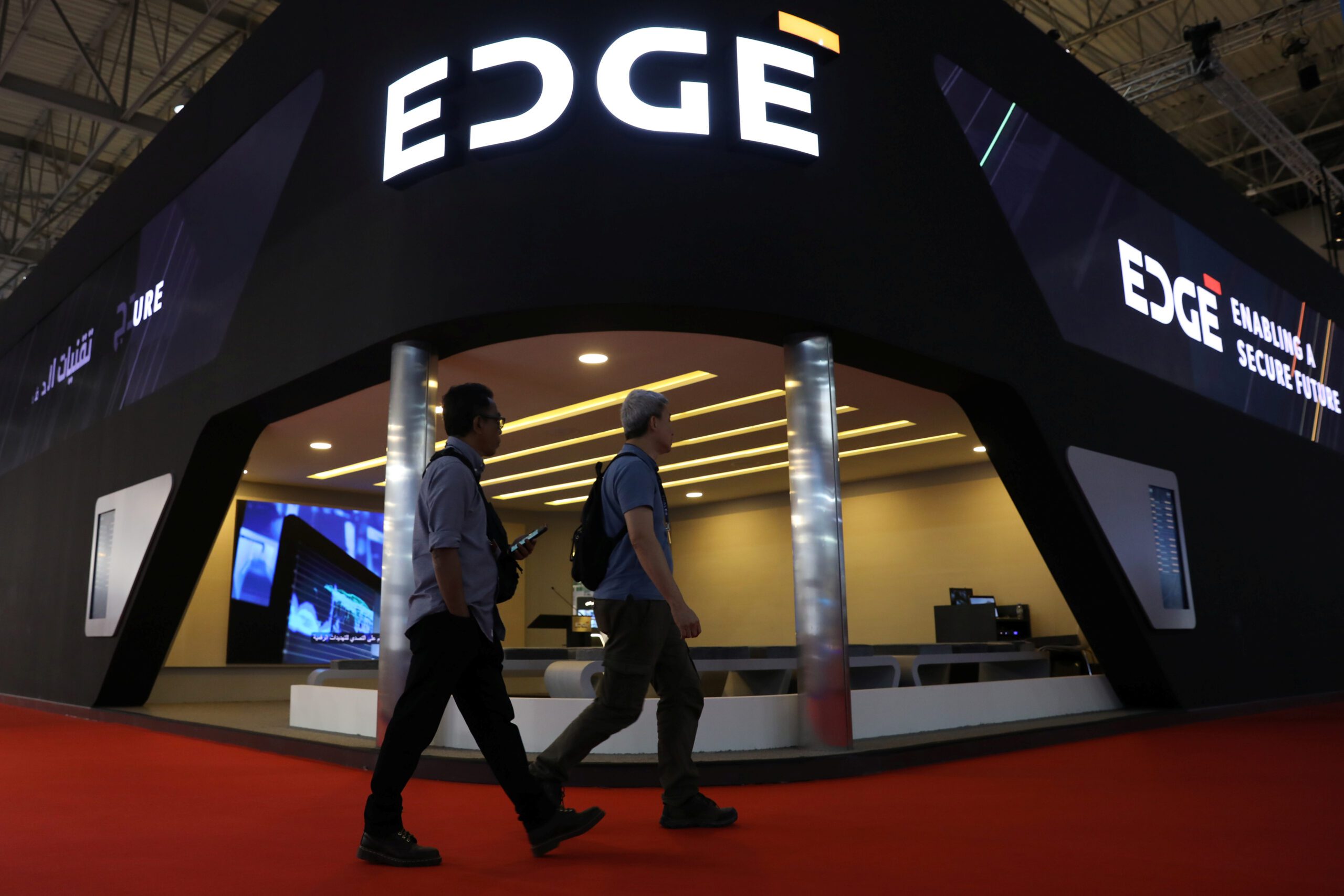
Visitors walk past the EDGE Group display during the Dubai Air Show in Dubai, United Arab Emirates, November 21, 2019. (REUTERS/Christopher Pike)
In January, Qatar and the United Arab Emirates announced a joint venture between their respective defense conglomerates, Barzan Holdings and EDGE Group. That Gulf states continue to expand their defense industries is no surprise; that Qatar and the UAE are engaging in collaborative industrial defense development is rather more remarkable given the states’ recent history. The announcement, made at the Qatari defense showcase at DIMDEX 2026 in Doha, may represent something more significant than a commercial arrangement: a tentative but tangible step toward rebuilding trust after one of the most acrimonious episodes in modern Gulf politics.
A Bumpy Couple of Decades
It has been a turbulent period for Qatari-Emirati relations. Post-Arab Spring, the states were on opposite sides of the defining debate that underpinned Arab politics: whether to accommodate or suppress Islamist movements. More than merely disagreeing philosophically, each side actively supported its own genre of proxy partner around the region. From Libya to Syria to Egypt, and more recently the Horn of Africa, Qatari and Emirati proxies frequently found themselves ranged against one another in a shadow competition for regional influence.
This divergence became acute when the UAE, Saudi Arabia, Bahrain, and Egypt launched a boycott of Qatar in June 2017. The boycott severed land, sea, and air links, expelled Qatari nationals, and sought to economically strangle the small peninsular state. The measures disrupted everything from food supply chains to family connections across borders. When the boycott was lifted in January 2021 through the Al-Ula Declaration, it was difficult to see how Qatari leaders could readily forgive and forget.
Signals From DIMDEX
The context of the Barzan-EDGE announcement is itself instructive in this regard, however. DIMDEX 2026 featured a notably large Emirati presence, with EDGE Group occupying one of the exhibition’s more prominent pavilions. Beyond mere attendance, the UAE committed as a tier one sponsor – a significant financial and symbolic investment in a Qatari showcase. The signing ceremony was accorded prime billing on the first day: a choreographed moment, paid for, invested in, and honored by both parties. Such gestures carry weight in Gulf politics, where symbolism and protocol serve as a parallel language of statecraft. Whether this reflects genuine strategic alignment or carefully managed optics remains an open question, but the investment of prestige by both parties suggests at minimum a shared interest in demonstrating reconciliation.
The Logic of Collaboration
Beyond the symbolism, there are sound rationales for Qatari-Emirati defense cooperation. Given EDGE’s broader portfolio and more mature technological base, the Emirati firm would likely serve as the primary provider of technology and expertise, with Barzan contributing limited market access, perhaps facilities, and capital. For Qatar, such an arrangement offers an accelerated path to defense industrial capability – where indigenous development might take a decade or more, partnership with a more established regional player compresses timelines considerably. This represents a marriage of convenience, certainly, but also a pragmatic recognition that smaller states seeking world-class defense capabilities benefit from pooling resources rather than duplicating efforts in isolation.
The deeper significance of this joint venture may lie in what it suggests about evolving attitudes toward intra-Gulf competition. For decades, the Gulf states have pursued parallel development strategies characterized more by rivalry than coordination. Each has sought to build national champions across sectors from aviation to finance to defense, often duplicating investments and competing for the same markets, talent, and prestige.
This competitive dynamic has produced impressive individual achievements but at considerable collective cost. That the UAE successfully launched a mission to Mars years before a train link to any other Gulf capital speaks to the domestic focus at the expense of meaningful regional integration.
Smaller Gulf states, such as Qatar, Kuwait, and the UAE, can afford competitive inefficiency for decades yet. Hydrocarbon revenue, sovereign wealth, and relatively small populations provide ample buffers against the costs of duplication. The question is whether affordability is the same as wisdom. As these states pursue economic diversification and knowledge economies less dependent on resource extraction, the logic of competition becomes less compelling and the benefits of coordination more apparent. Defense industries, with their high fixed costs and long development cycles, are precisely the sector where the case for collaboration is strongest.
Trust, Time, and Tentative Steps
None of this is to suggest that the Barzan-EDGE joint venture represents a fundamental transformation of Gulf politics or that the wounds of the boycott have healed. Trust, once broken, rebuilds slowly. Qatari policymakers would be imprudent to assume that the interests that drove the boycott have disappeared entirely, and Emirati leaders presumably remain wary of a neighbor whose regional alignments and media influence they sought so dramatically to curtail.
What the joint venture does suggest is that both sides see value in building institutional frameworks that create shared interests. Defense industrial partnerships, once established, generate their own constituencies and path dependencies. Joint development programs create stakeholders on both sides invested in the relationship’s continuation. In this sense, the Barzan-EDGE venture may be less an expression of existing trust than an instrument for building it – a calculated bet that shared projects can forge connections that diplomatic rhetoric alone cannot.
Whether this bet pays off will depend on factors beyond the control of either defense conglomerate: the evolution of regional alignments, the management of future disagreements, and the depth of commitment on both sides to making the partnership succeed when political winds shift. The Gulf has witnessed rapprochements before that proved superficial when tested by competing interests.
For now, the joint venture stands as a notable marker on an uncertain path. In a region where trust is scarce and history casts long shadows, such investment is itself significant – even if the full measure of reconciliation remains to be seen.
The views represented herein are the author's or speaker's own and do not necessarily reflect the views of AGSI, its staff, or its board of directors.
The “Make It in the Emirates” forum showcased how far the UAE’s growing defense manufacturing capabilities and ambitions have come – and how far they have left to go.
Gulf states need to prioritize enhanced regional defense cooperation with an expanded group of potential partners, consider using the financial leverage of sovereign wealth funds’ action, and ramp up diplomatic pressure to deter such attacks in the future.
The GCC states now consider an attack on one to be an attack on all, and Saudi Arabia may be covered by a Pakistani rather than U.S. military umbrella.
Where Hamas operates from matters less than the broader absence of any coherent vision – from Israel, the Palestinians, or the international community – for future Arab leadership in Gaza.