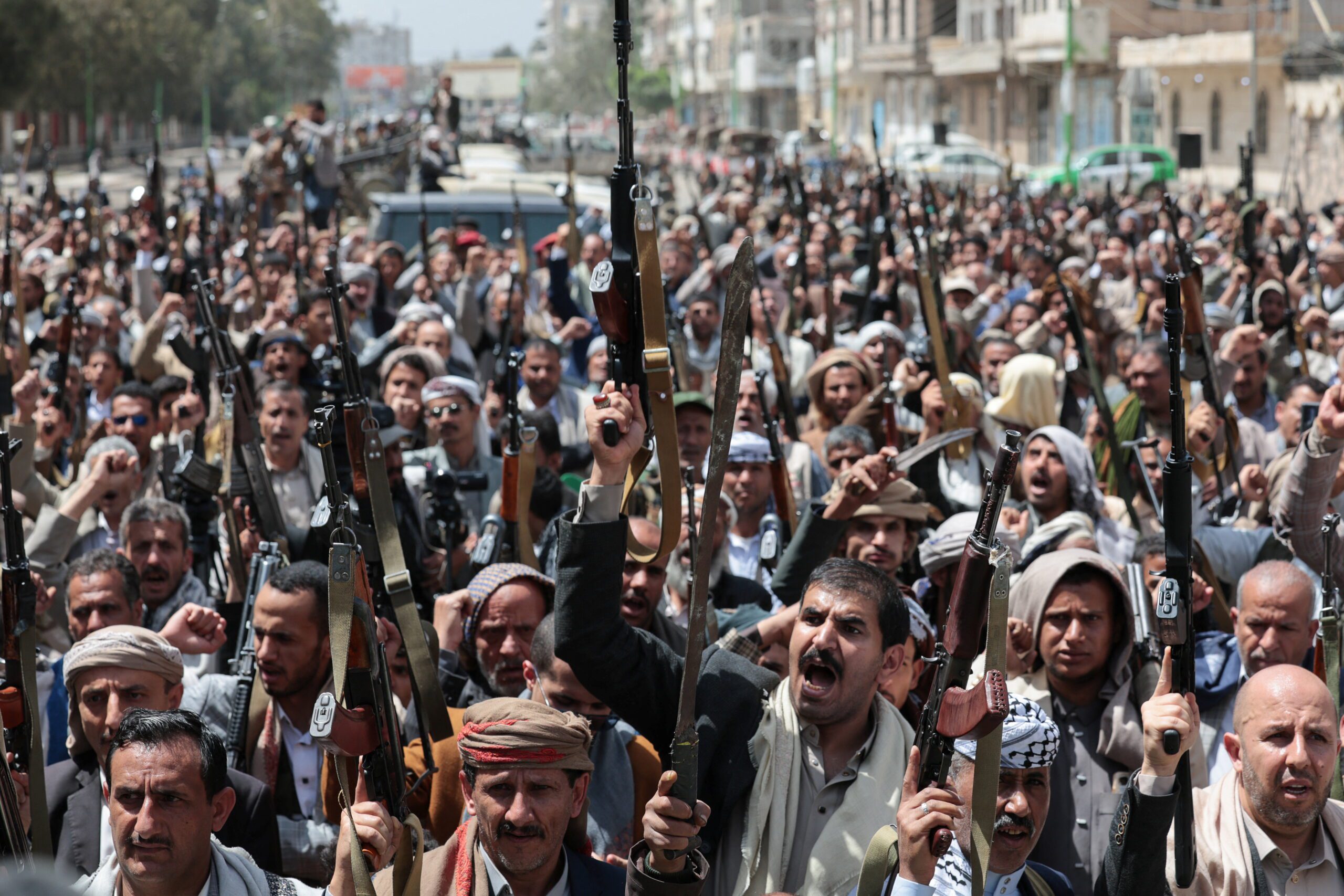
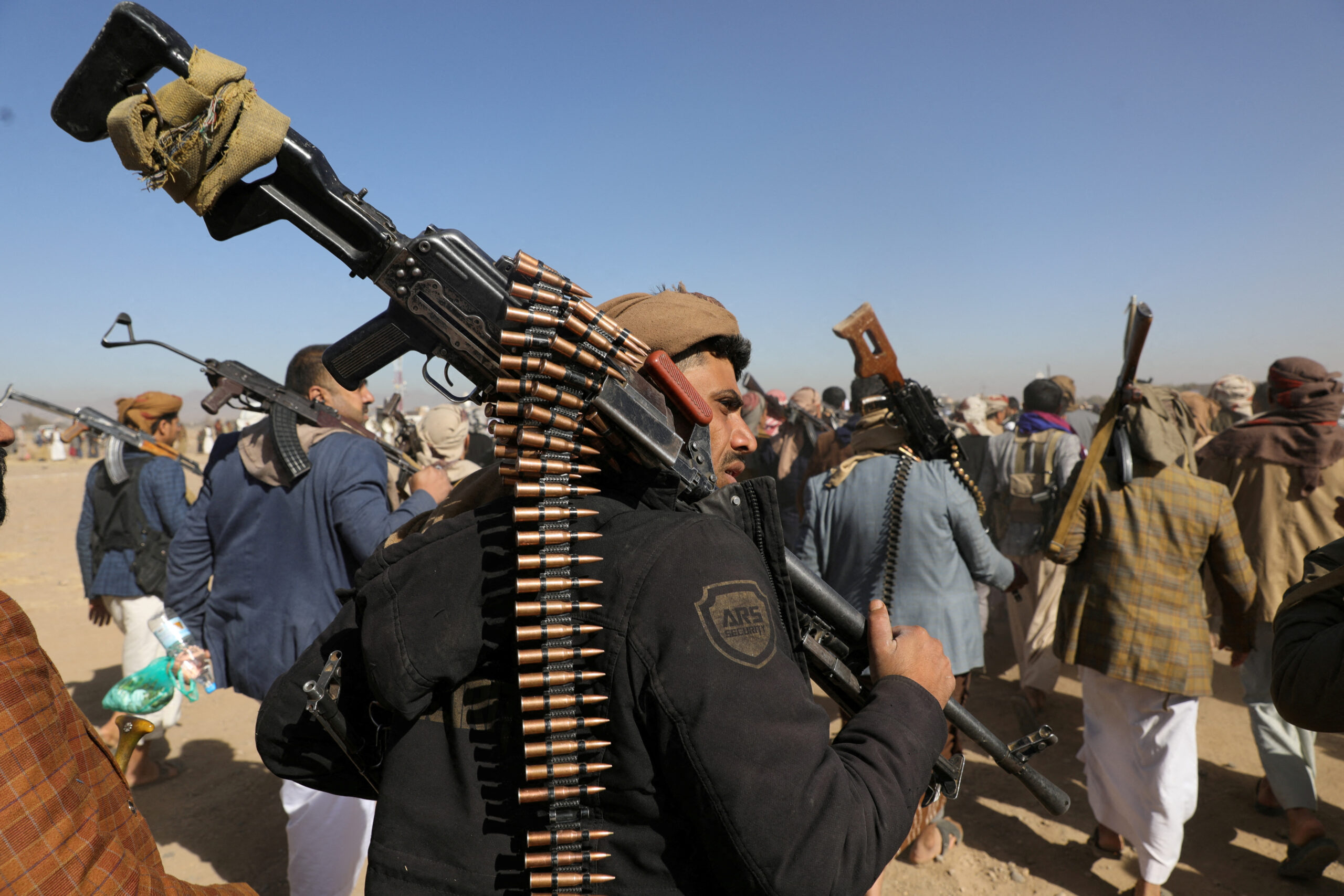
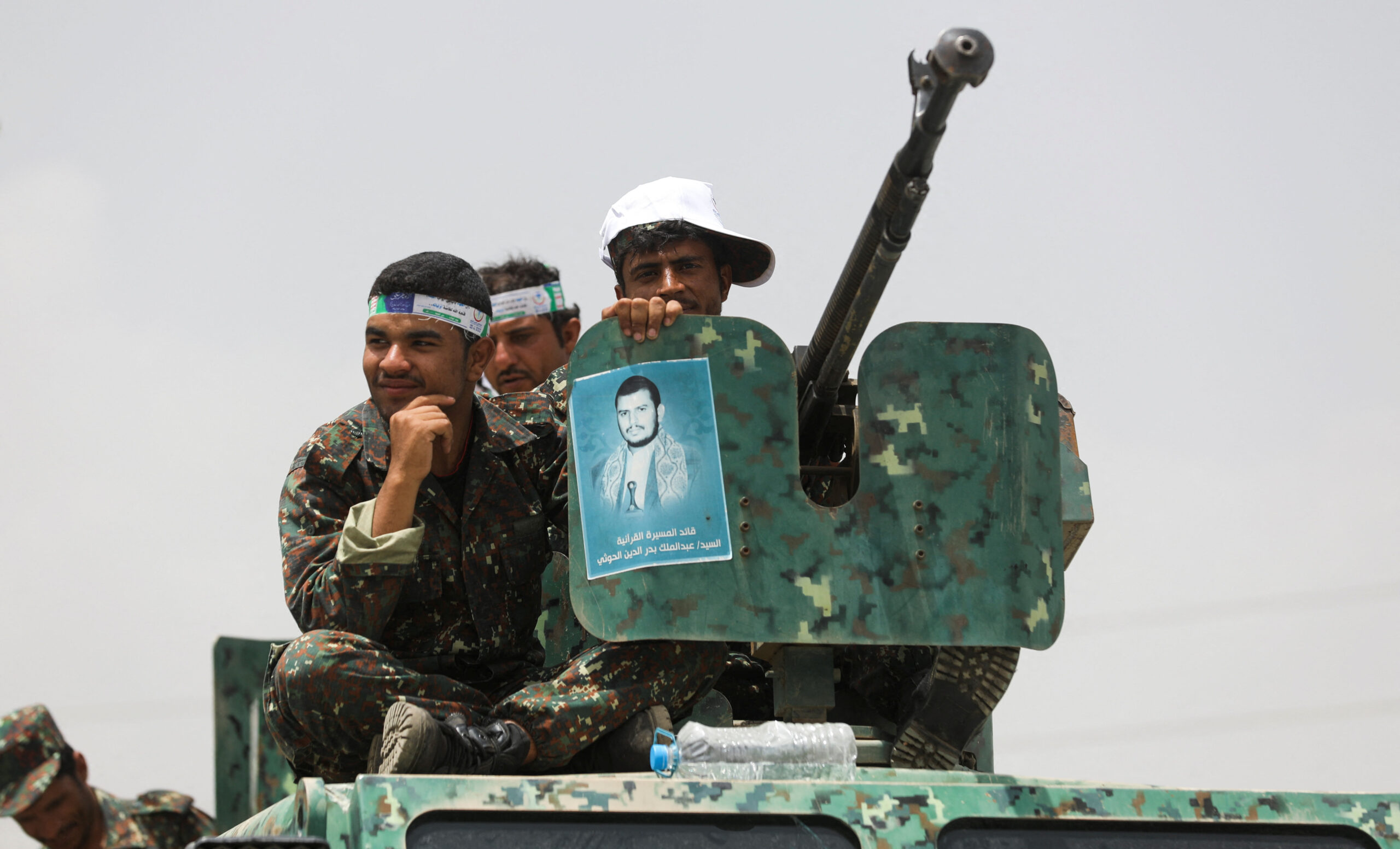
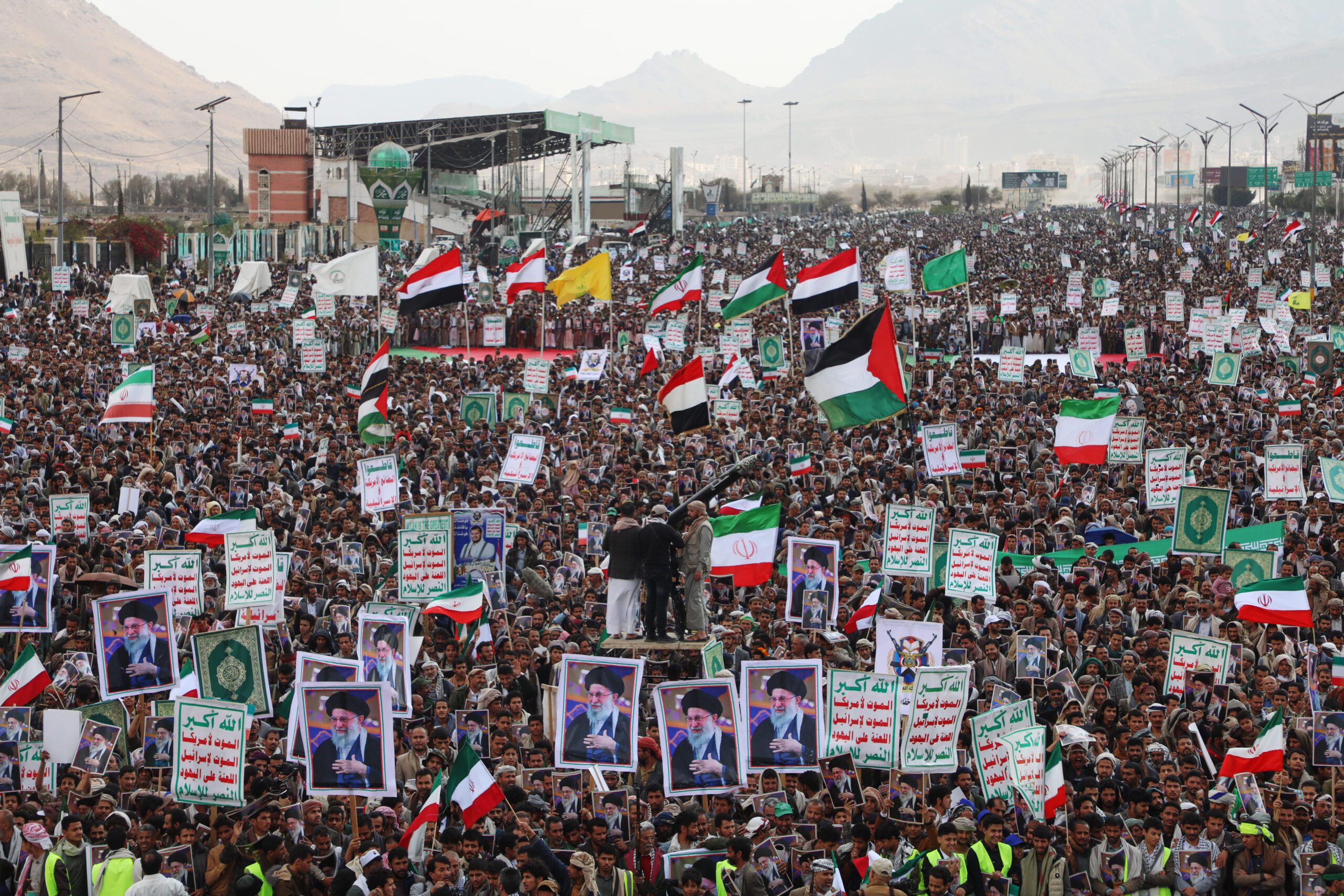
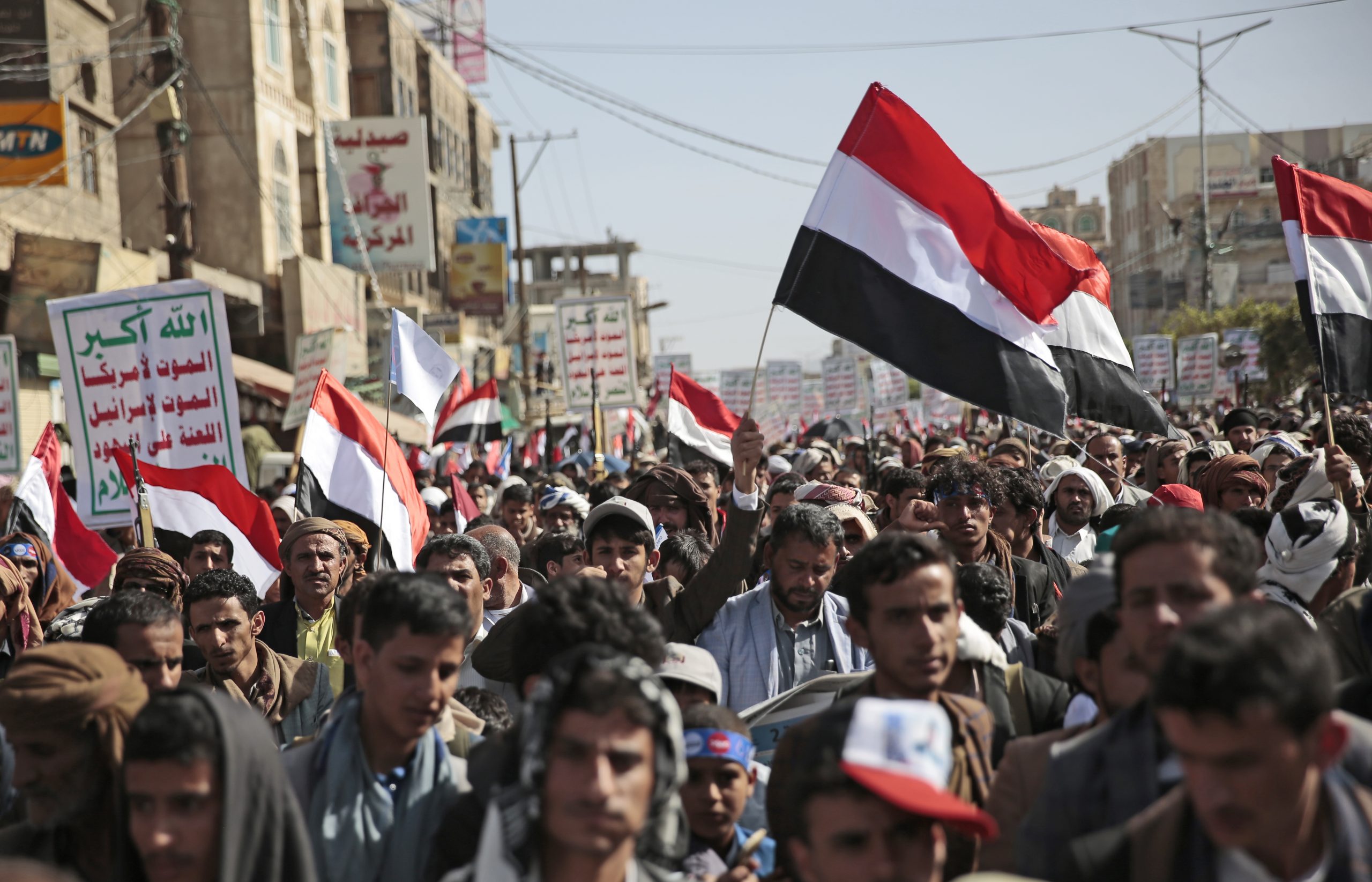
Houthi followers hold weapons during a pro-Iran demonstration in Sanaa, Yemen, April 6. (REUTERS/Khaled Abdullah)
Over the past several years, the Iran-backed Houthi movement has integrated a highly standardized “multipolarity” doctrine into its state-controlled media and diplomatic signaling. The vocabulary is being reproduced with an editorial consistency that points to shared institutional directive rather than independent analysis. The Houthis are conducting a foreign policy aimed at integrating themselves into a world order that can extend them the recognition they believe their movement needs.
Houthi media absorbed Iran’s strategic vocabulary years before the missile shipments and Quds Force coordination more widely exposed the Iranian-Houthi relationship. Houthi editorials discussed “American imperialism” in Tehran’s language in 2014 and 2015. The recent incorporation of Russian and Chinese framings into Houthi media looks like the application of the same mechanism as the movement seeks recognition from Moscow and Beijing as an actor with standing within the emerging Russia-China-Iran alignment or configuration.
Houthi public discourse is shaped by clear editorial guidelines dictating which global actors can be criticized. Under these guidelines, criticism of Moscow is avoided because it would undermine the movement’s position within the configuration, and the same incentive forecloses any scrutiny of China, such as Beijing’s treatment of Muslims in Xinjiang.
To be clear, the Houthis have long held genuine anti-U.S., anti-Western views that predate this more recent alignment with Russia and China, but the multipolarity vocabulary that the movement is now producing is different. This alignment with Moscow offers the kind of international standing Tehran cannot provide and positions the Houthi movement to be recognized as the governing authority of the Republic of Yemen. Russia shielded Syrian President Bashar al-Assad through years of Western pressure and helped preserve his place within the regional order long after many observers assumed his isolation would prove fatal, though Assad eventually fell in late 2024 through Turkish-backed military intervention rather than Western pressure. The Russian bet operated successfully for nearly a decade. For the Houthis, this is the kind of durable patronage, both material and psychological, that they covet and that the international order denies them.
The Houthis’ view of the multipolar order and their place in it has been articulated clearly for years in official Houthi media with a level of sophistication that is often not assumed of a movement that in recent years has still been referred to in Western news reports as a “ragtag militia.” Houthi positions on BRICS, the yuan and dollar, Taiwan, NATO expansion as a cause of the Ukraine war, and solidarity with the “Global South” have been constructed to support the positions of the emerging Russia-China-Iran alignment. Such issues in the past would have been outside the Houthis’ purview, but Houthi media has been purposely featuring them and staking a position supporting Russia and China. The Houthi state news agency has described the present moment as showing “preliminary signs of fundamental transformations in the global system toward a multipolar system that ends the unipolar hegemony,” and pointed to the war on Iran as the catalyst.
This language trickles down from the top of the Houthi movement. Houthi state media published an editorial by a senior member of the Houthi Supreme Political Council, Abdulaziz bin Habtour, who calls himself the founder of “Yemen BRICS Day,” sending a congratulatory message to the Russian philosopher Alexander Dugin, a leading theorist of Eurasianism and the multipolar world, in which he praises Dugin’s theory of international order and positions the Houthi movement within it. Habtour shows that the Houthi movement is not just a theological resistance project colored with anti-Americanism. It is also intellectually invested in the architecture of the multipolar order and aligned with the Russian thinkers who are theorizing it.
The Houthis legitimize Russian conduct by adopting the Russian worldview wholesale and presenting it to their audience as the correct reading of events. For example, when Russia bombs Ukrainian cities, Houthi-sponsored media describes the strikes as a special military operation against NATO-backed forces and the Ukrainian forces themselves as terrorists.
This alignment benefits the Houthi as a nonstate group because it increasingly decouples their geopolitical relevance from their domestic governance record and provides a measure of strategic durability that local politics alone cannot supply. Because the Houthis now measure their strategic value in the theater of great power competition, the incentive to accommodate domestic rivals evaporates.
The Western international order offers no path for the Houthi movement, with a founding identity that relies on anti-Americanism. Moscow, on the other hand, offers international cover and geopolitical status without demanding the structural concessions Washington requires. The attraction of this alignment is not merely rhetorical. It performs three major tangible functions for both the movement and the broader configuration.
First, control over Hodeidah and the Red Sea coastline allows the Houthis to weaponize the Bab el-Mandeb on behalf of the alignment. This dynamic positions Iran as the aggressive enforcer at the Strait of Hormuz and the Houthis as the gatekeepers at the Red Sea. The core of their strategic messaging is that the emerging world order needs the chokepoints the Houthis hold.
Houthi-sponsored media ties Iran’s shift to yuan-denominated oil transit fees to “the rust on the factories in Pennsylvania, Ohio, and Michigan,” a reference to the decline of U.S. industrial production in the Rust Belt states. The claim that U.S. industry has hollowed out runs through Russian and Chinese commentary, and Houthi columnists are reproducing it. Beyond economic arguments about U.S. decline, Houthi media also highlights examples of non-Western actors exercising strategic leverage. Houthi media points to Iran’s selective filtering of Chinese shipping as proof that power is no longer monopolized by major powers. Meanwhile, the Houthis have struck Western shipping in the Red Sea while exempting Chinese and Russian vessels through an arrangement confirmed by the U.S. Treasury, and Chinese technology and dual-use components have strengthened the precision of their targeting of Western vessels. The chokepoint is leverage against the West at a cost Russia and China do not have to absorb. If the Houthis resume strikes in the Red Sea, Russian and Chinese vessels are likely to again receive safe passage.
Second, the ideological function suits the Houthis. The case that the multipolar order is good for Arabs and Muslims has to be made in Arabic and from inside Islamic vocabulary, and neither Russia nor China can do that. Iran’s Persian language and Shia character limit its reach. By backing the Houthis, Russia and China signal to Sunni Arab audiences that the multipolar order is willing to find room for actors the U.S.-led order excludes, and that interest, not values, governs membership. Houthi columnists read the summit between President Donald J. Trump and President Xi Jinping as evidence of U.S. deterrence collapsing, framed Trump’s reception in Beijing as Chinese protocol disciplining a fallen power, and treated what they called the United States’ defeat in the war on Iran as the end of foreign intervention as a viable practice. Translation of this kind extends the multipolar project’s reach into the Sunni Arab populations within the U.S. security architecture in the Gulf, Egypt, and Jordan, the audience whose alignment helps hold the existing regional order together.
Third, Russia is using Yemen to support its recruitment pipeline. As early as 2024, Russia began recruiting Yemenis as a steady supply of fighters for its war in Ukraine. It routed these fighters through Oman and promised civilian work and Russian citizenship. The U.S. Treasury sanctioned a Houthi-linked operator for trafficking Yemenis to the Russian front in March 2025. In May, Ayman al-Najri, captured in eastern Ukraine, told a Ukrainian interviewer that he had been deceived about the work he was promised. The blackout in Houthi media around this controversial domestic topic that was being widely discussed in Yemen, despite extensive Houthi media coverage of Russia, suggests a degree of political sensitivity difficult to explain as mere editorial omission.
The Houthis have extracted significant benefits from this alignment. From Russia and China they receive diplomatic cover within international bodies where Western designations require partner enforcement. From Iran they receive military materiel and training. And, more broadly, they get the benefit of domestic political breathing room from being framed as an actor in an emerging international order rather than a localized civil conflict. Finally, it provides the psychological protection that comes from being inside an alliance whose framework strictly prohibits any of its members from being identified as a source of harm to the Yemeni population.
Ultimately, the Houthis are maximizing their durability by embedding themselves within the anti-hegemonic alignment anchored by Tehran. And although Russia and China do not offer an alternative to the Iranian axis; they widen it. They expand the universe to which Iran connects them, and that universe asks nothing of the Houthis that local politics would. For the Houthis, the attraction of this alignment extends beyond military support or diplomatic cover. It offers something Tehran alone cannot provide: a pathway toward international recognition. The movement is constructing a place for itself within an emerging political order and shaping its foreign policy around the expectation that such an order will eventually acknowledge it. The more the world recognizes them, the less they answer to Yemenis.
The views represented herein are the author's or speaker's own and do not necessarily reflect the views of AGSI, its staff, or its board of directors.
The Houthis’ expanding partnerships with al-Shabab and Al-Qaeda in the Arabian Peninsula are a growing threat to regional security and international shipping.
While not without risks, Trump’s redesignation of the Houthis as a foreign terrorist organization is a powerful diplomatic tool for Yemen’s government.
A U.N. agreement lifting Central Bank of Yemen economic restrictions may inadvertently embolden the Houthis and bolster their capacity to project military power.
Saudi-Houthi backchannel talks will not succeed in generating a comprehensive political settlement unless the concerns and grievances of all Yemeni factions as well as the region's long-term stability are given due consideration.