Should Saudi Policymakers Be Concerned About Rising Unemployment?
The recent increase in the Saudi unemployment rate is puzzling and may be due to statistical issues with the Labor Force Survey rather than a reflection of economic conditions.
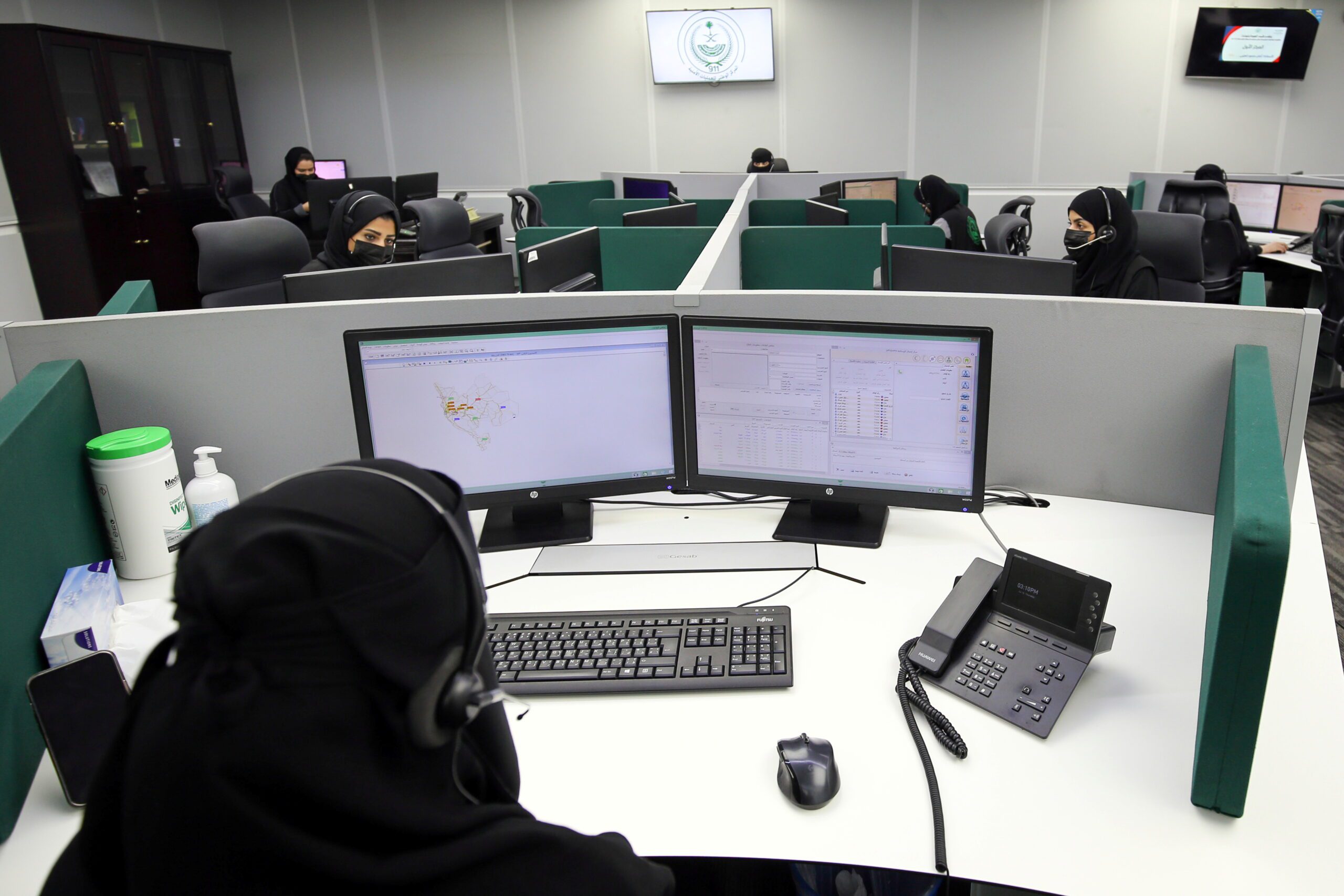
A Saudi woman works as an operator at the National Center for Security Operations for Haj, in Mecca, Saudi Arabia, July 15, 2021. (REUTERS/Ahmed Yousri)
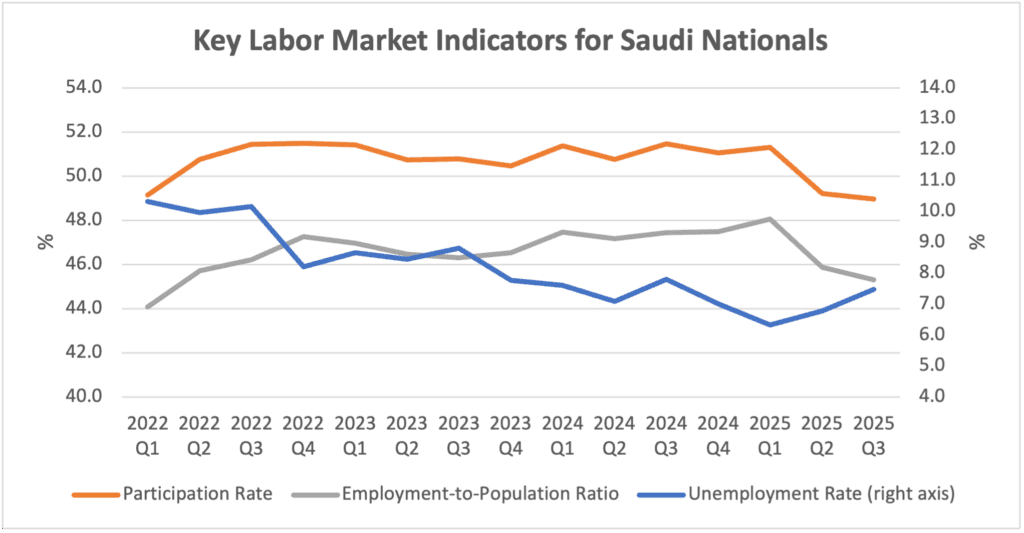
At face value, recent labor market data does not make happy reading for Saudi policymakers. The quarterly Labor Force Survey suggests that, during the second and third quarters of 2025 (the latest data available), the multiyear decline in the unemployment rate of Saudi nationals came to an end and that Saudis became less engaged with the labor market as the labor force participation rate and the employment-to-population ratio declined sharply.
Yet, this data is puzzling because other indicators show that the economy remains in good health. Non-oil growth has slowed, but at 3.7% in the third quarter of 2025 it was hardly weak. Meanwhile, indicators of employment from other sources suggest that job creation for Saudi nationals has continued at a reasonable clip. The Labor Force Survey data seems disconnected from most other economic indicators. This raises the possibility that the survey is providing misleading signals about the current state of the Saudi labor market.
A Closer Look at Saudi Labor Market Data
The key variables in the Labor Force Survey are the unemployment rate, labor force participation rate, and employment-to-population ratio. The unemployment rate is the number of people who are unemployed as a share of the labor force (defined as the total of all those who are employed and unemployed). The labor force participation rate is the labor force as a share of the working age population (defined as those aged 15 and above). The employment-to-population ratio is the number of employed people as a share of the working age population (again defined as those aged 15 and above).
Data on the unemployment rate, labor force participation rate, and employment-to-population ratio come from Saudi Arabia’s quarterly Labor Force Survey. As the name suggests, this data is based on a survey of a sample of the population (nationals and expatriates) in which respondents are asked a series of questions about their labor market activities. Employment data is also collected in the survey, but it is not published. Rather, the published employment data comes from the administrative records of the General Organization for Social Insurance and the Ministry of Human Resources and Social Development. This data is often referred to as “administrative” or “register-based” labor market data.
There are significant definitional differences between the Labor Force Survey and register-based data. The latter is a narrower measure of employment, as people working in the military and security services and those who are not registered with the General Organization for Social Insurance (which could include the self-employed and freelancers) do not feature. In mid-2024, the “register-based” data showed that 3.9 million Saudis were employed, while the author’s estimate is that the (unpublished) Labor Force Survey measure showed 6.2 million Saudis as employed. It is not clear why the statistics authorities do not publish the employment data from the survey – if there are concerns about its quality, these concerns would equally apply to the other data from the survey that is published.
The Labor Force Survey shows that the unemployment rate among Saudi nationals hit an all-time low of 6.3% in the first quarter of 2025 but subsequently increased to 6.8% in the second quarter and 7.5% in the third quarter. While this rate is still low by historical standards – as recently as the third quarter of 2022, it was over 10% – the 1.2 percentage point increase over two quarters is large and defies the usual seasonal pattern whereby the unemployment rate drops in the second quarter.
Source: General Authority for Statistics
The declines in the labor force participation rate and employment-to-population ratio for Saudi nationals in the second and third quarters were also unusually large. Both indicators have been on an upward trend in recent years but fell by over 2 percentage points from 51.3% to 49% and 48% to 45.3%, respectively, between the first and third quarters of 2025 (with most of the decline in the second quarter). In the third quarter, the indicators were at their lowest levels since mid-2021 and mid-2022 respectively.
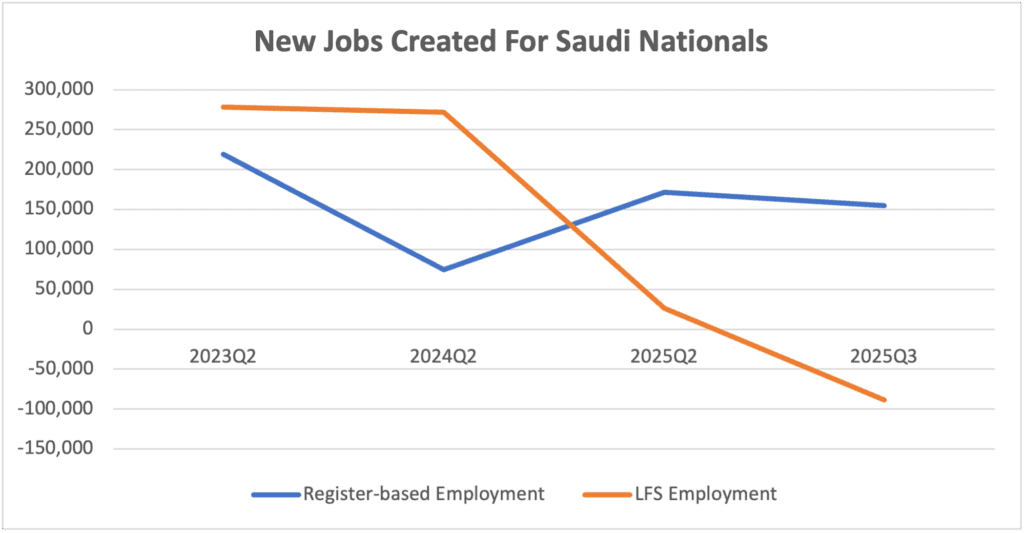
In contrast, the employment of Saudi nationals remained on a positive trend according to the register-based data. Employment increased by a total of 76,000 in the second and third quarters of 2025 compared to a 52,000 increase in the same two quarters of 2024. Continued employment growth is consistent with the results of the Riyadh Bank purchasing managers’ survey that shows that companies are still feeling optimistic about hiring.
A Difficult Circle to Square
A higher unemployment rate, a lower participation rate and employment-to-population ratio, and continued job creation are difficult to square with each other. There are two possible explanations. The first is that there has been a substantial acceleration in the growth of the working age population. The second is that there has been a divergence between the register-based and Labor Force Survey employment data.
A rapid increase in the working age population could be consistent with a drop in the employment-to-population ratio at a time of rising employment, a decline in the participation rate (as those aged 15-24 have a lower participation rate given many are in school or college), and an increase in the unemployment rate if employment does not grow sufficiently quickly to absorb the new entrants to the labor force. During 2023-24, the working age population grew by an average 3.2% per year. Looking at the age structure of the population in the 2024 population statistics, there is no reason to believe the growth rate of the working-age population would have significantly accelerated in 2025. Yet, to generate the observed movements in the unemployment, participation, and employment rates between the first and third quarters of 2025, the working age population would have had to increase by 6%. This is not realistic.
It therefore seems that the (unpublished) employment data from the Labor Force Survey must be telling a different story from the register-based data. Differences between the two data sources are not unusual. From mid-2022 to mid-2024, the register-based and survey data both showed increasing Saudi employment, but the estimated increase from the Labor Force Survey was nearly twice as large as from the register-based data – 560,000 new jobs created compared to 290,000. The author’s estimates suggest that employment in the survey data would have had to decline by around 90,000 over the past year to be consistent with the reported decline in the employment-to-population ratio (in the absence of population estimates for 2025, this estimate assumes growth in the working age population of 0.8% a quarter, in line with recent experience). This compares to an increase of 155,000 jobs in the register-based employment data over the same period, which seems easier to rationalize given current economic conditions.
Sources: General Authority for Statistics; author’s calculations. Note: Data shows the change in employment over the previous four quarters. The Labor Force Survey series is estimated.
Tread With Care
Given the emphasis that Vision 2030 places on increasing employment for Saudi nationals, having data that accurately tracks the trends in the labor market is essential. Unfortunately, at present, the published labor market data is difficult to interpret and does not seem to tell a consistent story across key variables. The decline in employment that seems to be implied in the Labor Force Survey is particularly difficult to rationalize given current economic conditions. This raises the question of whether the survey is accurately reflecting current conditions in the Saudi labor market.
Concerns about the quality of the Labor Force Survey data are not new. There has been considerable quarter-to-quarter volatility in the data in the past even during periods of relative economic calm. The reason for this volatility is unclear, but it could potentially be due to low survey response rates or sampling issues, as households are rotated in and out of the survey sample. Concerns are magnified by the fact that the labor market module of the 2022 Population Census, a key input for the survey, has still not been published more than two years after the initial round of census data was released. Improving the quality of the labor market data should be a high priority, as good data is the basis for good economic policymaking.
The views represented herein are the author's or speaker's own and do not necessarily reflect the views of AGSI, its staff, or its board of directors.
The Saudi government projects that the budget deficit will narrow during 2026-28, but this will depend on a rebound in oil prices and tight control of spending.
In its new strategy, the Saudi Public Investment Fund seems to focus more on investment returns and less on asset growth. How this will work in practice is less clear, including what it means for the future of existing projects, such as Neom.
Attacks on the East-West oil pipeline and other targets in Saudi Arabia will result in a larger-than-expected economic contraction in the kingdom this year.
The outbreak of the Iran war has halted the deepening of the economic relationship between the United States and the Gulf countries. While likely temporary, it could take some time before the upward trajectory is restored.
On January 8, AGSI hosted a virtual roundtable with its leadership and scholars as they look ahead and assess trends likely to shape the Gulf region and U.S. foreign policy during the coming year.