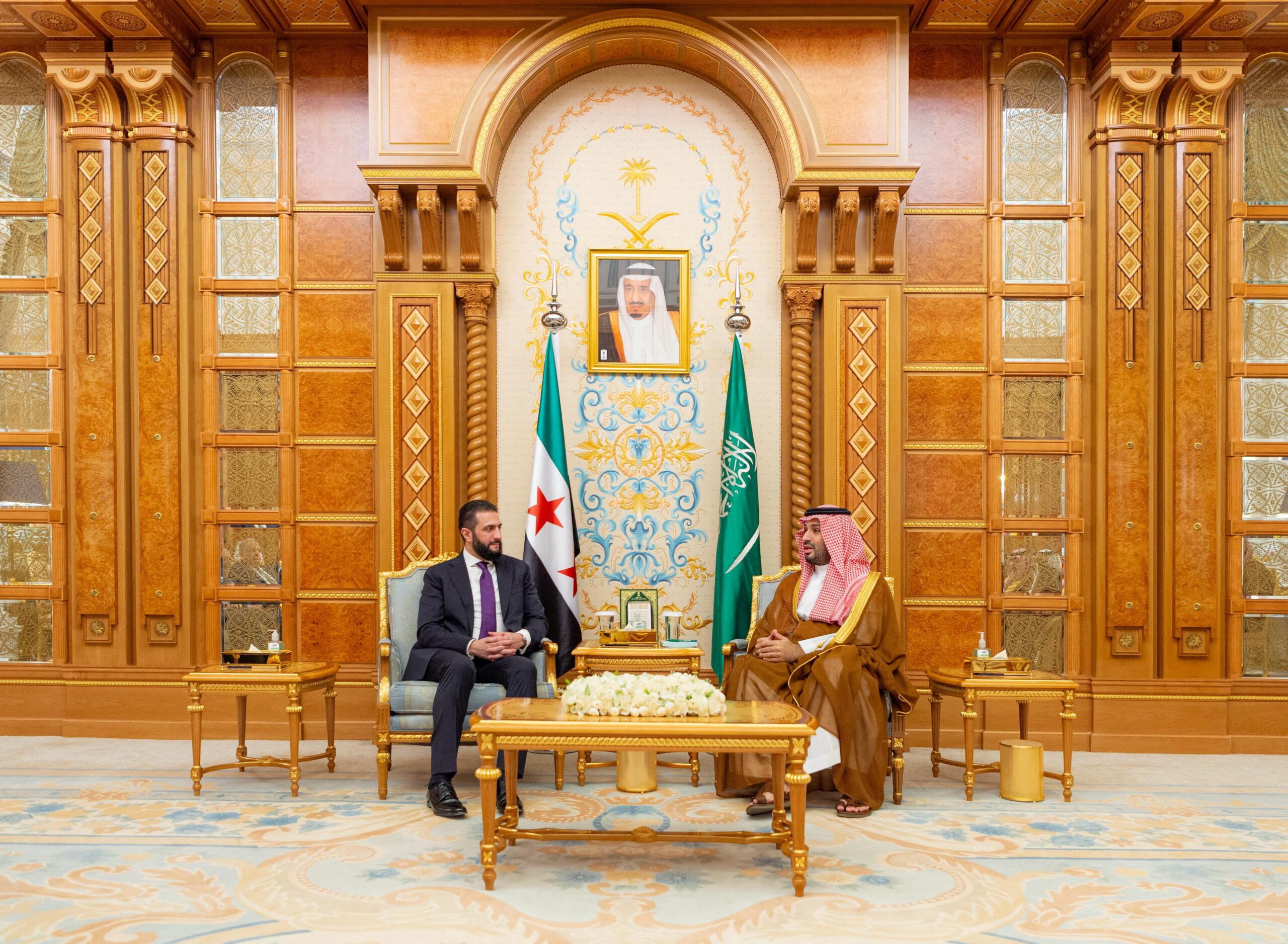
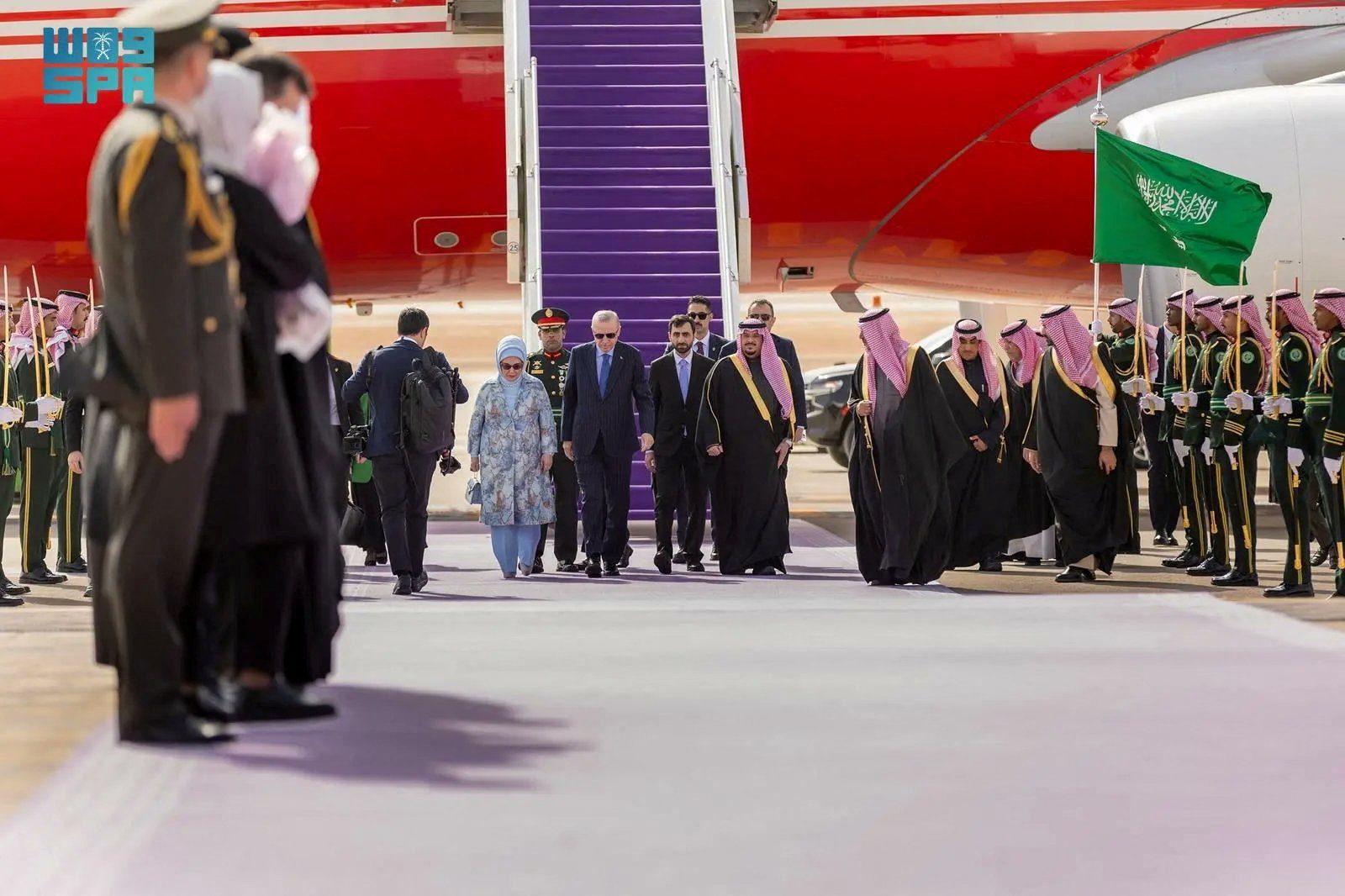
Syrian President Ahmed al-Sharaa meets with Saudi Crown Prince Mohammed bin Salman, in Riyadh, Saudi Arabia, October 29. (Saudi Press Agency/Handout via REUTERS)
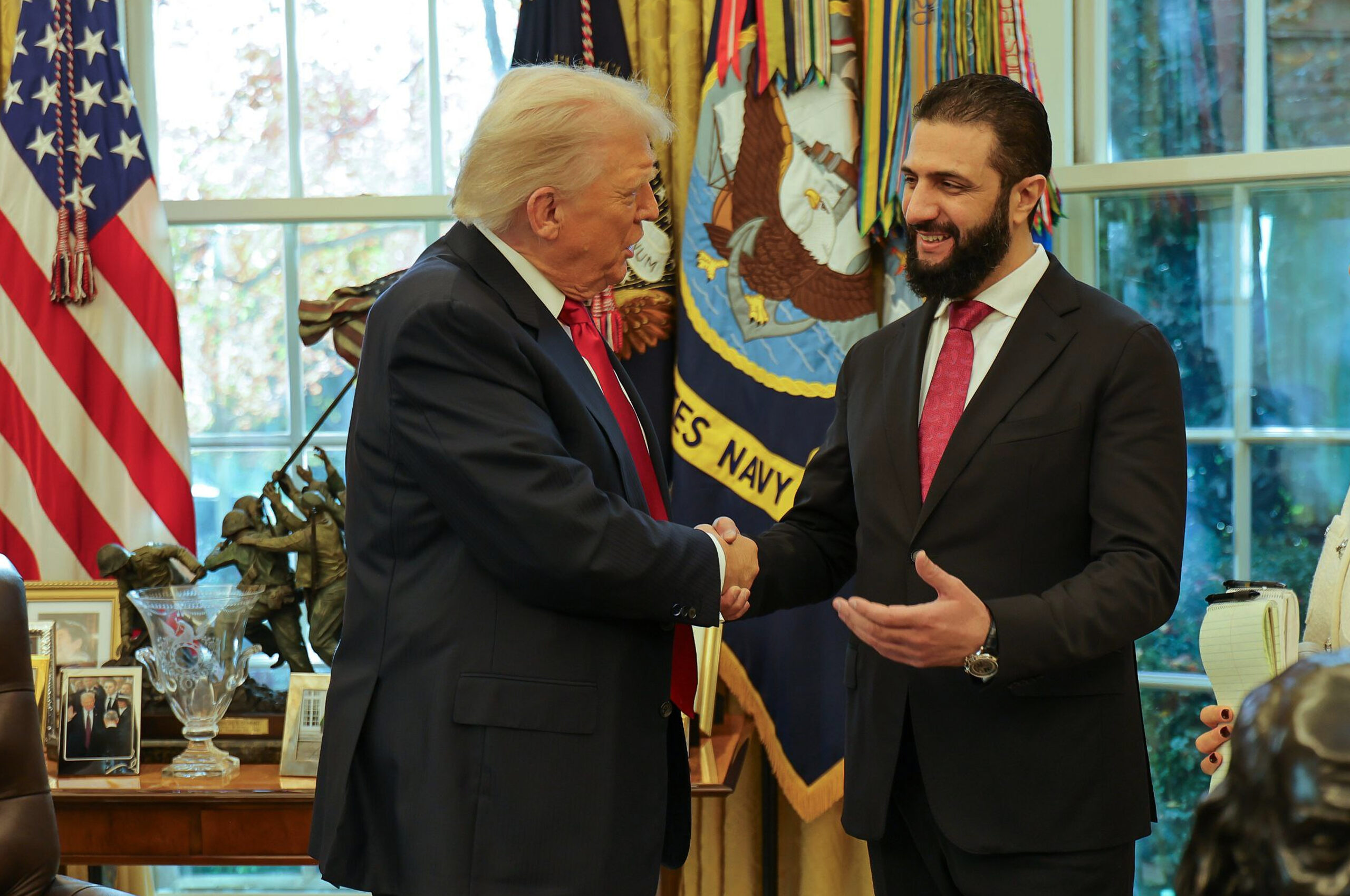
The historic mid-November Washington meeting with Syrian President Ahmed al-Sharaa marked the most significant formal U.S. engagement with Damascus in a generation. Crown Prince Mohammed bin Salman’s visit days later focused squarely on U.S.-Saudi strategic priorities – defense modernization, investment flows, and long-term security commitments – rather than Syria directly. Yet the sequencing is instructive because it underscores an emerging policy division of labor in which the United States pursues accelerated sanctions relief and diplomatic normalization, while the Gulf, led by Saudi Arabia, assumes responsibility for Syria’s stabilization and reconstruction.
Riyadh’s Strategic Motivations
One year after the collapse of Bashar al-Assad’s regime, relations between Riyadh and Damascus have undergone a dramatic reversal. The transformation has been driven by overlapping geopolitical shifts, economic ambitions, and Saudi Arabia’s determination to shape a new regional order that privileges Arab leadership over Iranian influence and channels cooperation with Turkey to constrain any outsized regional ambitions.
For over a decade, Saudi Arabia was one of Assad’s fiercest adversaries, supporting opposition forces and viewing Damascus as a conduit for Iranian expansionism. Assad’s abrupt collapse in December 2024 – toppled by Hayat Tahrir al-Sham, led by Ahmed al-Sharaa – upended that paradigm. The kingdom quickly moved to engage the new leadership, calculating that early outreach could prevent Syria’s descent into renewed chaos or Iranian reentrenchment.
At the core of Riyadh’s post-Assad strategy lie three imperatives: security containment, geopolitical balancing, and economic opportunity. First, Saudi Arabia seeks to preempt the resurgence of transnational jihadism and disrupt the narcotics economy – particularly the Captagon trade – that has corroded Syrian institutions and flooded Gulf markets. A stable, cooperative Damascus is seen as essential to shielding Saudi borders and domestic stability.
Second, Riyadh seeks to reassert Arab primacy in the Levant by weakening Iranian networks while keeping Turkish ambitions in check. In Syria – the Levant’s center of gravity – Saudi financial leverage and Turkish military weight make cooperation necessary, even as their complementary roles sharpen Riyadh’s wariness of Ankara’s regional aspirations. By exploiting Turkey’s dependence on Saudi and broader Gulf capital, Riyadh can work with Ankara when interests align while still constraining its bid for dominance.
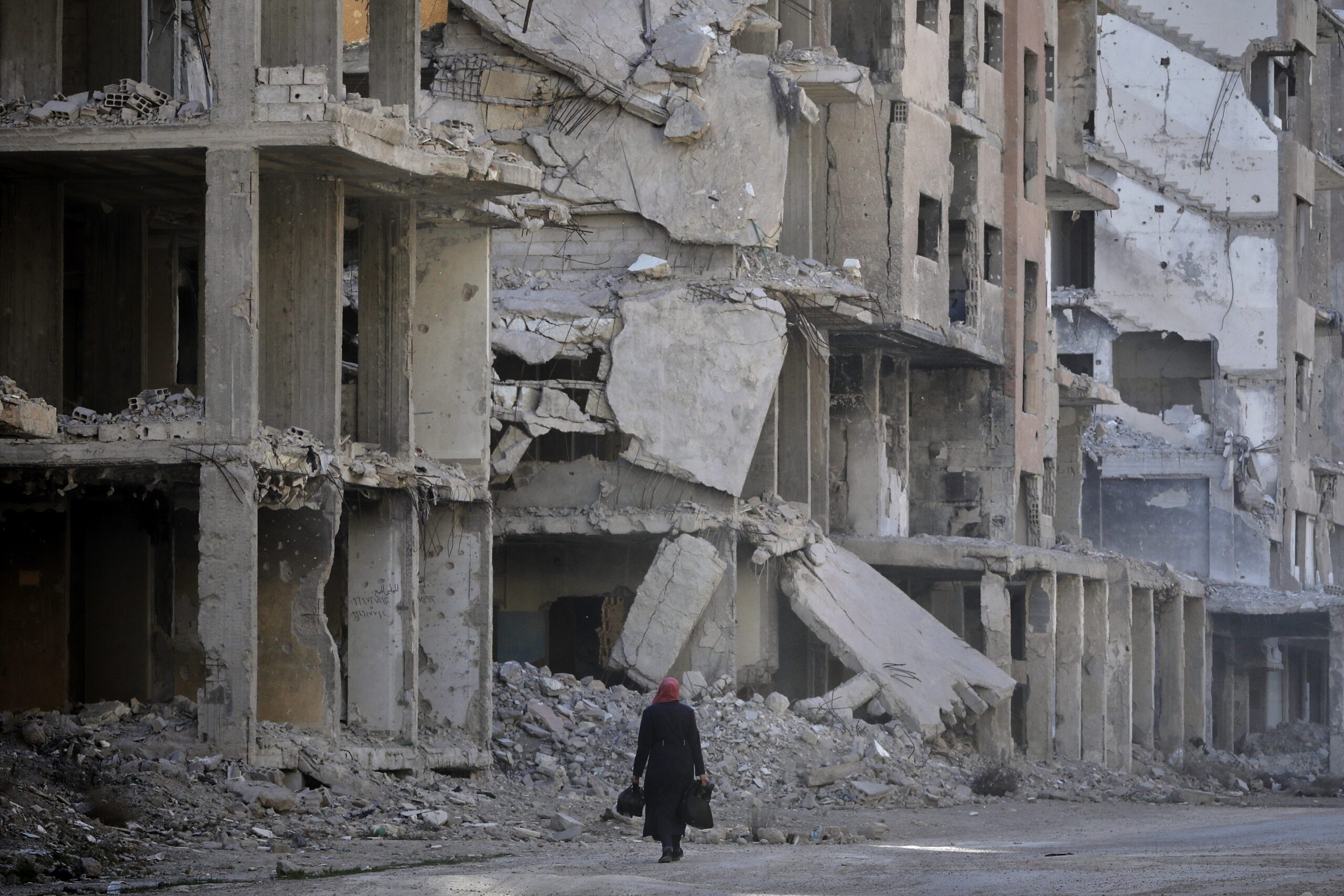
Third, Syria offers economic opportunity. Syria’s reconstruction, which the World Bank estimates will cost at least $216 billion, offers a vast arena for Gulf investment. Saudi official statements and bilateral agreements point toward the use of sovereign capital and private enterprise to rehabilitate infrastructure, energy grids, and transportation corridors, with the apparent aim of gradually integrating Syria into a Gulf-linked regional economic ecosystem centered on Saudi capital. Development, in this calculus, becomes an instrument of influence.
Saudi Arabia and Syria are discussing data cables linking the kingdom to Europe as part of a regional artificial intelligence and digital hub initiative, and the Saudi Telecom Company submitted a proposal for the project. Saudi renewable energy leader ACWA Power is also among Saudi companies poised to invest in Syria. In parallel, an International Monetary Fund team has already been in Damascus to support efforts to strengthen the capacity of Syria’s central bank, ensuring it can perform its essential functions and serve as a stabilizing anchor for the national economy.
Politically, Sharaa’s emphasis on nationalism and state restoration over ideological militancy resonates with Gulf sensibilities. His pragmatic willingness to distance Syria from Iran and Islamist movements has given Riyadh a rare opportunity to cultivate a partner that, while fragile, shares the Saudi preference for stability through state authority rather than revolutionary ideology.
With this in mind, Sharaa appears to have concluded that the surest route to Western goodwill runs through deepening alignment with Saudi Arabia, one of Washington’s primary Arab partners. Taken together, these moves signal Damascus’ recognition that Saudi Arabia – not Iran or Russia – is now the indispensable gateway to postwar normalization and economic reintegration. This calculation reflects a broader strategic shift, namely that Syria’s long-term sovereignty and economic recovery now depend less on ideological alignments and more on embedding the country within a Saudi-led, Western-endorsed framework.
In essence, Saudi Arabia views Syria’s transition not simply as regime change but as a geopolitical reset, a chance to entrench Gulf leadership across the northern Arab tier and to demonstrate that Arab reconstruction, not Iranian patronage or Turkish leverage, will determine the region’s future.
Milestones in a Rapid Rapprochement
The speed of normalization since late 2024 underscores Riyadh’s strategic urgency. The reopening of the Saudi Embassy in Damascus in September 2024 symbolized Syria’s reentry into the Arab system. Sharaa’s reciprocal visit to Riyadh in February 2025, his first foreign trip, sealed the personal rapport underpinning the political thaw.
Diplomatic efforts unfolded rapidly. A January summit in Riyadh gathered foreign ministers from the Gulf Cooperation Council states, Syria, the United States, and the European Union – signaling consensus on Syria’s reintegration and underscoring Saudi Arabia’s emergence as the principal convener of postwar diplomacy.
The pace accelerated further in March, when a Saudi-mediated border demarcation agreement between Syria and Lebanon, overseen by Saudi Defense Minister Khalid bin Salman, established mechanisms to curb militancy and cross-border smuggling, issues central to Riyadh’s security agenda.
Economic engagement quickly followed the political thaw. After the administration of President Donald J. Trump lifted select sanctions in mid-May – marking a successful lobbying effort by the Saudi crown prince – Saudi Arabia, together with Qatar, settled Syria’s $15 million arrears to the World Bank and later they jointly pledged $89 million to help maintain vital public services and cover state salaries. The Syrian-Saudi Investment Forum in Damascus in July concluded with a $6.4 billion Saudi investment pledge and the signing of a slew of agreements covering infrastructure, banking, energy, and real estate, alongside feasibility studies for a Syrian stock exchange and new power-generation projects. The two countries also concluded a bilateral Investment Promotion and Protection Agreement and established a Saudi-Syrian Business Council.
Building on this momentum, Sharaa doubled down on the strategy he apparently believed would secure Western backing, visibly tying Syria’s recovery narrative to Saudi capital, regional leadership, and reformist branding. Addressing the Future Investment Initiative in Riyadh in late October, Sharaa underscored Saudi Arabia’s “key role” in rebuilding postwar Syria while courting global investors. He cast Syria as an emerging trade corridor and noted that it had already attracted more than $28 billion in pledged foreign investment. In mid-November, the Saudi tanker Petalidi delivered the first crude-oil grant shipment to help stabilize refinery operations and bolster Syria’s wider economic recovery.
For Washington, this alignment fits neatly within its broader posture of “strategic minimalism,” supporting a Gulf-led stabilization effort that limits Iran’s influence, contains Russia’s footprint, and avoids the costs of direct U.S. engagement. Russia’s muted presence in this phase of Syria’s transition – shaped by bandwidth constraints from the war in Ukraine and an implicit recognition that Gulf financing will dictate Syria’s future political economy – further underlines the shifting balance of power.
Politically, Saudi Arabia has sought to recast Syria as a stabilizing pillar rather than a flashpoint. It has condemned Israeli airstrikes on Syrian territory and championed respect for sovereignty in United Nations and Arab League forums, situating Damascus within a Gulf-led security narrative. Riyadh has approached the integration of former HTS members into local governance pragmatically, focusing on stability and effective administration rather than rigid ideological scrutiny. It remains to be seen whether the December 13 killing of two U.S. military personnel and one civilian interpreter, at a site near Palmyra in central Syria, will upend some of the assumptions for the integration of HTS by Riyadh, Damascus, and Washington. The incident may also test the viability of Washington’s preference for engagement in Syria through strategic minimalism.
Riyadh’s proactive posture may also reflect lessons from its past hesitations – particularly in Yemen and Iraq – where delayed engagement arguably contributed to Iran entrenching itself deeply before Saudi Arabia acted. Its early, front-loaded engagement in Syria is thus best understood as a preemptive strategy to shape conditions before rival actors can fill the vacuum.
The Expanding U.S.-Saudi-Syrian Triangle
All these developments suggest the Syria file is now embedded within a broader U.S.-Saudi strategic compact. Congress’ repeal of the 2019 Caesar Syria Civilian Protection Act under the National Defense Authorization Act removes the broadest sanctions constraining engagement with Syria. In place of automatic snapbacks, Washington has installed a four-year conditional oversight framework tied to security and governance benchmarks. For Riyadh, the move lowers legal exposure and shifts investment decisions decisively toward managing Syria’s political and security risks rather than sanctions risk.
Within that newly permissive – but still conditional – framework, for Riyadh, this partnership confers immense strategic dividends. It amplifies Saudi Arabia’s diplomatic weight, aligns its regional ambitions with Washington’s minimalist engagement model, and cements its image as the indispensable Arab interlocutor between Damascus and the West. For Syria, it offers political rehabilitation and economic lifelines.
Persistent Fault Lines and Risks
Yet beneath the momentum lie vulnerabilities that could unravel the project. Domestically, Syria remains deeply fragmented. Violence has erupted intermittently in Suwayda, and while the March bloodshed in coastal Alawite areas has not repeated, underlying sectarian divisions and tensions remain pronounced. Recent parliamentary appointments hint at inclusivity, but social reconciliation remains nascent at best. The political step that builds on inclusivity, the prospect of some level of representative governance, remains only a contested, notional concept. These domestic fractures, if unaddressed, could compound external pressures and erode the foundations of Riyadh’s stabilization strategy.
Externally, Syria sits at the intersection of rival power projections. Relying on the goodwill it amassed in helping HTS develop and eventually overthrow the Assad regime, Turkey continues to occupy northern territories with troops and through proxy militias, pursuing a problematic buffer-zone agenda that is likely to eventually cause friction with Damascus. By some accounts, remnants of Iranian proxies continue to operate in Syria. Israel’s repeated airstrikes on Shia militias and Hezbollah’s logistical corridors and weapons depots perpetuate volatility. Geir Pedersen, warned in August before his resignation as U.N. special envoy for Syria that the country’s “transition remains on the knife-edge.”
Economically, accelerating sanctions relief is critical, but formal repeal of the Caesar Act does not eliminate all hurdles. Even after formal removal, major investors are likely to wait months before committing substantial capital, given lingering challenges, including Syria’s fragile political governance, persistent security problems, weak infrastructure, and volatile currency.
Smuggling and narcotics trafficking could undercut progress. Saudi efforts to strengthen border enforcement through trilateral coordination with Syria and Iraq remain embryonic and easily disrupted by political shifts or corruption.
The Kurdish question compounds these strains. The U.S.-backed Syrian Democratic Forces still control much of the northeast, including the country’s oil production and agriculture, and the process for integrating these forces into the national army has stalled. Ankara’s hostility toward Kurdish autonomy and Damascus’ reluctance to share power make compromise elusive. A senior SDF commander, Sipan Hemo, recently warned of renewed conflict if negotiations fail, underscoring the volatility of this fault line – his hard line a reminder that tough rhetoric is a part of the negotiations process. Any escalation could derail reconstruction and test Riyadh’s diplomatic agility.
Saudi Postconflict Statecraft
Saudi Arabia’s embrace of the Sharaa government and orchestration of Syria’s regional and international reintegration represent a defining experiment in postconflict statecraft. Using financial leverage, diplomatic pragmatism, and coordination with the United States, Riyadh aims to forge a Gulf-led regional order that prioritizes Arab sovereignty and stability over ideological or proxy-driven agendas. If the strategy succeeds, it will further cement Saudi Arabia’s position as a key regional power.
Success could reshape Syria’s trajectory and the broader Middle Eastern security architecture, positioning Gulf states as both financiers and guarantors of order. Yet domestic fragmentation, residual militancy, competing foreign interests, and uncertain Western politics threaten to derail the project. For now, the Saudi-U.S. partnership stands as a symbol of strategic interdependence, with Riyadh providing capital and regional legitimacy, while Washington offers diplomatic and security backing. Whether this experiment proves a model for Gulf-led stabilization and reconstruction or a cautionary tale of the limits of external engineering will shape the region’s political landscape for years to come.
The views represented herein are the author's or speaker's own and do not necessarily reflect the views of AGSI, its staff, or its board of directors.
Syria’s challenge moving ahead will be the difficult effort to develop a political system that will empower Syria’s people to embrace the more pedestrian but necessary political compromises upon which inclusion and representative government are based.
The fall of the Assad regime has not only reopened Syria to regional reintegration but also exposed the fragmented ambitions of Gulf powers seeking to shape its future.
As the U.S. government begins lifting sanctions on Syria, the key questions will focus on the speed and scope of reconstruction and whether the Syrian government can meet accelerating expectations.
Operation Epic Fury has delivered tactical gains without a viable strategic end state. The Strait of Hormuz remains effectively closed, Iran’s leadership has reorganized, and the diplomatic track has fractured.
February talks between Saudi Arabia and Turkey signaled the emergence of a pragmatic regional order grounded in economic complementarity, defense cooperation, and shared anxieties about instability.
The durability of recent peace gestures, energy deals, and revenue-sharing agreements will hinge on political consensus and restraint, both within Kurdistan and across Iraq’s fractured national landscape.
By linking domestic renewable energy capacity with industrial-scale production and export corridors, Oman is building a framework to transform its hydrogen ambitions into a sustainable and globally relevant industry.