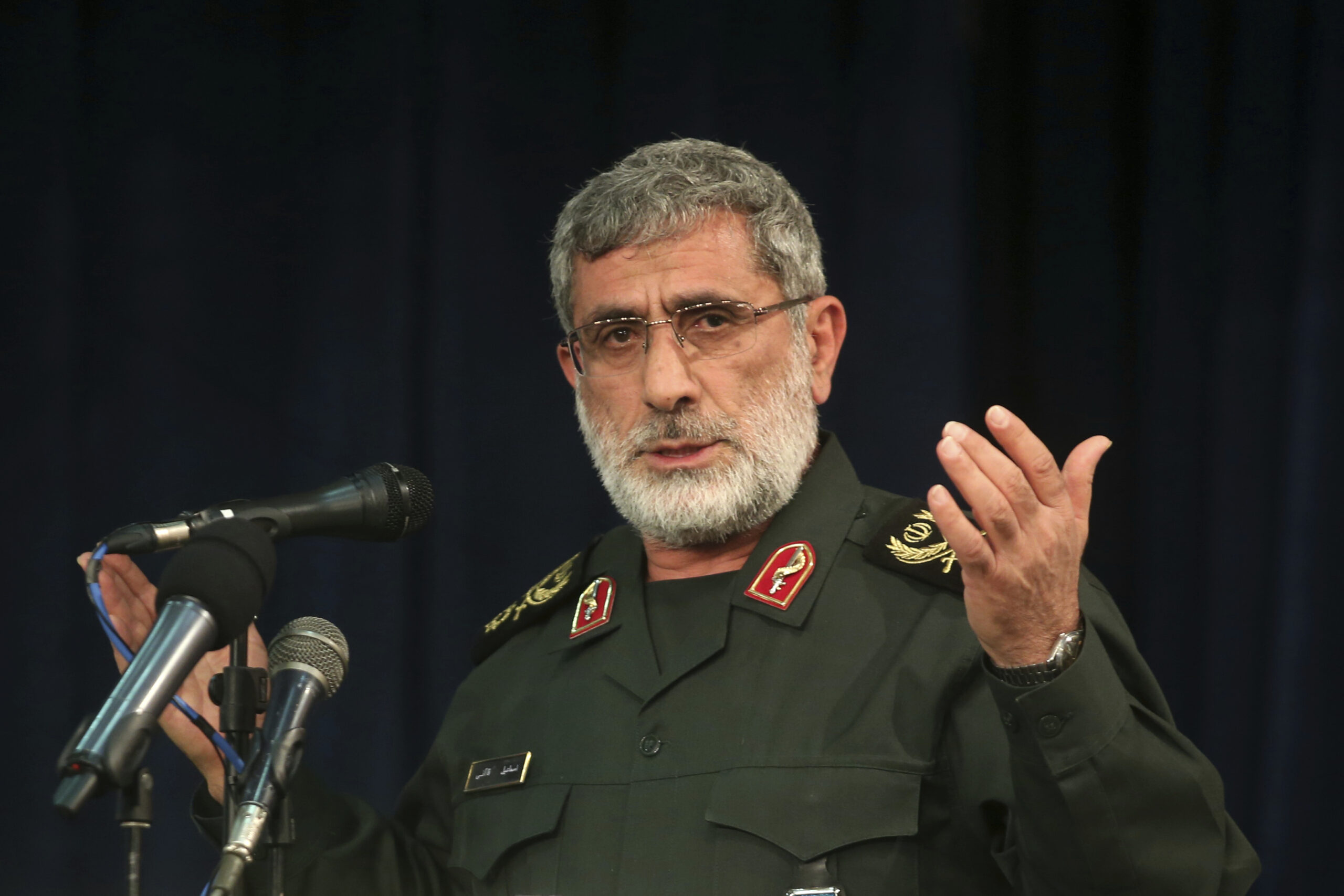
In this Nov. 5, 2016 photo, Brigadier General Ismail Qaani speaks in a meeting in Tehran, Iran. (Mohammad Ali Marizad/Tasnim News Agency via AP)
Iran praised Hamas’ October 7 attack in southern Israel but denied involvement in the attack, and the United States and Israel to a degree denied – or failed to acknowledge – direct Iranian involvement. Regardless of the political expediency guiding the statements from the three capitals, the travels reported by Iran’s state-censored media of Brigadier General Ismail Qaani, commander of the expeditionary Quds Force of the Islamic Revolutionary Guard Corps, show minor anomalies concerning Palestinian affairs. While this doesn’t offer “smoking gun” evidence of direct Quds Force involvement in the Hamas attack, it does provide an overview of Qaani’s functions and perhaps priorities since he was appointed Quds Force chief January 3, 2020.
In a search for “Qaani” and “Quds Force” in varying transliterations in online Persian and English sources, including Google search, BBC Monitoring Middle East, and the Noor Mags database, there were 138 reports on Qaani’s location from January 3, 2020 to October 3, 2023.
Judging from these reports, Qaani spent most of his time in Iran (94 reports), followed by Iraq (32 reports), Syria (10 reports), and Lebanon (two reports). Translated into individual visits, Qaani has reportedly made 26 visits abroad since January 2020 – 18 to Iraq, six to Syria, and two to Lebanon.
There is nothing unusual in media coverage of Qaani’s activities within Iran. Of the 94 reports covering Qaani’s activities in Iran, 53 were about his attendance at funeral or commemoration services of Quds Force personnel and their families. Qaani likely perceives public support as critical for the Quds Force’s recruitment and devotes considerable time to paying his respects to fallen soldiers and their families. Twenty-three reports concerned his public functions in the company of high-ranking government officials, briefing official bodies, such as the Parliament or Assembly of Experts, and attending Supreme Leader Ayatollah Ali Khamenei’s addresses. This is also not surprising because Qaani, like his predecessors, is working to shape policymaking in competition with other parts of the government bureaucracy. Six reports were on Qaani’s meetings with members of the Shia clergy in Iran, which may serve purposes ranging from securing religious legitimacy for Quds Force operations to recruitment of foreign students attending theological seminaries in Iran. The remaining reports for Iran cover Qaani’s public speeches, addresses to assemblies of IRGC cadres, and visits with members of the Afghan Fatemiyoun Division, a Shia militia, and their relatives. These visits were held at bases near the city of Mashhad (and in Syria), likely due to Qaani’s inability to visit Afghanistan.
Reports on Qaani’s foreign visits are largely in line with what can be expected of a Quds Force chief and with English-language coverage of Iran’s regional activities. But there also seems to be a minor anomaly concerning Palestinian affairs.
On 18 occasions, Qaani’s visited neighboring Iraq. The January 3, 2020 assassination of Quds Force chief Major General Qassim Suleimani had little impact on the highly institutionalized Quds Force. Leadership succession was uncontested, and while the Quds Force is perhaps different in style under Qaani, it is just as effective as under Suleimani. The killing of Abu Mahdi al-Muhandis, the deputy commander of the Popular Mobilization Forces, an array of Iraqi militias that contains pro-Iranian forces, in the same attack threw the PMF into a state of chaos from which the less institutionalized organization has not recovered.
In the immediate aftermath of his appointment, Qaani, likely fearing the assassination of Suleimani was intended to provoke a war with Iran, devoted significant effort to quiet diplomacy focused on the United States and reportedly instructed Shia militias not to give the United States or Israel any justification to start a war. At times, Shia Iraqi militias attacked U.S. targets in Iraq, but in his meetings with Iraqi government officials, Qaani reportedly dismissed suggestions that the attacks were ordered by Iran.
As Quds Force chief, Qaani has also engaged in lengthy negotiations to bring about an Iraqi Cabinet composition acceptable to Tehran. This contributed to Iraqi society turning against Iran, which came to be perceived as a destabilizing factor in Iraqi politics. Separately, the presence of armed Iranian Kurdish opposition fighters in Iraq’s Kurdistan region and Israel’s reported use of Iraqi air space to attack targets in Iran have demanded Qaani’s attention. But there was also one anomaly in Qaani’s visits to Iraq: During his September 5-13 visit, his latest, he was scheduled to meet Iraqi and Palestinian representatives. This is the only public reference to Qaani’s in-person meetings with Palestinian representatives anywhere and represents an anomaly.
Qaani’s six visits to Syria were also largely within the range of what can be expected from a Quds Force chief. By 2020, the regime of Syrian President Bashar al-Assad was stabilized, and the objective of the Quds Force’s military intervention in Syria changed from stabilizing the Baath regime and securing an overland corridor connecting Iran, Iraq, and Syria to Lebanon to building a dormant front against Israel on the Syria-Israel border. Israel systematically bombarded Iranian and allied positions in Syria, at times imposing losses on Iran, but the Quds Force has dug in. During his visits, Qaani reportedly inspected Quds Force and allied forces as well as the Iraq-Syria border.
Remarkably, since taking over the Quds Force, Qaani has only visited Lebanese Hezbollah’s territory twice. During his December 1, 2020 visit to Lebanon, Qaani allegedly instructed the Hezbollah leadership to avoid provoking Israel following an assassination of an Iranian nuclear scientist Israel is believed to have been behind. Qaani’s last visit to Lebanon reportedly took place in April and served the opposite purpose of coordinating an April 6 missile attack against Israel.
There is no publicly available evidence of Quds Force involvement in the ongoing Israel-Hamas conflict, just a couple of minor anomalies. This is in stark contrast to Qaani’s recent public speeches and correspondence, which all include the word “Palestine.” However, tracking Qaani’s movements offers insights into the public functions of the Quds Force, perhaps revealing adjustments in its general focus over time.
The views represented herein are the author's or speaker's own and do not necessarily reflect the views of AGSI, its staff, or its board of directors.
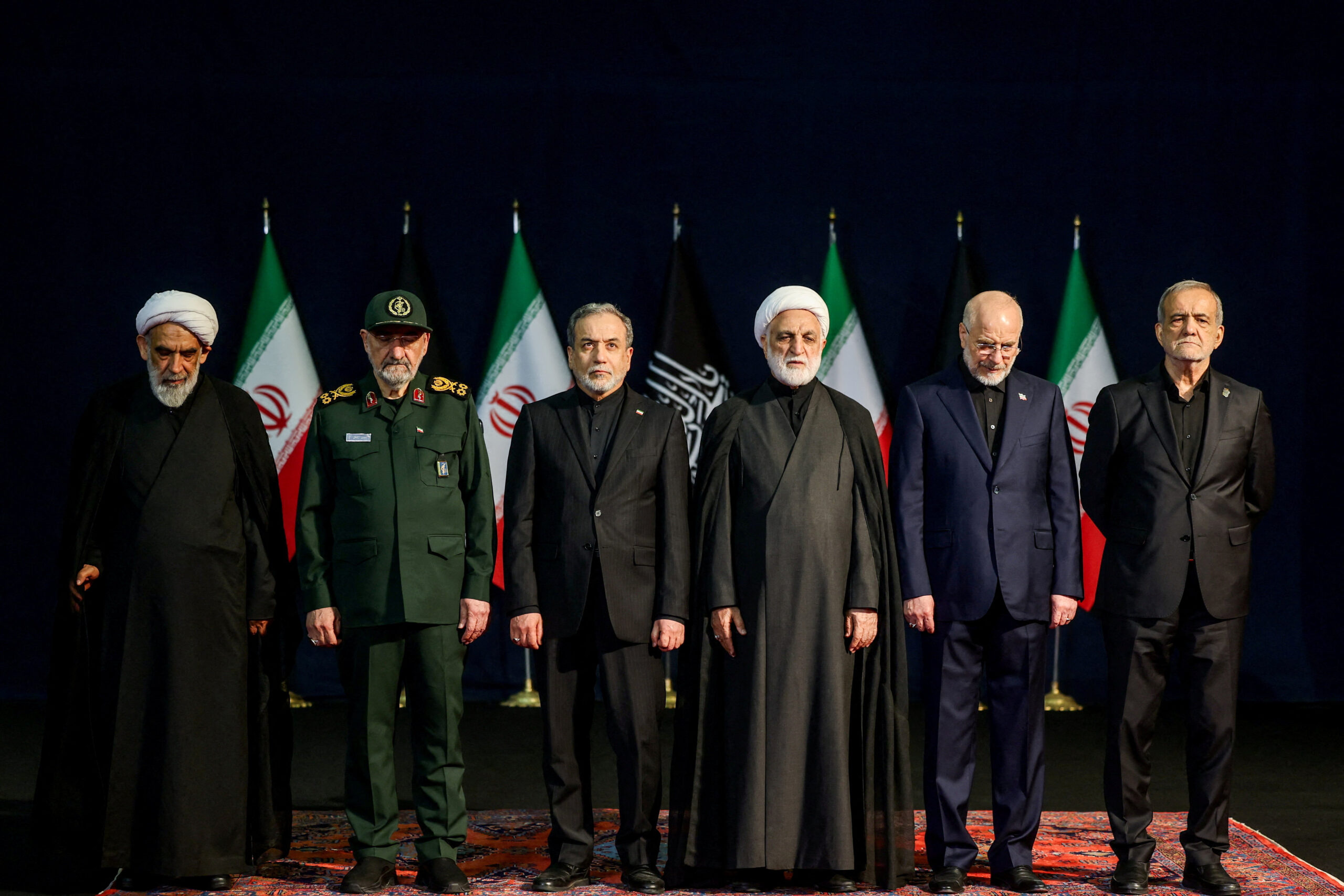
After U.S.-Israeli strikes killed Supreme Leader Ayatollah Ali Khamenei on February 28, Iran’s collective leadership has concluded that the best defense is a good offense.
Wartime pressure has temporarily aligned the leadership’s overriding interest in regime survival, even as its members continue to differ over the costs, methods, and ultimate objectives of the war.
While there is historical precedent for collective leadership in Iran, today’s leadership includes representatives of the IRGC and regular military – a reflection of the IRGC’s expanding role and the necessities of governing under wartime conditions.