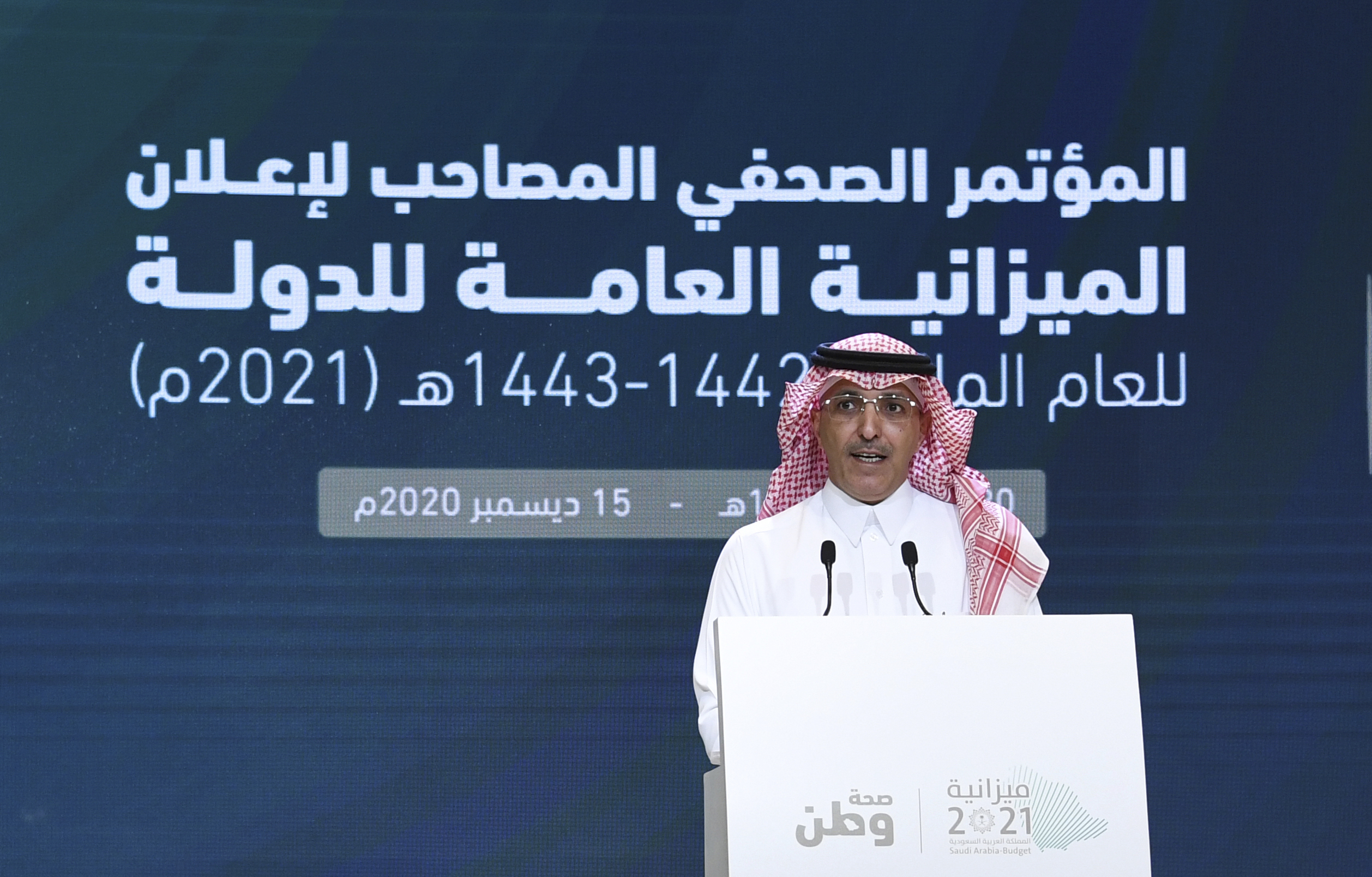
Saudi Finance Minister Mohammed al-Jadaan speaks during a press conference to announce Saudi Arabia's annual budget, Riyadh, Saudi Arabia, Dec. 15, 2020. (Saudi Press Agency via AP)
Over the past decade, government spending in Gulf Arab states has grown steadily despite periods of fiscal consolidation. Growing populations, large public sectors, ambitious development initiatives, and high-profile events demand significant expenditures. Yet the fallout from the coronavirus pandemic and oil price rout of 2020 appears to have ushered in a new fiscal trend: lower spending and persistent deficits.
Smaller 2021 budgets and conservative oil price assumptions – around $40 to $50 per barrel – reveal a partial budgetary realignment with economic realities. This cautious approach may permit Gulf governments’ balance sheets to end the year slightly better than expected, given that many oil market watchers have increased their 2021 price forecasts to between $50 and $60/bbl. However, a willingness to post large deficits and the emergence of coronavirus variants, threatening to extend the pandemic, will add more pressure to mounting economic challenges in Gulf Arab states.
Saudi Arabia’s $263.9 billion budget for 2021 is about 7% less than estimated spending for 2020. The expected 2020 deficit was $79.4 billion, about 12% of gross domestic product. Saudi officials hope that the deficit for 2021 will drop to around 5% of GDP. At $37.6 billion, this deficit expectation roughly equates to the $40 billion that the Public Investment Fund plans to inject into the country’s economy this year. The International Monetary Fund estimates Saudi Arabia’s fiscal break-even oil price to be approximately $68/bbl – not far off from bullish oil price forecasts.
Over the past couple of years, Saudi Arabia has taken a number of steps to increase non-oil revenue streams by imposing new taxes and fees alongside spending cuts. But the flip side of rolling out new revenue-generating mechanisms and fiscal consolidation is dampened investor demand. The kingdom has struggled to boost declining or low levels of foreign direct investment flows since 2008. A drop in spending is not music to investors’ ears. However, Saudi officials are aggressively promoting a number of high-profile investment initiatives from the country’s Red Sea coast to Riyadh. Policymakers are also slow-dripping plans for 20 new economic zones with investor-friendly regulatory environments.
Bahrain’s fiscal balance program resulted in a drop in spending in 2019 and 2020. The country’s draft budgets for 2021 and 2022 reflect minimal movement on the expenditure front, beyond a slight decrease in spending from $8.74 billion to $8.54 billion. Deficits will stay high after Bahrain’s fiscal deficit soared to an estimated $4.4 billion in 2020 – equating to around 14% of GDP. Based on an assumption of oil prices averaging $45/bbl, the country’s officials envisage deficits of $3.4 billion in 2021 and $3 billion in 2022. Bahrain may require additional financial support commitments from its Gulf neighbors for 2023 onward, according to Fitch Ratings.
After posting a roughly balanced budget in 2020, Qatar announced a 2021 budget of $53.5 billion. This allocation involves a 7.5% drop in spending, a $9.5 billion deficit, and relatively conservative average oil price of $40/bbl. The country is likely to keep posting deficits through 2024, when expanded gas output should help boost revenue. Yet negative turns in the global gas market over the coming years may add pressure to the Qatari government’s external debt burden, which reached $62.9 billion in 2020, up from $20.2 billion in 2015, according to the Ministry of Finance.
Oman also bears a heavy debt burden but possesses a shallow well of financial resources to meet its various obligations. For the 2021 budget, the country slashed expenditures by 14% compared to 2020 and has factored in an oil price assumption of $45/bbl. Even with these measures, Omani officials are anticipating a $5.7 billion deficit in 2021, which reflects about 8% of GDP. Oman’s medium-term fiscal plan aims for a steady reduction in the deficit – down to 1.7% of GDP in 2024 – and boosting non-oil revenue. However, there are concerns about the sultanate’s ability to meet these deficit and revenue targets.
The United Arab Emirates’ federal budget provides some insight into the fiscal dynamics playing out within individual emirates. The UAE’s 2021 federal budget declined 5% from 2020’s, which was the largest budget allocated since the country’s establishment. The size of Dubai’s 2021 budget is 14% below the emirate’s 2020 budget announced in December 2019, prior to adjustments related to the coronavirus pandemic and oil price rout. The ruler of Sharjah, however, approved the emirate’s largest ever budget – a 12% increase from the 2020 budget.
Kuwait also increased spending by about 7% for its 2021 fiscal year beginning in April. Kuwaiti officials are basing calculations on $45/bbl oil prices: It would take prices of about $90 to balance the budget. A shortfall of about $40 billion is projected, and the government has halted automatic annual transfers to the Future Generations Fund, a sovereign wealth fund. Instead, the government has been transferring performing assets, those with regular cash flows, to the Future Generations Fund in return for cash needed to meet monthly budget deficits. Without progress on a new debt plan, the country has limited options to meet its financing needs over the next year.
The overall size of Gulf budgets and their responsiveness – or lack thereof – to prevailing economic realities are only part of the problem. Another major obstacle involves the distorted nature of Gulf budgets. The oil and gas sector accounts for 70% or more of total government revenue in most Gulf states. Meanwhile, wages and subsidies often constitute a majority of government expenditures. These budgetary components are difficult to reform. Qatar – one of the better-placed countries to undertake fiscal adjustments – only managed to decrease allocations for salaries and wages by 1.9% from 2020 to 2021.
The durability of these revenue and expenditure structures has been impressive but ultimately will become unsustainable. Until deeper changes are made to the structural composition of budgets and non-oil revenue-generating mechanisms become institutionalized, minor adjustments on the margins of fiscal policy will have little overall impact on the ability of Gulf governments to successfully meet the challenges of today and those of tomorrow.
The views represented herein are the author's or speaker's own and do not necessarily reflect the views of AGSI, its staff, or its board of directors.
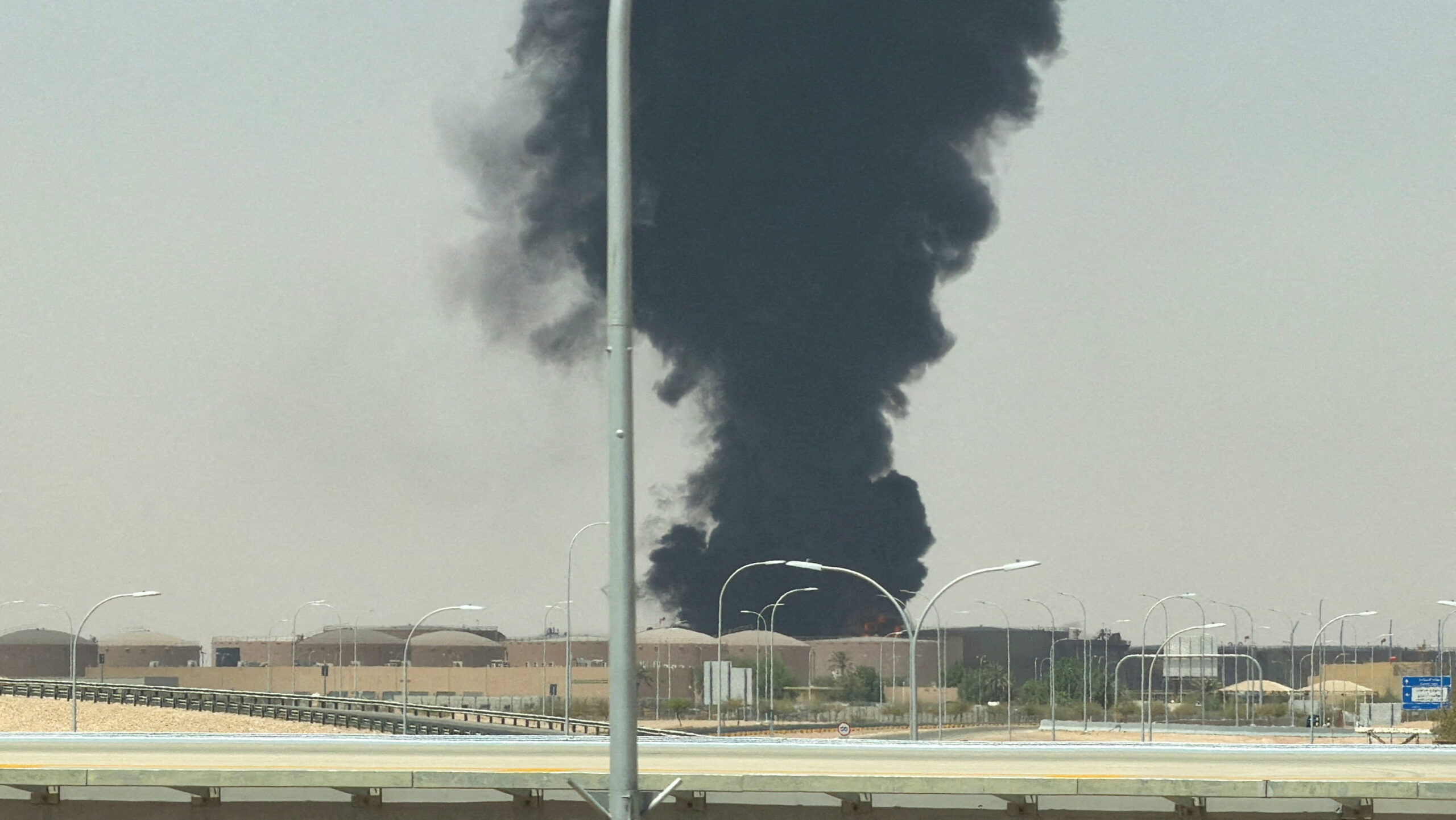
Attacks on the East-West oil pipeline and other targets in Saudi Arabia will result in a larger-than-expected economic contraction in the kingdom this year.
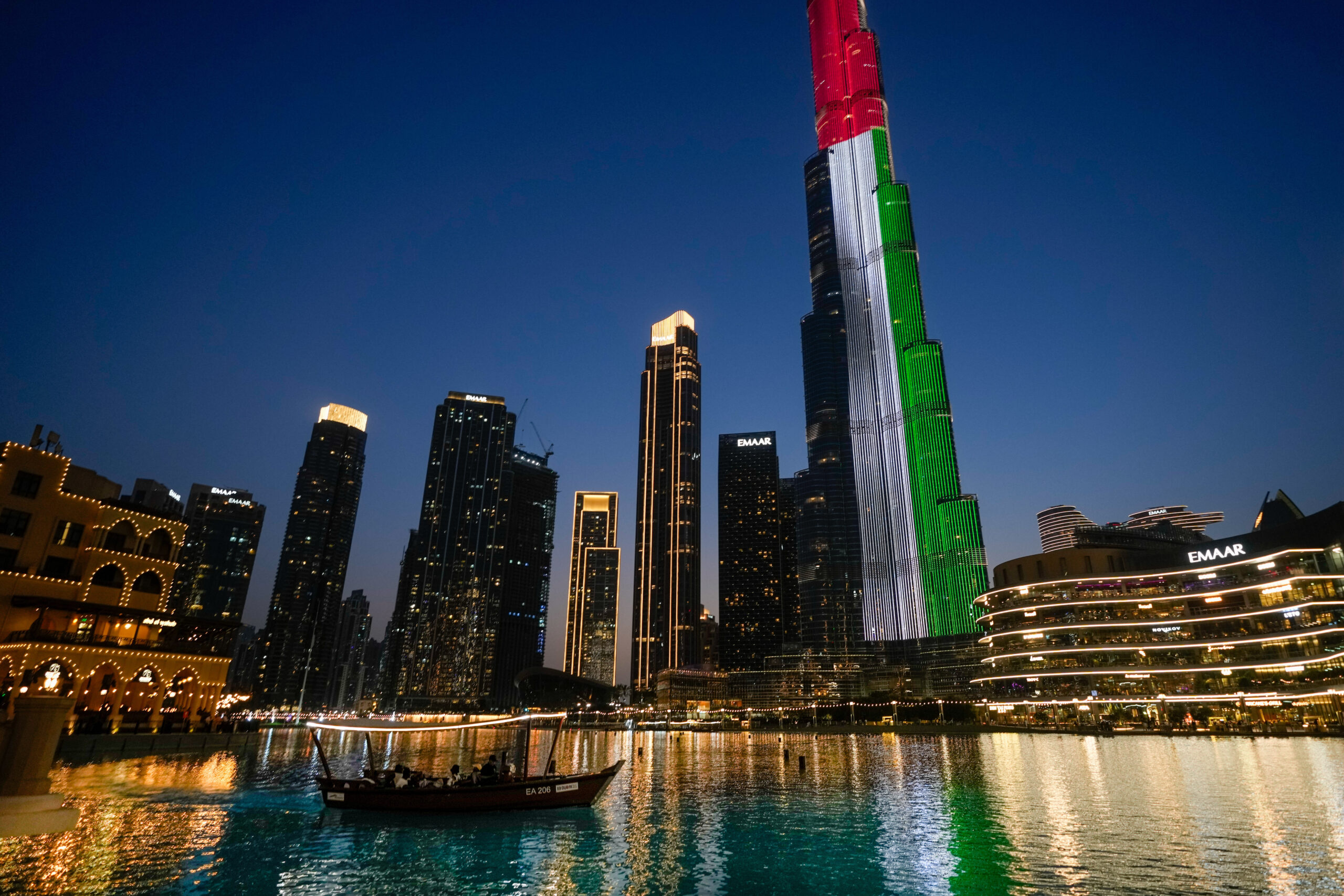
The UAE’s decision to halt trade and commercial ties with Iran reflects an exercise in applying carefully calibrated geoeconomic pressure amid an uncertain and evolving geopolitical context.
How the Gulf states choose to invest now could determine not just how they survive this crisis but how they sustain their role as both allocators and magnets of capital and superpowers in the global energy system.
The UAE’s decision to halt trade and commercial ties with Iran reflects an exercise in applying carefully calibrated geoeconomic pressure amid an uncertain and evolving geopolitical context.
France is positioning to be a more influential actor across the Middle East, but the European powerhouse is most likely to see immediate traction on the economic tracks that run to and from the Gulf.