Low-Cost Barrels Lure Oil Majors Back to the Middle East
From the Gulf to the eastern Mediterranean and North Africa, governments are recalibrating fiscal terms, monetization strategies, and partnership models to attract international players.
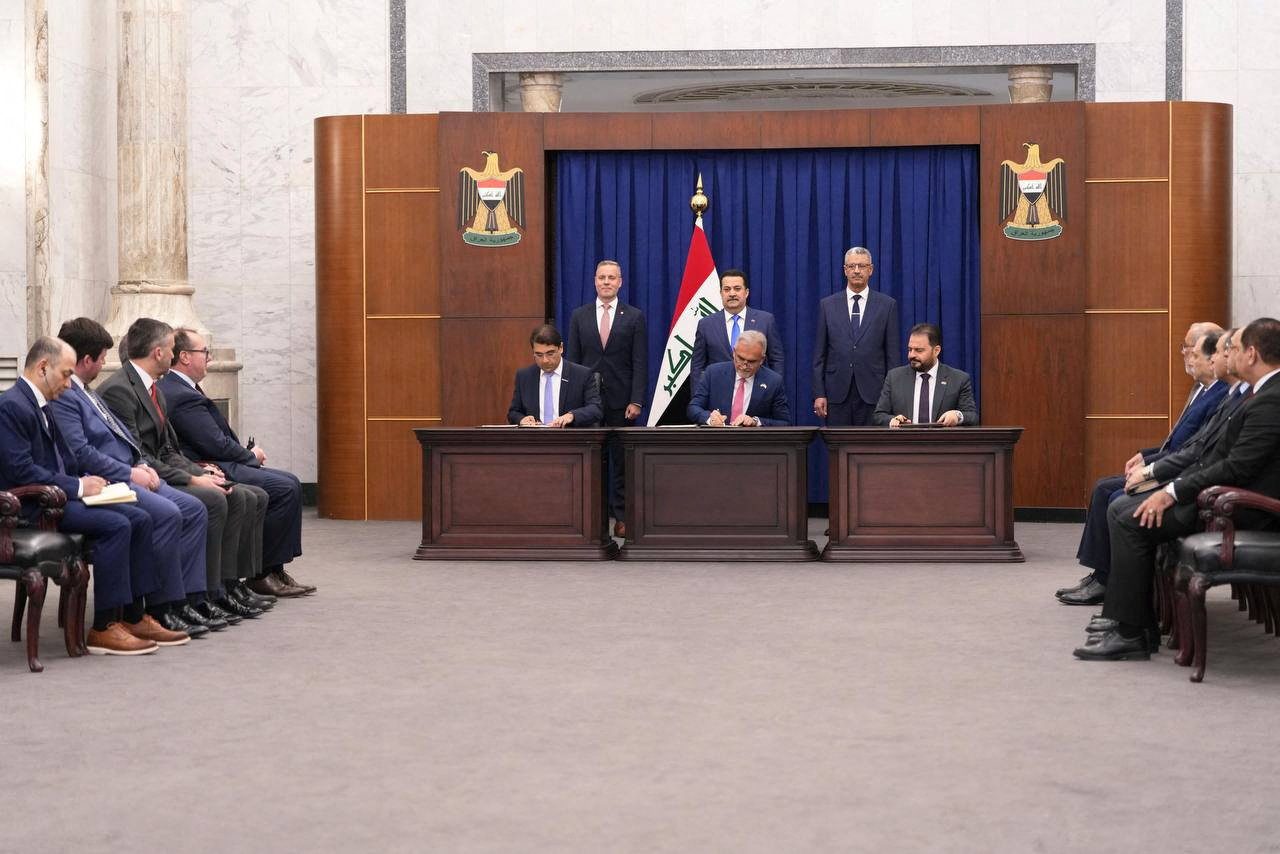
Iraqi Prime Minister Mohammed al-Sudani attends a signing ceremony for a preliminary agreement between Iraq's Oil Ministry and ExxonMobil to develop the Majnoon oil field, in Baghdad, Iraq, October 8, 2025. (Iraqi Prime Minister’s Media Office/Handout via REUTERS)
Kuwait’s long-anticipated reopening to international oil companies marks a clear shift in strategy that has U.S. and multinational energy firms once again gravitating toward the Middle East’s low-cost resource base. After years of political resistance and uncompetitive contract structures, Kuwait is now actively courting foreign capital and expertise as it seeks to lift crude capacity to 4 million barrels per day by 2035.
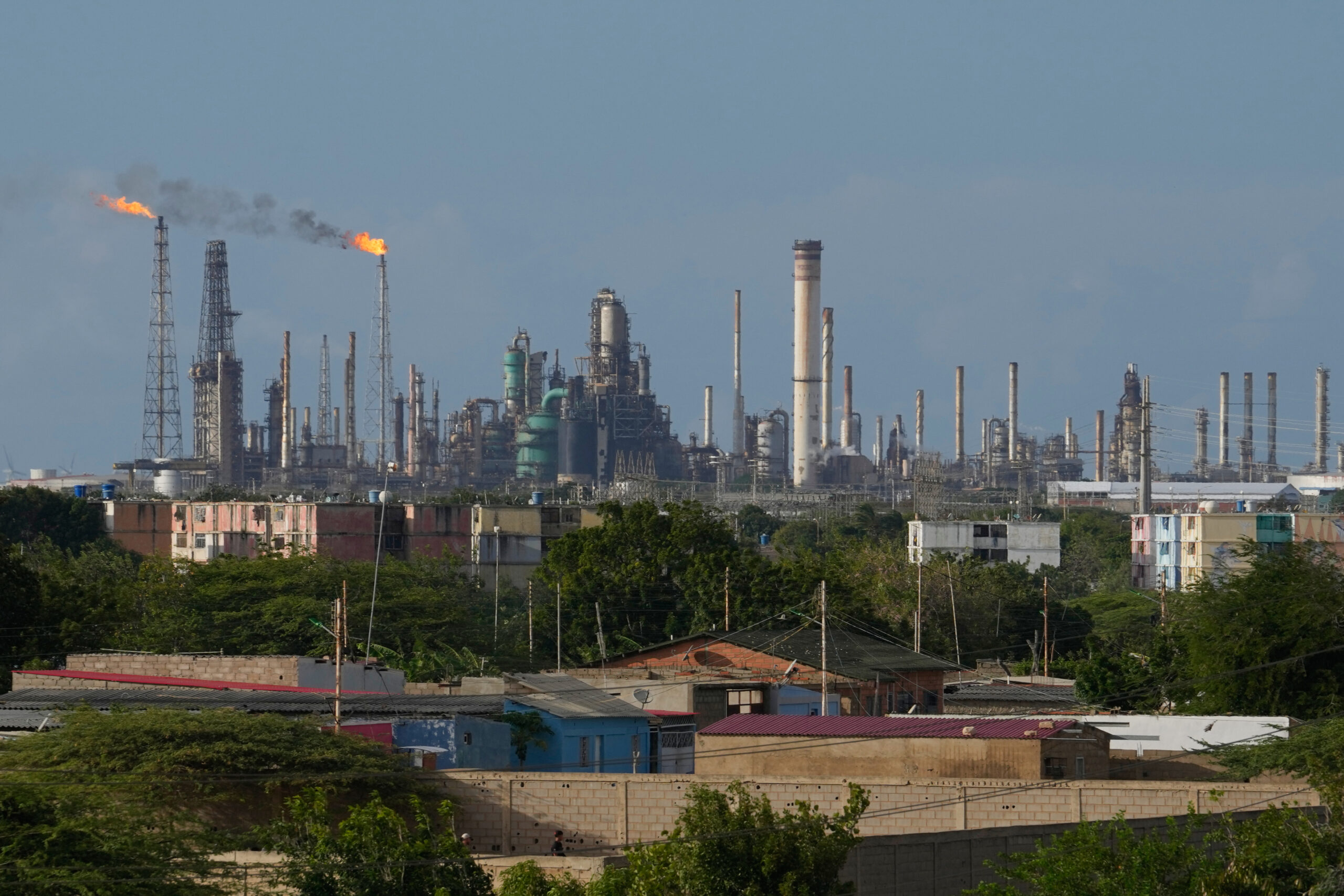
The shift reflects a broader regional trend. From the Gulf to the eastern Mediterranean and North Africa, governments are recalibrating fiscal terms, monetization strategies, and partnership models to attract international players. In parallel, the national oil companies themselves – led by QatarEnergy, the United Arab Emirates’ ADNOC, and Saudi Aramco – are expanding outward, leveraging partnerships with the majors not only within the region but globally. The result is a renewed two-way flow of capital and cooperation that is reshaping the Middle East’s energy investment landscape.
Kuwait Signals Turning Point
Kuwait has historically been one of the most difficult Gulf producers for international oil companies to access, constrained by constitutional limits and domestic political opposition. That stance is now softening.
Officials used February’s Kuwait Oil & Gas Show to underline the government’s commitment to attracting foreign investment, with Prime Minister Ahmed al-Abdullah al-Sabah pledging regulatory reforms to make the country a more competitive energy hub.
At the center of the push is a new upstream contract model being developed by Kuwait Petroleum Corporation. While details remain under wraps, the framework is intended to comply with constitutional constraints while offering more attractive commercial terms than the enhanced technical service agreements that previously failed to excite the majors.
Early signs of interest are emerging. KPC’s upstream arm, Kuwait Oil Company, signed a memorandum of understanding with TotalEnergies covering studies for potential exploration opportunities – the first such engagement in roughly a decade and a clear indicator of direction of travel.
Kuwait’s resource base remains compelling: 101.5 billion barrels of oil and 62.8 trillion cubic feet of gas. The issue has never been geology but commercial access. With capacity currently around 3.2 mb/d and a target of 4 mb/d by 2035, Kuwait needs outside capital and technology to bridge the gap.
The country is also studying midstream monetization through its Shaheen pipeline initiative, modeled on Aramco and ADNOC lease-and-leaseback structures. If executed, the scheme could raise up to $7 billion to fund upstream growth.
Taken together, the moves suggest Kuwait is finally aligning with regional peers in opening selectively to international investment.
Chevron Deepens Middle East Med Focus
Among U.S. majors, Chevron is emerging as one of the most active players positioning for the region’s next phase. Chevron CEO Mike Wirth has acknowledged the company has historically been “underweight” in the Middle East due to unattractive terms, but he noted that fiscal reforms in countries including Libya, Iraq, and Algeria are changing the calculus.
Chevron already holds a unique foothold in the Saudi-Kuwaiti Partitioned Neutral Zone, where production is recovering. Net output rose to around 65,000 b/d in 2025, the fastest growth since operations resumed in 2020, with further gains expected as drilling accelerates.
But the company’s most strategic regional position lies in the eastern Mediterranean, where it is the leading operator in Israel’s offshore gas sector. The U.S. major continues to expand capacity at the Tamar gas field while advancing major growth plans at Leviathan. It also operates the Aphrodite gas field offshore Cyprus with plans to tie output to Egypt’s liquefied natural gas terminals on the Mediterranean.
Chevron is also exploring new frontiers. It has signed a memorandum of understanding with Syria’s state oil firm to examine offshore gas potential, a move that could extend its eastern Mediterranean gas chain if political conditions stabilize. While still not a firm commitment, the agreement highlights the company’s willingness to reengage across the broader Levant basin.
In Iraq, Chevron has signed a preliminary agreement to replace Lukoil at the giant West Qurna-2 field and further develop the Nasiriya oil field, both in southern Iraq. Whether the deal moves forward depends on whether Baghdad is willing to amend legacy contract terms that do not offer attractive returns. Even so, the level of engagement underscores renewed international oil company appetite for large Middle East resource plays – provided fiscal terms are workable.
Iraq is hoping to lure international oil companies back to its upstream sector, having seen Shell, Occidental Petroleum, and ExxonMobil leave the country because of low returns under the existing technical services contracts that were offered to foreign investors in the first and second bidding rounds of 2009-10.
Now, ExxonMobil is negotiating a return to Iraq barely two years after it exited as operator of the West Qurna 1 oil field. It has signed a memorandum of understanding with the Iraqi Oil Ministry to develop the Majnoon oil field, which lies close to the border with Iran and was previously operated by Shell.
Although the technical service contracts remain in force at Iraq’s legacy assets, Baghdad launched its new “profit sharing” development and production contract model in 2018 to address investor concerns. All subsequent upstream awards have used this model.
The contract initially struggled to gain traction, with Iraq hosting lackluster bid rounds that didn’t offer acreage with sufficient resources to attract the majors. This changed in 2021 when Iraq began talks with TotalEnergies over development of the Ratawi oilfield, culminating in the signing of the multifaceted $27 billion Gas Growth Integrated Project in 2023.
In 2025, BP signed up to help further develop the Kirkuk oil field in northern Iraq, the first major oil discovery in the Middle East by a consortium of which BP, in a previous incarnation as Anglo Persian, was involved. The field’s production has been in decline due to a lack of investment and security concerns. Signing on either of the two U.S. heavyweights would be a major boost for Iraq’s upstream sector.
TotalEnergies Expands Its Regional Footprint
If Chevron is rebuilding its position, TotalEnergies is doubling down on an already dominant regional presence. The French major produced a record 681,000 b/d of oil liquids from its assets in the Middle East and North Africa in 2025, cementing its status as the largest international oil company in the region. TotalEnergies CEO Patrick Pouyanné has said that the company’s strategy is to prioritize low-cost barrels and expand into every Middle Eastern market where terms allow. “I have one dream, which is to put TotalEnergies in each of the countries of the Middle East,” he said during a February 11 presentation of the company’s 2025 results.
The approach is bearing fruit. Total holds major positions in Abu Dhabi’s onshore and offshore concessions, was the first international oil company into Qatar’s LNG expansion, and recently secured a landmark extension at Libya’s Waha concession.
The company’s trajectory illustrates the broader international oil company calculation: The Middle East’s low lifting costs, often below $4 per barrel of oil equivalent, remain difficult to match globally.
National Oil Companies Go Global With International Partners
While Western majors are leaning back into the Middle East, the region’s national oil companies are simultaneously pushing outward, often alongside the same international partners.
QatarEnergy is the clearest example. The state giant has rapidly expanded its exploration footprint across the eastern Mediterranean, farming into multiple Egyptian offshore blocks alongside ExxonMobil, Eni, Shell, and Chevron.
The strategy extends well beyond the region. In Guyana, QatarEnergy has taken a 35% stake in the offshore Block S4 alongside operator TotalEnergies and Petronas, continuing a pattern of global portfolio building. The move follows earlier, ultimately unsuccessful positions in the Orinduik and Kanuku blocks but demonstrates Doha’s determination to secure a long-term international upstream presence.
KPC’s overseas arm, Kuwait Foreign Exploration Company, which already has assets on five continents, has expanded further, recently acquiring a 20% stake in Shell’s Orca and Sul de Orca development in Brazil’s Santos Basin.
These partnerships reflect a structural shift. Gulf national oil companies are no longer purely domestic resource holders; they are becoming globally integrated investors, often leveraging relationships built in the Middle East to access opportunities abroad.
Syria Tests International Oil Company Appetite
Syria represents the frontier edge of this trend as it seeks to repair an economy ravaged by more than a decade of a brutal civil war. Washington’s support for Syrian President Ahmed al-Sharaa has encouraged U.S. energy companies to explore potential reentry into the country.
Damascus has signed a string of agreements with foreign firms – including Chevron, ConocoPhillips, and UAE-based Dana Gas – as it seeks to rebuild a devastated energy sector and close a severe gas supply gap. The government is also preparing to offer five offshore blocks, potentially opening a new exploration province in the Levant basin. But significant hurdles remain: Sanctions exposure, modest resource scale, and lingering political risk may limit major commitments by international oil companies.
Libya Reemerges
Libya is another market benefiting from the regionwide recalibration of fiscal terms. The country’s revamped contract framework and improving security environment have revived international oil company interest. TotalEnergies has already locked in the Waha extension, and both Chevron and ExxonMobil have been exploring new opportunities in the North African country even as it remains divided and politically unstable.
But from an upstream perspective, Libya’s appeal lies in large, underdeveloped reserves combined with relatively low development costs. Output reached a 13-year high of 1.37 mb/d in 2025, and officials believe significant upside remains.
For the majors, Libya offers one of the few remaining opportunities globally to add meaningful conventional volumes at competitive cost – assuming the current status quo holds.
Gulf Money Flows into U.S. LNG
The investment relationship is increasingly two way. Gulf producers are not only attracting Western capital but also deploying their own financial firepower into international energy infrastructure.
Both the UAE and Saudi Arabia have taken stakes in U.S. LNG export projects, reflecting a broader strategy of securing downstream market access while diversifying revenue streams. QatarEnergy has followed a similar path through its extensive LNG partnerships with international majors.
These moves reinforce the deepening interdependence between Middle Eastern national oil companies and global energy markets. The region is no longer simply a supplier of upstream resources; it is becoming a major capital provider across the energy value chain.
The Structural Drivers
Several forces are underpinning the renewed international oil company migration toward the Middle East. After years of underinvestment in the upstream sector, the multinationals are being forced to realign portfolios to offset natural decline and rebuild their reserve base. The Middle East’s low-cost resource base provides a pathway to rebalance their portfolios.
Improved contract terms provide an added incentive as countries from Iraq to Libya to Kuwait are adjusting fiscal frameworks to compete for capital. With cost discipline back in focus and upstream portfolios under pressure, the majors are prioritizing low breakeven barrels – the Middle East’s core competitive advantage.
The Middle East’s vast resource base is another draw, providing some of the world’s largest undeveloped conventional oil and gas reserves and vast tracts of unexplored or underexplored acreage in countries such as Libya and Iraq.
At the same time, the national oil companies are becoming more commercially sophisticated partners, offering integrated opportunities spanning upstream, LNG, and international ventures.
Outlook: A New Cycle Taking Shape
The emerging pattern suggests the Middle East is entering a new investment cycle – one characterized less by simple concession access and more by complex, multidirectional partnerships between national and international oil companies.
Kuwait’s tentative opening may prove particularly significant. If the country succeeds in designing a constitutionally compliant but commercially attractive contract model, it could unlock one of the last largely closed Gulf upstream provinces.
Chevron’s expanding eastern Mediterranean footprint, TotalEnergies’ regional push, and QatarEnergy’s global reach all point in the same direction: The majors and the Middle East’s national oil companies are today more partners than rivals.
For international companies, the prize remains unchanged – vast, low-cost reserves capable of anchoring portfolios for decades. For regional producers, the calculus is equally clear: The international oil companies bring with them technology, capital, and market access.
All these factors are contributing to the shift in the center of gravity in global upstream investment back to the Middle East.
The views represented herein are the author's or speaker's own and do not necessarily reflect the views of AGSI, its staff, or its board of directors.
A founding member of OPEC is now effectively under external control, raising questions about sovereignty, influence, and the resilience of producer-led market management.
The International Energy Agency sees demand increasing as rising living standards in developing countries and geopolitical anxieties push policymakers to favor energy affordability and reliability over aggressive decarbonization.
There was a growing war risk premium in the oil markets tied to escalating regional tensions; the shift from shadow confrontation to direct military action changes the calculus.
A founding member of OPEC is now effectively under external control, raising questions about sovereignty, influence, and the resilience of producer-led market management.
The International Energy Agency sees demand increasing as rising living standards in developing countries and geopolitical anxieties push policymakers to favor energy affordability and reliability over aggressive decarbonization.