Emerging Technologies and U.S. Military Power in the Gulf
U.S. force projection in the Gulf is increasingly relying on artificial intelligence, unmanned platforms, and space technology, using these systems to augment existing military infrastructure.
On July 28, U.S. Central Command and the United Arab Emirates announced an agreement to launch Talon Synapse, the first bilateral task force dedicated to expediting the integration of military artificial intelligence applications into operational planning and execution. The initiative is the latest milestone in CENTCOM’s expanding adoption of AI-enabled and unmanned capabilities, including Task Force 59’s pioneering use of unmanned systems in rescue and combat operations and Space Force’s growing contributions to Operation Epic Fury.
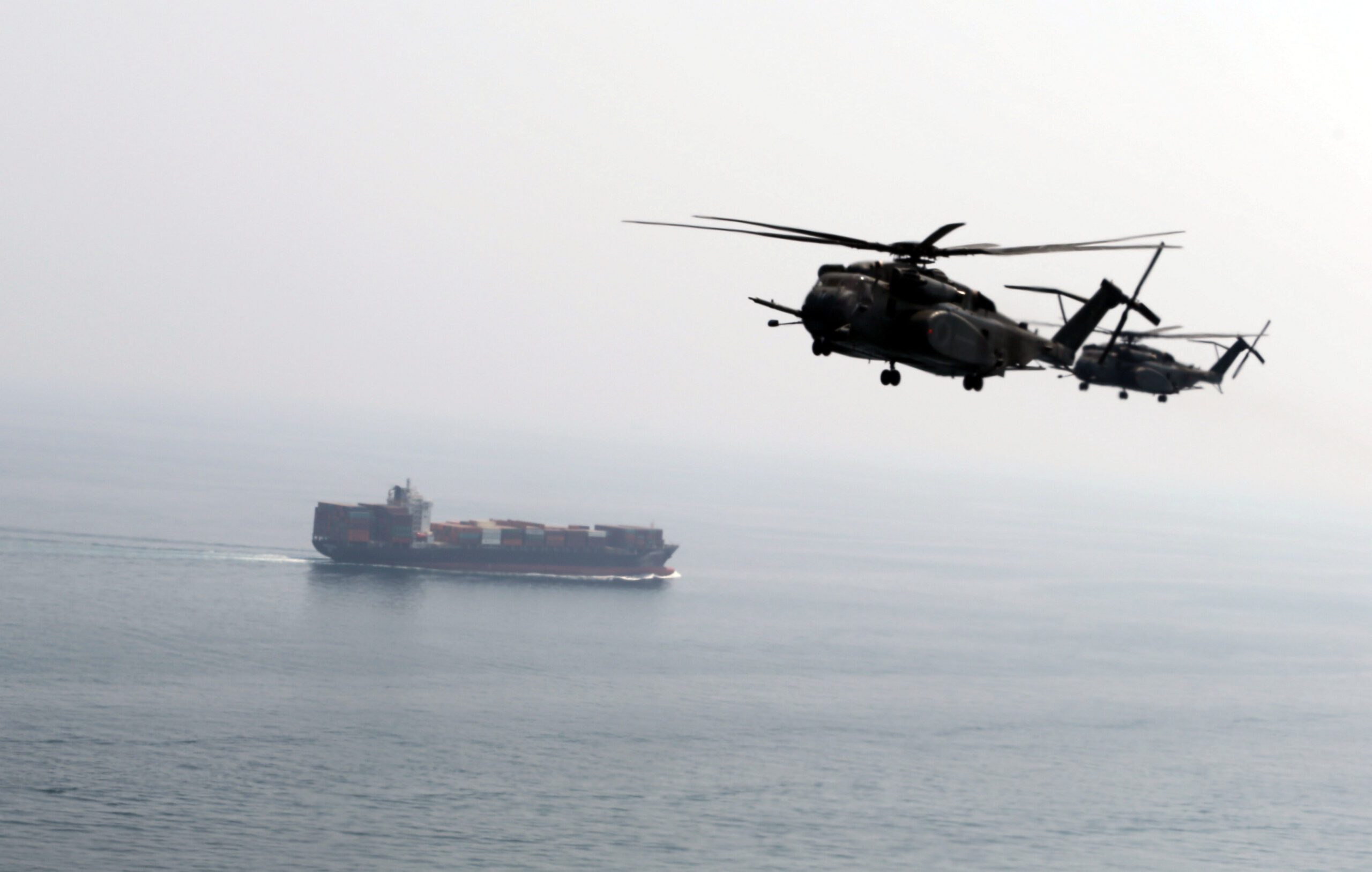
The ongoing conflict with Iran, and the subsequent blockade of the Strait of Hormuz, underscores the U.S. power projection’s heavy reliance on manned platforms. Yet, the increasing integration of advanced technologies into military operations is part of Washington’s hybrid approach using these tools to augment, rather than replace, conventional military power.
AI
Launched in late August, Talon Synapse is headquartered in Abu Dhabi and staffed by approximately 20 U.S. and Emirati specialists in AI, data, and cybersecurity. According to CENTCOM commander Vice Admiral Brad Cooper, the task force is designed to “rapidly deliver evolving AI advancements to our warfighters.” Its initial priorities include integrating AI-enabled applications into intelligence support, critical infrastructure protection, and regional security monitoring.
Although the agreement establishing Talon Synapse was finalized in June, its origins can be traced to Cooper’s first official visit to the UAE as CENTCOM commander in September 2025, when he met with the UAE’s national security advisor, Tahnoun bin Zayed al-Nahyan, and armed forces chief of staff, Lieutenant General Issa Saif al-Mazrouei. The partnership is the product of a broader strategic convergence that has steadily expanded beyond commercial technology into defense cooperation. AI-driven defense cooperation also featured prominently during Tahnoun’s official visit to Washington in March 2025. While the trip was widely noted for its massive investment commitments, it also carried a significant security dimension, reflected in meetings with then-National Security Advisor Michael Waltz and Central Intelligence Agency Director John Ratcliffe.
The cornerstone of this cooperation is the U.S.-UAE AI Acceleration Partnership. Signed during President Donald J. Trump’s May 2025 visit to Abu Dhabi, the framework institutionalized collaboration on AI development and the protection of critical technologies, including the launch of an Abu Dhabi-based 1 gigawatt AI data center and the establishment of a bilateral working group. The two governments reached a preliminary agreement allowing the UAE to import 500,000 Nvidia Blackwell chips annually between 2025 and 2027. The Department of Commerce authorized the first shipment of 35,000 chips in October 2025.
The engagement has since evolved beyond tech transfers into regulatory and defense coordination. In March, the AI working group held its first interagency meeting on security, governance, and licensing rules for U.S.-origin AI chips. The participation of representatives from the Department of Defense revealed the military track that was developing alongside the broader commercial partnership. This trajectory became even clearer in mid-July, when the Commerce Department’s Bureau of Industry and Security upgraded the UAE’s status under the Export Administration Regulations as a U.S. Major Defense Partner. Among other measures, the decision eased access to commerce-controlled defense technologies, including advanced AI chips and servers.
These developments are mutually reinforcing, aligning Washington’s AI strategy with its military operational requirements in the Gulf. At the strategic level, “America’s AI Action Plan” identifies the integration of AI into warfighting and back-office functions, alongside closer cooperation with partners on export controls, as critical pillars for maintaining the United States’ technological edge.
At the operational level, Operation Epic Fury has offered an early demonstration of this approach. CENTCOM is employing a growing suite of AI-enabled tools to fuse multiple intelligence streams to accelerate large-scale targeting and improve battlefield situational awareness. Cooper noted that these systems enable operators to “sift through vast amounts of data in seconds,” allowing commanders to “cut through the noise and make smarter decisions faster than the enemy can react.”
Unmanned
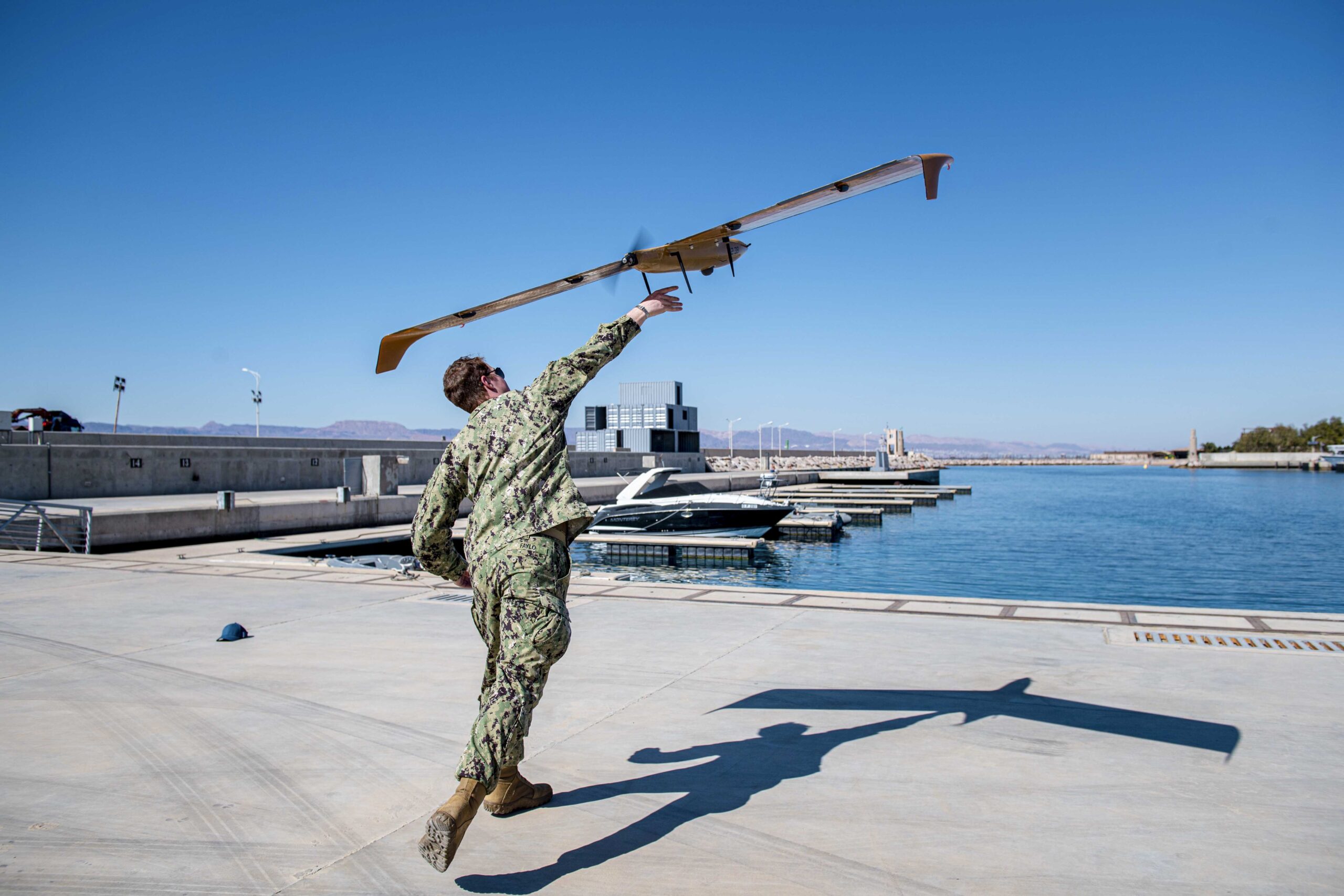
Launched in 2021, Task Force 59 has become CENTCOM’s principal vehicle for hastening the integration of AI and unmanned tools into fleet operations. The unit tests, integrates, and fields emerging technologies across the maritime domain.
Operating from hubs in Bahrain and Jordan, Task Force 59 has conducted a series of exercises involving uncrewed air, surface, and underwater vehicles. Their primary role has been to collect real-time data through distributed sensors, improving maritime domain awareness and supporting a more comprehensive operational picture.
Recent operations, however, suggest that the unit is moving beyond experimentation. On June 8, a Corsair unmanned surface vessel operated by Task Force 59 assisted in rescuing two crewmembers from a U.S. Army AH-64 Apache downed off the coast of Oman. The mission was reported as the first personnel recovery by an unmanned surface vessel in U.S. military history.
A month later, CENTCOM employed three Corsair vessels in strikes against Iran’s Bandar Abbas naval base, damaging a submarine and ship maintenance facilities. The operation was the United States’ first reported combat use of one-way attack surface drones.
Manufactured by Texas-based Saronic Technologies, the 24-foot Corsair reflects a new standard of rapid defense procurement. Unveiled in October 2024, it progressed from prototype to serial production in less than a year, culminating in a $392 million production contract for the Navy in late 2025. By May, Saronic had produced its 30th vessel, demonstrating the company’s ability to scale production rapidly.
The acquisition and operational employment of the Corsair illustrate how CENTCOM is expanding the role of unmanned systems beyond traditional intelligence, surveillance, and reconnaissance missions toward operational tasks that directly reduce risk to personnel. Whether these deployments become routine remains to be seen, but they signal a gradual shift in how uncrewed platforms are being integrated into U.S. military operations in the Gulf, not as substitutes for conventional forces but as force multipliers alongside them.
Space
Less visible than the deployments of uncrewed systems at sea, space capabilities provide the digital backbone that enables many of the AI-based and uncrewed systems increasingly being used by CENTCOM.
The U.S. Space Forces – Central has come to play a growing role in military operations. In Operation Epic Fury, Cooper stressed, “our space superiority has been a key enabler to this fight.” He said Space Force personnel pursued two complementary objectives, degrading Iranian capabilities while helping protect U.S. forces across the theater.
This contribution was also highlighted by Chairman of the Joint Chiefs of Staff General Dan Caine, who described Space Command as among the “first movers” in applying nonkinetic effects to disrupt, degrade, and blind Iran’s ability to see, communicate, and respond.
Although many of Space Forces – Central’s activities remain classified, its conventional missions have included missile warnings as well as navigation and communication support. Its nonkinetic contributions, instead, have likely centered on electronic warfare, including the jamming and spoofing of Iranian satellite communication systems used for command-and-control, targeting, and missile operations.
Established in 2022 as the theater-focused command supporting CENTCOM, Space Forces – Central is headquartered at MacDill Air Force Base in Florida with a forward command post at Al Udeid Air Base in Qatar. Despite a relatively limited contingent comprising about 28 specialists, the command provides sustained space-based capabilities across the region, integrating intelligence, communications, and missile detection into day-to-day operations.
An Integrated Operational Architecture
The significance of Talon Synapse, Task Force 59, and Space Forces – Central lies less in the individual technologies experimented with and the creation of specialized commands than in the emergence of an integrated operational architecture.
Each initiative represents a complementary pillar of a broader transformation in the U.S. military’s operational approach, reflecting the increasing interdependence among technologies across domains. Uncrewed systems generate vast quantities of data; AI significantly accelerates the processing and exploitation of that data; and space capabilities provide the communications and navigation infrastructure that allows both uncrewed systems and AI to function as an integrated system.
Rather than replacing traditional military power, CENTCOM is building a force in which AI-enabled tools, unmanned systems, and space-based capabilities act as power multipliers for conventional platforms. Operation Epic Fury offered an early demonstration of this hybrid operational model and how this digitally enabled force architecture may shape future U.S. military operations in the Gulf and beyond.
The views represented herein are the author's or speaker's own and do not necessarily reflect the views of AGSI, its staff, or its board of directors.
With an aging and largely untested fleet, U.S. mine clearing operations can restore maritime access but only under favorable political and operational conditions.
The convergence of Gulf capital and energy with U.S. technology leadership signals the emergence of a U.S.-Gulf AI axis with global economic and geopolitical implications.
If the U.S. F-35 sale goes through, it will add a new layer to Saudi airpower. But the fifth-generation fighter by itself will not address Saudi Arabia’s present and future vulnerabilities.
With an aging and largely untested fleet, U.S. mine clearing operations can restore maritime access but only under favorable political and operational conditions.
NATO’s Operation Ocean Shield helped secure freedom of navigation in the Red Sea, but diplomatic fractures and naval constraints mean its success is unlikely to be repeated in the Strait of Hormuz.