Sep 24, 2024
Who Was Ibrahim Aqil, the Assassinated Hezbollah Commander?
The September 24 edition of the Iran Media Review highlights biographies and commentary on senior Hezbollah leaders killed in suspected Israeli attacks.

A series of suspected Israeli attacks against Hezbollah have not only rattled the Lebanese militia but also Iran’s state-censored media, which is struggling for words to report the debacle to the Iranian audience. The assassination of Ibrahim Aqil, commander in chief of Hezbollah’s Radwan forces, illustrates the depth of Hezbollah’s, and indirectly Iran’s, problem: Hezbollah is losing senior and seasoned commanders so fast that it may find it difficult to identify qualified replacements.
- September 21: Islamic Revolutionary Guard Corps mouthpiece Mashregh News published a biography of Aqil:
- “Martyr Ibrahim Aqil, a military commander known as Tahsin, who was martyred during the Zionist regime’s attack in the southern Beirut neighborhood of Dahiya, was the chief of the Radwan special operation forces of Lebanese Hezbollah. He was among the most influential military commanders of the Radwan forces and second in importance after Fuad Shukr,” who was killed July 30. “The United States government had put a $7 million bounty for information leading to his assassination or arrest.”
- “His nom de guerre was Tahsin, and he was a prominent Hezbollah member. In the 1980s, he was one of the main elements of the Islamic Jihad Organization, one of the military branches of Hezbollah, which was involved in the bombing of the United States Embassy in Beirut. The 1983 bombing of the Marine barracks was another mission of this jihadi group, which was conducted successfully. The Americans claim he, and his team, were also involved in taking German and American nationals hostage in Lebanon.”
- September 21: In a separate post, Mashregh News released a photo of Aqil with Imad Mughniyeh, founding member of Lebanon’s Islamic Jihad Organization, who was assassinated February 12, 2008.
- September 21: Islamic Republic of Iran Broadcasting posted a short documentary on Aqil, which was originally aired by the Beirut-based Al Mayadeen satellite television network. The documentary claimed:
- “Martyr Aqil was born in Bednayel in Baalbek district on December 24, 1962. He belonged to the generation of the founders of the Islamic Amal organization. He was involved in the expansion of human resources of the Resistance. By the mid-1990s, he was the chief of staff of Islamic Amal. From 1997 to the liberation of southern Lebanon in 2000, he was in charge of operations in the Jabal Amil area and led many important operations … In the 2006 Israeli war against Lebanon, he played an important role in the heroic defense of Lebanon and supervised the establishment, expansion, and command of the Radwan forces … From 2008 onward, he was the chief of operations and a member of the Jihad Council … He was also a prominent jihadi commander, who engaged in operations against takfiri groups in the eastern borders of Lebanon, in Al-Qusayr,” in the Homs governorate in Syria, Al-Qalamoun region of Syria, and other areas in Syria. “Since the beginning of the Al-Aqsa Deluge operation, this martyr was engaged in planning and supervision of military operations of the Radwan forces.”
- September 21: Mashregh News reported Ahmad Mahmoud Wahabi, a senior Hezbollah commander and member of the leadership of the Radwan forces, was among the dozens of individuals killed in the September 17 and 18 attacks in southern Lebanon.
- September 21: Under the headline “How Does Israel Manage to Assassinate Leaders and Senior Commanders of Hezbollah?” Mashregh News republished an article by political analyst Saber Golanbari, originally published on his Telegram channel “Negahi Digar,” in which he wrote:
- “It is said that the chief of special operations of Hezbollah was targeted while meeting other Radwan force commanders … A gathering of commanders in one location is in itself a security failure but also raises the question why they have not established deep tunnels, like in Gaza, to be capable of convening in a secure location under sensitive circumstances … Israel appears to have infiltrated Hezbollah’s communications, and responses to previous Israeli attacks have clearly failed to deter Israel … In comparison with the 2006 war, Hezbollah is losing many of its key commanders … Now … Hezbollah most likely finds itself in a situation in which it is compelled to give Israel a harsh answer … However, it is not known if such an answer is possible under the present circumstances and may also ignite an all-out war.”
The views represented herein are the author's or speaker's own and do not necessarily reflect the views of AGSI, its staff, or its board of directors.
Related
Iran Media Review
Sep 20, 2024
Iranian Officials on Attacks in Lebanon
The September 20 edition of the Iran Media Review examines Iranian commentary regarding what Tehran’s response should be to suspected Israeli attacks against Lebanese Hezbollah.
Iran Media Review
Sep 17, 2024
Nuclear Negotiations Under the Shadow of the Ukraine War
The September 17 edition of the Iran Media Review explores debates by Iranian political activists and analysts over Iran’s close ties with Russia.
Sep 20, 2024
Iranian Officials on Attacks in Lebanon
The September 20 edition of the Iran Media Review examines Iranian commentary regarding what Tehran’s response should be to suspected Israeli attacks against Lebanese Hezbollah.
Sep 17, 2024
Nuclear Negotiations Under the Shadow of the Ukraine War
The September 17 edition of the Iran Media Review explores debates by Iranian political activists and analysts over Iran’s close ties with Russia.
Analysis
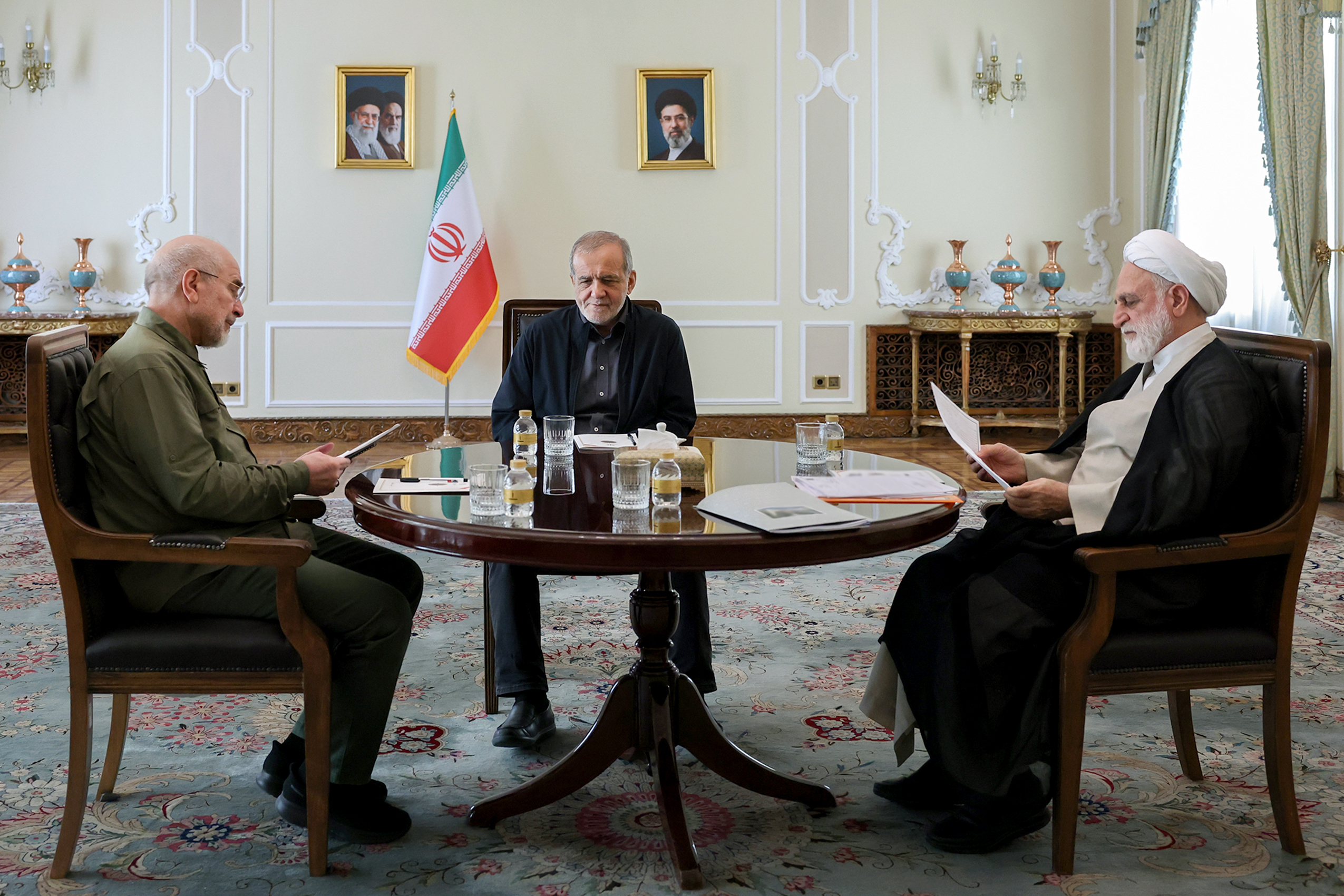
The Committee of Six and Strategic Decision Making in Iran
Remarks by Iran’s president offer a rare glimpse of how the Islamic Republic has adapted its decision making to the absence of its supreme leader.
Mohsen Rezaei at the Helm of Iran’s Supreme National Security Council
Under Rezaei, the SNSC could prove constructive or paralyze strategic decision making.
The Islamic Republic Returns to Offense
After U.S.-Israeli strikes killed Supreme Leader Ayatollah Ali Khamenei on February 28, Iran’s collective leadership has concluded that the best defense is a good offense.
Iran’s Collective Strategic Decision Making
Wartime pressure has temporarily aligned the leadership’s overriding interest in regime survival, even as its members continue to differ over the costs, methods, and ultimate objectives of the war.
Events
Oct 6, 2026
Is the U.S.-Iran Stalemate a “New Normal” or the Prelude to Another Explosion?
On October 6, AGSI hosted a discussion on the U.S.-Iran stalemate and the prospects for a cease-fire.
Speakers



Book Talk: Iran and the Bomb: The United States, Iran and the Nuclear Question
On June 16, AGSI hosted a discussion on the evolution of Iran's nuclear program.
Speakers
Apr 21, 2026
Inside Iran’s Wartime Leadership: Power, Succession, and Regime Stability
On April 21, AGSI hosted a discussion on the evolution of Iran's leadership during the war.
Speakers

Mar 18, 2026
In Its Conflict With the United States and Israel, Does Escalation Favor Iran?
On March 18, AGSI hosted a discussion on the escalation of the Iran war.
Speakers