As the UAE navigates a more volatile regional environment, the next phase of its space effort will hinge on how quickly it can scale its commercial ecosystem and deepen international integration.
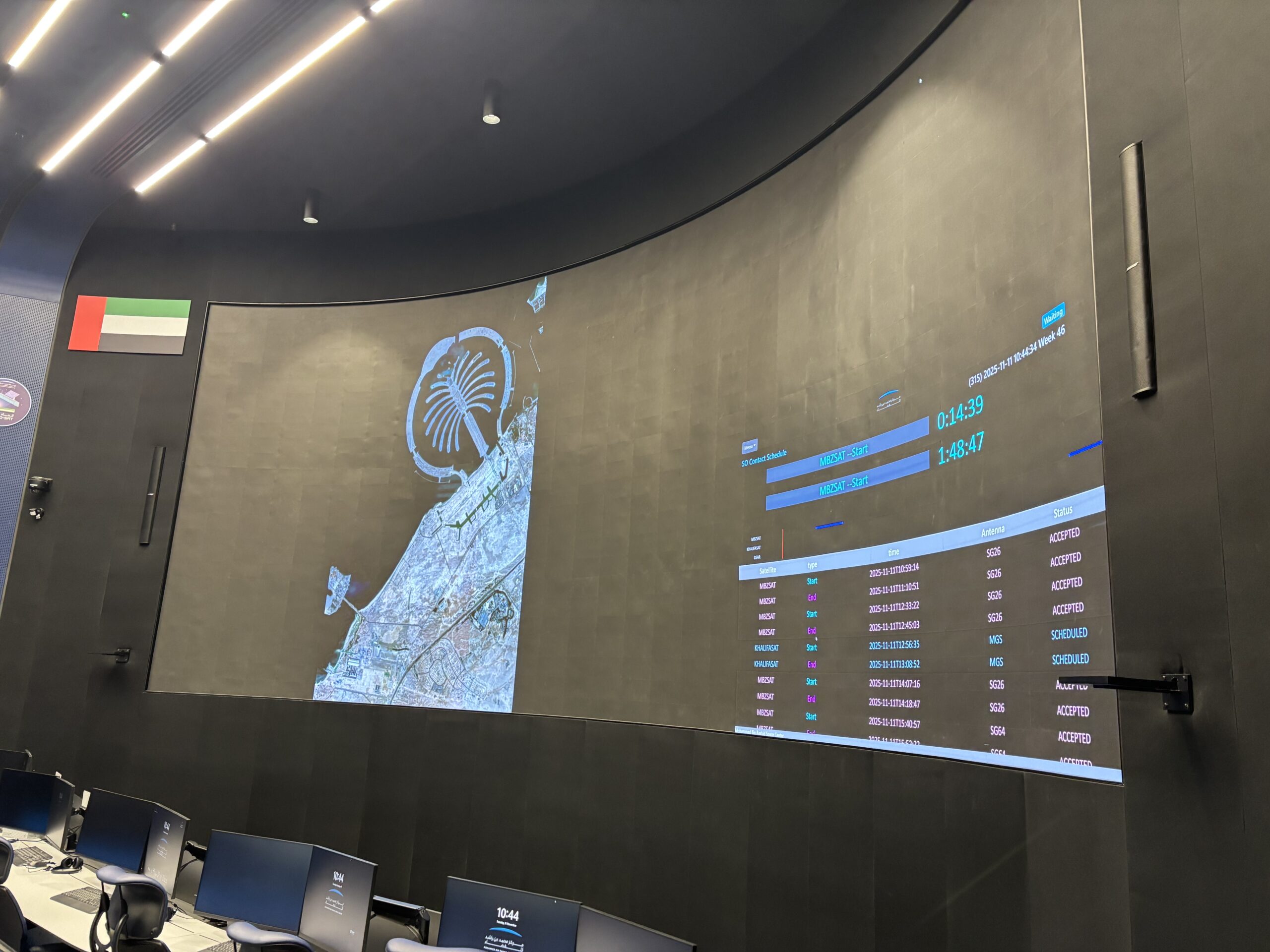
The Mohammed Bin Rashid Space Centre, in Dubai, the United Arab Emirates. (Raymond E. Karam)
The United Arab Emirates’ space sector is entering a pivotal phase. Even before the onset of recent regional tensions, momentum had been building toward a more commercially anchored, globally integrated industrial base signaling a deliberate shift from state-led ambition to long-term economic and strategic positioning with greater emphasis placed on sovereignty and reducing strategic dependencies.
With more than $12 billion invested to date, the UAE has established the foundational elements of a credible space economy – satellite manufacturing, planetary science, astronaut programs, and advanced research. What has been emerging is a second phase defined by private sector acceleration, capital formation, and ecosystem density. This second phase represents an inflection point for the ambitious program and an opportunity to emphasize the UAE’s enduring capability in this sphere.
The UAE’s approach to its space program has been neither accidental nor incremental. It is structured around three core advantages: speed, capital, and talent, anchored by a vision that treats space as a core industry shaping present economic and geopolitical relevance. The ability to significantly compress development timelines is not simply a function of funding but of governance, alignment, and risk tolerance. Capital, both sovereign and increasingly private, is being deployed with strategic intent to crowd in innovation rather than substitute for it. And, critically, the UAE continues to attract and cultivate a globally competitive talent base, positioning itself as a nexus for technical and entrepreneurial capability.
Equally important is the UAE’s effort to position itself as a launchpad, not a closed market. The domestic opportunity is only one dimension; the broader strategy is outward facing, enabling companies based in the UAE to serve regional and global demand. This is particularly relevant as space-based capabilities, such as Earth observation, communications, and emerging in-orbit services, become increasingly essential to both economic and security architectures. In a period of rising geopolitical complexity, demand signals for these technologies are strengthening, creating tangible commercial pathways for companies able to operate at speed and scale.
The UAE model also emphasizes a commitment to multilateralism and co-development. Rather than pursuing technological sovereignty in isolation, the UAE is building it through partnerships, aligning with international players across government and industry to accelerate capability development. This creates a framework for bilateral cooperation, particularly with the United States, where complementary priorities around commercial space ecosystems and next-generation technologies are already well established.
From a private sector perspective, the implications are clear. The UAE is not simply a market to enter; it is a platform to build from. Companies that engage early, align with national priorities, and contribute to ecosystem development stand to benefit significantly as the sector matures. This includes not only traditional aerospace players but also adjacent industries, including data analytics, artificial intelligence, advanced manufacturing, and cybersecurity, which will underpin the next wave of space-enabled services.
This growth will be driven by people as much as technology or policy. Emirati nationals and international residents alike should be well positioned to build globally competitive companies, leveraging the UAE’s infrastructure, regulatory environment, and access to capital. The long-term success of the space industrial base will depend on sustaining this entrepreneurial momentum. In a sector as competitive as space economy development, further scrutiny and questions help bolster the overall effort, not detract from it. The UAE space program certainly has a lot going for it; in the months and years ahead, the UAE will need to clarify how it intends to cultivate and retain top-tier technical talent at scale and ensure that education and pipelines for the workforce and recruitment can keep pace with its ambitions. The program will also need to clarify how it balances state-backed scaling with vibrant private sector collaboration to ensure that innovation remains the lodestar.
The question is no longer whether the UAE will play a significant role in the global space economy; it already does. The more relevant question is how quickly it can scale its commercial ecosystem and deepen international integration. If current trends are any indication, the UAE is not only keeping pace with global developments but, in several respects, setting the tempo.
For stakeholders across the transatlantic space community, this presents a clear opportunity to engage, partner, and build alongside a country that, even amid regional uncertainty, continues to position space as a central pillar of its economic and strategic future.
The views represented herein are the author's or speaker's own and do not necessarily reflect the views of AGSI, its staff, or its board of directors.
Oman is positioning itself as a future regional hub for space applications and innovation and a host, regulator, and service provider embedded within the global space economy.
Emirati leaders hope the UAE Space Agency can speed up the journey to carbon neutrality and position the country as a hub of climate technology and research.