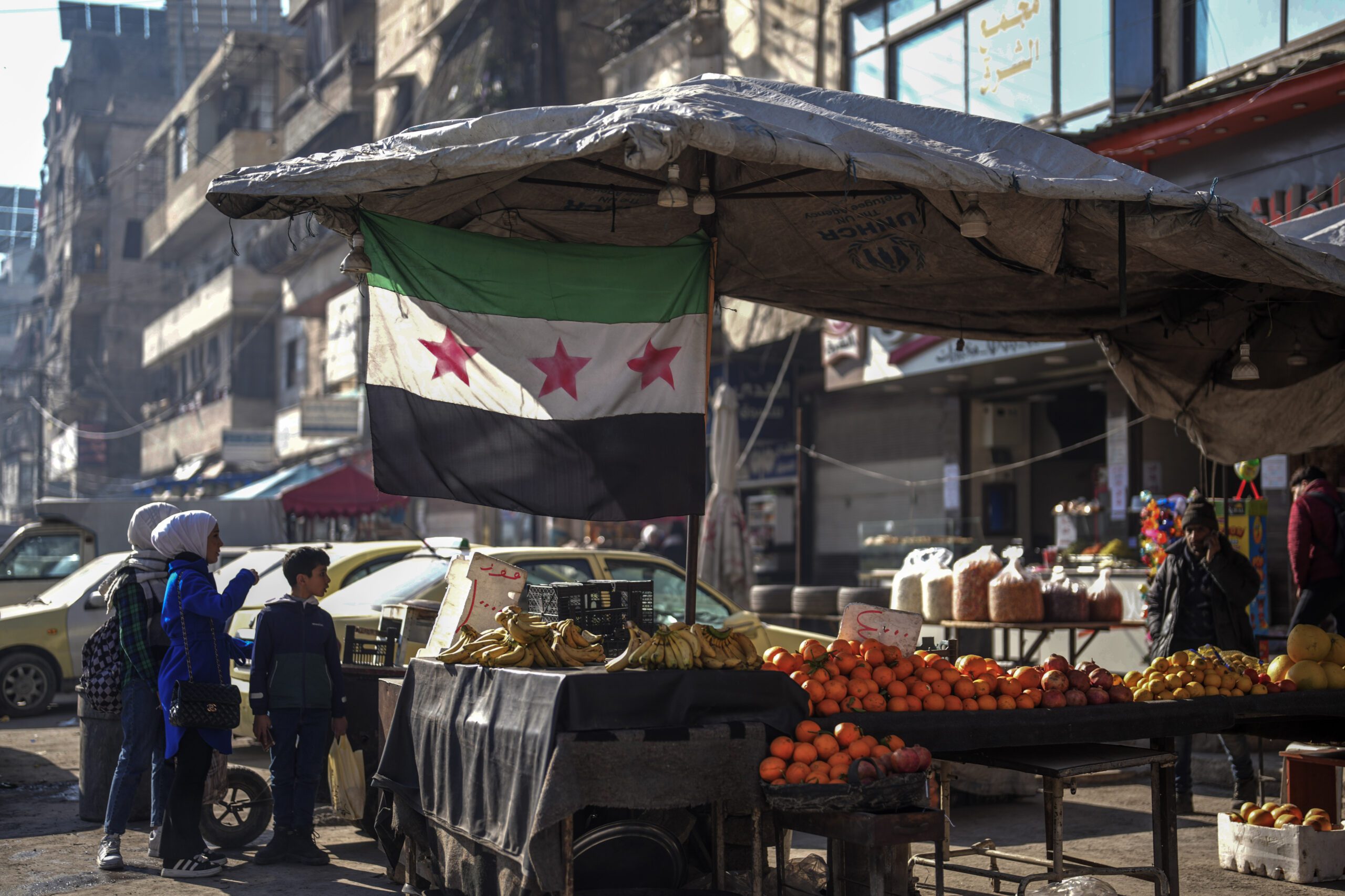
New investment deals, mainly from the Gulf states and Turkey, are opening a path for Syrian reconstruction. But the fragile security situation and financial environment remain hurdles for foreign investment.
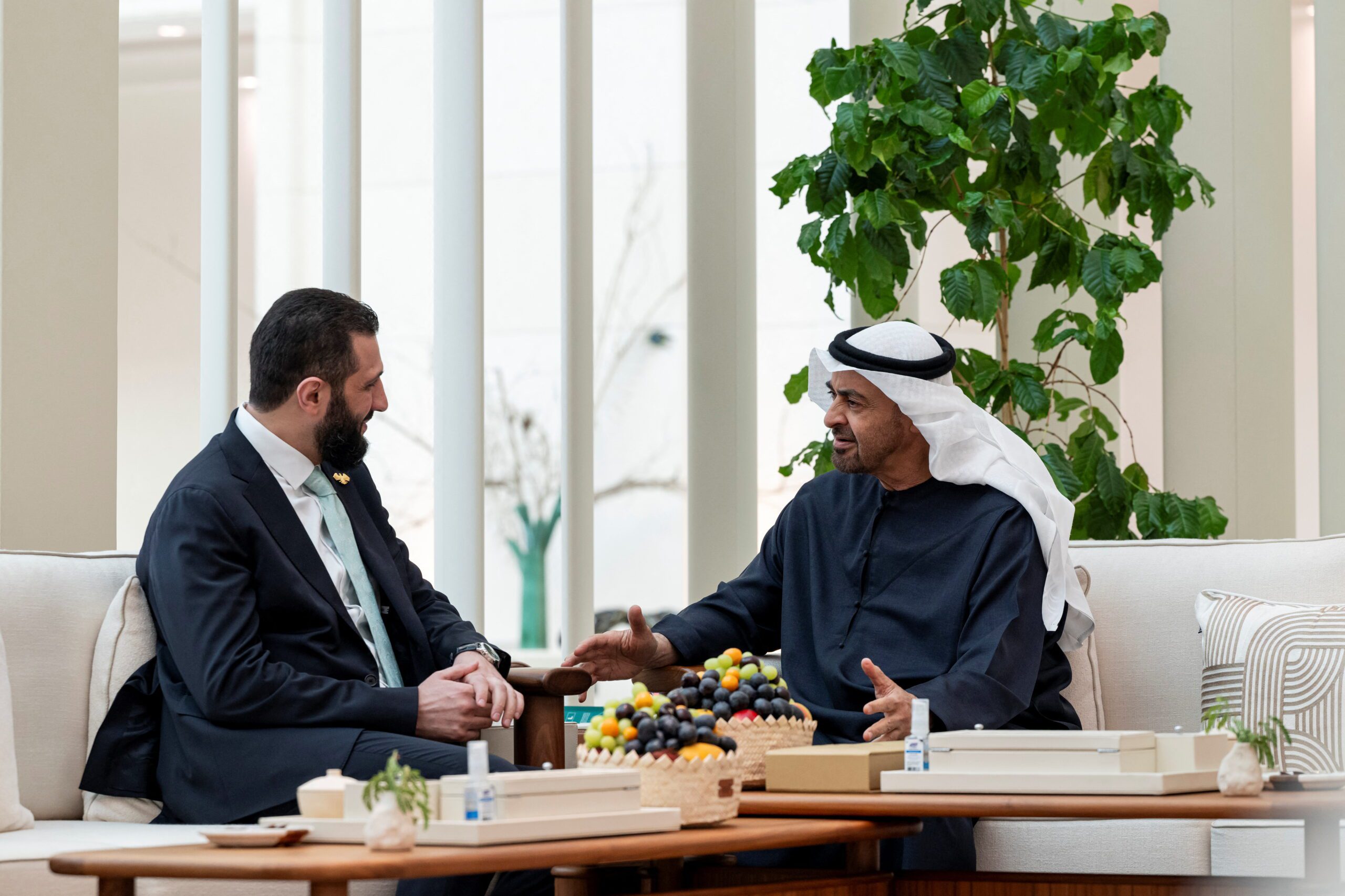
President of the United Arab Emirates Mohammed bin Zayed al-Nahyan meets with Syrian President Ahmed al-Sharaa in Abu Dhabi, UAE, July 7, 2025. (Mohamed Al Hammadi/UAE Presidential Court/Handout via Reuters)
In December 2025, Congress voted to repeal the Caesar Syria Civilian Protection Act under the National Defense Authorization Act, lifting a rigorous sanctions regime imposed on Syria in 2019 in response to Bashar al-Assad’s regime’s widespread human rights violations against civilians. U.S. sanctions on Syria, however, long predate the Caesar Act, going back to 1979, when the country was designated a state sponsor of terrorism under Hafez al-Assad. The repeal of the Caesar Act in such a relatively short period of time, just a year after the fall of the Assad regime, represents not only a political victory for the country but also renewed hope for long-awaited economic relief for the Syrian people. Unfortunately, with the state sponsor of terrorism designation still in place, international banks, insurance companies, and arbitration organizations remain fearful of transactions or association with Syrian entities, which continues to prevent most large-scale foreign investment from flowing into the country, despite the growing list of investment commitments from the Gulf and broader region.
Syria has endured an immense human toll since the start of the revolution in March 2011, with hundreds of thousands of people killed and a severe displaced persons and refugee crisis. It was also left in ruins: $140 billion to $345 billion will be required for reconstruction, and roughly 90% of the population lives in poverty.
Despite its limited resources, the new Syrian leadership has made notable initial efforts to alleviate economic hardship and begin economic recovery. In June 2025, the government raised public sector wages by 200%. While the country has yet to meet its population’s full electricity needs, it arranged a deal in August 2025 for Turkish gas imports to extend electricity supply from roughly 3-4 hours per day to 8-10 hours. By the end of 2025, full electricity had been restored to Damascus. Additionally, the Ministry of Economy reported the creation of more than 30,000 jobs following the opening of 2,000 new factories and the expansion of 207 others across sectors including food production, textiles, chemical processing, and engineering, showing early signs of private sector reactivation. The government also signed large investment agreements and memorandums of understanding with regional and global partners in multiple sectors.
Although the repeal of the Caesar Act removed a major barrier to economic engagement, and the government is actively working to address economic challenges, Syria’s fragile political and security environment continues to keep political risk elevated, limiting the pace and scale of foreign investment. However, as with the Turkish gas deal, regional states are looking for economic opportunities in Syria that make sense and can help the country recover.
Regional Investors Test the Waters
At the October 2025 Future Investment Initiative in Riyadh, Syrian President Ahmed al-Sharaa announced that in six months Syria had attracted $28 billion in foreign investment commitments, largely from regional partners, particularly the Gulf states and Turkey. Most of the deals were in the form of memorandums of understanding and other nonbinding agreements. Nevertheless, these commitments are strong diplomatic and commercial signaling of support for Syria’s economic revival and political stabilization. This is because a politically stable Syria aligns with the interests of the Gulf states: containing the refugee crisis, countering Iran’s influence, reintegrating Syria into the Arab fold, combatting illicit drug trafficking, and supporting Gulf states’ economic diversification efforts.
Saudi Arabia, Turkey, and Qatar played a crucial role in swaying the U.S. decision to provide Syria with sanctions relief and eventually repeal the Caesar Act. They were also the first to test the waters economically. In May 2025, Qatar’s UCC Holdings led a consortium of international companies, including three Turkish firms, to sign a $7 billion memorandum of understanding in Syria’s energy sector to cover roughly half of the country’s power needs. The consortium signed a $4 billion agreement in August 2025 to expand and develop the Damascus International Airport. Additionally, in July 2025, Saudi investors pledged an estimated $6.4 billion across Syria’s real estate, infrastructure, and telecommunications sectors. Qatar and Saudi Arabia have also worked jointly to settle Syria’s $15.5 million outstanding debt to the World Bank and support the government move to increase public sector wages.
The United Arab Emirates also struck an investment agreement with Syria in the logistics and transportation sectors despite its cautious approach to the new leadership in Damascus. In July 2025, DP World signed an $800 million deal to develop Tartous port, which will provide the UAE with strategic access in the eastern Mediterranean. In August, the UAE National Investment Corporation signed a $2 billion agreement to build a metro system in Damascus.
Fragile Political and Security Environment
While the repeal of the Caesar Act and these investment commitments are important steps toward economic recovery, they remain insufficient to meet Syria’s vast reconstruction needs and meaningfully improve living conditions for most of the population. The country’s fragile domestic, political, and security environment continues to pose a significant risk, discouraging more risk-averse investors at a moment when Syria is in urgent need of external capital.
Syria’s continued designation as a state sponsor of terrorism by the U.S. Department of State limits access to global banking networks and reinforces investor caution despite the repeal of secondary sanctions. International financial institutions remain deeply reluctant to issue letters of credit, establish escrow accounts, or engage in other critical financial activities involving Syrian entities for fear of being designated by the U.S. Department of the Treasury’s Office of Foreign Assets Control as a specially designated national suspected of supporting terrorism under the state sponsor of terrorism designation. Such a designation could render a bank or other entity liable for hundreds of millions of dollars in fines and cause reputational damage sufficient to destroy the institution. Such potential penalties, even if unlikely in the current environment, are so draconian that radical overcompliance is the watchword for any banks or other financial institutions with any dollar-denominated exposure. Repeal of Syria’s designation requires President Donald J. Trump to certify to Congress that Syria has not engaged in or supported terrorism in the previous six months. Congress has the notional authority to override such a certification with a joint resolution. Observers speculate the holdup in repeal is linked to questions about the Sharaa government’s counterterrorism performance and its effective sidelining of foreign fighters in its ranks. The timeline for repeal remains unclear at this point.
Security conditions have also reinforced investor caution. There have been recent clashes between the Syrian army and Syrian Democratic Forces, a Kurdish-led coalition in northeast Syria that has links to the Kurdistan Workers’ Party in Turkey. The fighting erupted in early January after monthslong negotiations between the Sharaa government and the SDF failed to lead to any implementation of a March 10, 2025 agreement to integrate SDF forces into the Syrian army. The Syrian government launched a limited military operation in two SDF-controlled neighborhoods in Aleppo and broadened out into a full-bore military offensive that recaptured much of the territory in northeast Syria previously held by the SDF. The outcome ultimately strengthened the Syrian government’s position by restoring control over key energy, water, and agricultural resources, enhancing its leverage in future negotiations and reinforcing its role as Washington’s counterterrorism partner amid growing U.S. signals that the SDF’s role in that capacity is coming to an end. A January 30 follow-on cease-fire agreement between the Sharaa government and the SDF, finalized with U.S. government help, solidified these on-the-ground realities but did improve the conditions under which SDF elements will be integrated into the Syrian military. The agreement reinstated a long-standing SDF demand that its forces be integrated as units rather than individuals. These forces will likely remain in Al Hasakah province in the northeast, the SDF’s stronghold.
Beyond the military confrontation in northeast Syria, Israel has been acting as a destabilizing force in the country, reportedly carrying out more than 1,000 airstrikes and 400 ground incursions between December 2024 and December 2025. Israel also seized approximately 155 square miles of Syrian territory following the fall of the Assad regime, a move that Damascus continues to view as a violation of its sovereignty. In July 2025, Israel bombed Syria’s Ministry of Defense in response to fighting in Suwayda, a Druze-majority area in the south. The fighting resulted in human rights violations and civilian casualties among both Druze and Bedouin communities. Meanwhile, ongoing U.S.-mediated efforts to negotiate a security framework between Syria and Israel have not yielded substantial progress, and Suwayda remains out of the Syrian government’s control.
Moreover, the struggle against Assad-era remnants is apparently not over, further contributing to the fragility of Syria’s political and security landscape. Assad’s billionaire cousin, Rami Makhlouf, and former intelligence chief Kamal Hassan are reportedly competing to spend millions of dollars from exile to recruit tens of thousands of fighters from Alawite-majority areas in an effort to regain lost influence following the fall of the regime.
The fall of the Assad regime combined with the weakening of Hezbollah and Iran amid their military confrontations with Israel as well as Iran’s recent civil unrest driven by a severe economic crisis have led to a significant decline in Tehran’s influence in Syria. Iran’s influence in Syria has suffered a catastrophic collapse since the fall of Assad, although reports persist that Tehran continues to look for opportunities in instability to reassert that influence. That expulsion of Iranian influence remains one of the brightest spots for Syria’s political and security horizon. It also reinforces Gulf Arab interest in investment and diplomatic engagement in Syria to reinforce Damascus’ reintegration into the Arab world after four and a half decades of a suffocating Iranian embrace.
Having emerged from more than 14 years of conflict, Syria faces the daunting task of rebuilding not only its economy but also its social and political fabric, a process that will require time, patience, and careful statecraft. Yet the establishment of strong relationships with regional allies and Western partners can provide Damascus with the diplomatic and economic support needed to sustain recovery efforts.
The views represented herein are the author's or speaker's own and do not necessarily reflect the views of AGSI, its staff, or its board of directors.
Syria’s challenge moving ahead will be the difficult effort to develop a political system that will empower Syria’s people to embrace the more pedestrian but necessary political compromises upon which inclusion and representative government are based.
At least four significant geostrategic efforts focused on Syria are underway, an indication of the continuing fascination with – and desire to shape – developments in Syria.
While hydrocarbons will likely continue to dominate Kuwait-China economic ties, the two countries are increasing cooperation in sectors such as construction, logistics, and renewable energy, suggesting a growing appetite to broaden ties beyond oil.
For Syria to have a chance at stability, the United States and the EU need to urgently consider lifting the layers of economic sanctions imposed on Syria under Assad and allow Gulf countries to help rebuild the war-torn country.