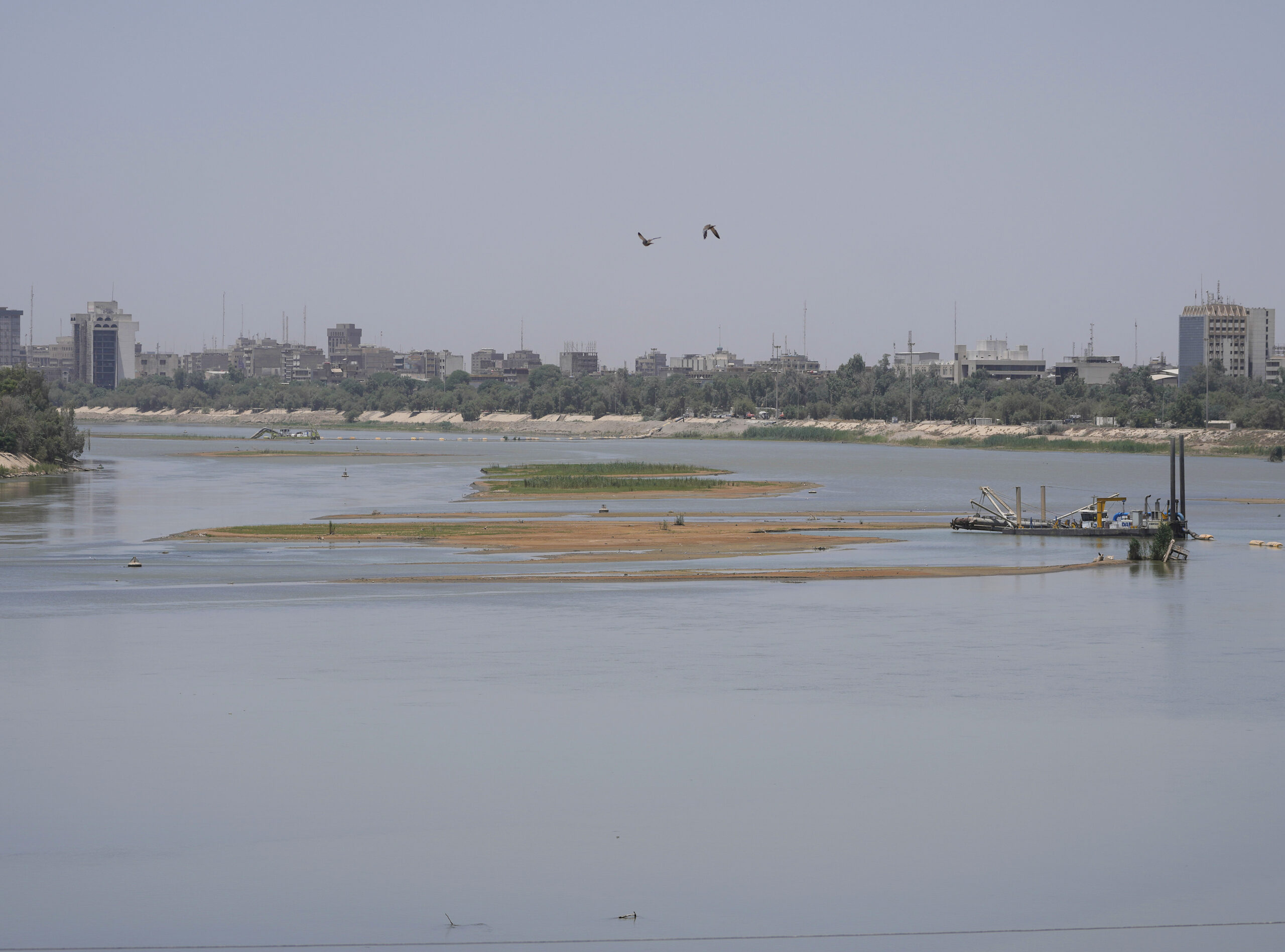
Significantly low water levels are seen on the Tigris river in Baghdad, Iraq, May 28, 2022. (AP Photo/Hadi Mizban)
Iraq is facing water bankruptcy, with reserves predicted to run out by August. A crisis that previously disproportionately displaced the residents of southern Iraq and the marshlands, people working in the agricultural sector, and rural low-income households now looms with severe consequences for all Iraqis, even the political elite.
In April 2024, Iraqi Prime Minister Mohammed al-Sudani and Turkish President Recep Tayyip Erdogan signed the Iraq-Turkey Water Cooperation Framework. This extendable 10-year memorandum of understanding was the first comprehensive and official water-sharing framework between the two countries in decades, detailing long-term water management projects, joint planning teams, and coordinated water use. Although Iraq and Turkey have previously reached limited agreements and informal understandings on water issues, these have lacked joint monitoring and enforcement mechanisms, leading to further disputes and their ultimate failure.
In November 2025, Iraqi Foreign Minister Fuad Hussein and Turkish Foreign Minister Hakan Fidan met to sign a second memorandum of understanding, detailing comprehensive executive mechanisms to build on the 2024 memorandum. With Iraq’s government still pending formation, the second memorandum has not yet been approved by the Iraqi Cabinet. The previous Parliament’s mandate has concluded, and the current caretaker Cabinet is restricted to handling only the “daily affairs” of the state and cannot act on long-term political decisions.
As the August depletion threshold nears and Iraq faces the challenges of climate change, hydropolitics, and its oil-dependent economic model, can this framework be implemented ahead of the looming deadline to help secure Iraq’s water future? Or will delays and structural challenges undermine its ability to avert the crisis?
Inside the Water Crisis
Iraq’s water insecurity stems in part from hydropolitics and climate change. Turkey’s Southeastern Anatolia Project – a large-scale system of dams and irrigation works developed over several decades – has significantly reshaped the Tigris and Euphrates river systems. Through major structures, such as the Ataturk Dam on the Euphrates and the Ilisu Dam on the Tigris, it has contributed to drastic water shortfalls in Iraq since at least the early 2000s, reducing inflows by an estimated 56%. To the east, Iran has constructed the Daryan and Sardasht dams, restricting tributary inflows to the Tigris basin. To the west, Syria’s Tabqa Dam further regulates the Euphrates before it reaches Iraqi territory. Compounding Iraq’s vulnerability, Turkey, Iran, and Syria are each facing their own worsening water crises, driven by decades of overextraction, poor management, and intensifying climate stress.
Iraq still uses a version of the outdated Babylonian flood irrigation system, a centuries-old, gravity-fed basin irrigation system in which river water is diverted to flood fields, resulting in significant waste through evaporation, seepage, and poor flow control. The hugely diminished water volumes Iraq receives from the heavily dammed Tigris and Euphrates rivers can no longer sustain such an inefficient system. Historically, agriculture in Iraq has relied on flooding from the Tigris and Euphrates rivers. However, Iraq has not experienced sustained flooding since 1988. Despite rainfall early this year adding to reservoir levels, they remain below capacity, and there is still a risk of drought. In addition, the slower river flows from upstream dams, in tandem with poor drainage in traditional irrigation, create stagnation. Coupled with extreme heat-driven evaporation, this has resulted in a highly saline terrain, constraining agriculture and displacing many Iraqis.
Further contributing to Iraq’s water crisis is the structure of its rentier political economy. Since nationalizing its oil in the 1970s and especially since 2003, Iraq has relied on hydrocarbon rents rather than taxes. Currently, 90% of the government’s revenue is derived from oil exports, which are then redistributed to the public through public-sector jobs as well as fuel, electricity, and water subsidies. This has led to the creation of a relational social contract between the state’s revenue and the country’s production. Subsidies are expected as a right, and water conservation is viewed as a breach of the social contract. With Iraq’s population rapidly rising – expected to reach 48.9 million by 2028 – so is water overconsumption.
Inside the Deal
The November 2025 executive mechanism memorandum aims to strengthen Iraq’s water security, restore agricultural lands, and improve water governance and resource management. Its mechanisms directly address long-standing disputed assessments held by both sides and provide financing measures.
The Turkish government has expressed strong criticism of Iraq’s water consumption and outdated irrigation systems, and so, as part of the deal, Turkey agreed to assist in reforming and modernizing Iraq’s water management systems. Turkish companies approved by Iraqi authorities will be contracted to develop water projects and modern irrigation techniques. These companies will be funded by Iraq, either through its annual budget or an Iraq-Turkey fund. Iraq will deposit crude oil revenue from sales to Turkish buyers in the fund, and the Turkish contractors will be paid from it.
This model emulates Iraq’s partnership with China; however, the Iraq-China fund requires a fixed 100,000 barrels per day of oil to finance the account. Conversely, the Iraq-Turkey fund will sell a variable number of oil barrels, translating into variable oil revenue. This is intentional, as it allows the two countries to adjust project scales in line with available income, avoids binding Iraq to a fixed export quota, and reflects the reality that oil flows to Turkey can shift due to geopolitical tensions and infrastructure constraints. Additionally, if the Iraqi oil is reexported from Turkey to European markets, Iraq will collect 65% of the gains generated above the prevailing global reference price. A joint committee representing both countries will oversee the project’s implementation, with funding managed by the Iraqi Ministry of Finance.
Further, to address Iraqi criticism that Turkey’s dams have restricted water flows, and accusations that Turkey has not honored the 2014 memorandum of understanding guaranteeing Iraq a “fair and equitable share of water,” Turkey agreed to release 1 billion cubic meters of water into Iraq.
Not an “Oil for Water” Agreement
Many media reports are inaccurately framing this water-sharing deal as an “oil for water” agreement. Agreements must be approved by the Iraqi Parliament, whereas memorandums of understanding are approved by the Cabinet. The “oil for water” terminology also implies that Iraq is trading its own crude oil for access to Turkey’s water. But the two countries have long been at odds: Turkey asserts that the waters are transboundary and emphasizes its upstream position as a means of control, while Iraq maintains that the waters are international and should be shared equitably among all riparian states. The negotiating offices did not discuss this point of friction during the drafting of the memorandum.
Iraq’s inherently volatile oil-dependent economy also threatens to jeopardize implementation and the country’s water security. Iraq’s reliance on oil revenue means that if it is unable to deposit funds into the project’s Iraq-Turkey fund, then it will struggle to finance the Turkish-contracted water infrastructure systems. Oil reserves are the country’s primary source of revenue, and any shortfalls, such as insufficient production, low oil prices, or delays in revenue collection, directly threaten the sustainability of these infrastructure systems. While this recent memorandum of understanding with Turkey is a strategic win on paper, it has yet to be implemented, and Iraq’s oil reserves are finite.
Iraq’s water crisis has reached the level of a national emergency, demanding immediate and coordinated policy action. The Iraq-Turkey Water Cooperation Framework offers a critical opportunity to stabilize the country’s water future, but its success hinges on timely government formation and a stable economic model. In the short term, officials must expedite approval of the deal, initiate targeted irrigation reforms in the most water-stressed regions, and reduce water subsidies tied to overconsumption. Over the medium to long term, Iraq must work to diversify its economy.
With August fast approaching, delays heighten the risk of widespread water shortages. Without swift action, Iraq is likely to face severe depletion of its water reserves, resulting in significant economic and social consequences.
The views represented herein are the author's or speaker's own and do not necessarily reflect the views of AGSI, its staff, or its board of directors.
The U.S.-Israeli attack on Iran has exposed Iraq’s structural fragilities: territorial permeability, economic monoculture, energy dependence, and politically mediated sovereignty.
The government-formation crisis is a test of whether Iraq can assert genuine sovereignty in a system still shaped by foreign influence, factional vetoes, and constitutional loopholes.