NATO’s Operation Ocean Shield helped secure freedom of navigation in the Red Sea, but diplomatic fractures and naval constraints mean its success is unlikely to be repeated in the Strait of Hormuz.
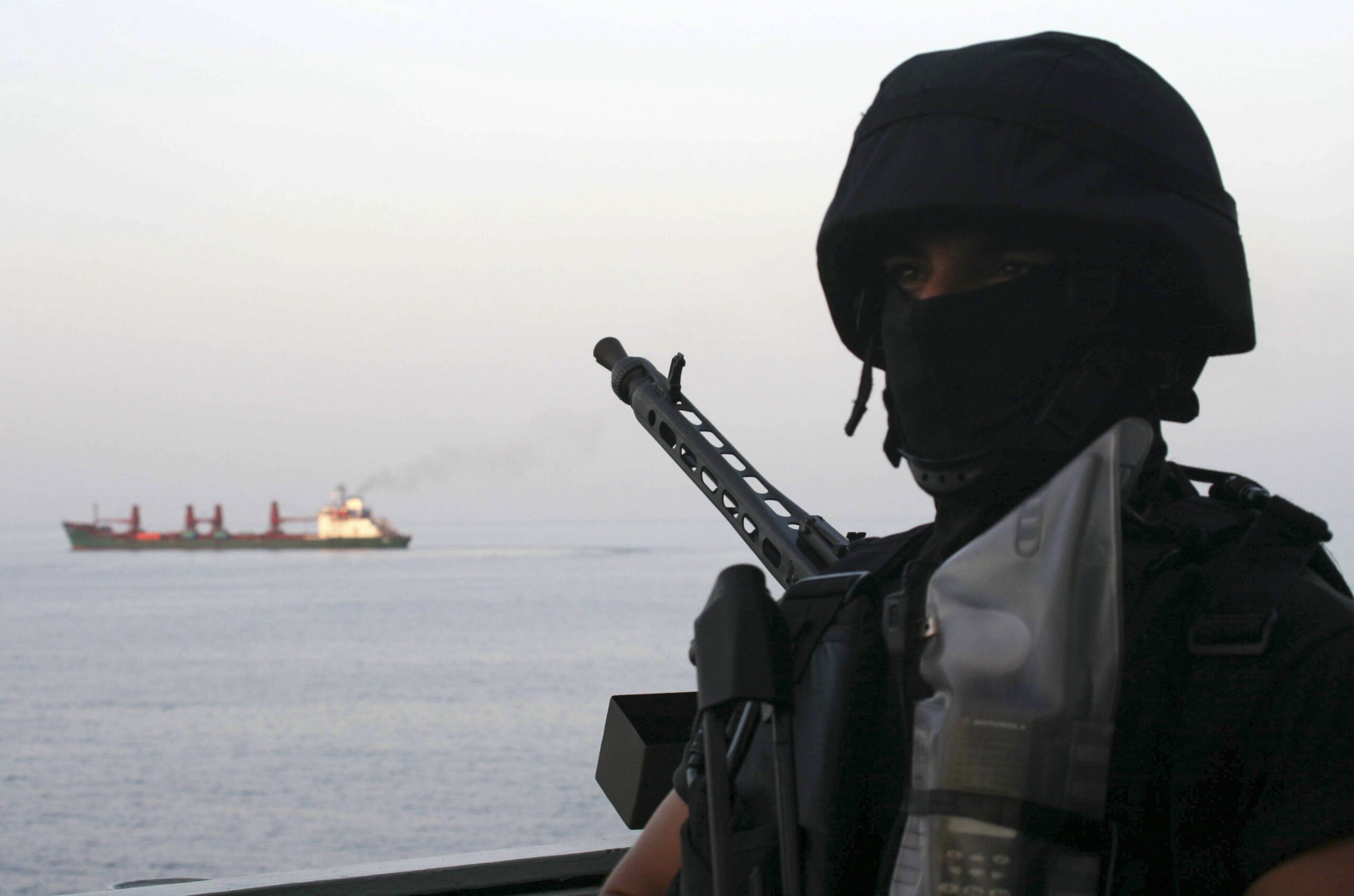
A service member stands guard aboard the Portuguese warship NRP Corte-Real escorting the United Nations World Food Program ship, MV Fidel, in the Indian Ocean off Somalia's coastline, May 14, 2009. (REUTERS/NATO/Handout)
Since Iran effectively closed the Strait of Hormuz February 28, policymakers in Europe and the United States have been assessing whether NATO can help safeguard freedom of navigation and if Operation Ocean Shield can serve as a viable blueprint for a NATO role in the Gulf. Conducted from 2009-16, the mission was the alliance’s most sustained out-of-area maritime security operation, combining naval escorts, deterrence, and regional capacity building.
Yet, while Ocean Shield offers NATO’s closest precedent for prolonged maritime engagement beyond the Euro-Atlantic, replicating it in the Gulf confronts far steeper political and strategic constraints.
Operation Ocean Shield
Somalia’s prolonged state collapse created permissive conditions for piracy to flourish in the late 2000s. Attacks surged along key shipping lanes in the Gulf of Aden, threatening a critical artery of global trade.
At the request of United Nations Secretary-General Ban Ki-moon and backed by U.N. Security Council resolutions, NATO launched Operation Allied Provider in late 2008. The naval component of the alliance’s rapid-response force in the Mediterranean was already scheduled to conduct port visits to the Gulf and was, in part, repurposed to escort U.N. World Food Program vessels delivering aid to Somalia. As hijacking-for-ransom episodes intensified, Operation Allied Protector followed in early 2009, shifting the mandate from escort to deterrence and disruption of pirate activity.
Recognizing the limits of short-term deployments, a consensus emerged among allies at the Strasbourg-Kehl Summit in April 2009 about the need for a sustained counterpiracy approach. This led the North Atlantic Council, NATO’s chief political decision-making body, to launch Operation Ocean Shield in August 2009. The mission was a shift from temporary responses to a structured, multiyear engagement that combined naval patrols and ad hoc escorts with capacity-building support for regional states.
Command and control followed NATO’s standard model, with strategic oversight by the supreme allied commander Europe and operational control through NATO Maritime Command. The force posture typically included three to five vessels on a six-month rotation, supported by maritime patrol aircraft. Notably, non-NATO partners, such as Ukraine, New Zealand, and Australia, contributed to Ocean Shield, underscoring its multilateral approach.
As piracy attacks gradually subsided, NATO adapted its force posture in 2015, shifting to a “focused presence” approach by concentrating deployments during high-risk intermonsoon periods. With hijacking-for-ransom episodes largely ended, Operation Ocean Shield concluded in 2016.
In nearly eight years of out-of-area missions, the operation demonstrated NATO’s institutional and operational capacity to evolve into a sustained maritime security provider. A solid legal mandate, broad political consensus, and permissive operational conditions were critical to its success. These elements are absent in the Strait of Hormuz, where the strategic environment is markedly more contested.
Trump’s Pressure Campaign
Roughly two weeks into the U.S.-Israeli conflict with Iran, as maritime disruption intensified across the Strait of Hormuz, President Donald J. Trump turned to NATO, presenting the alliance with a significant stress test. Transatlantic relations were already strained by the administration’s push to annex Greenland, which had deepened rifts between Washington and European capitals.
Since the onset of Operation Epic Fury, Trump has made conflicting remarks regarding NATO allies. On the one hand, he castigated European partners for insufficient contributions and threatened consequences for continued inaction; on the other, he dismissed them as strategically marginal, insisting the United States can achieve its military objectives unilaterally. This signaling suggests the White House viewed a rapid NATO response as a test of allegiance to U.S. leadership. By Trump’s own account, however, “They were tested and they failed.”
In an effort to contain the fallout, NATO Secretary-General Mark Rutte met with Trump April 8 in Washington. Rutte sought to position himself as a mediator, acknowledging U.S. frustrations while defending allied contributions. He emphasized that the majority of European states had offered the United States a platform to project power by providing basing, logistics, and overflight support. He also framed Operation Epic Fury as an enhancement to collective security by delivering a severe blow to Iran’s nuclear and missile capabilities.
While the visit appears to have tempered immediate tensions, the underlying dispute remains unresolved, particularly as maritime disruption in the strait persists. For Trump, NATO alignment appears less a product of consultation than of coercion; he asserted that European allies have not “understood anything unless they have pressure placed upon them.” Threats of punitive measures, including potential withdrawals of U.S. forces, against noncooperative NATO members point to a growing reliance on coercive diplomacy to extract greater European support. Germany appears to be the first country to face such pressure: On May 1, the Pentagon announced the planned withdrawal of approximately 5,000 troops from the European ally’s territory.
A Divided Europe
European allies delivered a piecemeal and calibrated response to Washington’s requests for support, balancing alliance commitments with escalation management, legal concerns, and force posture constraints.
Among the more restrictive positions, Spain denied the use of its airspace to U.S. forces, while Poland rebuffed a U.S. request to transfer one of its two Patriot air-defense batteries to the Middle East.
Italy also denied access to a batch of Middle East-bound U.S. military aircraft at Sigonella Air Base in Sicily, a facility routinely used for U.S. operations, though Rome framed this as a procedural issue rather than a political rupture. At the same time, it signaled openness to providing air-defense support to Gulf partners. France followed a comparable dual-track approach, maintaining U.S. overflight permissions while deploying Rafale jets to the United Arab Emirates to secure its bases and support Abu Dhabi.
At the more supportive end, Romania granted Washington access to a major Black Sea air base as a logistical hub for refueling and satellite communication activities. Similarly, Germany allowed the United States to use Ramstein Air Base to coordinate combat operations against Iran.
Hormuz Is Not Somalia
Undoubtedly, the United States, with its military strength and the security dependence of many European allies, wields disproportionate influence within NATO. Yet the alliance remains a consensus-driven organization in which decisions emerge from collective agreement rather than imposition. This underpins the political legitimacy of NATO operations but also requires negotiation among 32 members, often slowing decision making. Given this institutional logic, coercion is ill-suited to securing durable alignment, while consultation and consensus remain the primary mechanisms of cohesion.
Accordingly, the launch of any NATO operation is the outcome of deliberation within the North Atlantic Council. Historical precedents also point to the importance of a solid legal basis, often anchored in U.N. Security Council resolutions. NATO’s military authorities lead operational planning, while the North Atlantic Council retains continuous political oversight through periodic reviews.
For these reasons, the military support Trump expects from European allies sits uneasily with NATO’s established decision-making and operational model. Trump’s model is instead closer to a coalition of the willing driven by a dominant actor in which aligned partners have limited influence over strategy. The absence of a clear U.N. Security Council mandate further weakens the legal and political basis for collective engagement.
While the Trump administration has framed Operation Epic Fury as necessary to prevent a nuclear-armed, missile-capable Iran, a goal European allies broadly support in principle, they largely view the conflict as a war of choice rather than an act of self-defense. This perception reinforces their preference for diplomatic de-escalation over military involvement.
Concerns over entrapment in a conflict in which they exert limited influence, combined with more immediate security pressures closer to home, further constrain European engagement. With a persistent Russian threat, European navies face acute capability trade-offs. Ongoing commitments in the North Sea and Mediterranean, alongside contributions to Operation Aspides in the Red Sea, have stretched naval assets thin, leaving limited capacity for high-end deployments in the Gulf.
European allies remain willing to contribute to maritime security in the Strait of Hormuz. Germany has signaled openness to supporting stabilization efforts in a postconflict phase, and France and the United Kingdom are leading a 40-state initiative to develop a coordinated maritime security framework. What they resist, however, is direct participation in combat operations against Iran and the deployment of assets in a highly contested theater, where the risks of escalation and strategic entanglement are acute.
The Ocean Shield model is thus a useful reference illustrating NATO’s operational potential. However, legal, political, and strategic constraints suggest it won’t be replicated in the contested Strait of Hormuz theater.
The views represented herein are the author's or speaker's own and do not necessarily reflect the views of AGSI, its staff, or its board of directors.
In the future landscape of Gulf security, the United States may remain an essential arms supplier but wield less influence over force structure and military doctrine.
While underscoring the EU’s ambitions to expand its maritime security goals in the region, Operation Aspides faces operational and political challenges.
U.S. force projection in the Gulf is increasingly relying on artificial intelligence, unmanned platforms, and space technology, using these systems to augment existing military infrastructure.
With an aging and largely untested fleet, U.S. mine clearing operations can restore maritime access but only under favorable political and operational conditions.